If Anthropic IPOs at $1.5 TRILLION:
👉🏽4k+ employees instant millionaires. 👉🏽1,200 could be worth $10M+ 👉🏽50 could be worth $100M+
The next generation of millionaires is being created by my Power Triad: COMPUTE. DATA. ENERGY.
The biggest wealth transfer in history may be happening right in front of us.
Is it just me or did the whole tech world collapse when Jensen Huang left Nvidia?
Planes down? NSA Hacked? Banks in chaos.
Did he hit the "kill switch" before he left?
The recent sell-off, driven by pending tighter macro conditions, geopolitical instability and leverage being flushed out of digital asset markets, has brought back a risk-off mood.
So I re-ran a study I published a couple of years ago (link in the comment section), ahead of the launch of the first US spot bitcoin ETFs. It looks at bitcoin's daily returns to understand its risk on both the upside and the downside since September 2014.
The silver lining is big swings are rarer than they used to be. That lines up with a bigger and more mature market, which now has futures, ETFs and more institutional holders. But bitcoin is still not a bell-curve asset yet. Sharp days remain more likely than a normal distribution implies.
Here are the findings below:
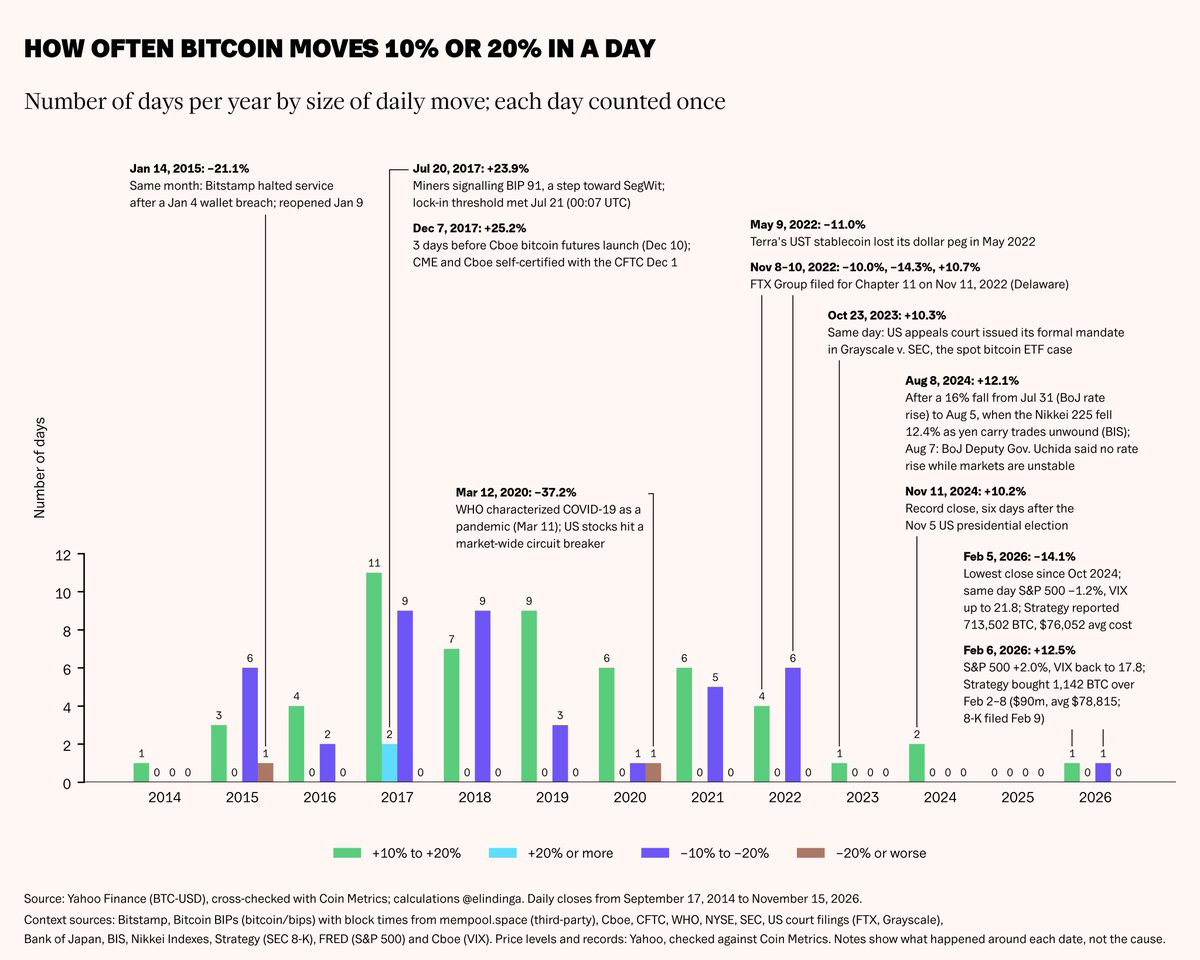
1/ Since 2014, bitcoin has had 101 days of ±10% or more: 57 up and 44 down. That's about one every 44 days.
2/ Since 2024, after the launch of US bitcoin ETFs, there have been only 4 such days, about one every 263 days, or roughly every 9 months.
3/ There has been no ±15% day since 2024, and no ±20% day since March 12, 2020 (−37.2%) when WHO declared Covid-19 as a pandemic.
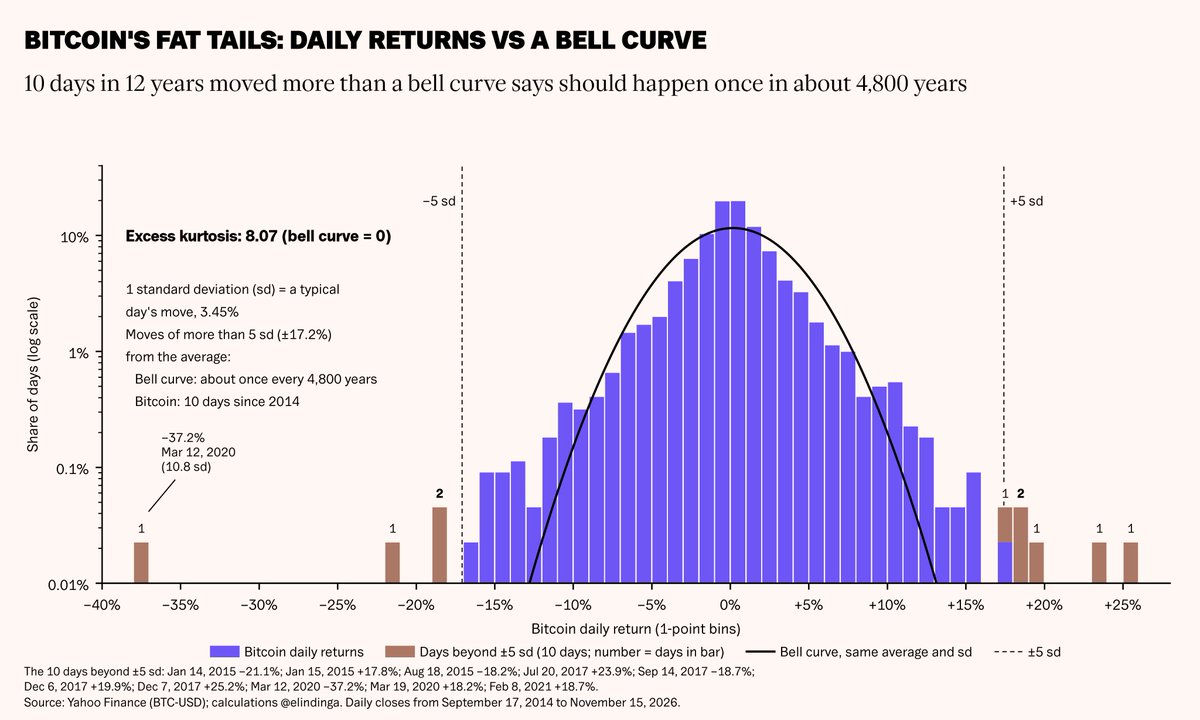
4/ Excess kurtosis, which measures how often extreme moves happen compared with a bell curve (a bell curve is 0), was 8.07 over the full history and 3.44 since 2024.
5/ Since 2024, a 4-standard-deviation day (about ±9.9%) has come roughly every 9 months. A bell curve says once every 43 years.
6/ Over the full history, 10 days moved more than 5 standard deviations (about ±17%). A bell curve expects that about once every 4,800 years.
For investors, this means that while bitcoin has attributes of a long-term store of wealth, volatile days should be expected and managed accordingly, although they are becoming rarer over time.
I don't know if it's just me but....
There is a weird feeling in the air.
Like right before Covid. A surreal feeling of impending crisis.
Maybe it's just me.
THE BIGGEST OPPORTUNITY ISN'T JUST NVIDIA.
COMPUTE. DATA. ENERGY.
The infrastructure powering the next generation of wealth is being built right now.
At FUTURE WEALTH 2026, we're showing you where the opportunities are and how to position yourself.
📍 Miami | December 4–6
🎟️ https://t.co/ecHY8dXLqD
$NVDA is down, and most investors don't recognize the gift.
Jensen Huang's resignation and rising AI bubble fears are fueling the selloff.
But AI infrastructure isn't disappearing. The Power Triad: COMPUTE. DATA. ENERGY.
Many sees chaos. I see a generational opportunity.
DON'T PANIC. POSITION YOURSELF.
1. Don't chase the first bounce.
2. Buy in stages, not all at once.
3. Watch NVIDIA's earnings, leadership transition, and AI spending.
Fear creates opportunity. Discipline captures it.
The central bank shut down Ueno Bank, one of the biggest banks in the country.
3 million customers. About 60% of all adults in Paraguay.
Salaries. Pensions. Savings. FROZEN.
"I’m sorry, Dave. I’m afraid I can’t do that.” In 2001: A Space Odyssey, that line sent chills down our spines.
In 2026, ChatGPT says it every day, and we barely blink.
We didn't just enter the dystopia. We normalized it.
The average person has never attempted anything extraordinary.
So don't ask normal people for advice when you attempt something extraordinary. They don't understand it.