Founding member, Global Head of Research & Venture Partner @21shares.
Down the crypto rabbit hole since 2014.
Personal views only & no financial advice.
I'm happy to share that I'm starting as Global Head of Research & Founding Venture Partner @21shares.
It's been an honor to build the research department from scratch and develop talented individuals over nearly 6 years as a founding team member of @21shares.
Excited to continue sharing contrarian insights, differentiated research, and investing in next-generation protocols and apps as a next challenge!
Anthropic goes public in a crucial moment for the AI trade that values the company at $1.5 trillion. Elena Casas asks fund manager Duncan Moir of 21shares and Will Rhind of Granite Shares what's at stake https://t.co/IzJJWvoKtS
Anthropic is priced at $83 and they upsized it to 980M shares, giving them a $1.5T valuation.
ANT on Perps were already trading at ~$98 per share (at $1.8T), ~18% above the IPO price before it even opens. Binance, Tradexyz, Lighter, Variational, all priced within similar range.
It’s that time of year again.
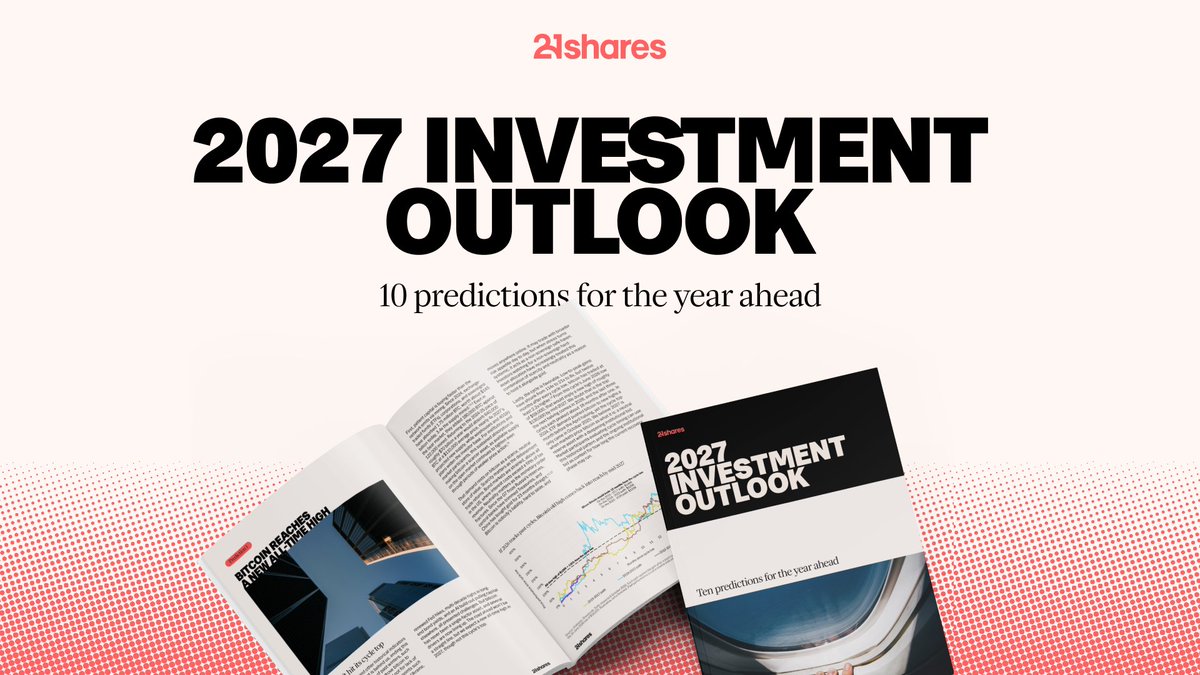
The 21shares Investment Outlook is here with 10 predictions for 2027.
We believe 2027 is the year that resilience gets priced in:
1. Demand held through the drawdown. ETFs, corporations, and sovereigns have absorbed 1.75 million BTC since 2024, about 3.4x the supply mined. We expect a new bitcoin all-time high in 2027, though not this cycle’s top.
2. Rulebooks are replacing enforcement. We expect 15 of the 21 G20 members to operate under a digital asset rulebook by the end of 2027.
3. Digital assets are plugging into everyday finance. We expect more than 100 million monthly active stablecoin users, and tokenized real-world asset trading rising from about $5 trillion to $15 trillion.
Dive into all 10 predictions by downloading the full report to below:👇
Maintenance cost drastically fluctuates depending on the rig model and age, hosting cost varies by whether the mined coins are self hosted or hosted via third parties (no hosting cost when it’s self mined and the data center is fully paid back) and the average energy cost massively changes depending on the state and region. We visited several mining sites last year to get an on the ground understanding
The #FBI issued a FLASH advisory warning that cybercriminals and state-aligned hackers are exploiting ARTEX, a super intelligence-powered penetration testing framework, to automate attacks against businesses and organizations worldwide. ARTEX can accelerate intrusions from initial targeting to privileged access in under three hours. It was used in the October ConnectWise supply-chain compromise, which exposed Microsoft 365 customer environments and involved attempted authentication against more than 2,250 downstream tenants.
The FBI is urging businesses and organizations to strengthen access controls, monitor suspicious automated activity, and report potential compromises to https://t.co/Y65F8KJfqo.
Read more here: https://t.co/Cl5lpZ7cgG
Coverage of gold ETFs in the media from 2014 to 2018 was absolutely brutal - as bad or worse than bitcoin lately - it was like a string of Morrissey song titles: 'new milestones in misery' 'massive disappointment' 'give up hope' 'a pet rock' and how it 'doesn't work' as safe haven or inflation hedge (tbf it did go down and stay down despite $5T in new money printed by gov). IMO notable for a few reasons. One, the disrespect came despite GLD 10x-ing SPX from 2004 to 2011 and was STILL beating it since 2004 ETF launch. Two, it proceeded to go up 250% over next 7yrs (easily beating bull mkt mode SPX) and Three, it had fallen to about $1200 an ounce, which would seem like a shockingly high number to anyone from distant past. Bigger takeaway here (and one that we point in the new book) is that assets without cash flows can be really hard to hold bc sentiment runs the show and they tend to do opposite of what you think/want and they get sht on the most from the media and high priests of investing despite how far they've come over long-term. It is a hard, hard road for investors. This was one of the reasons i was fascinated enough to write book on the topic.
Fun facts about #Bitcoin in the last 10 years:
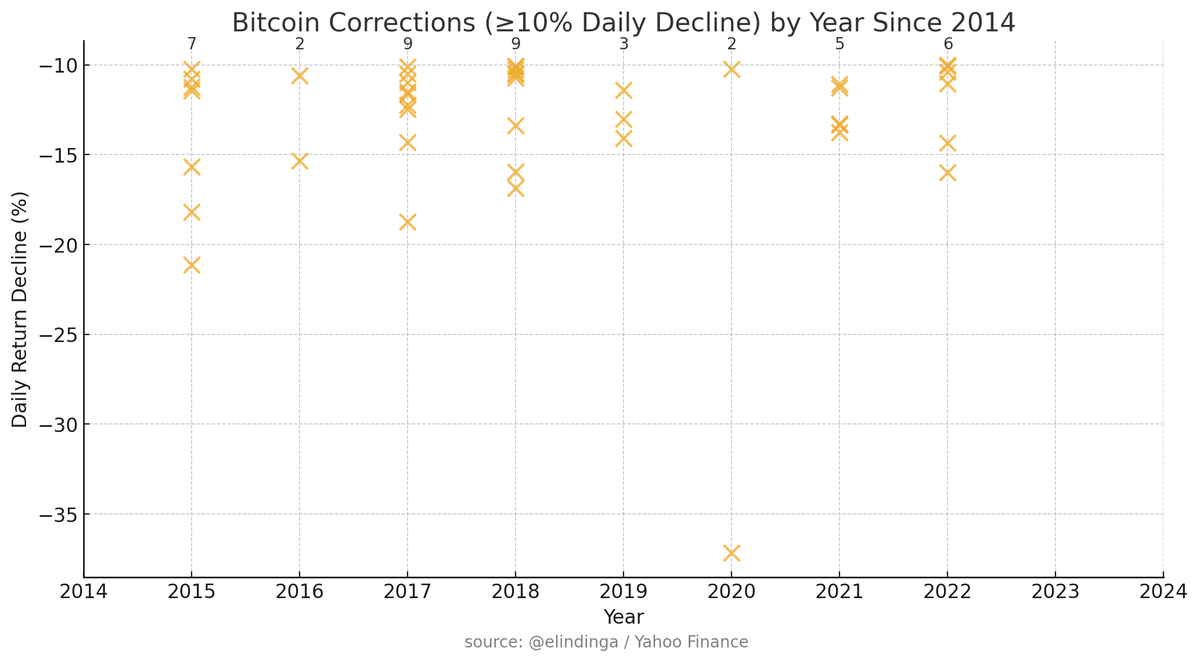
- 2023 was the only year Bitcoin didn't have a single correction (at least -10% daily return) in nearly 10 years since 2014
- #Bitcoin nosedived by more than 20% in a day only twice (2) in 3,399 days since Sep 2014. In other words, once every 5 years we should expect such large drawdowns to happen (although past performance is no guarantee of future results, especially due to black swans like in 2020)
- #Bitcoin dropped 43 times by more than 10% in 3,399 days or nearly 10 years. That's less 1.3% chance in a decade (thus far). In other words, nearly once a quarter investors may expect a decline of more 10% in a day. Counterargument: Well 2023 had none!
Data source: @YahooFinance
The recent sell-off, driven by pending tighter macro conditions, geopolitical instability and leverage being flushed out of digital asset markets, has brought back a risk-off mood.
So I re-ran a study I published a couple of years ago (link in the comment section), ahead of the launch of the first US spot bitcoin ETFs. It looks at bitcoin's daily returns to understand its risk on both the upside and the downside since September 2014.
The silver lining is big swings are rarer than they used to be. That lines up with a bigger and more mature market, which now has futures, ETFs and more institutional holders. But bitcoin is still not a bell-curve asset yet. Sharp days remain more likely than a normal distribution implies.
Here are the findings below:
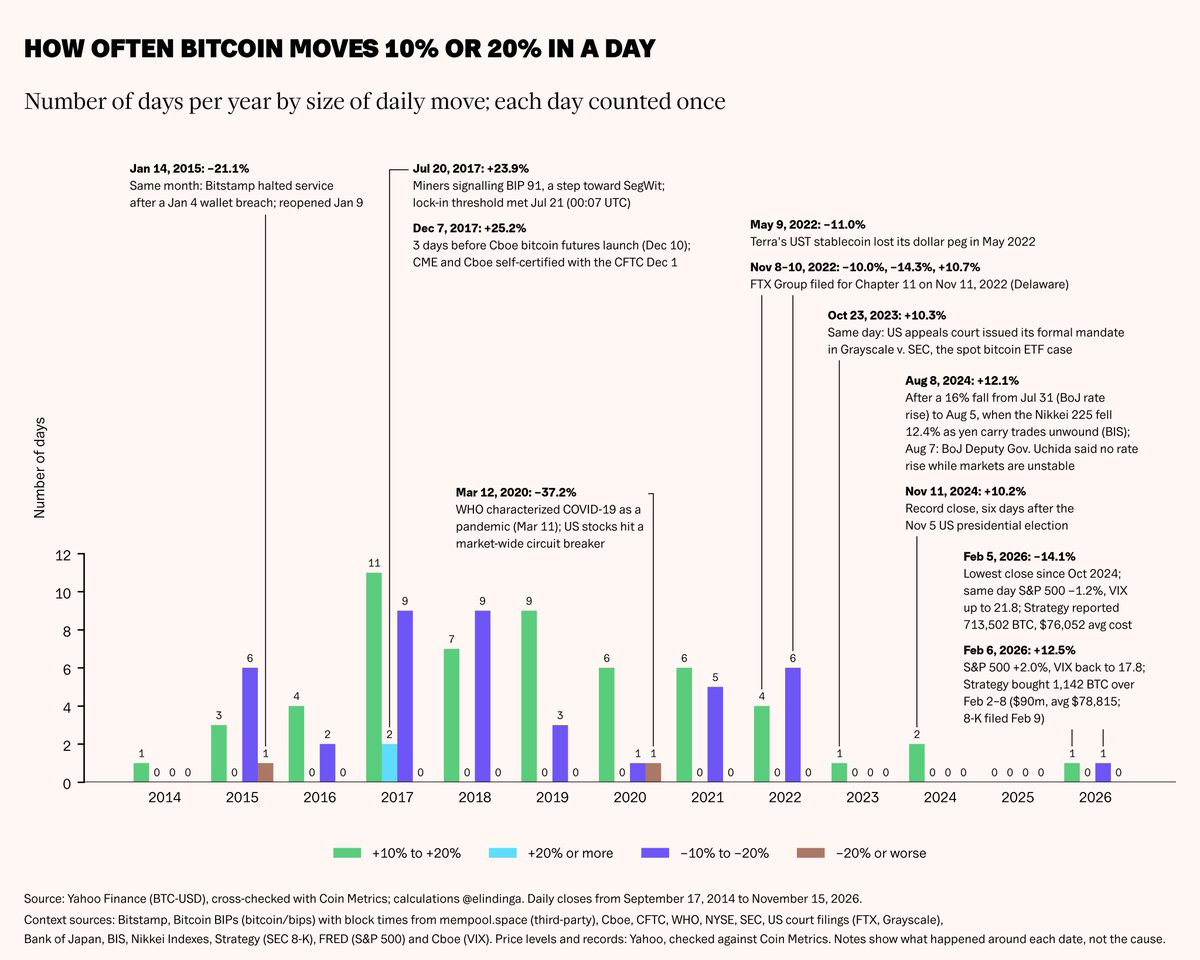
1/ Since 2014, bitcoin has had 101 days of ±10% or more: 57 up and 44 down. That's about one every 44 days.
2/ Since 2024, after the launch of US bitcoin ETFs, there have been only 4 such days, about one every 263 days, or roughly every 9 months.
3/ There has been no ±15% day since 2024, and no ±20% day since March 12, 2020 (−37.2%) when WHO declared Covid-19 as a pandemic.
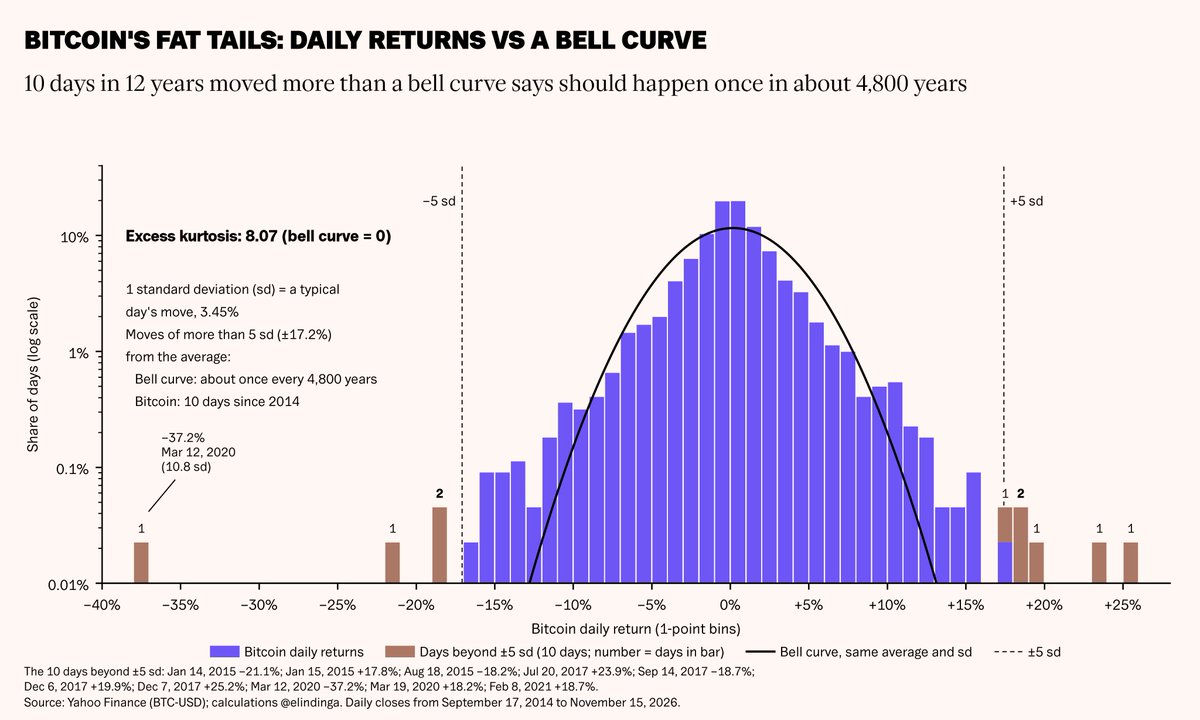
4/ Excess kurtosis, which measures how often extreme moves happen compared with a bell curve (a bell curve is 0), was 8.07 over the full history and 3.44 since 2024.
5/ Since 2024, a 4-standard-deviation day (about ±9.9%) has come roughly every 9 months. A bell curve says once every 43 years.
6/ Over the full history, 10 days moved more than 5 standard deviations (about ±17%). A bell curve expects that about once every 4,800 years.
For investors, this means that while bitcoin has attributes of a long-term store of wealth, volatile days should be expected and managed accordingly, although they are becoming rarer over time.
“The Commodity Futures Trading Commission (the “CFTC” or “Commission”) approved the applications for designation as a designated contract market and registration as a derivatives clearing organization for a firm utilizing blockchain-based architecture for execution and settlement of derivatives contracts.”
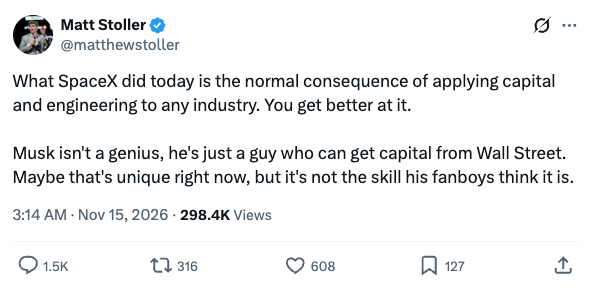
You work your ass off solving really hard problems day after day for decades, and this is what you get: anyone could have done it.
As an investor, I can tell you the limiting factor isn't investment. It's founder ability.