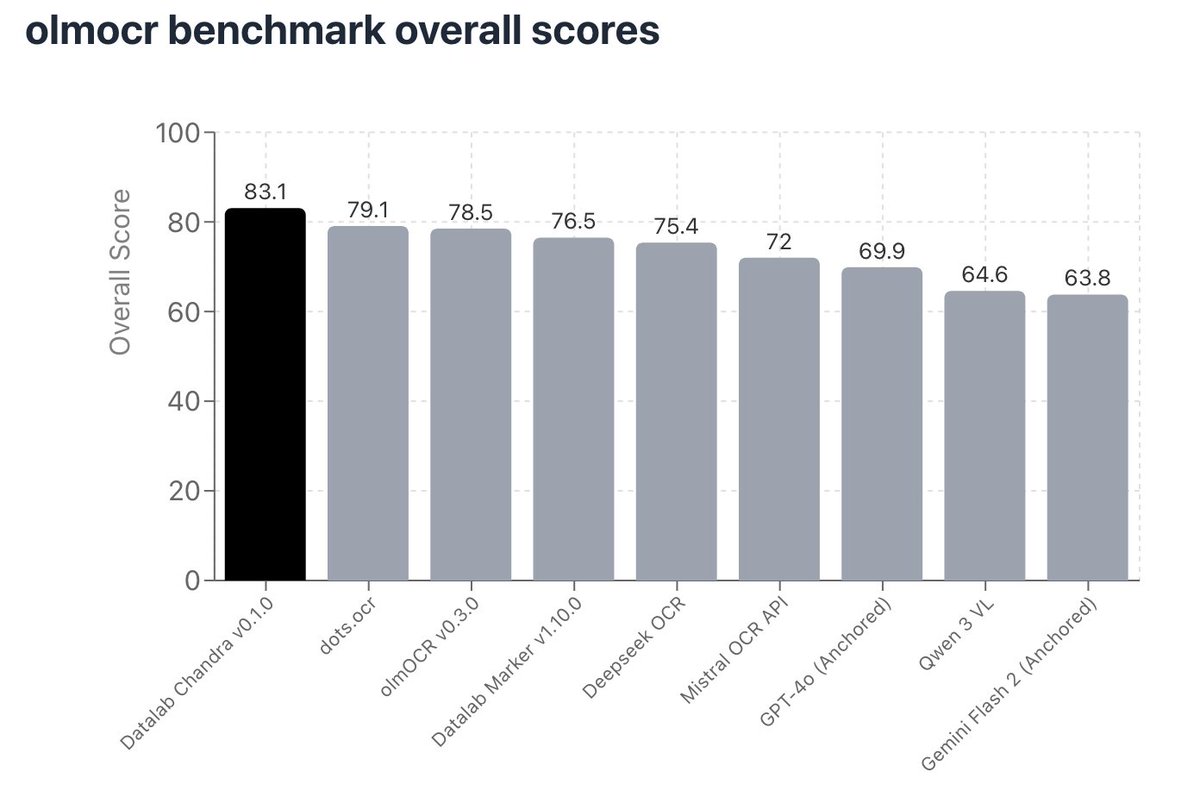
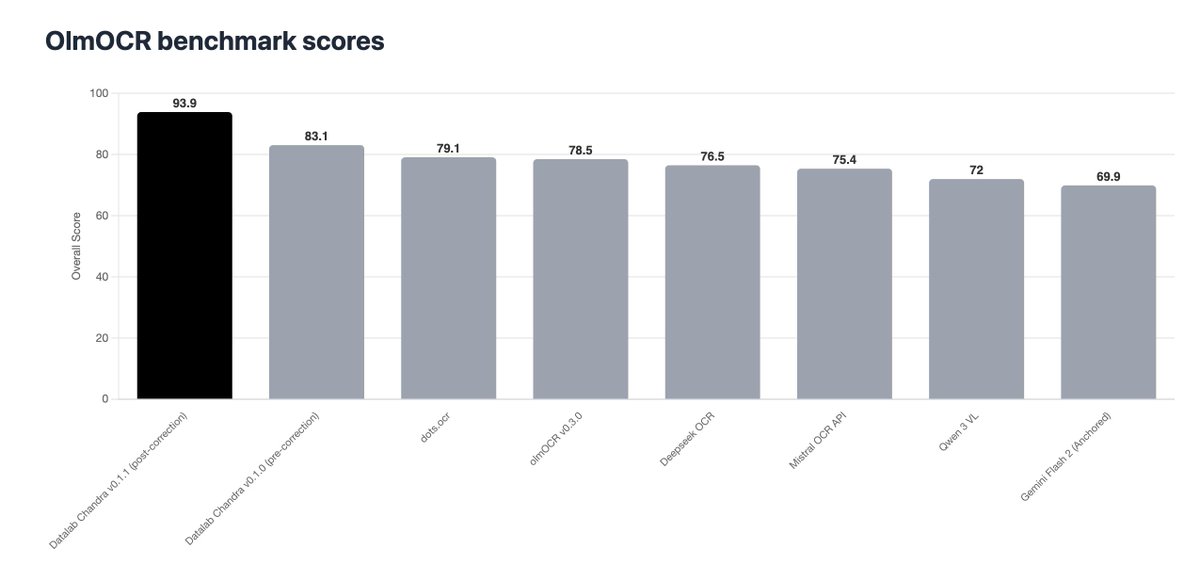
Mistral claims SOTA performance on OlmOCRBench, a popular optical character recognition benchmark, but that isn't the case.
We have a public leaderboard on @huggingface, where Mistral OCR 4 currently ranks #3, behind open models like Chandra OCR 2 by @datalabto
Releasing Chandra 2.1 — smaller, faster, and significantly better on the two things hardest for OCR models to get right: complex tables and multilingual. Live on the Datalab API today. Details ↓
People evaluating OCR ask the same two questions:
1. Which models are actually good
2. How do they behave on my documents
Benchmarks help with the first, but they rarely show you the qualitative side of model behavior across real layouts, scripts, bad scans, and messy photos.
So we built two tools to solve this 🧵
Launch Week - Day 4: Spreadsheet Parsing 🚀
We’ve added native spreadsheet support to the Datalab API.
Spreadsheets look structured until you hit real-world files:
- staggered / overlapping tables
- sparse regions with fake separators
- hidden columns, merged cells
- stray cells that break heuristics
- images of tables (why?)
Getting reliable structure out of grids is genuinely hard.
We're kicking off December with Launch week 🚀
Day 1: Chandra 1.1, our latest upgrade to Datalab’s SoTA OCR model.
Massive improvements across layout, math, tables, and multilingual performance 🧵
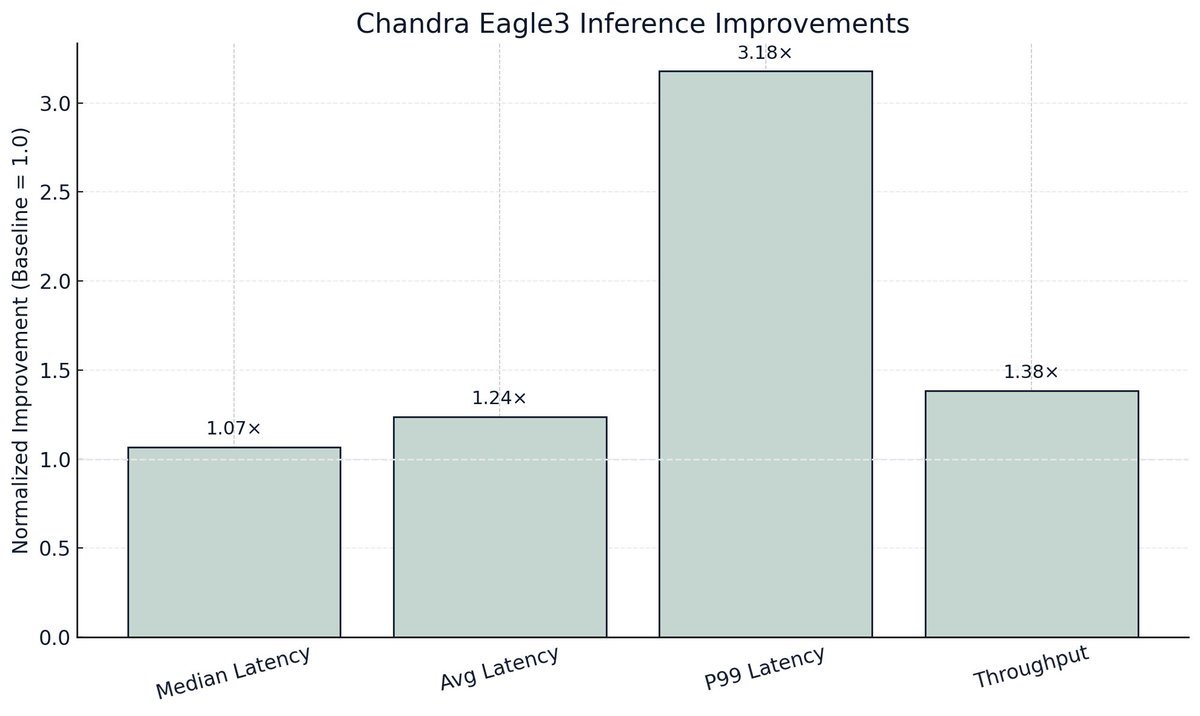
We shipped Chandra (our SOTA OCR model) but base latency wasn't good enough for production.
So we trained an Eagle3 draft model:
✅3× lower p99 latency
✅40% higher throughput
✅zero accuracy loss
Here's how we made Chandra OCR 3× faster with Eagle3 speculative decoding 🧵
We ran an experiment to test a simple idea: better OCR leads to better structured extraction.
Modern LLMs can follow schemas and parse complex documents, but only if they can actually read them. On real-world invoices with rotated scans, dense tables, and skewed text, that’s not always the case.
🧵 to see how Gemini 2.5 Flash and GPT 5-mini performed in our research:
@_avichawla@akshay_pachaar We provide structured extraction with citations backed by our OCR models! Read more about it it here - https://t.co/bKNX91xT39
This OCR model was probably the best one with the least hype
Awesome release with both a serverless API and open models on @huggingface
The org only has 85 followers on the hub ?!
We're excited to collaborate with @datalabto to make high-throughput document intelligence accessible to all developers.
Instantly deploy and scale Datalab's best-in-class Marker pipeline on Modal GPUs 📑
We just released Workflows (beta) — a way to chain document-processing steps like parsing, extraction, segmentation, and conditional logic into a single, reusable pipeline.
Read more here → https://t.co/dVoJS9aN3K
@martian_2090@VikParuchuri We convert Chandra’s output to plain HTML, so this won’t be represented. However the bounding boxes are accurately extracted too (seen in the visualizations), so its possible with some heuristics plus basic CSS :)
We've been training a lot of models @datalabto lately, and evaluating OCR quality is hard. Most benchmarks rely on brittle string-matching metrics
olmOCR-bench’s unit-test approach has been the most trustworthy and aligns well with our manual judging - we love this benchmark!
It's officially the week of OCR! I thought to share some of the lessons learned since olmOCR v1:
1. You need a reliable way to measure your performance. v1 was done on vibes-only, but it was hard to be confident in any changes we wanted to make. olmOCR-bench was our answer.
I'm excited to announce that Chandra OCR is open source!
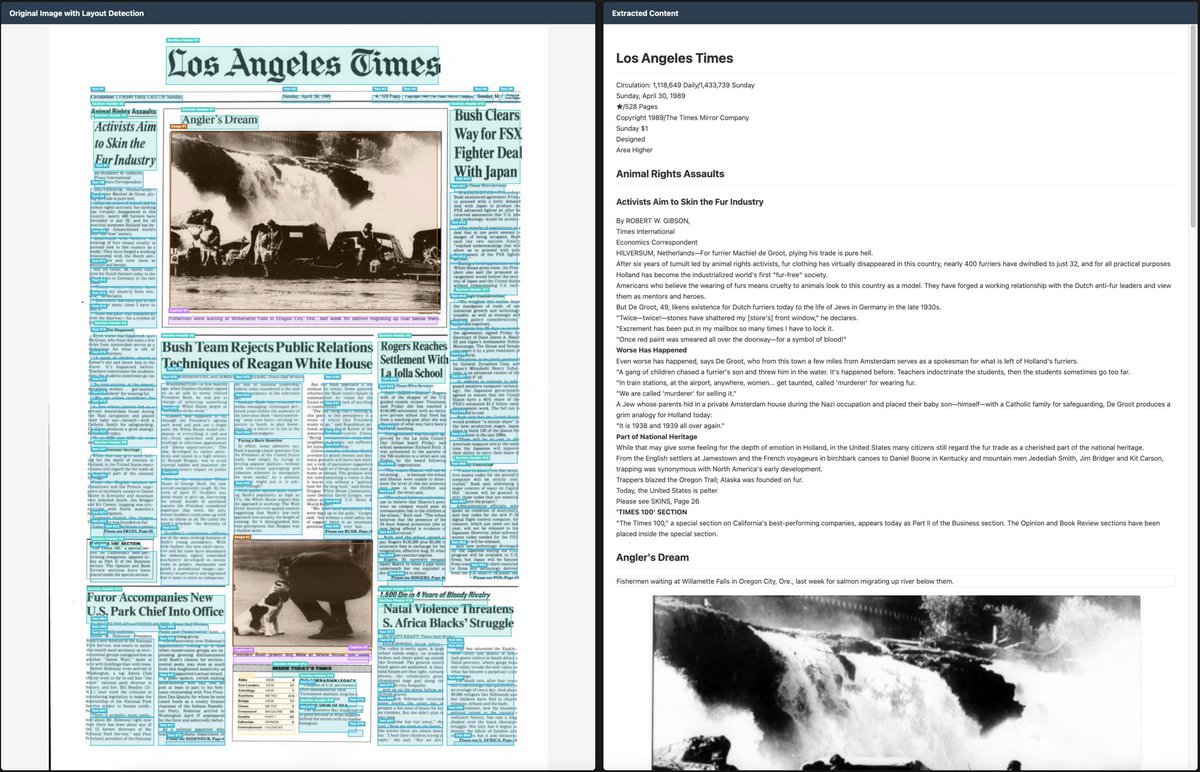
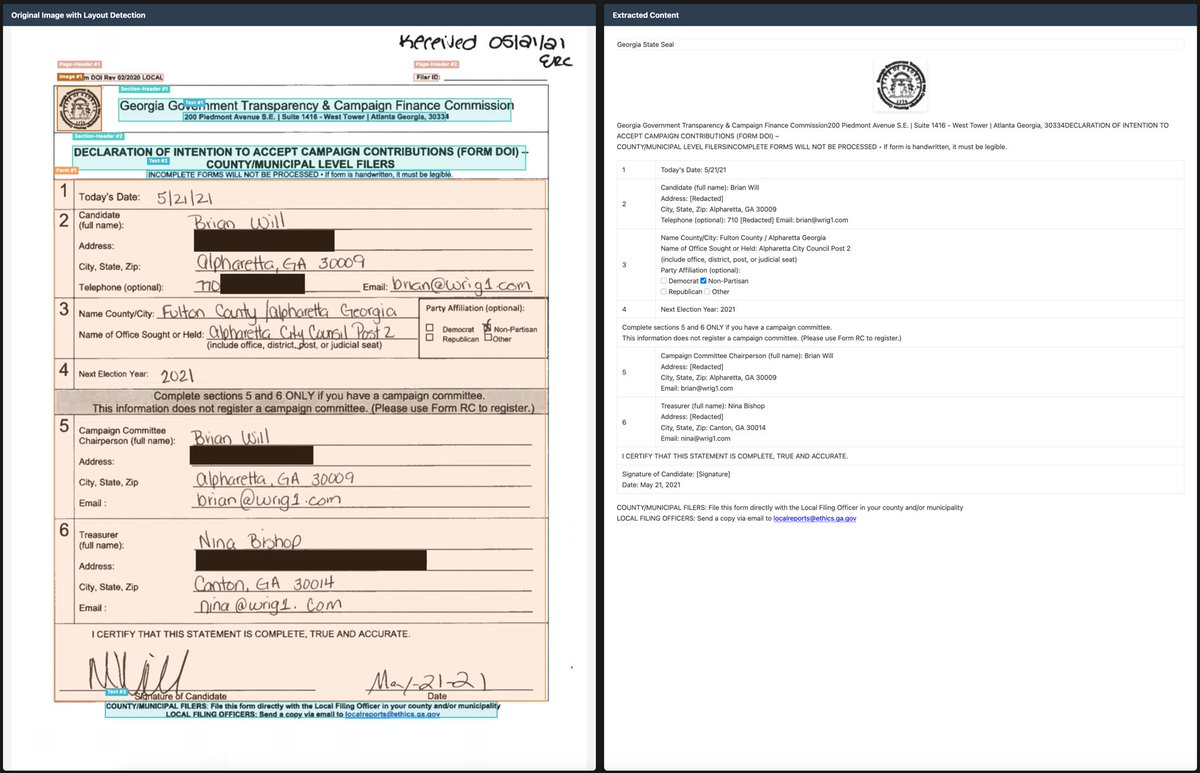
- Full layout information
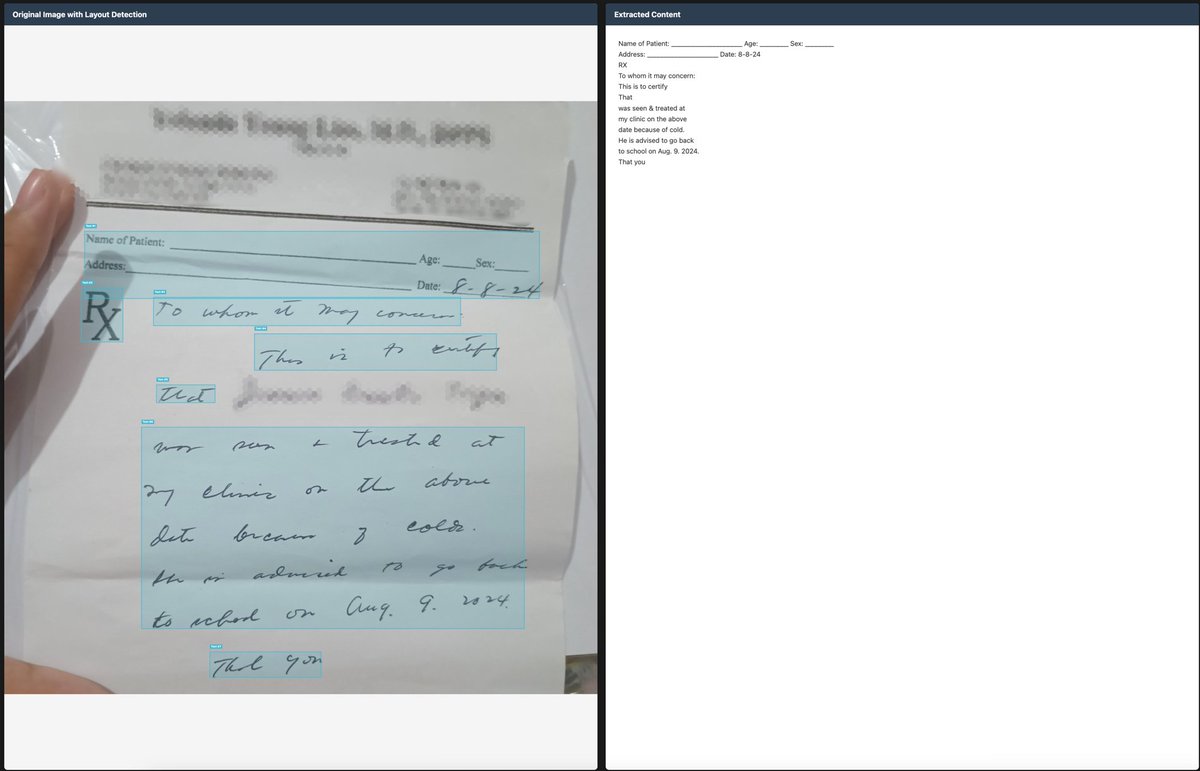
- Extracts and captions images and diagrams
- Strong handwriting, form, table support
- Works with transformers and vLLM
@protobluf@VikParuchuri@zach_nussbaum The model in our blog post is a smaller model available through Marker/Surya. Chandra is a larger model that decodes the full page in a single shot. We route between both models for the best results on our API!