A subtraction game. The goal is to get the lowest answer. Roll dice four times and each S places the number on their game board. Once a number is played, it can't be moved. This was an assessment. Both had the right answer, but oh the reasoning.
This week, I got a snapshot of how knowledge impacts reading.
I was progress monitoring my reading intervention group with two passages, one fiction and one nonfiction.
Here's how that played out (1/8) 🧵
Common Outcomes of PBIS in Schools:
•Students behave for rewards, not internal motivation. “What do I get if I behave?” becomes common.
•Chronic disruptors stay in class, impacting everyone else.
•Teacher exhaustion from tracking behavior, rewards, data, and meetings.
Students who took notes by hand scored ~28% higher on conceptual questions than laptop note-takers.
Writing forces your brain to process and compress ideas instead of copying them.
Not surprising to be honest. Teachers are being micromanaged by admin, textbook companies, testing companies, and politicians who have never managed a large group of diverse children, let alone teach a child to read. It might help if teachers were given a bathroom break.
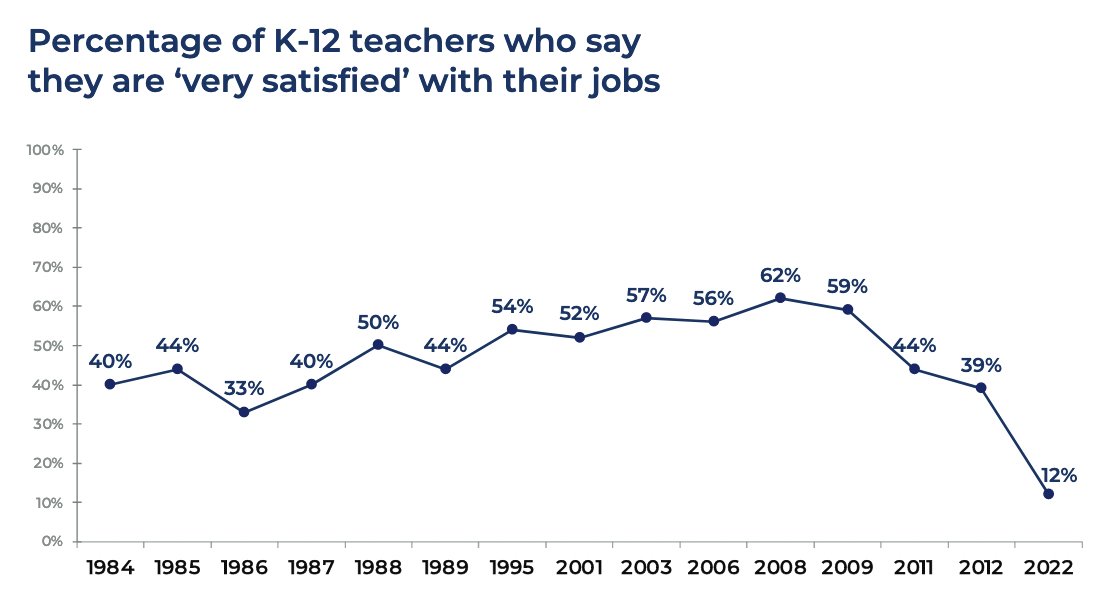
In 2008, 62% of teachers said they were very satisfied with their job.
In 2022, that dropped to 12%.
We've got a serious problem brewing in education...
A child who reads twenty minutes a day encounters millions of words in a year.
That exposure builds vocabulary, background knowledge, and language patterns.
No worksheet can compete with that.
Reading widely is one of the most powerful learning engines we have.
If you haven’t taught in a classroom post-Covid, you don’t know what it is like to teach the modern student.
The students have changed.
Teaching has changed.
You have to be in the classroom daily to understand what I mean.
OTD in 1980….
The Joe Greene Coca-Cola commercial airs during Super Bowl XIV
Although it debuted earlier that season, the ad reaches new heights with a Super Bowl audience, eventually elevating it to one of the most memorable ads in sports history.
I don’t know what to make of prolific people on social media who appear to never have mixed feelings. Who take a certain side, defend a certain position down the line no matter what has occurred. I mean, nothing ever happens to make a person cry foul on their own team? Nothing?? Is there no point when our side has gone too far? I can’t comprehend it. Seems to me that is putting way too much confidence in humans. Nobody’s always right. The thing about straight lines drawn by human hands is how prone they are to get crooked.
When a 2nd-grade math word problem is written at a 4th-grade reading level, it’s not really about the math anymore.
It’s about reading above grade level.
Reading belongs in math. Kids have to make sense of problems.
But when the language is harder than the math, the outcome is predictable.
Students can understand the math.
They can know how to solve it.
And still fail — because of how the question is written.
This isn’t an accident.
International comparisons (PISA and TIMSS) show that U.S. math assessments are often longer, wordier, and more linguistically complex than those used in many higher-performing countries — even when testing the same math concepts.
In other words, testing companies design questions that make it easier to miss the math.
If we want math scores to mean something, grade-level math needs grade-level language.
Dear Parents—your child doesn’t need to be the smartest in the class, the best on the field, or the most talented in the room.
But they do need to be teachable.
We’ve raised a generation that can Google every answer, but too many are forgetting how to listen, respect, and learn.
Being teachable isn’t about grades or intelligence—it’s about humility. It’s about realizing you don’t know everything and being willing to grow when someone tries to help you.
As parents, we don’t need to raise perfect kids.
We need to raise kids who can take feedback without falling apart.
Who can apologize.
Who can show respect even when they disagree.
Who can be corrected without becoming combative.
Because teachability will take them further than talent ever will.