What is the last book you read, and when was it?
Whether you finished a bestseller yesterday or haven't opened a physical page in months, something massive is happening this week that powers the entire publishing landscape.
The Frankfurter Buchmesse (Frankfurt Book Fair) 2026 kicks off tomorrow, running from October 7 to 11!
Are you attending the fair in Frankfurt, or have you been there before?
@gifuly Combinado Fuly!!
Imagino que seja muito legal mesmo, fico me perguntando se é tão legal assim pra um mero leitor não envolvido na indústria, haha!
Sério isso da empresa? Que legal! Sempre que vier, dá um alô!
What is the last book you read, and when was it?
Whether you finished a bestseller yesterday or haven't opened a physical page in months, something massive is happening this week that powers the entire publishing landscape.
The Frankfurter Buchmesse (Frankfurt Book Fair) 2026 kicks off tomorrow, running from October 7 to 11!
Are you attending the fair in Frankfurt, or have you been there before?
Really enjoyed this post (link in the reply 🔗 ) about sending your parents a Tailscale node, because it reminded me how much this little piece of software has changed what “self hosting” means for me.
In my case, Tailscale eventually became the glue for a small private cloud for my family. We live in different places, but I can host useful apps, shared services, and our own Google Drive style storage without exposing everything directly to the public internet or making everyone understand VPNs, ports, DNS, certificates, and all the other things around networking.
What I particularly like about Tailscale is that it makes physical distance almost irrelevant. A computer sitting in one home can become infrastructure for people hundreds or thousands of kilometers away, while still feeling like another machine on the local network.
There is something very cool about taking an old computer, a Raspberry Pi, or some tiny always-on box, plugging it in at a family member’s house, and suddenly having another node in your own little distributed cloud.
Sometimes the best cloud region is just your parents’ house. 😄
One of those engineering ideas that sounds slightly crazy at first, and then surprisingly obvious once you understand the problem:
We built our own npm registry at Deel.
With more than 200 repositories, a supply chain attack creates a pretty unpleasant question: “Are we using the compromised version anywhere?”
You could scan every lockfile across every repository, account for npm, pnpm and Yarn, deal with different lockfile versions, remember that the default branch is not necessarily what developers have installed locally, and then repeat the whole process whenever something happens.
Or you can look at the problem from a different layer... Every package installation eventually needs to talk to a registry.
So instead of trying to observe hundreds of repositories independently, the team built a caching registry proxy and made that the control point.
npm, pnpm and Yarn all speak the same underlying registry protocol, which, somewhat surprisingly, comes down to a relatively small set of HTTP endpoints.
Once you own that layer, some interesting things become possible. Packages can be scanned before they ever reach a developer machine, release age policies can be enforced centrally regardless of the package manager being used, packages can be cached in infrastructure we control, and answering “where are we using this version?” becomes a database query instead of a company wide search through lockfiles.
I think there is a nice architecture lesson in here.
Sometimes solving a problem across hundreds of systems does not mean building something that operates across hundreds of systems. Sometimes there is a shared boundary where all that complexity collapses into one place.
And sometimes something that sounds like “lets build our own npm registry” is actually just a handful of HTTP endpoints sitting at exactly the right point in the architecture.
Really cool engineering from the team at Deel 👏
(Link to the original article in the reply)
I recently started to believe that software engineers should try hobbies that get them away from software, but not necessarily hobbies that have nothing to do with engineering. Hear me out.
Gardening, woodworking, pottery, building things, fixing things. I was thinking about this because this week I needed to build a somewhat simple wooden structure for some plants on my balcony. It should have been a small weekend project, for someone who knew what needed to be done. Instead, it took me almost a week, several trips to the hardware store, a few wrong assumptions, some holes drilled in the wrong places, and considerably more thinking than I expected. It was also a hell of a lot of fun!
The funny thing is that it did not feel completely different from programming. You have resources, constraints, a problem, and how you solve it is up to you. Then you implement something, discover that reality disagrees with your design, adjust it, try again, and eventually end up with something that works.
Pretty familiar, right? Except that at the end there is a physical object sitting in front of you. Well, hopefully.
While doing some research, I came across two interesting ideas from occupational psychology. The spillover hypothesis suggests that we sometimes choose leisure activities that reproduce things we enjoy at work, such as problem solving, learning, and building. The compensation hypothesis suggests almost the opposite, that we look for hobbies that give us what work is not giving us.
I think these kinds of hobbies can do both. They preserve the part of engineering many of us enjoy, figuring things out, solving problems, creating something, while giving us something software often does not, physicality, distance from the screen, and a tangible feedback loop.
There is also research around recovery from work that talks about psychological detachment, relaxation, mastery, and control. Those last two are especially interesting for engineers. You choose the problem, decide how deep you want to go, learn something new, make mistakes without opening a Jira ticket, and eventually you can point at something and say, “I made that.”
With AI and agentic coding becoming a larger part of software development, I think some of us have started to feel that a little bit of the fun has disappeared. We do not spend as many hours stubbornly grinding through a problem, trying things, failing, learning something unexpected, and finally getting that satisfying “it works” moment. That is great for productivity, but productivity is not really the point of this post. The interesting part is that we can find that same feeling somewhere else, while also giving ourselves a much needed break from being chronically online.
The bottom line is: sometimes it is just nice to spend an entire afternoon drinking coffee, staring at a pile of pieces, and thinking about how the hell you are going to turn all of that into something that works.
Stop onboarding new engineers by walking them through folder hierarchies and controllers. Most application code is just repetitive plumbing anyway. Start directly with the database schema instead. https://t.co/rRbQ15LJJc
I was recently reflecting on some of the shared thoughts of many of us software engineers, and I came to believe even more that the assumption that AI will eliminate software engineering misses a fundamental truth: writing code was never the primary objective. Not gonna lie, it’s a hell of a fun, but coding was simply the necessary, labor-intensive mechanism for translating concepts into execution.
Now that AI agents can generate and refactor syntax at near-zero marginal cost, the bottleneck in software creation has moved upstream and downstream simultaneously.
Upstream, the challenge is context orchestration and boundary definition. AI operates effectively only within explicit constraints. If an engineer cannot precisely define domain boundaries, data contracts, implementation standards and business rules, AI merely generates high-velocity cognitive debt and architectural drift… Which, at the end of the day, you as an engineer will still be responsible for.
Downstream, the challenge is system governance and verification. When autonomous tools produce hundreds of lines of code in seconds, the engineer's role shifts from author to editor-in-chief. The workload centers on evaluating systemic failure modes, balancing latency against compute costs, enforcing security boundaries, and maintaining system integrity over time. That can be a lot harder with the amount of generated output, but that’s something else.
This shift fundamentally alters the core skill set of engineering. The value is no longer in typing implementation details, but in making high-level technical trade-offs. Engineers who embrace this evolution will naturally elevate into system architects responsible for orchestrating intelligent components.
The future of this work belongs to engineers who stop viewing syntax as their primary output and start treating system design, context architecture, and governance as their true deliverables. Being able to evaluate, compare, and choose between trade-offs for the same problem is, more than ever, the most valuable skillset an engineer can have.
(English version at the end)
No dia do primeiro turno das eleições presidenciais brasileiras, a data para terminar de ler Fahrenheit 451, de Ray Bradbury, não poderia ser mais adequada.
No dia em que escolhemos o tipo de futuro que queremos para o Brasil, termino um livro que imagina uma sociedade em que os livros são proibidos e queimados. Um mundo em que o vazio da mente impera sobre o indivíduo, em que tudo parece conspirar para esvaziá-lo de profundidade, reflexão e pensamento crítico, transformando-o em um invólucro de ideias prontas.
Mas talvez a parte mais inquietante da obra seja justamente esta: Bradbury não coloca toda a culpa no Estado.
A censura dos livros e sua queima pelos bombeiros são apenas a manifestação mais explícita daquele mundo. Há também as enormes telas de televisão que ocupam as paredes, o entretenimento constante, o barulho incessante e, sobretudo, a escolha progressiva do próprio indivíduo pelo conforto, pela distração e pelo prazer instantâneo em detrimento do conhecimento e da reflexão.
É uma espécie de hedonismo anestésico. Não pensar demais. Não sofrer demais. Não questionar demais.
E, quase setenta anos depois, é difícil não pensar em nós mesmos. Se você constantemente se pega “scrollando” pelas redes sociais sem saber exatamente por quê, sem procurar nada e, no fim, sem ganhar nada, talvez valha a pena pensar sobre isso também.
Um belo dia para terminar esse livro e refletir sobre a sociedade que eu quero ajudar a construir.
-----
On the day of the first round of Brazil’s presidential election, I could hardly have chosen a more fitting date to finish reading Fahrenheit 451, by Ray Bradbury.
On a day when we choose the kind of future we want for Brazil, I finish a book that imagines a society where books are banned and burned. A world where emptiness of thought takes hold of the individual, where everything seems designed to strip people of depth, reflection, and critical thinking, turning them into vessels filled with ready-made ideas.
But perhaps the most unsettling part of the book is precisely this: Bradbury does not place all the blame on the State.
The censorship of books and their burning by firefighters are only the most explicit manifestations of that world. There are also the enormous television screens covering entire walls, the constant entertainment, the endless noise, and, above all, the individual’s gradual choice of comfort, distraction, and instant gratification over knowledge and reflection.
It is a kind of anesthetizing hedonism. Do not think too much. Do not suffer too much. Do not question too much.
And almost seventy years later, it is difficult not to think about ourselves. If you constantly find yourself scrolling through social media without really knowing why, looking for nothing and ultimately gaining nothing from it, perhaps that is worth reflecting on as well.
A fitting day to finish this book and reflect on the kind of society I want to help build.
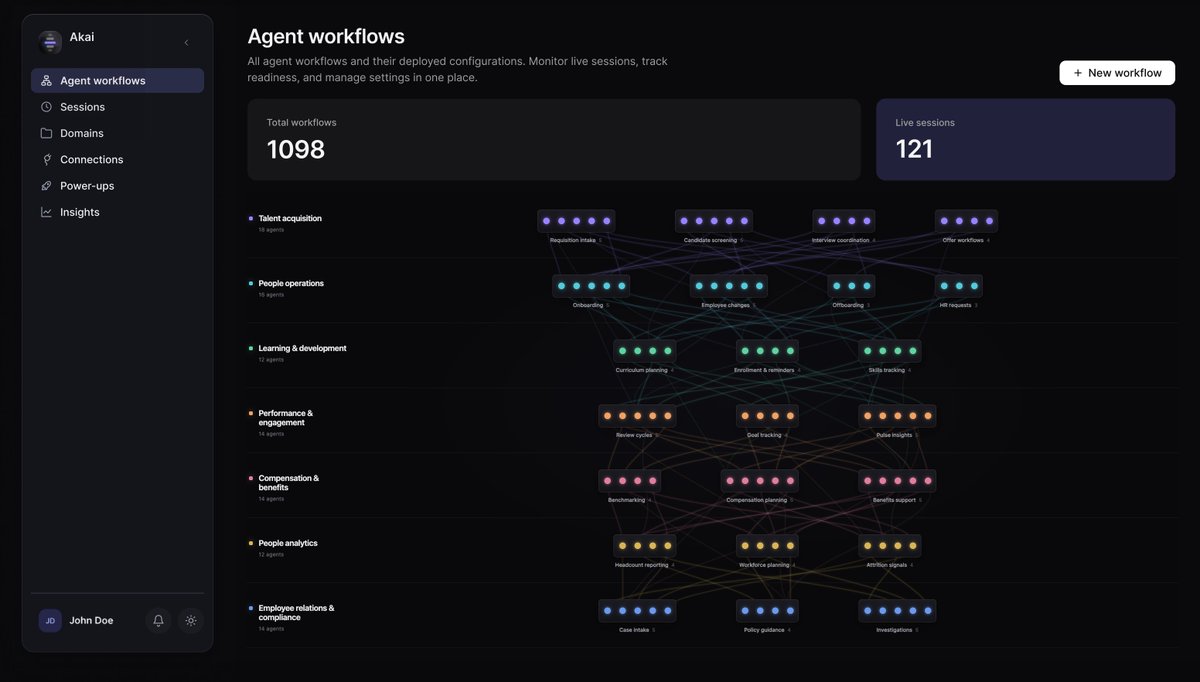
What we have been building internally at Deel over the last few months is easily the coolest thing I've seen so far!
We originally created Akai just to fix our own repetitive operations across Finance, HR, and Compliance. We never intended to make it a product, but it helped us add $140M in ARR in 90 days without new hires, so launching it publicly was a no-brainer.
The best part is how it handles work. Instead of writing complex API integrations, you just record your screen doing the manual task. Akai captures the workflow, figures out weird edge cases, and lets you adjust steps in plain English.
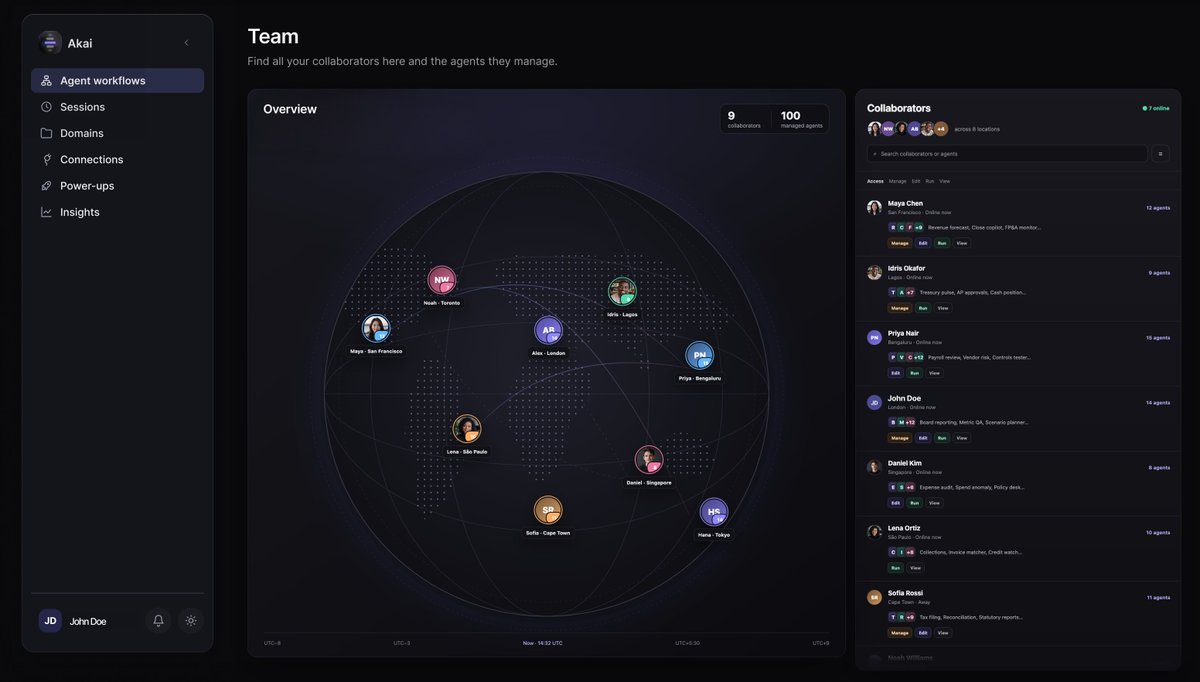
Unlike standard AI coding tools where everyone builds in silos, it is built for real team collaboration. In our payment ops alone, we automated 85% of reconciliation and saved 500+ hours of manual work every week.
We are even launching it with an Automation Guarantee, where you get a full refund if we cannot automate 1,000 hours of work in your first 30 days!
If you still think about AI efficiency as “you writing better prompts”, you might be missing where the industry is actually heading. For years, we have been trained to sit in front of a text-box machine and type. A kingdom where we are the only ruler, a plane which has only one pilot.
Now we are in the AI Agents era, and for many of us this is really hard to navigate. Moving to a true agentic mindset changes that dynamic entirely. Instead of acting as the proactive operator holding the AI's hand through every step, you hand off an objective to an autonomous worker that takes the initiative, executes in the background, and pings you only when the job is finished. You become an orchestra conductor, now the machine still goes where you point, but every part moves independently.
When you give an agent execution access through local CLI tools like OpenClaw or headless browser drivers, the entire structure of work changes. You are no longer asking questions, you are delegating entire operational loops. Your planning phase still needs to be done correctly, you need to think about the constraints of the agent, about the goals to be evaluated and the overall direction it needs to move to. But the heavy-lifting part of the work? Not yours anymore. An agent can monitor system logs, spin up a local Docker container to reproduce a bug, write a patch, run unit tests, and open a pull request while you focus on higher level strategy. It shifts your daily role from doing the manual grunt work to acting as an executive editor who simply approves or rejects finished drafts.
This move from reactive prompting to proactive delegation drastically cuts down on cognitive fatigue. The real value comes from letting the system handle the chaotic middle, like navigating unexpected terminal errors, retrying failed API calls, or fetching updated data without needing your constant supervision. While unconstrained autonomy always carries the risk of loop drift, setting structured guardrails lets the agent take the initiative safely, bringing you in only for critical approvals before taking irreversible actions.
We are quickly leaving behind the era where humans act as the manual glue between software tools. The highest leverage comes from letting agents initiate, iterate, and solve problems proactively in the background, leaving you to manage outcomes rather than execution. How much of your daily routine have you handed over to background execution, and where are you still holding onto the steering wheel?
EXCITED TO LAUNCH: Akai (https://t.co/mMBMmX4NCr)
Deel added >$140M ARR in 90 days without increasing headcount by automating~600 Full Time Employees' equivalent in work with Akai.
Akai was an internal tool to automate our painfully repetitive operations in Finance, HR, Accounts Payable, and Compliance, etc. We never intended to make this a product.
But we watched revenue per employee grow from $130K to $215K
We built >8k agents that do the work of ~600 employees
It had such a dramatic impact on our business that today we are launching it for everyone.
How it works: Say you're automating payment reconciliation:
1. Record your screen while manually matching a messy transaction and Akai will capture your screen, voice, server requests
2. Akai will see that you pulled unformatted wire transfer info from an archaic bank portal, put it in some excel sheet, checked NetSuite invoices, payment history, and put a ticket on Zendesk
3. Akai reads between the lines and build a workflow + steps + conditional guardrails. It learns tacit edge cases, like resolving malformed invoice references without you writing a single regex
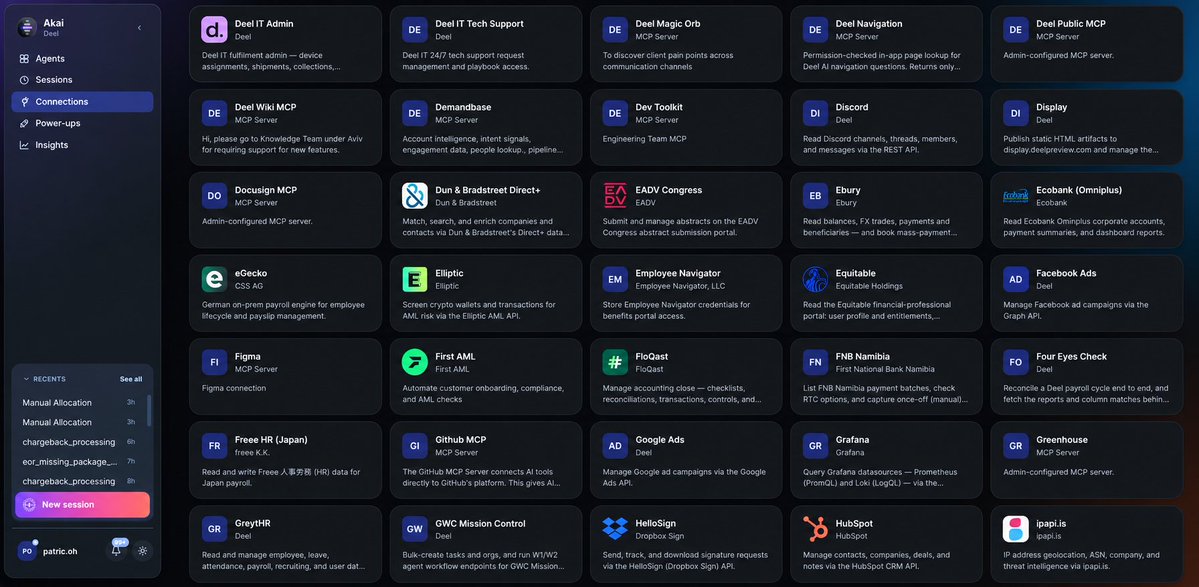
4. Simply connect NetSuite, your ledger, Zendesk, PSPs, and even legacy bank portals with zero API access
5. Run the workflow and tell it what to adjust in plain English: "strip slashes on wire memos and auto-apply partial payments." It adapts instantly
6. Once it works for you, add 100s of colleagues. Your entire payment ops team forks and extends the workflow for new PSPs, secondary ledgers, or regional settlement rules
7. We automated 85% of our payment reconciliation end to end, eliminating 500+ hours of soul-crushing manual grunt work every single week.
Claude Code/Codex can't do this in multiplayer mode. Every person rebuilds the same skill from scratch in their own way.
Deel built Akai to:
1. Understand backend operations edge cases (it had to work for our 7000 person team first)
2. Collaborative across 1000s of employees
3. Self-Learning from millions of runs
4. Optimises cost and gets cheaper every run
We're so confident that we're announcing an Automation Guarantee:
If our engineers can't automate a thousand of hours of work in your first 30 days, you get a full refund.
Book a demo: https://t.co/VESnztdck3 if you're an exec at a company with hundreds of employees
I feel like I'm doing something wrong in this whole AI / agentic coding thing. I already use Claude at work, so I wanted to explore Codex in some personal projects. Humble setup, 20ish dollars subscription...
I see a lot of hype about the new Codex Astra, but being mindful of my valuable tokens, I'm using Terra High for coding and going pretty far with amazing results...
The worst thing is that "personal project" is kind of underplaying it. It's actually a pretty complex system with 3 independent services, Redis, event bus... the whole lot.
Do you all really need Astra for your stuff? I mean, yeah it does cool stuff. I saw a video of someone using it to reproduce a picture in Paint... nice... and?