I am looking to hire 1–2 postdocs for next year. Please feel free to reach out if interested in: (1) Inter-brain information translation & control (2) Characterizing brain states via thermodynamics & control theory (3) Comparing qualia structures across individuals and identifying their neural substrates.
Application details coming soon.
My first-authored paper has just been published in Scientific Reports!
Our theme:
👉 “To what extent can multimodal large language models (MLLMs) estimate the complex structure of human emotions?”
https://t.co/Rd4eOTSdkA
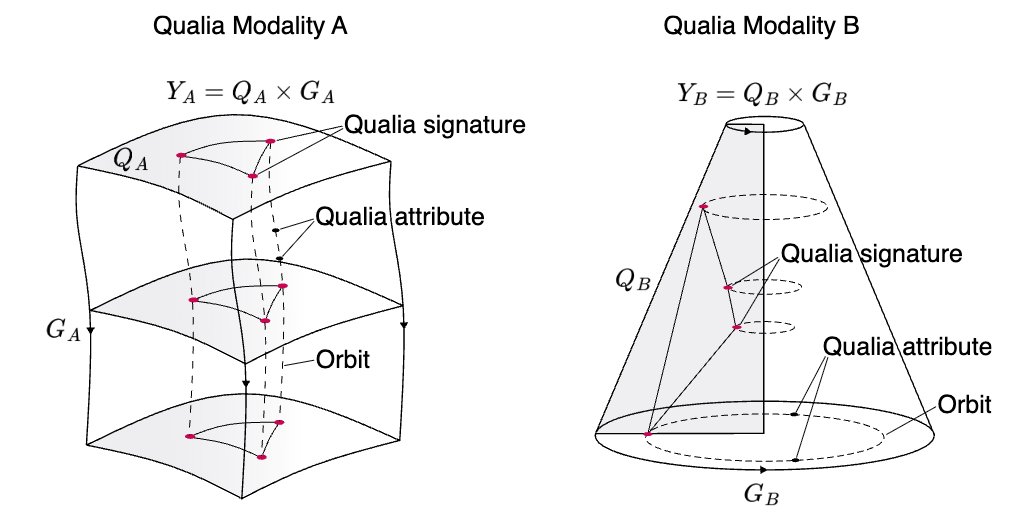
Excited to share our new preprint! "Principal bundle geometry of qualia: Understanding the quality of consciousness from symmetry", co-first-authored with Ryota Kanai @kanair_jp and co-authored with Chanseok Lim. https://t.co/8CXydqcpG8
We propose that the relational structure of qualia is characterized by principal bundle geometry, which naturally arises from the symmetries that the brain learns from the world.
Excited to share our new paper in iScience! 🎉
https://t.co/OOvCHLwYcg
We present an unsupervised alignment framework applied to neural recordings, enabling comparison of neural representations across individuals and brain areas—without relying on stimulus correspondence.
Excited to share another new paper in Journal of Neuroscience Methods!
We introduce GWTune, a toolbox for unsupervised alignment using Gromov–Wasserstein Optimal Transport (GWOT).
Open-source and ready to use.
🔗 https://t.co/Avsu3xUIsu
🧰 https://t.co/ZVoPNrzQSa
Info theory offers powerful measures for capturing complexity & interaction among elements of a complex system, like the brain! 🧠 Here's our new unified reference for key info-theoretic time series measures ft. 📊 visuals, ➗equations, & 💬descriptions:
https://t.co/nbBxTNHmhU
Our latest preprint! @H_A_Research@takato1414@NishimotoShinji
https://t.co/VFYfcKEpkM
We investigated to what extent Multimodal LLMs replicate human high-dimensional emotion structures using unsupervised alignment. MLLMs achieve unprecedented accuracy at capturing emotion structures, but precise alignment remains challenging.
So happy to see Taguchi-san’s paper published! I had the pleasure of closely guiding this work — it’s been incredibly rewarding to watch it take shape over time. A real testament to his perseverance and dedication — well done!
For more details, check out the thread under his original post.
For me, this marks the latest in a series of studies on identifying network cores, particularly in the context of consciousness:
– Informational cores: https://t.co/nRxqlRFQ5G (w/ @kanair, @oizumim)
– Bidirectionally connected cores in a mouse structural connectome: https://t.co/8bAKp1OyLD (w/ Y. Aoki, @oizumim)
Check them out too!
Our paper is out in #JNeurosci! @_ttaguchi@JunKitazono@shuxnys
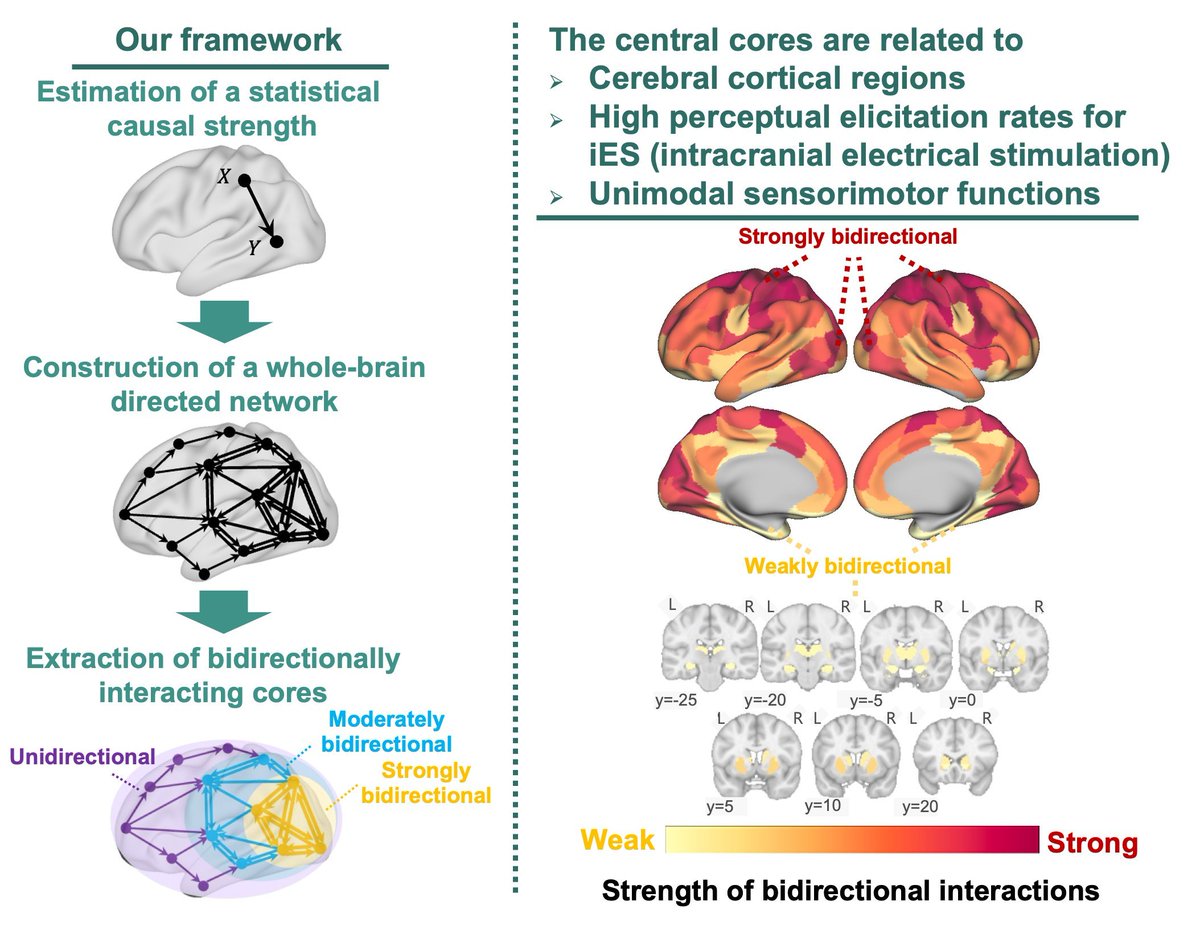
Bidirectional signaling (feedforward and feedback loops) is ubiquitous in the brain and considered fundamental to brain function—but where exactly in the brain do these strong bidirectional networks emerge, and how are they related to specific cognitive functions?
Dive into the details in this thread by @_ttaguchi 👇
https://t.co/NK5knKjKJI
Our proposed framework offers new insights into the roles of network cores with strong bidirectional interactions, giving us a better understanding of their influence on conscious perception and sensorimotor functions.
For more details, check out our full study! (11/11)
Here, we introduced a new framework to identify subnetworks with strong bidirectional interactions, which we call the “cores” of a network. The framework consists of two steps. (4/n)
Further analyses, including a meta-analysis, suggest that the central cores relate to lower-order sensorimotor functions. The fig shows that regions with strong bidirectional interactions are associated with terms such as “eye movements,” “visual perception,” and “motor.” (10/n)