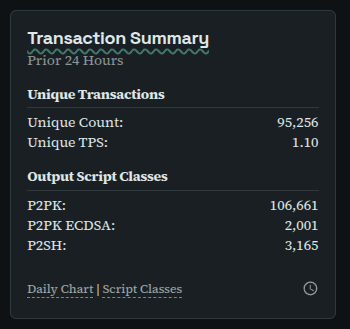
oh so kaspa hasn't failed its that no one is using it now. haha.
We are making progress I like it.
And by the way Kaspa had 95,256 transactions in the last 24 hours with 38,000 addresses being unique senders.
So what stats do you need to see for Kaspa to be considered used and by more than 3 people?
⚡ KAS UPDATE
$KAS hat den 200-Tage-MA zurückerobert!
——
Aber was bedeutet das eigentlich?
Der 200-Tage-MA (Moving Average) ist der Durchschnittskurs von KAS über die vergangenen 200 Handelstage.
Er glättet die täglichen Schwankungen und zeigt dadurch den übergeordneten Trend.
📈 Kurs über dem 200-Tage-MA
→ langfristiges Momentum wird bullischer↗️
📉 Kurs unter dem 200-Tage-MA
→ langfristiger Abwärtstrend bleibt eher intakt↘️
Deshalb beobachten viele Trader genau diese Linie.
Und $KAS?
Zum ersten Mal seit März liegt KAS wieder über seinem 200-Tage-MA.
Noch interessanter:
+48 % seit den Juli-Tiefs.
Das bedeutet nicht, dass der nächste Move garantiert nach oben geht (der 200-Tage-MA ist ja kein Orakel oder Kaufsignal).
Aber ein nachhaltiger Ausbruch darüber KANN ein wichtiges Signal sein:
Der langfristige Trend beginnt sich zu drehen - UND genau deshalb ist die aktuelle Bewegung bei KAS interessant.
Denn wenn sich nach Monaten unter diesem langfristigen Durchschnitt etwas verändert, wird es interessant - ob $KAS sie auch als Support halten kann. 👀
Was meinst DU?
LIKE❤️ = wenn du KAS verstehst und hältst
REPOST ♻️ = wenn andere diesen Move sehen sollten
#Kaspa #KAS #KaspaGermany
@RonSwanonson@KaspaSilver Tag Auto Souto Service, Wolfie’s Bar and Latino Viščiukas.
Or just open https://t.co/SFNYCZRb5a.
Funny how “reputable” only seems to count if it’s been taking bitcoin for 15 years.
INSIGHTS⚡️ Toccata put covenants and zero-knowledge verification on Kaspa’s Layer-1 rather than leaving them on a roadmap.
That changes what developers can enforce in a transaction itself. In our assessment, native programmability is the first serious attempt to make Kaspa more than a high-speed payments DAG.
A fast ledger without logic stays a transfer network. kaspa:native @kaspaunchained 🔐🛠️
#Kaspa #Bitcoin
Kaspa is beginning to occupy a category that is difficult to compare directly with traditional blockchains because the pieces being assembled operate at different layers of the stack.
Covenants give Kaspa native, enforceable state transitions at the L1. Instead of a UTXO merely answering “who can spend this?”, a covenant can constrain how that spend transforms into the next state. That creates the foundation for vaults, escrow, programmable assets, decentralized exchanges, smart wallets and complex financial primitives without abandoning Kaspa’s UTXO architecture.
Argent pushes this concept upward. It provides an actor-based programming model where applications can be expressed as collections of stateful covenant actors that consume and create one another atomically. Argent compiles these higher-level application definitions into auditable SilverScript, turning what would otherwise require intricate hand-written covenant logic into something much closer to application development. The significance is not simply “smart contracts on Kaspa.” It is the emergence of a native programming stack for composing UTXO state machines.
Then comes DAGKnight. Its importance is fundamentally different. Covenants and Argent expand what Kaspa can compute and enforce; DAGKnight advances how quickly and robustly the underlying consensus can coordinate that activity. Its design targets extremely low block intervals while strengthening resilience under adverse network conditions, pushing proof-of-work consensus toward a regime where high-frequency decentralized settlement becomes increasingly practical.
Put these layers together and the picture changes: Kaspa is not merely adding programmability to a fast PoW network. It is building a vertically integrated architecture where high-throughput consensus, native programmable state, developer tooling, and eventually proof-driven execution can reinforce one another.
That combination is what could place Kaspa in its own category: not another L1 competing for the same smart-contract narrative, but a programmable, high-throughput proof-of-work settlement network designed around parallelism from the protocol upward.
@RonSwanonson@KaspaSilver Kaspa is used by three people. What a clown, look at how it was made especially for you. Tell me how many Bitcoin transactions there have been since 2009?
>Focusing on transaction speeds or other features that can be achieved in layers only creates compromises in security and finality that a truly decentralized protocol can not take
You cannot prove this statement to be true. You are just saying it. Kaspa has solved this.
I have been telling you for months using L2 is not really Bitcoin and money fails in layers.
Please share where Kaspa has failed because I never have to use my money via a L2 and has worked for me just fine since Kaspas inception.
Look, we all probably already know about @kaspaunchained and all that. But we've dug deep to find the most obscure, interesting, and fun facts about $KAS👇
1️⃣ Its monetary policy is based on music
Kaspa’s “chromatic” emission schedule started at 440 KAS per second, the same number as the frequency of concert A: 440 Hz.
Every month, the issuance rate decreases by the same ratio as moving down one semitone on a musical scale.
After 12 steps, issuance halves. That’s one octave down. Someone literally turned music theory into monetary policy.
2️⃣ There’s an ancient Bible verse hidden in its genesis block
Kaspa’s genesis block contains Ezra 7:18, written in Aramaic, a passage about deciding what to do with remaining silver and gold.
The Aramaic word for silver is “kaspa” (כספא), which appears in the verse itself.
So the message embedded in the network’s beginning actually contains its own name. You can still find the Aramaic text in Kaspa’s source code.
3️⃣ Its backstory includes a plan to mine with optical hardware
DAGLabs, the company behind Kaspa’s early development, raised roughly $8 million and explored optical proof-of-work mining hardware.
Part of the original business plan involved developing that hardware and selling or distributing its mining capacity.
The plan didn’t work out, partly because the technology wasn’t mature enough. But Kaspa continued toward a public launch without a premine.
A cryptocurrency with an abandoned optical-mining origin story.
4️⃣ Its founder is mentioned in Ethereum’s whitepaper
Years before $KAS existed, Yonatan Sompolinsky and Aviv Zohar introduced the GHOST protocol in 2013.
Ethereum’s whitepaper explicitly credits their work and discusses a modified version of GHOST.
Sompolinsky later founded Kaspa, whose GHOSTDAG protocol grew out of that broader research lineage.
Kaspa launched in 2021, but its founder’s contribution to crypto history goes back much further.
5️⃣ Its logo is supposed to look slightly imperfect
Ever noticed that the circle around Kaspa’s logo isn’t perfectly round?
That’s intentional. The outer ring represents a worn silver coin, the kind that has actually passed through people’s hands.
The bent “K” suggests movement while also drawing inspiration from ancient lettering.
Even the logo carries a little piece of the project’s “silver” identity.
One closed door shouldn’t stop you from using Kaspa.
Miners are the computers that add transactions to the network. If one leaves yours out, another can still add it.
It’s called censorship resistance, and on Kaspa it works within seconds.
INSIGHTS⚡️ Kaspa’s BlockDAG still does the thing most proof-of-work chains cannot: high block frequency without collapsing into a single slow chain.
Speed at the base layer is the original thesis. We view that throughput as proven; the open question is what gets built on it now that programmability is live.
Fast settlement is a feature. Applications are the product. kaspa:native @kaspaunchained ⚡🧱
#Kaspa #Crypto #Web3