Top Prompt Engineering Interview Questions
1. What is Prompt Engineering?
Prompt engineering is the process of designing and optimizing prompts (instructions) given to AI models to generate accurate, relevant, and useful outputs.
A prompt may include
✔ Instructions
✔ Context
✔ Examples
✔ Constraints
✔ Output format
*✅ Example:*
Instead of:
“Write about AI”
Use:
“Explain Generative AI in simple language with 3 real-world examples for beginners.”
*2. Why is Prompt Engineering Important in AI?*
Prompt engineering is important because AI models depend heavily on the quality of the input they receive.
*A good prompt helps:*
✔ Improve accuracy
✔ Reduce hallucinations
✔ Control tone and style
✔ Generate structured outputs
✔ Improve reasoning
✔ Save time and cost
✅ Better prompts = Better AI responses.
*3. Difference Between Prompt Engineering and Traditional Programming*
*🖥 Traditional Programming:*
- Uses fixed rules and logic
- Deterministic outputs
- Requires coding syntax
*🤖 Prompt Engineering:*
- Uses natural language instructions
- AI interprets intent dynamically
- Probabilistic outputs
*✅ Example:*
*Traditional Code:*
if marks > 40:
print("Pass")
*Prompt Engineering:*
“Determine whether the student passed based on marks greater than 40.”
*4. How Does Prompt Engineering Affect Model Behavior?*
Prompt engineering directly influences:
✔ Accuracy
✔ Creativity
✔ Tone
✔ Structure
✔ Reasoning depth
✔ Safety behavior
Even small wording changes can produce very different outputs.
*✅ Example:*
*Prompt 1:*
“Explain Python.”
*Prompt 2:*
“Explain Python for a 10-year-old using simple analogies.”
The second prompt changes the complexity and tone completely.
*5. What Makes a Prompt “Good”?*
A good prompt is:
✔ Clear
✔ Specific
✔ Context-aware
✔ Structured
✔ Goal-oriented
*✅ Bad Prompt:*
“Tell me about databases.”
*✅ Good Prompt:*
“Explain relational databases with examples of MySQL and PostgreSQL in under 200 words.”
*6. What Are the Basic Components of a Prompt?*
*🧩 Main Components:*
*1️⃣ Instruction*
→ What the AI should do
*2️⃣ Context*
→ Background information
*3️⃣ Input Data*
→ Content to process
*4️⃣ Output Format*
→ Desired response structure
*5️⃣ Constraints*
→ Rules or limitations
*✅ Example:*
“Summarize this article in 5 bullet points using simple English.”
*7. What is Context in a Prompt?*
Context is the background information provided to help the AI understand the task more accurately.
*It improves:*
✔ Relevance
✔ Accuracy
✔ Personalization
✔ Consistency
*✅ Example:*
*Without context:*
“Write an email.”
*With context:*
“Write a professional leave request email for a 3-day medical leave.”
*8. What is the “Instruction” in a Prompt?*
The instruction is the command that tells the AI what action to perform.
*Examples:*
✔ Explain
✔ Summarize
✔ Translate
✔ Analyze
✔ Compare
✔ Generate
*✅ Example:*
“Translate this paragraph into French.”
Here, “Translate” is the instruction.
*9. How Do You Measure Prompt Quality?*
Prompt quality is measured using:
✔ Accuracy
✔ Relevance
✔ Completeness
✔ Consistency
✔ Formatting correctness
✔ Hallucination rate
✔ User satisfaction
✅ A high-quality prompt consistently produces reliable results with minimal retries.
*10. Why is Prompt Engineering Called “The New Programming”?*
Prompt engineering is called “the new programming” because prompts are becoming a way to control AI systems just like code controls software.
Instead of writing strict logic, developers now guide AI behavior using natural language instructions.
Example
“Act as a customer support assistant and answer politely.”
Generative AI & Large Language Models LLMs
After learning:
✅ Python Fundamentals
✅ Data Handling
✅ Visualization
✅ Statistics
✅ Machine Learning
✅ Deep Learning
✅ NLP
✅ Computer Vision
now comes the most trending and revolutionary field in AI:
Generative AI & LLMs
This technology powers:
- ChatGPT
- AI image generators
- AI coding assistants
- AI voice tools
- AI video creation
- Smart AI agents
What is Generative AI?
Generative AI is a branch of AI that creates new content such as:
✅ Text
✅ Images
✅ Audio
✅ Video
✅ Code
Instead of only analyzing data, Generative AI can generate completely new outputs.
Why Generative AI is Important
Generative AI is transforming industries:
- Education
- Healthcare
- Marketing
- Software Development
- Design
- Content Creation
It helps automate creative and intelligent tasks at massive scale.
What are Large Language Models LLMs?
LLMs are advanced AI models trained on massive text datasets.
*They understand:*
- Language
- Context
- Patterns
- Meaning
*Popular LLMs*
- ChatGPT
- Gemini
- Claude
- Llama
How LLMs Work
LLMs predict the next word/token based on context.
*Simple Example*
*Input:*
> “AI is transforming…”
*Prediction:*
> “the world”
This prediction process happens billions of times during training.
Transformer Architecture
Modern LLMs are based on Transformers.
*Transformers changed AI completely because they:*
✅ Understand context better
✅ Handle large text efficiently
✅ Scale effectively
Attention Mechanism
Attention helps models focus on important words.
*Example*
*Sentence:*
> “The cat chased the mouse because it was hungry.”
*Attention helps identify:*
“it” refers to the cat.
Important Generative AI Tools
*1. OpenAI APIs*
Used for:
- Chatbots
- AI assistants
- Text generation
*2. Hugging Face*
Popular platform for:
- LLMs
- AI models
- Transformers
*Website*
Hugging Face
*3. LangChain*
Framework for building LLM applications.
*Used For*
- AI agents
- Chatbots
- RAG systems
*4. LlamaIndex*
Used for:
- Connecting LLMs with documents/data
Prompt Engineering
One of the most important Generative AI skills.
Prompt engineering means designing effective prompts to get better AI responses.
*Bad Prompt*
> “Tell me about AI”
Good Prompt
> “Explain Artificial Intelligence in simple terms for beginners with real-world examples.”
Types of Prompting
*1. Zero-Shot Prompting*
No examples provided.
*2. Few-Shot Prompting*
Examples are included.
*3. Chain-of-Thought Prompting*
Encourages step-by-step reasoning.
RAG — Retrieval-Augmented Generation*
RAG combines:
- Search systems
- LLMs
How It Works
1. Retrieve relevant information
2. Send context to LLM
3. Generate better answers
Vector Databases
LLMs use embeddings stored in vector databases.
*Popular Vector DBs*
- Pinecone
- ChromaDB
- Weaviate
Embeddings
Embeddings convert:
- Text
- Images
- Data
into numerical vectors.
These vectors help AI understand similarity and meaning.
AI Image Generation
Generative AI can create images from prompts.
*Popular Models*
- DALL·E
- Stable Diffusion
AI Audio & Music Generation
AI can generate:
✅ Voiceovers
✅ Songs
✅ Background music
✅ Sound effects
AI Agents
AI agents are autonomous systems that:
- Think
- Plan
- Use tools
- Complete tasks
*Examples*
- AI coding agents
- AI research assistants
- Automation bots
Data Handling with Python (Most Important Step Before ML)
After learning Python fundamentals, the next major step in AI is understanding how to work with data.
Because in AI:
- Data is everything
- Models learn from data
- Better data = Better AI systems
Before jumping into:
- Machine Learning
- Deep Learning
- Neural Networks
you must learn how to:
✅ Read data
✅ Clean data
✅ Analyze data
✅ Transform data
✅ Visualize data
This process is called Data Handling.
*🧠 Why Data Handling is Important in AI*
Real-world data is usually:
- Messy
- Incomplete
- Unstructured
- Full of missing values
AI Engineers spend huge time cleaning and preparing data before training models.
👉 In real companies:
- 70% Data Handling
- 30% Model Building
That’s why mastering data handling is extremely important.
*📦 Most Important Python Libraries for Data Handling*
*1. NumPy*
Used for:
- Numerical computing
- Arrays
- Mathematical operations
*2. Pandas*
Used for:
- Data analysis
- Data cleaning
- Working with CSV/Excel files
*3. Matplotlib & Plotly*
Used for:
- Data visualization
- Graphs
- Charts
*🔢 1. NumPy Fundamentals*
NumPy is the foundation of data science and AI.
It provides powerful array operations.
*Install NumPy*
pip install numpy
*Create Arrays*
import numpy as np
arr = np.array()[1][2][3][4]
print(arr)
*Mathematical Operations*
arr = np.array()[1][2][3]
print(arr + 2)
print(arr * 2)
*Why NumPy is Important for AI?*
AI models process massive numerical data using arrays and matrices.
*📊 2. Pandas Fundamentals*
Pandas is the most important library for data analysis.
*Install Pandas*
pip install pandas
*Create DataFrame*
import pandas as pd
data = {
"Name": ["A", "B", "C"],
"Marks":
}[90][85][95]
df = pd.DataFrame(data)
print(df)
*📂 3. Reading CSV Files*
Most AI datasets come in CSV format.
df = https://t.co/GDwE4mhBkh_csv("data.csv")
print(df.head())
*🔍 4. Exploring Data*
*Check Dataset Information*
print(https://t.co/SZMwQSc6SZ())
*Check Missing Values*
print(df.isnull().sum())
*Statistical Summary*
print(df.describe())
*🧹 5. Data Cleaning*
Real-world datasets contain:
- Missing values
- Duplicate values
- Incorrect data
*Remove Missing Values*
df.dropna(inplace=True)
*Fill Missing Values*
df.fillna(0, inplace=True)
*Remove Duplicates*
df.drop_duplicates(inplace=True)
*📌 6. Filtering Data*
high_marks = df[df["Marks"] > 90]
print(high_marks)
*📈 7. Sorting Data*
df.sort_values(by="Marks", ascending=False)
*📊 8. GroupBy Operations*
Very important for analysis.
df.groupby("Department")["Salary"].mean()
*🔄 9. Merging Datasets*
merged = pd.merge(df1, df2, on="ID")
*📉 10. Data Visualization Basics*
Visualization helps understand patterns quickly.
*Install Matplotlib*
pip install matplotlib
*Simple Line Plot*
import matplotlib.pyplot as plt
x =
y =[1][2][3][10][20][30]
plt.plot(x, y)
https://t.co/MSPXcTWw2s()
*📊 Common Charts in AI*
✅ Line Chart
✅ Bar Chart
✅ Histogram
✅ Pie Chart
✅ Scatter Plot
✅ Heatmap
*🔥 Mini Projects for Practice*
*Beginner Projects*
✅ Student Marks Analysis
✅ IPL Dataset Analysis
✅ COVID Data Analysis
✅ Sales Dashboard
*Intermediate Projects*
✅ Netflix Data Analysis
✅ YouTube Trending Analysis
✅ Stock Market Analysis
*📚 Best Platforms for AI Datasets*
- Kaggle
- UCI Machine Learning Repository
- https://t.co/wb8Drm1pcV
*🎯 Skills You Must Master Before ML*
Before learning Machine Learning, become comfortable with:
✅ NumPy Arrays
✅ Pandas DataFrames
✅ Data Cleaning
✅ Handling Missing Values
✅ Filtering & Sorting
✅ GroupBy Operations
✅ Visualization
✅ CSV Handling
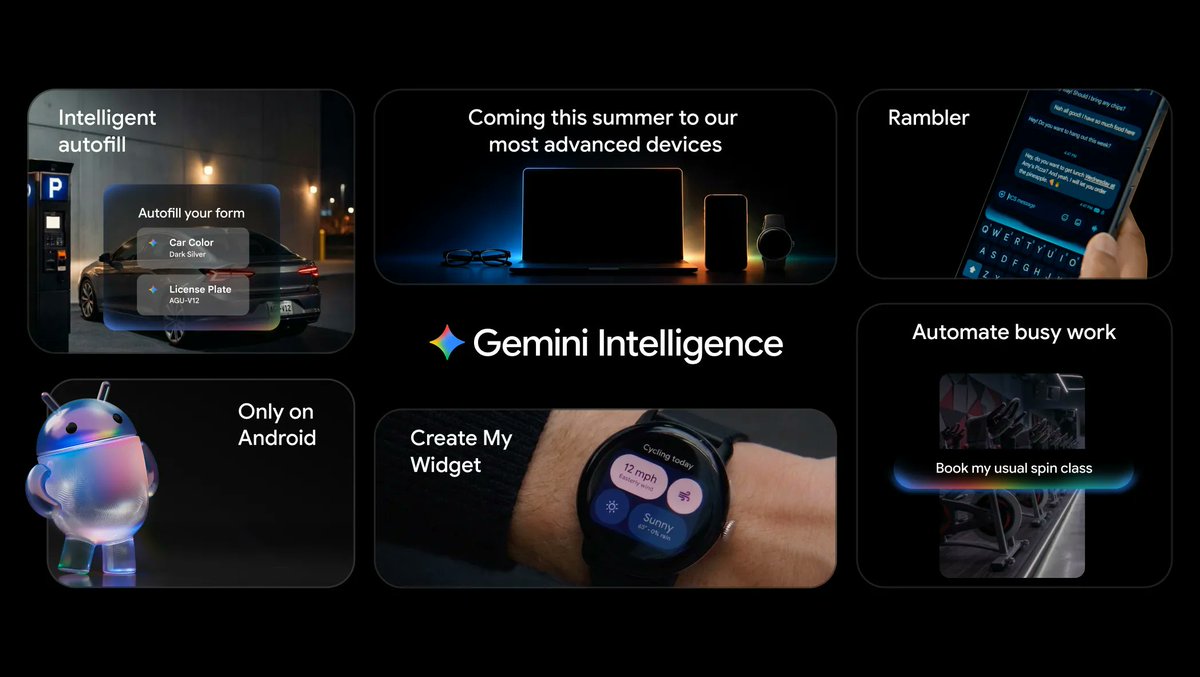
Today at the @Android Show (I/O edition) we announced Gemini Intelligence - bringing the best of Gemini to our most advanced devices.
Automate multi-step tasks across apps and Chrome, fill out forms in a single tap, turn spoken thoughts into polished text with Rambler, build custom widgets & loads more.
21 Generative AI Terms You Should Know-
1. Generative AI*
→ AI that creates original content like text, images, videos, music, and code.
2. Text Generation*
→ AI generating human-like written content from prompts or instructions.
3. Image Generation*
→ AI creating realistic or artistic images using text prompts.
4. Video Generation*
→ AI producing videos automatically from text, images, or scripts.
5. Code Generation*
→ AI generating programming code, functions, or software solutions.
6. Prompt*
→ Instructions given to generative AI systems to create outputs.
7. Prompt Engineering*
→ Crafting optimized prompts to improve AI-generated results.
8. LLM (Large Language Model)*
→ Large AI systems trained on huge text datasets to generate natural language responses.
9. Transformer Model*
→ The deep learning architecture powering most modern generative AI systems.
10. Token*
→ Small text units processed by AI during understanding and generation.
11. Fine-Tuning*
→ Training an existing AI model on specialized datasets for specific tasks.
12. Multimodal AI*
→ AI capable of generating and understanding multiple content types together.
13. Diffusion Model*
→ AI models commonly used for generating realistic images and videos.
14. Hallucination*
→ AI generating incorrect or fabricated information confidently.
15. Inference*
→ The process where trained AI models generate outputs for users.
16. Embeddings*
→ Numerical representations helping AI understand relationships between data and meaning.
17. Synthetic Data*
→ Artificially generated data created by AI for training or testing purposes.
18. AI Creativity*
→ AI combining learned patterns to generate new and unique outputs.
19. Content Personalization*
→ AI generating customized content based on user preferences or behavior.
20. Open Source Generative AI*
→ Publicly available generative AI models developers can modify and improve.
21. AI Copilot*
→ Generative AI assistants designed to help humans work faster and more efficiently.
Generative AI is transforming how people create, work, learn, and build businesses.
Latest Microsoft Copilot Updates May 2026
Copilot Cowork Mode
- Biggest 2026 update: plans & executes multi-step tasks in background, users delegate work & monitor checkpoints
Agent Mode Expansion*
- Copilot moves from chat assistant to action-taking AI agent running workflows across Microsoft 365
Copilot Notebook Grounding*
- Agents stay aligned with your references & working materials for better accuracy
Thinking Mode Selector*
- Toggle between reasoning modes like o3/o4-mini for complex tasks
Outlook Copilot Improvements*
- Anchored to the email you're viewing for higher accuracy
Security Copilot Upgrades*
- Agentic Secret Finder detects exposed credentials in emails, chats, documents & screenshots
Multi-agent Reasoning*
- Full integration with Microsoft Defender, Entra & Purview for security workflows
Copilot Dashboard Insights*
- New metrics for admins: satisfaction, intent & usage tracking across teams
Computer Use Capability*
- Automate web & desktop apps — General Availability May 2026
Complete Roadmap to Learn Generative AI
*1. Understand Basics of AI & Machine Learning*
Learn concepts like supervised/unsupervised learning, neural networks, and deep learning fundamentals.
*2. Study Generative Models*
Focus on models like GANs (Generative Adversarial Networks), VAEs (Variational Autoencoders), and autoregressive models.
*3. Learn Deep Learning Frameworks*
Get hands-on with TensorFlow or PyTorch for building and training models.
*4. Explore Natural Language Processing (NLP)*
Understand transformers, language models like GPT, BERT, and sequence-to-sequence models.
*5. Hands-On Projects*
Build projects like image generation, text generation, style transfer, and chatbot development.
*6. Work with Pretrained Models & APIs*
Use models like OpenAI’s GPT, DALL·E, Stable Diffusion to create generative applications.
*7. Learn Ethical AI & Bias*
Study the impact, challenges, and responsible use of generative AI technologies.
*8. Keep Updated with Research*
Follow latest papers, blogs, and tutorials to stay ahead in this rapidly evolving field.
🥰guy's... please, stay alive for the books you haven't read, the TV show you haven't finished, and the stray cats you haven't petted yet.
stay alive for the smell of rain, your morning coffee, the songs that will become ur new favorites, and the versions of urself you haven't met yet