Starting my build in public journey.
I’ve joined Project Shipyard Season 3 by AI Learn Circle, and for the next month, I’ll be building https://t.co/mXqGEGzGIK in public.
I'm building Mizual.ai- an AI assistant for visual content creation starting with ecommerce visuals. Instead of expecting people to master prompting to maintain context and consistency while juggle multiple tools, https://t.co/mXqGEGzGIK guides them through the entire creative workflow while maintaining context from idea to final visual.
Over the next month, I’m committing to:
→ Talk to users and understand their problems
→ Ship fast and iterate based on what I learn
→ Get 10+ active users
→ Get my first paying customer
I’ll share the journey openly here.
The things that work.
The things that don’t.
The bugs, pivots, and uncomfortable learnings.
Day 1 starts now.
A big thank you to @AILearnCircle for the opportunity, and to the partners supporting this cohort: @dodopayments , @AntlerGlobal , MonoCloud, @useflo101 , @maximem_ai & @finmo.
@buildinpublic
Very common way that people sabotage themselves without realising is by preoccupying themselves with worst case scenarios.
We often create these "irrational fears" as a safe distraction from confronting some deeper truth or life changes.
For example, you're anxious about being fired from job might really be the idea that you aren't worthy of another job or being humiliated by a higher-up.
HOW TO RESOLVE THIS
1. Catch the irrational scenario you are obsessing over and ask what it would mean if it came true.
2. Identify the uncomfortable truth or real life change you are actually avoiding.
3. Drop the defense mechanism and direct your energy toward taking one concrete action in the present.
Reference- The Mountain Is You
this is what happened during w2 of project shipyard s3 by @AILearnCircle
we had @Connect_Mani from @SarvamAI come in and talk about something every builder needs to hear:
"don’t just build. build with intent. build with good product sense. and yes talk to users a lot more often"
he spoke about product sense, how to think about what you’re building, what you should actually spend time on and what makes a product genuinely good.
Mani also shared some super interesting stories from his time at Sarvam + Sable Money. loved the whole session.
then Varun lash from Aspire took us into the GTM world
4 pillars, how to think about each one, what to experiment with and how he’s seen this play out through his journey at Zolve + Aspire.
big big thanks to @useflo101 , @avneer_bh for hosting us and being such a solid partner for shipyard s3 ❤️
we ended the 10-hour sprint with every builder sharing what they’ve done over the last 2 weeks.
also, @Abhidwivedimany casually ended the day with some beatboxing 😂
now the GTM arc begins.
HSR was fun.
Indiranagar, we’re coming.
super excited to see what these builders ship next.
to all the builders who are misfits but are creating awesome stuff @MohithSarmaKLK , @atypical_chai , @mahaulguy , @_vin_mehta_ , @AditiDewan12 , @joshibhai , @RahulRanjan_R, @notbhuvanesh, @ErKiranKumar_ , @renukarajpuria, @vishalphdk, @RaviVidharshana and many others
I spent hours interviewing 16+ D2C brand founders and marketers about their visual workflows.
A massive ideological war is happening right now in e-commerce:
AI Storytelling vs. Pure Authenticity.
Here is how three different players see it: 👇
The Agency Marketer: "We use AI for 80% of our ads, but we have strict guardrails. The rule is simple: AI works perfectly, provided people can't tell it's AI. The second they spot it, they lose interest."
Had a frustrating experience with @withpronto today.
I booked a cook and requested a non-veg dish. The cook who was assigned to me doesn’t cook non-vegetarian food.
She asked if I could cook the non-veg dish myself while she helped with the prep and cooked the other things.
Why isn’t there an option in the app to specify this preference?
And even if the product doesn’t support it yet, this could have easily been handled at the ops level with a quick call before assigning the cook.
The cook also mentioned that these kinds of mismatches have already been communicated to the team, but apparently nothing has been done.
Eventually, she called a friend who came and cooked for me. Things got delayed quite a bit, but that wasn’t a big issue for me.
What bothered me more was seeing the cook put in an uncomfortable situation where she had to reconsider her own cooking preferences, while also having the pressure of time and ratings.
This feels like a basic product + operations issue that should have been thought through, especially in India where dietary preferences can vary a lot.
@withpronto would request you to look into this and fix it.
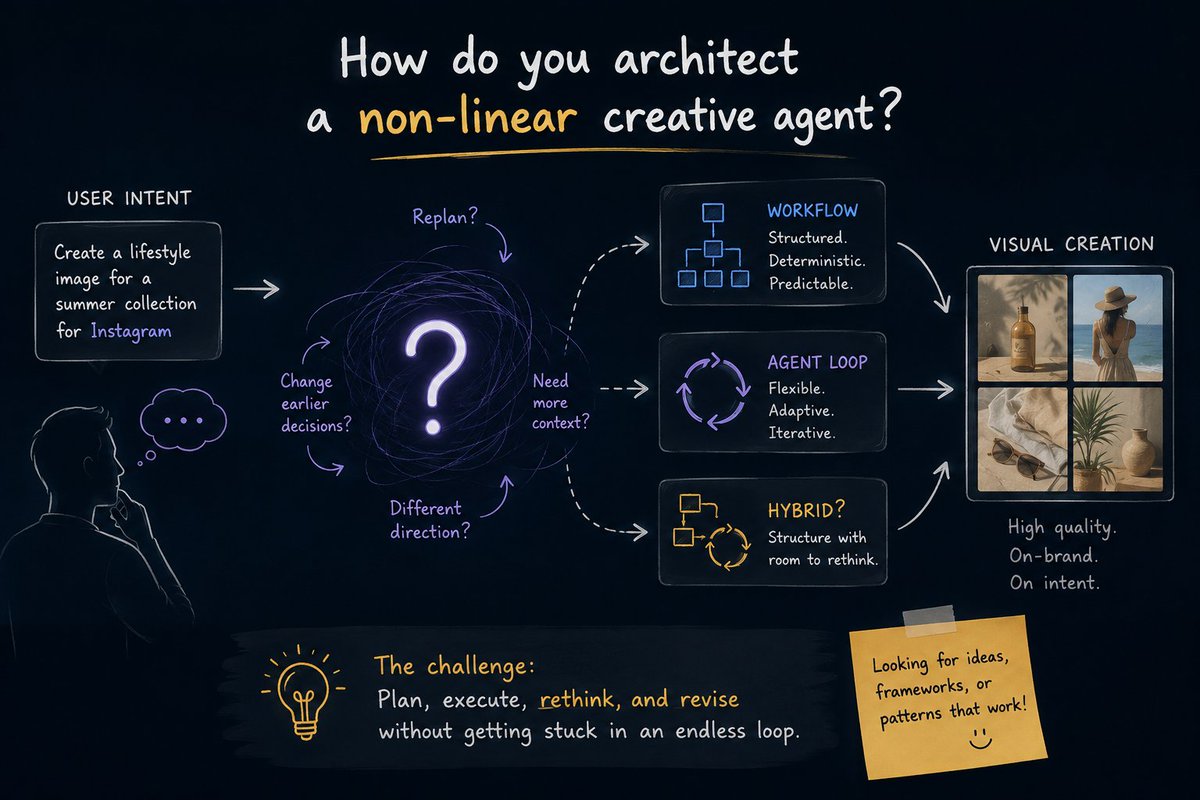
Stuck on agent architecture
I’m building an assistant for visual design creation where a task can be a single action or a multi-step process depending on the user’s intent.
The tricky part: visual creation is highly non-linear.
You might plan:
product → model → background → generate
…and then realize halfway through that the model, composition, or even the original direction needs to change.
So what’s the right architecture here?
Deterministic workflows?
A ReAct-style loop?
Something in between?
How would you architect an agent that can plan, execute, rethink, and revise without turning everything into an unpredictable loop?
Today was a reminder that customer discovery is not just about talking to users. Sometimes, it’s about waiting for users.
Found 20 ecommerce founders on LinkedIn.
Sent 5 personalized connection requests.
Had 2 discovery calls scheduled from last week.
0 showed up.
One forgot. One never replied.
The second one hurt a little.
I was exhausted, had a backache, but still prepared my questions, opened my notes and got ready for the call.
Then you wait.
5 minutes. Sent a reminder.
10 minutes. Sent a final message to reconnect later.
Nothing.
Completely understand that things come up and plans change.
But it still sucks when someone doesn’t take a minute to let you know they can’t make it, especially when you’ve set aside time for the conversation.
Customer discovery is also learning how to deal with this.
Anyway, tomorrow is another day.
Back to finding users.
“People share their failures first before success.”- @1997harkirat
“Nobody pays for a prototype.”- @Pulkit_Learn
Two things I took away from my first Shipyards S3 Opening day.
As builders, it’s easy to keep building because building feels like progress. But users pay in effort before they pay in money.
Time to spend less time building and more time validating.
@buildinpublic@AILearnCircle
Starting my build in public journey.
I’ve joined Project Shipyard Season 3 by AI Learn Circle, and for the next month, I’ll be building https://t.co/mXqGEGzGIK in public.
I'm building Mizual.ai- an AI assistant for visual content creation starting with ecommerce visuals. Instead of expecting people to master prompting to maintain context and consistency while juggle multiple tools, https://t.co/mXqGEGzGIK guides them through the entire creative workflow while maintaining context from idea to final visual.
Over the next month, I’m committing to:
→ Talk to users and understand their problems
→ Ship fast and iterate based on what I learn
→ Get 10+ active users
→ Get my first paying customer
I’ll share the journey openly here.
The things that work.
The things that don’t.
The bugs, pivots, and uncomfortable learnings.
Day 1 starts now.
A big thank you to @AILearnCircle for the opportunity, and to the partners supporting this cohort: @dodopayments , @AntlerGlobal , MonoCloud, @useflo101 , @maximem_ai & @finmo.
@buildinpublic