A fake participant can do more damage than no participant at all.Because unreliable responses don’t just leave gaps in your research.
At Echovane, every participant goes through 30+ checks across two layers of verification.
Model neutrality in the harness is becoming a huge requirement for production voice and multimodal apps too.
For our use case in long conversations with respondents we maintain a fine balance of the best model for low-latency multilingual turn-taking, the best model for long-context memory across a 90-minute session, and the best model for video/micro-expression synthesis. These models are rarely the same.
Infact the orchestration itself becomes an engineering challenge. Interestingly, the leading model keeps changing every quarter and varies so much with languages.
Value compounds in the orchestration and eval harness.
Synthetic panels are useful for one thing - killing low-effort Likert surveys that were already half-ruined by survey bots.
Where they hit a hard wall is novel behavior. An LLM trained on past distributions can predict how someone rates a familiar toothpaste concept.
It cannot tell you why someone keeps two different tubes by the sink, abandons a new formula after week one, or pauses for 3 seconds before saying they "love" it!!
Synthetic replaces bad quant AND actually makes fast, real multimodal human truth even more valuable, because you need ground truth to calibrate anything synthetic.
Your audience is 1 in 1,000. Sometimes rarer.
When the people you need aren’t on any panel, we trigger specialized fieldwork and find them.
Every one is screened and verified before the interview starts.
Incidence below 0.1% is a normal brief for us.
One of the coolest things I've ever seen!! Loved the thunderclap as the starship dropped out of the heavens, before the catch. True alien tech. Huge congrats @elonmusk and the @SpaceX team! the whole stack is now proven out. Ad Astra! 🚀
Web apps can have the best-looking UIs, but if they don’t have an MCP, they instantly feel outdated. Like, why does my agent need to click through 10 different screens? 😅
This Independence Day 🇮🇳, I asked, "What will the next century of young Indians look like?"
$0.01 Drone Deliveries. UAVs that never land. Groceries in under 10 minutes.
Meet The 22nd Century Indian. A Documentary on a New India.
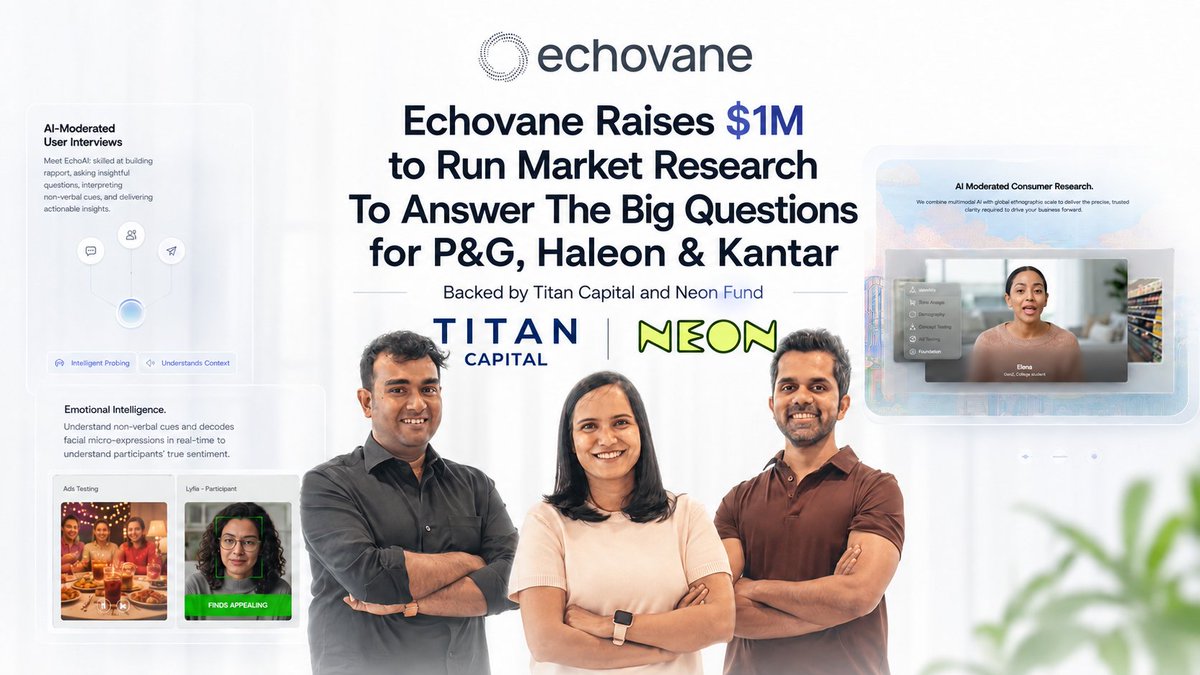
Echovane raises $1M co-led by Titan Capital and Neon Fund to run done-for-you AI market research for P&G, Haleon and Kantar, cutting studies from weeks to days.
#echovane#ai...Show more
We've raised $6.5M to kill vector databases.
Every system today retrieves context the same way: vector search that stores everything as flat embeddings and returns whatever "feels" closest.
Similar, sure. Relevant? Almost never.
Embeddings can’t tell a Q3 renewal clause from a Q1 termination notice if the language is close enough.
A friend of mine asked his AI about a contract last week, and it returned a detailed, perfectly crafted answer pulled from a completely different client’s file.
Once you’re dealing with 10M+ documents, these mix-ups happen all the time.
VectorDB accuracy goes to shit.
We built @hydra_db for exactly this.
HydraDB builds an ontology-first context graph over your data, maps relationships between entities, understands the 'why' behind documents, and tracks how information evolves over time.
So when you ask about 'Apple,' it knows you mean the company you're serving as a customer. Not the fruit.
Even when a vector DB's similarity score says 0.94.
More below ⬇️
A lot of having taste about something is just caring about it enough to be honest with yourself, so that you can get past "I like what I like" to "Is this actually good?"
The CTO of @emergentlabs is my batchmate from IIT BHU. The Managing Director for @AnthropicAI India @ighose is a senior from IIT BHU, and the head of Digital India Foundation Arvind Sir @buzzindelhi is also from IIT BHU.
Great to see IIT BHU already making powerful contributions to the AI landscape.
Drop 5/14: Introducing Bulbul V3, our latest text-to-speech model. It raises the bar for how human it sounds, while being super robust.
In an independent third-party human listening study, Bulbul V3 delivers the highest listener preference, and low error rates across use-cases and languages. See details in our blog, but first watch the video. https://t.co/HkijWrupi9
There’s an unspoken truth in design that almost no one wants to admit:
A huge part of the job is just making things look good. That’s it. That's the core.
But somewhere along the way, we became afraid to say that out loud. So we built an entire layer of performance around design (frameworks, titles, systems, etc).
When a client asks me, "Why did you do it this way?" my honest answer is usually, "Because it looks good." Because it feels right. Because it creates the experience I wanted.
But in today's design community, that answer would come across as irresponsible and unprofessional.
We're expected to be able to defend every pixel like they were the result of years of academic research, when in reality it was simply the result of taste.
But taste is too subjective, too illusive, too unmeasurable to package up so we wrap intuition in paragraphs of theory and call it a case study.
This is why I rarely talk about “design” as a discipline. The moment you try to intellectualize it, you lose the thing that actually matters.
Design isn’t complicated. People complicate it to defend their importance.