INSTEAD OF WATCHING NETFLIX TONIGHT.
Spend 1 hour with this.
Claude AI FULL COURSE that teaches you how to BUILD and AUTOMATE anything.
The people who watch this tonight will wake up tomorrow with a new skill.
Watch it and Bookmark it now.
Discover the latest #patentapplication from #OpenAI with #US20260154218A1: "TILED IN-MEMORY COMPUTING ARCHITECTURE".
This innovative compute tile integrates compute engines and a GP processor. Each engine features a compute-in-memory module for vector-matrix multiplication, storing matrix weights efficiently.
The GP processor manages engines, processes VMM outputs, and executes nonlinear operations. Data movement can bypass the GP processor, optimizing performance.
#InMemoryComputing #DataProcessing
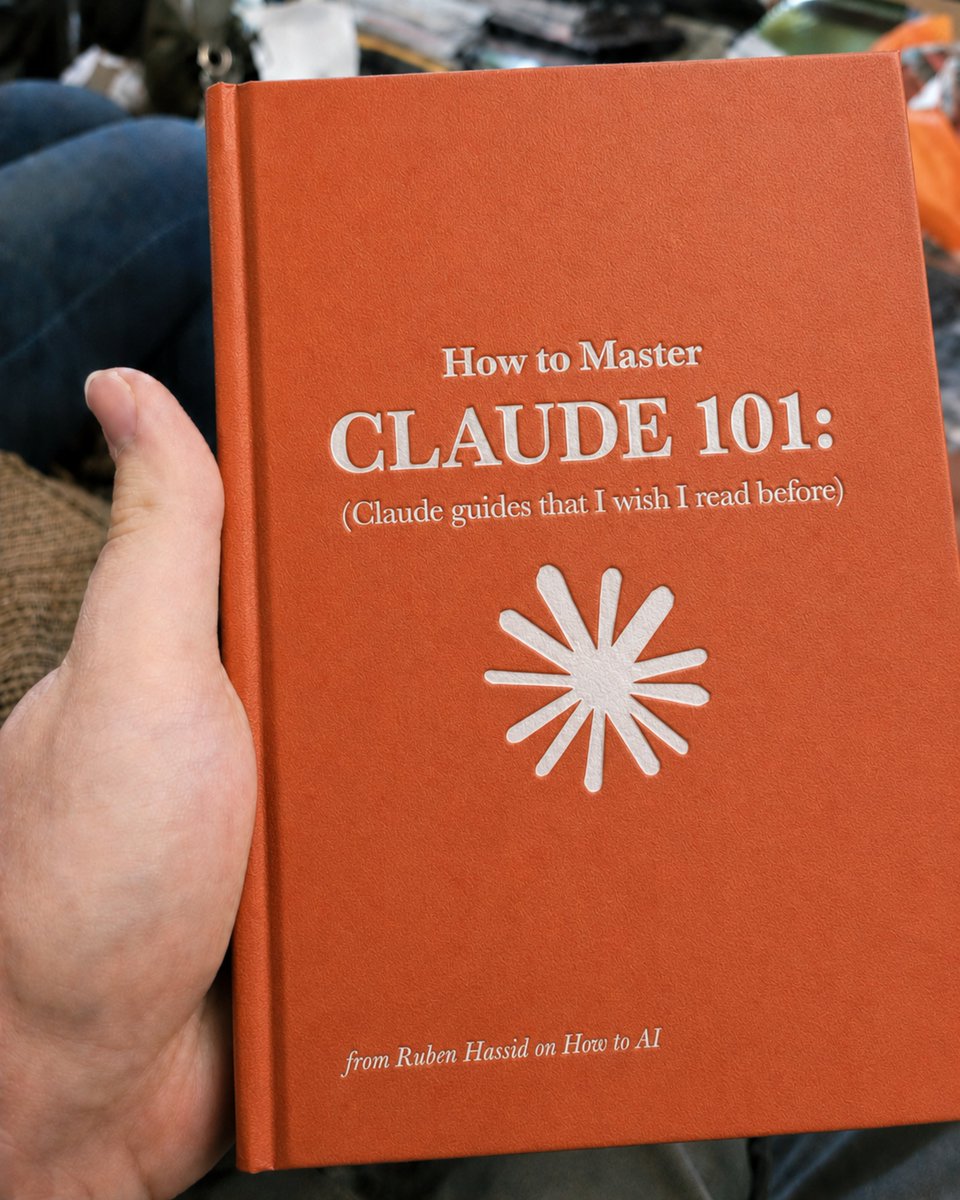
I spent 1000 hours figuring out Claude the hard way.
Here are guides I wish someone had sent me earlier:
Claude for Dummies: https://t.co/QQDmzBAoH5
Claude certificates: https://t.co/ClEur2iLI2
How to prompt Claude: https://t.co/Sw2tg2PMMc
Claude Cowork: https://t.co/uWTpOI3oyE
Claude for teams: https://t.co/qxlcqheAme
Cowork + Projects: https://t.co/xU97EpdrEe
Claude for slides: https://t.co/L0bPMgWEsy
Claude Skills: https://t.co/6cHYYfjpP2
Claude connectors: https://t.co/cSPMBUNmRG
Stop hitting Claude's limits: https://t.co/Yu24rPQafQ
Upload yourself in Claude: https://t.co/LyV7fegv4c
Stop prompting Claude: https://t.co/45xPLDRB6Y
Claude Code: https://t.co/UgE9xBXnm6
___
1. Save this list for later (three dots, top right).
2. Share it with a friend by ♻️ reposting this image.
3. Subscribe to my free newsletter: https://t.co/psB7XxAv8w.
Claude Code creator:
"I don't prompt Claude anymore. I write loops - and the loops do the work. My job is to write loops."
in 30 minutes Boris reveals his actual daily Claude Code setup.
Claude Code + loops + dynamic workflow
Worth more than a $500 vibe-coding course
800G is now the working assumption for AI infrastructure builds. The real question is how to time the move to 1.6T. AOI's Simon Ximen on supply chain risk, OSFP form factor consolidation, and why optical qualification needs to run parallel to GPU procurement, not after it.
https://t.co/lGgrB56j52 $AAOI
The market read CPO as the death of the pluggable transceiver. NVIDIA did the opposite, investing $2B each into Coherent and Lumentum, the suppliers it was supposed to cannibalize, and both sit on the Spectrum-X Ethernet Photonics supply chain that went into production on May 31 at Taiwan GTC. CPO does not remove the transceiver, it unbundles the economics that sat inside one module into laser, fiber, and packaging.
- The 11 disclosed suppliers split into four value layers
- How transceiver cannibalization and ELS laser content offset inside one company, and the two variables that set the net
- The single spot that, if it falls out, stops the line, and why that is different from stock alpha
The most expensive word in AI infrastructure is still “bottleneck.”
First it was GPUs, then HBM, then optics. This piece looks at the point where memory and optics meet:
MicroLED optical interconnects. The striking part is that Samsung Electronics, SK hynix, and Micron have all invested in the same startup, Avicena.
Avicena’s LightBundle uses MicroLED arrays instead of lasers, built around a “wide and slow” optical architecture.
The idea is not to push one channel faster, but to move data through hundreds of low-speed parallel optical lanes with lower power and latency.
The reason memory makers care is that this could become one of the structural candidates for future memory fabric, especially as HBM bandwidth keeps scaling.
If you still think of MicroLED only as a display technology, this article is a good reason to look again.
Law professors wrote questions they were asked during office hours. Gemini 2.5 & humans answered them then other law professors blindly judged the results:
-Gemini had a 75% win rate vs. professors
-Gemini's answers were rated LESS harmful than humans
-Newer models do even better
In a new Stanford study, law professors by far preferred Gemini 2.5 Pro's responses over those written by their peers when they were unaware of who wrote the answers.
$TE shows how heat, vacuum pressure and precision engineering turn glass, EVA and solar cells into a fully sealed solar module.
This lamination step protects the cells, improves durability and supports the bigger push to become a leader in American solar manufacturing.
$CRDO earnings just signaled a major problem for $AAOI?
On AECs: Credo said active electrical cables are now “the preferred solution for rack connectivity and for many multi-rack deployments up to 7 meters.”
1000x greater reliability than commodity laser-based optical modules. At lower power.
That is $AAOI’s core market.
Then the ALC bombshell. Active LED Cables. Optical reach up to 30m using micro-LED instead of traditional lasers. AEC-class reliability with optical range. Management said ALCs could ramp with “very much similar” dynamics to AEC and ZeroFlap.
Meaning fast. And big.
That is the rest of $AAOI’s market.
Credo also said hyperscalers are no longer optimizing for lowest module cost. The priority is now “reliability, power efficiency, signal integrity and telemetry.”
ZeroFlap optics carry 3-digit ASPs vs 2-digit for commodity components. “Meaningful improvement in network reliability, time to cluster stability, and long term uptime.”
Hyperscalers are telling you they will pay more for better.
That is the opposite of what commodity transceiver suppliers need to hear.
$AAOI’s exposure is concentrated in exactly the undifferentiated short-reach laser modules that:
AEC displaces under 7m
ALC targets out to 30m
As buying criteria shift from unit cost to uptime and power, the addressable market for commodity optics at short distances is shrinking.
$CRDO is not just growing. It is eating the market that $AAOI needs to survive.
Bro caught his girl cheating on him and smacked her phone out her hand because she was being defensive but instead she took a hit at him which resulted in her getting whopped real hard.
We gotta give it to her for taking those hits and still stood...