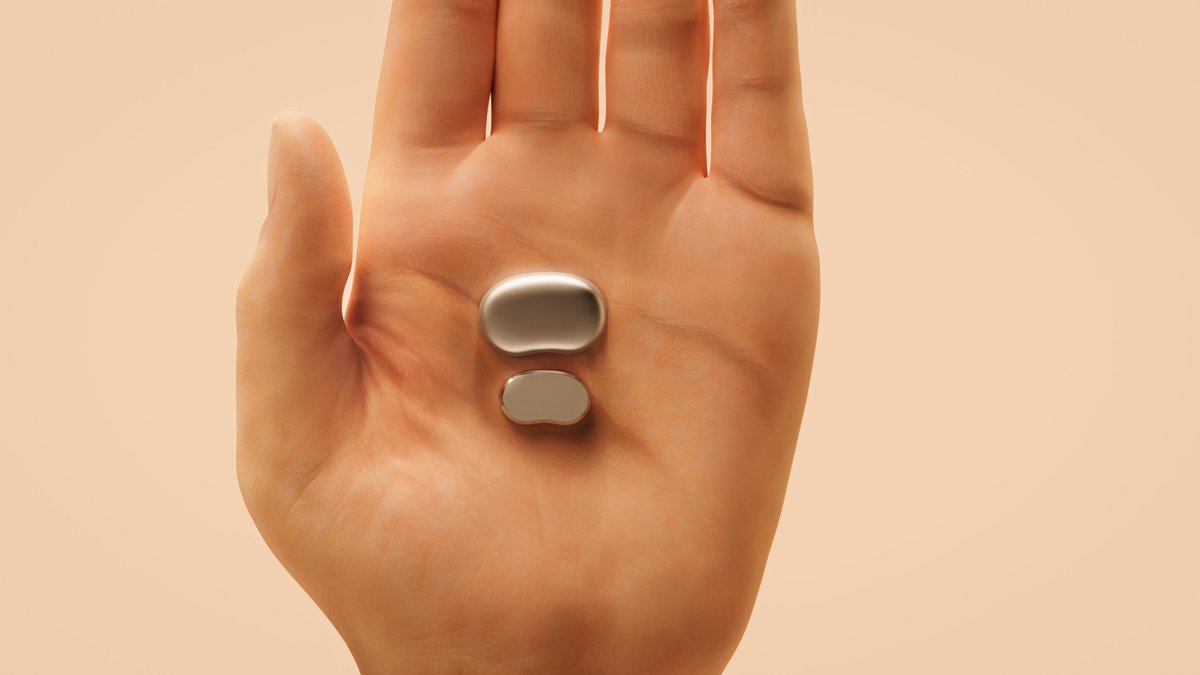
Temple is now less than half the size of what you've seen so far.
Volumetrically, Temple is now the smallest wearable on the market, and the most^10 powerful. Living and training with Temple is going to change your life.
We will start taking pre-orders for our limited launch edition @temple very soon - shipping before the end of 2026. Join our mailing list on https://t.co/XxGR9Hpq58 to stay up to date.
I am hiring senior engineers for my Live Streaming team. Please apply directly and retweet so that good candidates can discover this opportunity.
https://t.co/PQolZvv2Cb
Last one on this topic, and I have been holding this in myself for a while.
For centuries, class divides kept the labor of the poor invisible to the rich. Factory workers toiled behind walls, farmers in distant fields, domestic help in backrooms. The wealthy consumed the fruits of that labor without ever seeing the faces or the fatigue behind it. No direct encounter, no personal guilt.
The gig economy shattered that invisibility, at unprecedented scale.
Suddenly, the poor aren't hidden away. They're at your doorstep: the delivery partner handing over your ₹1000+ biryani, late-night groceries, or quick-commerce essentials. You see them in the rain, heat, traffic, often on borrowed bikes, working 8–10 hours for earnings that give them sustenance. You see their exhaustion, their polite smile masking frustration with life in general.
This is the first time in history at this scale that the working class and consuming class interact face-to-face, transaction after transaction. And that discomfort with our own selves is why we are uncomfortable about the gig economy. We want these people to look our part, so that the guilt we feel while taking orders from them feels less.
We aren't just debating economics. We are confronting guilt. That ₹800 order might equal their entire day's earnings after fuel, bike rent, and app cuts. We tip awkwardly, or avoid eye contact, because the inequality is no longer abstract. It's personal.
Pre-gig era, the rich could enjoy luxury without moral discomfort. Labor was out of sight. Now, every doorbell ring is a reminder of systemic inequality. That's why debates explode. It's not just policy. It's emotional reckoning. Some defend the system (“they choose it”), others demand change (“this isn't progress, its exploitation”).
And here’s the uncomfortable twist: the unsaid ask of clumsy ‘solutions’ isn’t dignity. It is about returning to invisibility.
Ban gig work and you don’t solve inequality. You remove livelihoods. These jobs don’t magically reappear as formal, protected employment the next day. They disappear, or they get pushed back into the informal economy where there are even fewer protections and even less accountability. Over-regulate it until the model breaks, and you achieve the same outcome through paperwork instead of slogans: the work evaporates, prices rise, demand collapses, and the people we claim to protect are the first to lose income.
And then what happens?
The rich get their old comfort back. Convenience returns without faces. Guilt dissolves. We go back to clean abstractions and moral posturing from a distance. The poor don’t become safer, they become invisible again: back in cash economies, back in backrooms, back in shadows where regulation rarely reaches and dignity isn’t even debated.
The gig economy just exposed the reality of inequality to the people who previously had the luxury of not seeing it. The doorbell is not the problem. The question is what we do after opening the door.
Visibility is the price of progress. We can either use this discomfort to build something better (which we keep doing continuously as delivery partners are our backbone), or we can ban and over-regulate our way back into ignorance. One of those choices improves lives. The other simply helps the consuming class feel virtuous in the dark.
One more thing. Our 10 minute delivery promise is enabled by the density of stores around your homes. It’s not enabled by asking delivery partners to drive fast. Delivery partners don’t even have a timer on their app to indicate what was the original time promised to the customer.
After you place your order on Blinkit, it is picked and packed within 2.5 minutes. And then the rider drives an average of under 2kms in about 8 minutes. That's an average of 15kmph.
I understand why everybody thinks why 10 minutes must be risking lives, because it is indeed hard to imagine the sheer complexity of the system design which enables quick deliveries.
Also, if you've ever wanted to know why millions of Indians voluntarily take up platform work and sometimes even prefer it to regular jobs, JUST ASK any rider partner when you get your next food or grocery order.
You will be humbled by how rational and honest they will be with you.
Having said that, no system is perfect, and we are all for making it better than today. However, it is far from what it is being portrayed on social media by people who don't understand how our system works and why.
If I were outside the system, I would also believe that gig workers are being exploited, but that's not true.
We are hiring for 2 Machine Learning Engineers in Bangalore office.
you'll work directly with me on super impactful projects
Drop your best work in the comments👇 and I will personally reach out to you if you are a fit.
Please Don't DM!
@vijayshekhar I don’t think it relates to work from home. Systems generally come with security (ZScaler VPN, disk encryption etc). The company in this case might not have it.
Why the hell does the @airtelindia and @TRAI want me to listen the broadcast message every time when I’m making an urgent call. Isn’t it enough once in a day?
Hindustan Unilever Limited (HUL), India’s largest FMCG company, is introducing a new approach to deliver its products directly to retail outlets - the direct-to-Kirana model, which could replace the traditional distribution system.
Just came across this post by Dheeraj Gupta on LinkedIn, and I couldn't resist sharing it here!
This post may change your rest of the life: 🔖
Where to Stop is Satisfaction.
I really enjoy "Kaun Banega Crorepati," a show that blends intelligence and entertainment. It adds to my knowledge, and I feel very happy whenever my answers are correct.
In a recent episode, Neeraj Saxena was the fastest to answer in the "Fastest Finger" round and took the hot seat.
#KaunBanegaCrorepati @SrBachchan
Just because you worked hard once in your life, doesn’t mean it will be enough for all the new things to come.
Consistency is more important than the one intensity.
What you’ve gained in past, can be easily lost in future, especially if you don’t put in the effort to keep it.
If Goldman Sachs, DE Shaw or Atlan, don’t visit your college for placements, They are hiring Off-Campus for Intern roles 💯
.
.
.
- Goldman Sachs
Program: Engineering Campus Hiring Program
Hire: Intern and Chance of Full-time
Stipend/CTC: 1 lakh /26 lakhs
- DE Shaw
Program: Ascend Educare Program
Hire: Intern and Chance of Full-time
- Atlan
Program: Engineering Fellowship Program
Hire: Intern and Chance of Full-time
Get the complete details about each program, eligibility, previous year questions and prep sheet.
Goldman Sachs: https://t.co/6RsgOJZEGF
Atlan: https://t.co/M0ACarJwdG
DE Shaw: https://t.co/UlkgtW5Tsv
Repost it for good karma! ❤️