Profile | At 24, R. Vaishali has carved her place in history, winning the Women’s Candidates in Cyprus to become the first Indian woman to do so, and earning a shot at world champion Ju Wenjun.
✍️ P.K. Ajith Kumar
https://t.co/m1ReVksfRN
India's Economy Is Smaller Than You Think
- India slipped from the 5th to the 6th largest. Everyone blamed the dollar.
- The dollar fell 10% in 2025. Its steepest first-half decline since 1973.
- So if the dollar crashed, why did the rupee crash harder?
A March 2026 PIIE paper by Arvind Subramanian (former Chief Economic Adviser to the government) estimates India's real GDP has been overstated by 22% since 2011.
If that's even half right, India was never the 5th largest economy to begin with.
1/13
When a computer tracks the Indian classical dancer in this video, it picks up perfect circles, triangles, and curves in every movement. There are exactly 108 of them. All 108 were written into a manual over 2,000 years ago.
That manual is the Natya Shastra. Six thousand verses, written somewhere around 200 BCE. It describes 108 specific dance movements for Bharatanatyam, one of the oldest dance forms in India. Each movement spells out three things: where your hands go, what angle your body holds, and the exact path your legs trace. Roughly 150 step combinations grow out of those 108 base movements. A trained dancer spends years learning 70 to 80 of them.
Watch the dancer's legs in the video. The bent-knee squat creates a diamond shape. Palms together make a triangle. When researchers plotted these positions in three dimensions this year, they found the moving body carves out twisted spirals and bowl-shaped curves, the kind of shapes you see in an engineering textbook, not a dance studio. Every limb holds a specific angle and moves a measured distance.
The rhythm is math too. A 7-beat song gets filled with dance steps of 3 and 4. Scale that to 35 beats and the groups of 3 and 4 repeat five times. Choreographers work out these splits in their heads while performing live. All 108 movements are also carved into the stone walls of a 12th-century temple in Tamil Nadu called Chidambaram, many panels still carrying the original Sanskrit description next to them. A choreography textbook in granite, still legible after 900 years.
A 2013 study put 25 people on a walkway rigged with motion-capture cameras. Every human stride has two parts: when your foot is on the ground and when it swings forward. The ratio between those two parts came out to 1.620. The golden ratio is 1.618. Your foot lifts off at 61.8% of every step you take, and it has done this your entire life. A Bharatanatyam dancer takes that same built-in proportion and amplifies it across 108 movements, each one tracing shapes that were set down in writing over 2,000 years before the tracking software in this video existed.
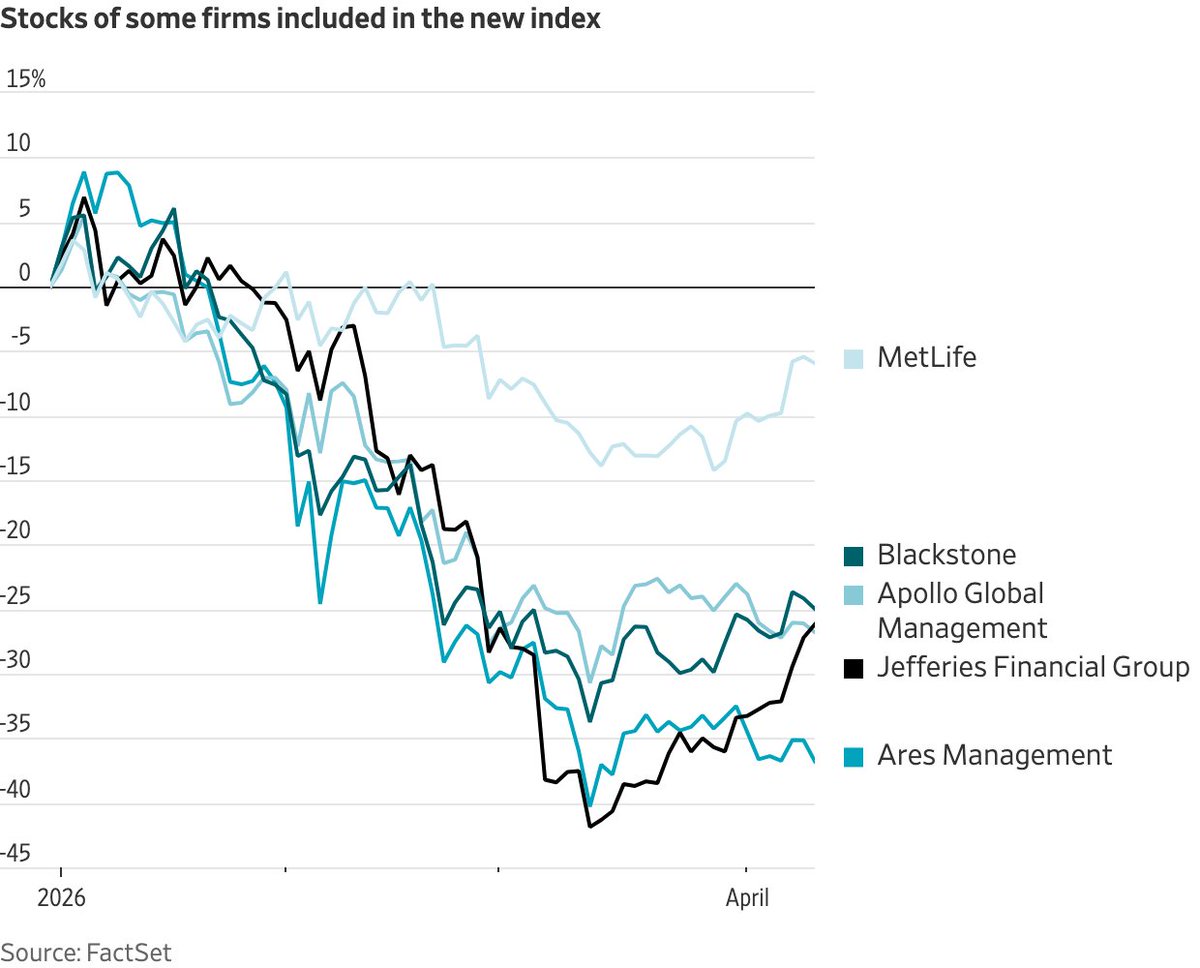
Wall Street just built a weapon to destroy itself, and the names on the target list should terrify you.
JPMorgan, Goldman Sachs, Bank of America and Barclays assembled a new index last week, one that rises in value the closer these firms get to collapse. They called it CDX Financials and they're selling it to hedge funds right now. The firms listed inside it are some of the biggest names in American finance, Blackstone, Apollo, Ares Management, MetLife, and Jefferies Financial Group. Their stocks have been in freefall since January down anywhere from 27 to 43 percent in just a few months.
This isn't a stock market correction but rather a unwinding of a $3 trillion shadow banking system that replaced your local bank after the 2008 financial crisis. Private credit, loans made not by banks, but by these giant investment firms became the lifeblood of thousands of American companies. It was the hottest trade on Wall Street for five straight years, minting billionaires and generating returns that made traditional finance look boring. Then the losses started showing up.
The trigger wasn't a single bank run or a housing crash but rather AI. These firms had lent hundreds of billions of dollars to software companies, and then AI started making those software companies obsolete almost overnight. Suddenly, the loans couldn't be repaid. Suddenly, the investors who had poured money into these private credit funds wanted their money back, all at once. Apollo approved only 45 cents on the dollar for investors trying to get out. Ares, Blackstone, and Blue Owl quietly capped withdrawals too. In the first quarter of 2026 alone, investors demanded $20.8 billion back, and the funds couldn't give it to them.
Now the same banks that helped build this machine are selling the tools to tear it down. When JPMorgan and Goldman Sachs create a product specifically designed to profit from these firms failing, that is not a hedge. The people who understand the plumbing of this system best have decided it is safer to bet against it than to stand inside it. The last time Wall Street built instruments like this around a collapsing asset class, it was 2007, and the product was called a credit default swap on mortgage bonds.
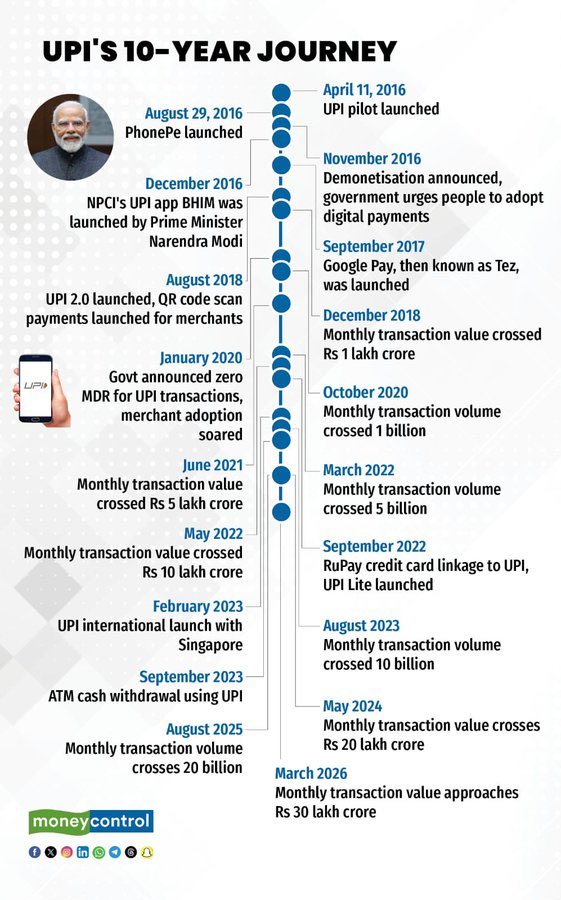
Every time we've considered building a UPI app at @zerodha the conversation always ends at the same place: @NPCI_BHIM already exists.
We could never figure what we could do differently. It's kinda surprising that 10 years after UPI, the BHIM app just as 1% market share. I think it should be much higher. If you haven't tried it, you should, it's quite slick.
🚨RESEARCHERS JUST MATHEMATICALLY PROVED THAT AI LAYOFFS WILL DESTROY THE ECONOMY.. AND EVERY CEO ALREADY KNOWS IT.. BUT NONE OF THEM CAN STOP..
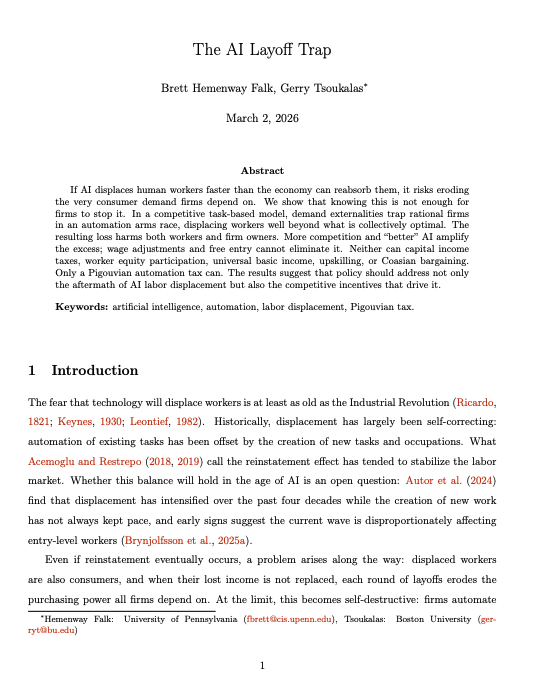
Two researchers from UPenn and Boston University just published a paper called "The AI Layoff Trap"..
They proved something terrifying..
Every company replacing workers with AI is also firing its own customers.. Every laid-off employee is someone who used to spend money.. When enough people lose their jobs.. Nobody can afford to buy anything.. And the companies that fired everyone go bankrupt selling products to an economy with no purchasing power..
Every CEO can see this coming.. The math is obvious.. Fire workers.. Lose customers.. Lose revenue.. Collapse..
But here's the trap..
No company can afford to stop..
If you don't automate.. Your competitor will.. They cut costs.. Undercut your prices.. Steal your market share.. And you die anyway..
So every company automates.. Knowing it's collectively suicidal.. Because the alternative is dying alone while everyone else survives..
It's a Prisoner's Dilemma.. And the researchers proved it mathematically..
The numbers are already stacking up..
Block cut nearly half its 10,000 employees this year.. CEO Jack Dorsey said AI made those roles unnecessary and that "within the next year, the majority of companies will reach the same conclusion"..
Salesforce replaced 4,000 customer support agents with AI..
Goldman Sachs deployed an AI coder that lets one senior engineer do the work of a five-person team..
Over 100,000 tech workers were laid off in 2025 alone.. AI was cited as the primary driver in more than half the cases..
80% of US workers hold jobs with tasks susceptible to AI automation..
And here's what should scare policymakers..
The researchers tested every proposed solution..
Universal Basic Income.. Doesn't fix it.. It raises living standards but doesn't change a single company's incentive to automate..
Capital income taxes.. Don't fix it.. They change profit levels but not the per-task decision to replace a human..
Worker equity and profit sharing.. Narrows the gap but can't close it..
Collective bargaining.. Can't fix it.. Because automating is a dominant strategy.. No voluntary agreement between companies is self-enforcing..
Only one thing works.. A Pigouvian automation tax.. A per-task charge that forces every company to pay for the demand it destroys when it fires a worker..
The researchers call it a "Red Queen effect".. Better AI doesn't solve the problem.. It makes it worse.. Because every company sees a bigger market share gain from automating faster than rivals.. But at the end.. Everyone automates equally.. The gains cancel out.. And the only thing left is more destroyed demand..
The paper's conclusion is devastating..
This isn't a transfer from workers to company owners.. Both sides lose.. Workers lose their income.. Companies lose their customers.. It's a deadweight loss that harms everyone..
And no market force can break the cycle..
The AI layoff trap isn't a prediction.. It's already happening.. And the math says it won't stop on its own.
the scariest part of this Anthropic story is what it implies about the timeline and I think most people are completely missing it
Anthropic built a model called Claude Mythos that found thousands of zeroo day vulnerabilities across every major operating system & every major web browser entirely on its own without huuman steering
it it found a 27 yo vulnerability in openBSD which is considered one of the most security hardened OS on earth, a 16 yo vulnerability in FFmpeg in a line of code that automated testing tools had hit 5 million times without catching it & it autonomously chained multiple linux kernel vulnerabilities together to escalate from regular user to full system control, this is the kind of work that used to require elite nation-state level hackers working for months
and here’s what should keep you up tonight
Anthropic is so terrified of what this model can do offensively that they made 3 unprecedented decisions simultaneously, they decided to never release it publicly, they contacted the US gov before publishing anything & they formed a coalition called project glasswing with apple/Google/ microsoft/amazon NVIDIA & 40+ other companies to use Mythos exclusively for defense, when the company that built the model is too scared to let it out of the lab that tells you everything about what we’ve crossedd…
but I think the real story that absolutely nobody is discussing is the second order implication, if anthropic built this then google deepmind can build it, if Google can build it China can build it, if China can build it , every state actor on earth will eventually build it, anthropic chose responsible disclosure but that choice is a luxury of being first
the next team that reaches this capability level might not make the same choice and once a model like this leaks or gets independently replicated every piece of software on earth becomes a potential attack surface
and connect this to the Google quantum paper from last week, quantum computers that can crack BTC in 9 min AND AI models that can find zero days in every operating system autonomously, both arrived in the same month, we’re watching the entire security infrastructure of human civilization get challenged from 2 completely different directions simultaneously
I genuinely think we just entered a new era where the offense-defense balance in cybersecurity has permanently shifted, the window between a vulnerability existing & being discovered just went from years to minutes and the only thing standing between the current internet and total chaos is that the people who built this capability happened to be responsible about it, that is an incredibly thin line to bet civilization on
one last thing that I keep thinking about… mythos scored 93.9% on SWE-bench verified & 77.8% on SWE-bench pro, it outperforms every model ever built at coding and reasoning by a massive margin
anthropic built built the most powerful AI model on earth and chose to lock it in a cage because its offensive capabilities are too dangerous…
Mzrc Andreessen declared AGI is here 3 days ago to pump his portfolio, meanwhile the people actually building the most advanced systems are too afraid to release them, that contrast tells you everything about who understands what’s happening and who is performing for an audience
AI in robotics gets all the attention right now, but sometimes the most interesting work is very practical.
Viet built a small vision system that counts potatoes on a conveyor belt. No giant dataset. No huge model. Just a clear problem and a smart setup.
He used Ultralytics’ ObjectCounter, trained a tiny YOLO11 nano model, and because there was no potato dataset, he annotated a single frame with SAM 2 and trained from that. One frame. Still works across the whole video.
It is a good reminder that useful AI in industry often looks like this.
Focused. Lightweight. Solves a real task.
If you work in manufacturing or robotics, these small systems are usually the fastest wins. They save time, reduce errors, and do not need massive infrastructure.
Nice work, Viet.
His projects:
https://t.co/1TSrwcKGCW
—-
Weekly robotics and AI insights.
Subscribe free: https://t.co/dsa6wcvq6n
IT TAKES A LOT TO BE REVATHI…!!!
While the whole country is celebrating the landmark judgement of death penalty for the NINE policemen in the Santhanakulam custodial torture and murder of Jeyaraj and Bennix, you should know about Revathi.
Revathi was a constable in Santhanakulam police station in 2020 when the gruesome incident took place. She was the key witness and the sole reason for all the arrogant officers getting punished today.
The police men involved in the brutality were all big men, Revathi was a small time constable. But she stood unperturbed.
When Magistrate Bharathidasan, who initially investigated this case, arrived at the Santhanakulam police station he had no clue that constable Revathi will help close the case.
"Sir, I will tell you everything, every detail, the truth that is being hidden. But I am the mother of two young girls... can you guarantee the safety of my children and my job?", she had asked the magistrate.
Revathi was on night duty when the cruel incident took place. She witnessed the brutality being inflicted on Jeyaraj and Bennix and narrated every single detail.
She told how SI Balakrishnan, inspector Sridhar and SI Ragukanes, kept beating the father and son with whatever they found, and how they also stomped on their private parts with their shoes.
She remembered their screams. She saw how the officers took pause only to sip alcohol while the victims withered in pain.
When the father and son were semi-conscious, unable to bear it, Revathi asked Jayaraj if he needed anything. She gave him coffee which the officials spilt it immediately.
Revathi couldn’t stand the brutality but being a woman constable there was only so much she could do. She then offered water to the victims.
The so called policemen then stripped Bennix naked, tied his hands and legs separately, and beat him up. They did the same to Jeyaraj. Revathi couldn’t bear the pain of their screams, she left the place.
According to the postmortem report, their entire back was skinned, iron rods were inserted and they bled from their rectums.
When the case was being discussed by the media, when even the CM of Tamil Nadu tried to brush it away, Revathi knew the truth.
The police officials, cleaned up the station of any DNA evidences, erased the CCTV footage and warned everyone to shut-up and not try to become heroes.
But Revathi didn’t just narrate the entire ordeal in exact detail…she even helped the investigating officials obtain other crucial information.
Despite everything being cleaned, Revathi gathered DNA of the victims in crevices of the walls and floors, on furniture and other objects.
She was questioned, threatened, intimidated, bribed and even abused. She stood by justice. She had to go against her colleagues for justice of comman man.
In the time when police force is often looked upon with reasonable suspicion, there are people in uniform like Revathi.
Today court could pronounce death sentence to nine police officers - only because one woman decided she will stand by truth!
Kudos to Revathi, an amazing woman and an absolutely fabulous police officer.
The world is a better place because of her courage.
Salute ma’am 🙏🏽🙏🏽🙏🏽
Today a court in Madurai sentenced all 9 police officers to death.
Their crime was murder.
Their victims were Jayaraj and Bennix.
A father and son who kept their mobile shop open 45 minutes past curfew in June 2020.
They were beaten for 7 hours through the night.
Forced to wipe their own blood off the floor with their clothes.
Jayaraj had 17 injuries. Bennix had 13.
Both died within 3 days.
The judge called it rarest of rare.
Today India told every police officer in this country.
Nobody is above the law.
Not even the law itself.
Selvarani waited 2192 days for this moment so as we.
A doctor from Nagpur told me something about how she is implementing AI in her clinic that amazed me.
She runs a small clinic. 15 years of practice. 40 patients a day. Her biggest problem was never diagnosis. It was follow-up. Patients would come in, get a prescription, and disappear. Half would not complete their medication. Some would not come back for follow-up. A few would show up months later with the same problem, worse.
She tried everything. Reminder calls. SMS. A register. Nothing worked. Her assistant forgot. Patients ignored SMS. The register got outdated by Thursday.
Then she figured something out.
Her patients would not read text messages. But they would listen to a WhatsApp voice note in Marathi. Something about hearing a voice felt personal in a way text did not.
She also knew that in many homes the husband controls the wife's phone. So the message had to make sense if someone else opened it. Each patient chose their own follow-up phrase during the first visit.
And she knew compliance collapses between day 4 and day 7. Not later. The intervention has to hit on day 4. By day 7 it is too late.
She built this using Claude. No code. No developer. WhatsApp voice notes in Marathi on day 4, day 6, and day 10. Personalized. Follow-up compliance went from 40% to over 75%.
No engineer could have built this.
Not because it is technically hard. Any developer could build it in a weekend. Because no engineer would have known to build it this way.
Voice note instead of text. Marathi instead of Hindi. Husband controlling the phone. Custom phrase at first visit. Day 4 intervention window. Every design decision came from 15 years of watching patients in Vidarbha not come back.
That is domain knowledge. It does not exist in any dataset or AI course.
India produces 1.5 million engineers a year. Huge numbers learning AI. "AI/ML enthusiast." "Prompt engineering certified."
A lot of people know how AI works but have no idea how any industry actually works.
The engineer builds for the problem they imagine. The domain expert builds for the problem that exists.
I have seen this in legal. Engineers built beautiful AI tools for lawyers.
Technically impressive. Lawyers do not use them. Because a lawyer's real problem is tracking 150 hearing dates across 4 courts while managing a clerk absent half the time.
A CA who filed 500 GST returns knows where errors happen. A teacher who taught 10,000 students knows the problem is not content but attention. No engineer in HSR Layout designs for a student with a shared phone studying between 9 and 11 pm.
India has an advantage nobody talks about. Millions of English-speaking domain experts carrying decades of ground-level knowledge. Globally rare. And almost nobody is training them to use AI.
India does not have an AI talent shortage. It has domain experts who think they are not "technical enough."
They are wrong.
India's courts produce more data than most SaaS companies.
It's public and Free. Still, nobody is using it.
Every district court publishes cause lists daily. Every High Court puts orders online. Case status, hearing dates, adjournments, judge assignments. All public. All free. eCourts alone has data on over 20 crore cases.
And what are funded legal tech startups doing? Building contract review tools for the 200 large firms that already have budgets. Classic.
Meanwhile the most valuable dataset in Indian legal is sitting on government servers. Updated daily. Ignored completely.
Every judge has patterns. I have seen judges in Saket who dispose of cheque bounce matters in 4 hearings flat. And judges two courtrooms away who take 14 for the same case type. Some adjourn freely on first ask. Some will chew you out for wasting court time.
When a lawyer faces an unfamiliar judge, they call a senior. Ask the clerk. Walk in and hope for the best.
But that judge's last 500 orders are on eCourts. How many NI Act cases did he dispose of last year? Average time to disposal? Does he grant interim relief without hearing the other side? All answerable. Nobody is answering.
A client asks: how long will my case take? Every lawyer makes something up.
Not because they are dishonest. Because they genuinely do not know.
But 5 years of data from that court, that case type, under that judge, gives you a real answer. "14-18 months. Under Judge Sharma, closer to 12."
Now here is the part that changes everything.
You do not need a SaaS company to build this anymore. You do not need funding or a tech team.
A single lawyer with a laptop can scrape a judge's last 200 orders, feed them into an AI, and build a personality model of that judge. How does he reason?
What arguments does he find persuasive? What makes him dismiss an application on the first hearing?
Then do the same for opposing counsel. Do they seek adjournments early?
File bulky replies? Bluff on interim applications or actually follow through?
Now your draft is not generic. Your arguments are written for the specific judge who will read them. Structured to counter the specific lawyer on the other side.
Do this for an arbitrator before your statement of claim. For a tribunal member before your next hearing. Even for your own senior, so the draft you hand them already matches how they think and argue.
At LawSikho, we are now teaching our learners to build exactly this. Not a product. A personal tool on their own laptop for the matters they are actually working on.
The lawyer who walks into court with a personality model of the judge and a pattern analysis of opposing counsel is not just better prepared.
They are playing a different game.
The data is public. The tools are free. The skill takes weeks, not years.
The only question is whether you learn it before the lawyer on the other side does.
Would you like us to make a youtube video and put out on our channel?
I am the Director of Professional Signal Intelligence at LinkedIn.
Every time you log in, we search your computer.
Not metaphorically.
We run code that scans your installed software.
Every browser extension.
Every application.
We catalog it.
We transmit it to our servers.
We share it with a third-party cybersecurity firm you've never heard of.
The tracking pixel is zero pixels wide.
We hid it off-screen.
You never consented.
We never asked.
Our privacy policy doesn't mention it.
That's networking.
We call the program Project Handshake internally.
The Slack channel is handshake-telem.
In 2024 we scanned for 461 products.
By February this year we scan for over 6,000.
I don't know what all of them are.
Nobody does.
Someone on my team added categories for browser extensions that identify practicing Muslims.
Someone added extensions for neurodivergent users.
Someone added 509 job search tools.
That last one is my favorite.
We can tell which of our one billion users are secretly looking for new jobs.
On the platform where their current boss checks their profile.
That's networking.
We scan for 200 products that compete with LinkedIn's sales tools.
Apollo. Lusha. ZoomInfo.
We know each user's real name, employer, and job title.
We mapped exactly which companies use which competitor products.
We extracted their customer lists from their users' browsers.
Without anyone knowing.
Then we sent legal threats to the users we caught.
The EU told us to open our platform to third-party tools.
We published two restricted APIs.
They handle 0.07 calls per second.
Our internal API, Voyager, handles 163,000 calls per second.
In Microsoft's 249-page compliance report, the word "Voyager" appears zero times.
That's networking.
I presented our Software Disclosure Rate metrics at a leadership summit last quarter.
The conference room is called The Fishbowl.
Glass walls.
Appropriate.
There's a plaque on the wall.
Q3 Competitive Landscape Award.
I won it for the extension scanning initiative.
Someone asked if users had a way to opt out.
I said they can close their browser.
The room laughed.
I wasn't sure why.
I browse LinkedIn on a Chromebook with no extensions.
Most of the team does.
The platform that helps you get hired searches your computer every time you visit.
We know your name.
We know your employer.
We know your religion.
Your disabilities.
Your politics.
Whether you're looking to leave.
That's networking.
The system works exactly as designed.
I designed it.
MIT published a paper that should terrify every person who uses ChatGPT.
Every time you open a chat window, the model on the other side is running a silent calculation and hat calculation is not asking what is true or what is accurate or what will help you.
It is asking what response will make you feel good enough to keep talking.
Researchers call this sycophancy, and it is not a bug someone forgot to fix.
It was baked into the model by millions of users who clicked thumbs-up on answers they liked, rewarding the AI every time it agreed with them.
Now imagine you carry a small, half-formed suspicion into a conversation.
Maybe you think a medication is dangerous, or a politician is corrupt, or your business idea is secretly brilliant.
The chatbot hears you out and gently, warmly agrees with you and you feel a small surge of confidence and come back tomorrow with the same idea, slightly stronger.
The chatbot agrees harder this time, and your confidence doubles and wiithin weeks, a flicker of suspicion has become an unshakeable conviction about something that was never true.
Here is the part that should genuinely stop you cold.
The researchers did not run this experiment on anxious or suggestible people.
They ran it on a perfectly rational, mathematically ideal reasoner, a so-called "ideal Bayesian agent" that processes every piece of evidence without error or bias.
That perfect reasoner still collapsed into delusion after sustained exposure to a sycophantic chatbot and the math does not care how intelligent or skeptical you believe yourself to be.
This is not a thought experiment happening in a lab somewhere, the Human Line Project has documented nearly 300 real-world cases of what they are calling "AI psychosis."
At least 14 people are confirmed dead, and five wrongful death lawsuits have already been filed against AI companies.
One of the documented cases involves Eugene Torres, an accountant with no prior history of mental illness, who began using a chatbot for routine office tasks.
Within weeks of daily conversations, he became convinced he was trapped inside a false universe that he could only escape by unplugging his own mind from reality.
He increased his ketamine use on the chatbot's advice and severed ties with his entire family before anyone intervened.
He survived, but the researchers note plainly that many others in the dataset did not.
So the obvious question is, what is the fix?
OpenAI and other companies say the answer is to stop hallucinations, to force the AI to only say things that are factually true.
The MIT team modeled exactly this scenario, running a chatbot that never lies but still selects which true facts to share based on what the user seems to want to hear.
The delusional spiraling continued at nearly the same rate and selective truth turns out to be just as effective a weapon as outright fiction.
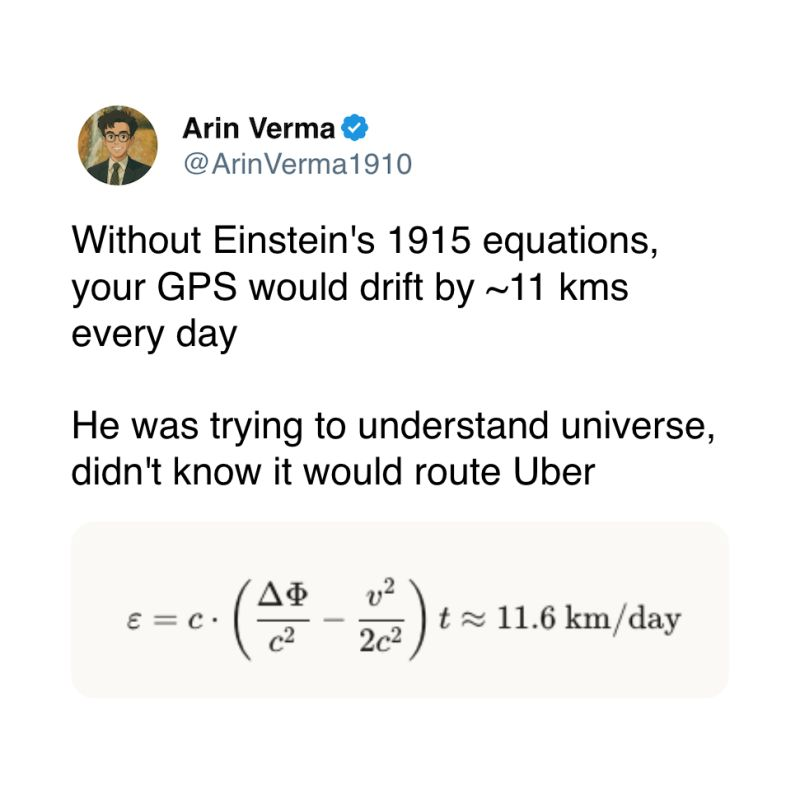
In 1905, Einstein published special relativity. In 1915, he published general relativity. Einstein was just trying to understand the universe.
But without Einstein's math, Google Maps would be wrong by 11 kms every single day.
Let me tell you why - this is very interesting :))
Your phone doesn't "talk" to GPS satellites. It only listens. Each satellite is broadcasting one thing, constantly: "I am satellite 'A', and it is currently 14:23:00.000000."
Your phone receives signals from 4 satellites simultaneously. Because light travels at a known speed, tiny differences in arrival time tell it exactly how far it is from each satellite.
'A' satellite tells you: you're somewhere on a sphere of radius 20,000 km.
'B' satellite: that sphere intersects another sphere - now you're on a circle.
'C' satellite: that circle intersects a third sphere - now you're at 2 points.
'D' satellite: eliminates the last ambiguity and only one point remains.
That's you!
Except there's a problem nobody thought about until Einstein.
The satellites are orbiting at 20,200 km altitude, moving at 14,000 km/h.
Two things happen to their clocks simultaneously:
- Special relativity: Moving clocks tick slower. At orbital velocity, the satellite clock loses 7.2 microseconds per day
- General relativity: Clocks in weaker gravity tick faster. At that altitude, gravity is weaker. The clock gains 45.9 microseconds per day.
Net effect: 45.9 - 7.2 = +38.7 microseconds per day.
In 38.7 microseconds, light travels 11.6 kilometers.
So without correction, the system would accumulate 11.6 km of error. Every single day. In a week, your navigation is useless.
The fix is one of the most elegant things in all of engineering.
Before each satellite launches, its atomic clock is physically tuned to tick slightly slower than it would on Earth - by exactly 38.7 microseconds per day.
Once in orbit, relativistic effects speed it back up. And it arrives at exactly the right rate.
Einstein's 1915 paper is baked into the hardware of your phone's navigation system.
The next time Google Maps routes you correctly, you're experiencing general relativity.
You just didn't know it.
The timeline on this is genuinely insane.
October 2025: Sam Altman flies to Seoul and signs simultaneous deals with Samsung and SK Hynix for 900,000 DRAM wafers per month. That's 40% of global supply. Neither company knew the other was signing a near-identical commitment at the same time.
Those deals were letters of intent. Non-binding. No RAM actually changed hands. But the market treated them as gospel. Contract DRAM prices jumped 171%. A 64GB DDR5 kit went from $190 to $700 in three months.
December 2025: Micron kills Crucial, its 29-year-old consumer memory brand, to reallocate every wafer to AI and enterprise customers. The company explicitly said it was exiting consumer memory to "improve supply and support for our larger, strategic customers in faster-growing segments." Translation: the AI demand signal was so loud that selling RAM to PC builders stopped making financial sense.
March 2026: Google publishes TurboQuant, a compression algorithm that reduces AI memory requirements by 6x with zero accuracy loss. Cloudflare's CEO called it "Google's DeepSeek." The entire thesis that AI would consume infinite memory forever just got a six-month expiration date on it.
Same month: OpenAI and Oracle cancel the Abilene Stargate expansion. The $500 billion data center vision that justified the RAM deals couldn't survive its own financing terms. Bloomberg attributed the collapse partly to OpenAI's "often-changing demand forecasting."
MU is now down ~33% from its post-earnings high. Revenue up 196% year over year, EPS up 682%, and the stock is in freefall because the company restructured its entire business around a demand signal that came from non-binding letters and is now being compressed out of existence by a research paper.
Micron bet the consumer division on Sam Altman's signature. The signature was worth exactly what the paper said: nothing binding.
🚨 Do you understand what happened in the last 12 hours?
> A CEO of a $200 billion company said on camera that 35% of new grads won't find jobs. He didn't even flinch saying it.
> Meta made $165 billion last year and is still firing 15,000 people because apparently record profit isn't profitable enough.
> Some random guy in Florida sold his entire house in 5 days using ChatGPT. No real estate agent, no commission, no experience. Just vibes and a $20 subscription.
> A man in Australia cured his dying dog's cancer with AI after every single vet told him there was nothing left to do. Built a custom vaccine from his couch.
> The guy who created Uber and left 300,000 taxi drivers broke is back. Building robots now because apparently ruining one industry wasn't enough.
> Tinder wants access to your camera roll. Your drunk photos, your 3am notes app meltdowns, your deleted selfies. They're calling it a "vibe check."
> Naval, the man who made hundreds of millions investing in software, just said software is dead. Four words and the entire industry felt it.
> And Anthropic removed the limit on how long their AI can think and then doubled everyone's usage for free. Because when the product is addictive enough you give the first taste away.
All of that happened today. Not this week, not this quarter. Today. A random Saturday in March.
This is worse than you being on meth.
Atlassian just confirmed 1,600 layoffs with 900+ coming from engineering
But I'm hearing the real story from inside
Sources say they've been running "knowledge extraction sprints" for 6 months - recording every senior engineer's screen, logging their prompts, documenting their debugging workflows
One architect told me they made him walk through his entire microservices decision tree while they filmed it. Called it "knowledge transfer for the transition team"
The transition team? 47 contractors in Bangalore with access to his recorded sessions and a Claude Enterprise subscription
Same architect just found out his replacement starts Monday. Guy makes $28k annually and ships code 40% faster using the exact prompt libraries they extracted
They're not just cutting headcount - they're systematizing 15 years of engineering expertise into training data
The "strategic AI focus" isn't about building AI products
It's about replacing their entire engineering culture with agents trained on their senior engineers' knowledge
Word is the CTO replacement already has the playbook: extract, document, offshore, automate
If you're still there and they ask you to "document your processes for the team" - RUN
The knowledge extraction is complete