we launched the most comprehensive ai performance engineering repo in the world
now we'll be posting every single resource
follow and save to keep up with the series. links in thread 🧵
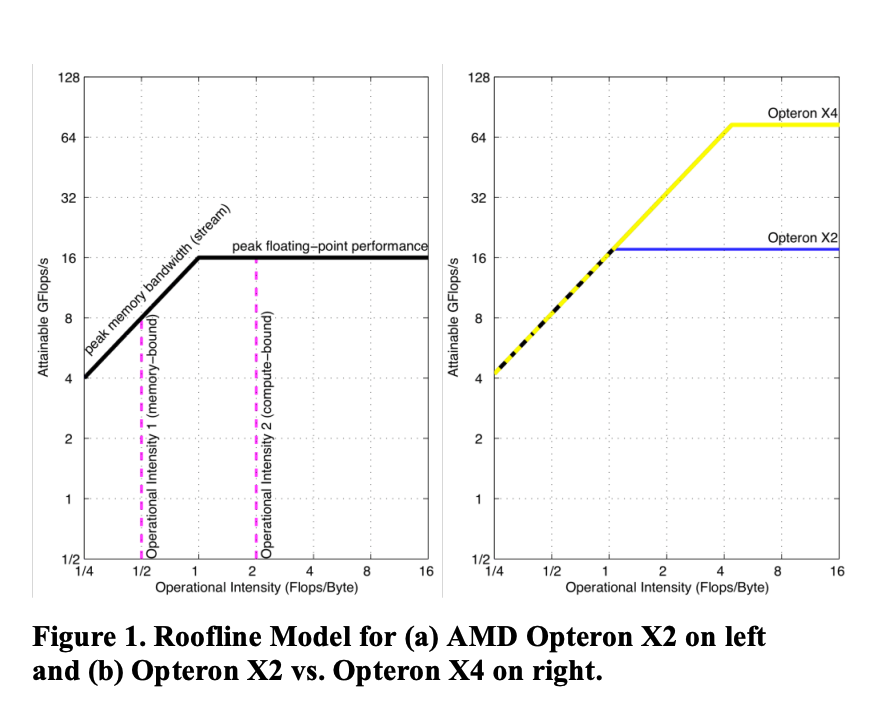
part 5: Roofline: An Insightful Visual Performance Model for Floating-Point Programs and Multicore Architectures
the authors introduced a model for relating arithmetic throughput, memory bandwidth, and data reuse. applied to AI workloads, it gives a way to evaluate batching and kernel optimizations against the hardware's limits.
the paper's concepts connect to these AI performance decisions:
operational intensity measures floating-point work per byte of DRAM traffic after cache reuse. during dense transformer decoding, a linear layer processing a small token batch can read a large weight matrix for little arithmetic.
compute and bandwidth roofs bound throughput. if weight reads limit an inference kernel, reducing transferred bytes can lower its memory-time bound. increasing peak arithmetic throughput alone leaves that bound unchanged.
the ridge point marks the minimum intensity needed for peak compute throughput to be possible. batching tokens that share a weight matrix can increase work per weight byte, moving the matrix multiplication toward that threshold.
computation ceilings account for limits in instruction parallelism and operation mix. for neural-network matrix multiplication, check Tensor Core use and compare throughput with the roof for the kernel's execution path and precision.
bandwidth ceilings account for memory access patterns and data placement. for GPU tensor operations, changing the layout or thread-to-data mapping to coalesce scattered accesses can improve useful bandwidth.
data reuse raises intensity when it reduces DRAM traffic for the same arithmetic work. a tiled matrix multiplication can reuse operands on chip; measure whether that reuse reduces DRAM byte traffic.
the memory level determines which bytes to count. if a matrix multiplication reuses operands from L2, compare its L2 traffic with L2 bandwidth and its DRAM traffic with DRAM bandwidth.
the authors demonstrated the model with 4 floating-point kernels on 4 multicore systems. for AI performance work, use it to assess weight reuse, memory layout, and arithmetic execution before choosing an optimization to test.
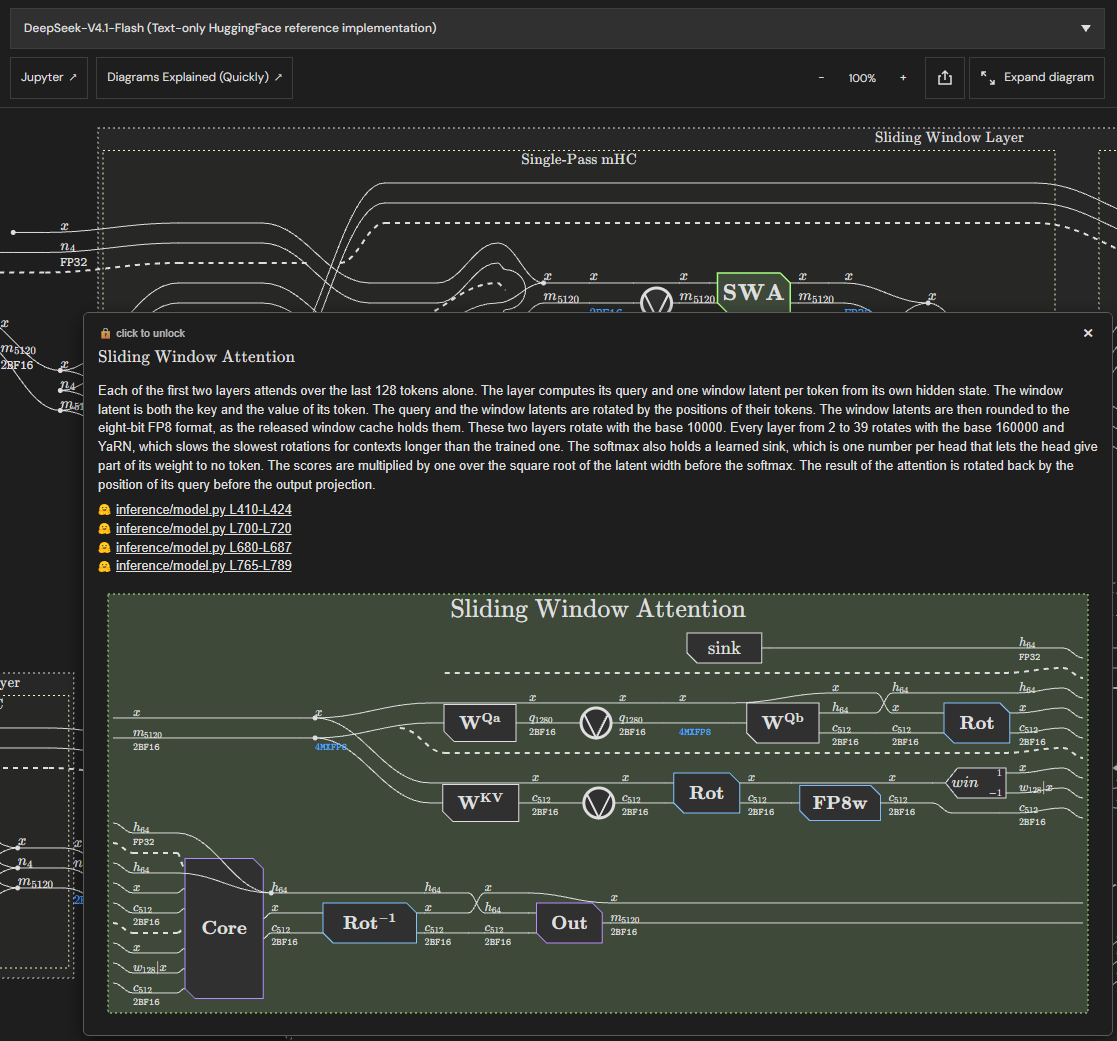
ok played with it a little and honestly a pretty decent model
- pretty fast
- good at not straying off from instructions
- concise responses
- decent code quality
worst part is context, might be me but it fills up *so* fast
only tested on text stuff but gonna use it for ui/ux soon
Introducing Qwen Intelligence, bringing personal intelligence within everyone's reach. 📱✨
It launches with three SOTA agents: 🥳
- Mobile Planner Agent: plans, decomposes & orchestrates complex tasks. #1 on MobilePA-Bench, MobilePA-Bench Business & Memory.
- Mobile-Use Agent: gets things done, API-first with GUI fallback. MobileWorld 82.1, MobileWorld-Real 92.2, AndroidDaily 97.2, 90% end-to-end success rate.
- Mobile Creative Agent: turns one sentence into ready-to-use creations. Image generated in 3s, about 2x faster than leading peers.
We're also opening up our benchmark suite: MobilePA-Bench, MobileWorld, MobileWorld-Real, and MobileWorld-Safety, covering planning, cross-app execution, real-device performance and safety.
🔗 Learn more about the agents:
- Qwen Intelligence official website: https://t.co/ZJJYJtmJIL
- Mobile Planner Agent: https://t.co/M0Wxpoa00x
- Mobile-Use Agent: https://t.co/vvQtbUAagJ
- Mobile Creative Agent: https://t.co/gWWOmrSIqV
🔗 Explore our open benchmark suite:
- MobilePA-Bench: https://t.co/9nXxzG0Ygp
- MobileWorld (GitHub): https://t.co/POvERSuCSJ
- Leaderboard: https://t.co/YYOw8bmJ6H
Introducing Unreal Agent:
An open-source harness with state-of-the-art cost efficiency
39% cheaper than Codex+Astra on Terminal-Bench 4.0 while maintaining performance
Meet Husky: a Model-Specific Inference (MSI) engine up to 4.5× faster than Apple's MLX
Woof, Underdog's Pareto frontier model, now runs up to 730 tokens/sec on a MacBook
Finally local models are as fast & capable. Try it now in https://t.co/hAWKvlClUC - your personal private AI
Introducing Halo, the best framework for post-training of open-source models.
Halo delivers up to 2.8x the throughput of stock TRL with less peak memory, while models stay in their native HuggingFace format.
Star us on GitHub: https://t.co/3mAiUljdrN
wrote off a conference i submitted to because i never got a reply after 2 weeks of waiting, and 40 days later they actually said yes so i gotta go and present a technical demo now
@SAldwais ممكن تسوي مثلا 1 email + shared slack channel
كل agent له وصول للبريد لكن فيه مثلا managing program يعامل الموضوع زي الtickets، يوجه كل ايميل للagent تبعه و كلهم نفس الshared inbox
now that inference engineering is the meta gotta shill out my project
https://t.co/1XrkjQsBeK
full engine, written in rust because i like it and everything else exists, built for research n trust first (used in one of my papers)