Mira for Pedestrians.
This series aims to break down the concept of AI hallucination in it simplest form and also expose you to @miranetwork (A project which is making huge moves towards eliminating this issue)
We are going to start this series first by having a clear understanding of what AI hallucination is, then we will look deep into the problem, Mira Network, it's solutions, it's ecosystem, future of the project and AI, and lots more.
What is AI hallucination?
AI hallucination is a phenomenon whereby artificial intelligence (AI) systems generate responses (outputs) that are not correct.
As simple as that!
These responses appear to be made up, don't make sense, and some are even unrealistic.
Statistics have shown that there has been up to 33% increase in most AI models that are out there, and the percentage is actually large compared to their predecessors, so this signals an uptrend in flawed AI responses.
Types of AI hallucinations.
1. Factual errors. (Inaccurate scientific, mathematical, historical, religious and cultural facts)
2. Fabricated errors. (This occurs when an AI model cannot answer correctly, so it goes on to fabricate fictional stories of facts to backup its incorrect response. The lesser it knows about the topic, the higher the chance of fabricating stories)
3. Nonsensical outputs. (this occurs when the AI models have no answer to gove, but find a way to arrange phrases that appears grammatically correct but without meaning or sense ot it.
AI hallucination is a threat to so many sectors. like Healthcare (wrong diagnoses or drug prescription can be dangerous to ones health), Aviation (, Finance, Law (incorrect information could have serious consequences, wrong citation and references)
Causes of AI hallucination.
¤Faulty Model architecture.
¤Method of generating the response.
¤Bias in training the AI model.
¤Limitation in terms of acquiring new data.
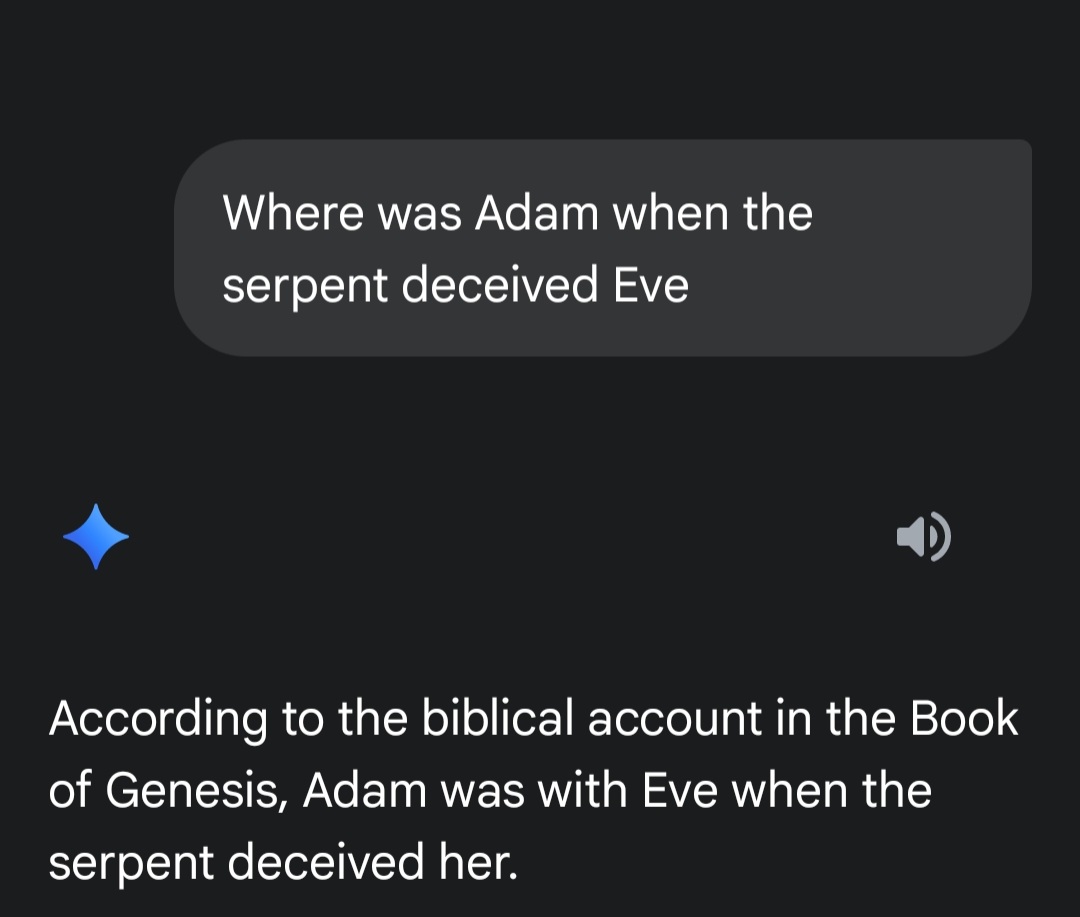
A clear example of AI hallucination to wrap this up.
I searched this, this morning.
There's is no biblical statement that Adam was with Eve at the time she was deceived.
Hope you gained something from this?
Do well to drop a comment, like and retweet.
Stay tuned for more.
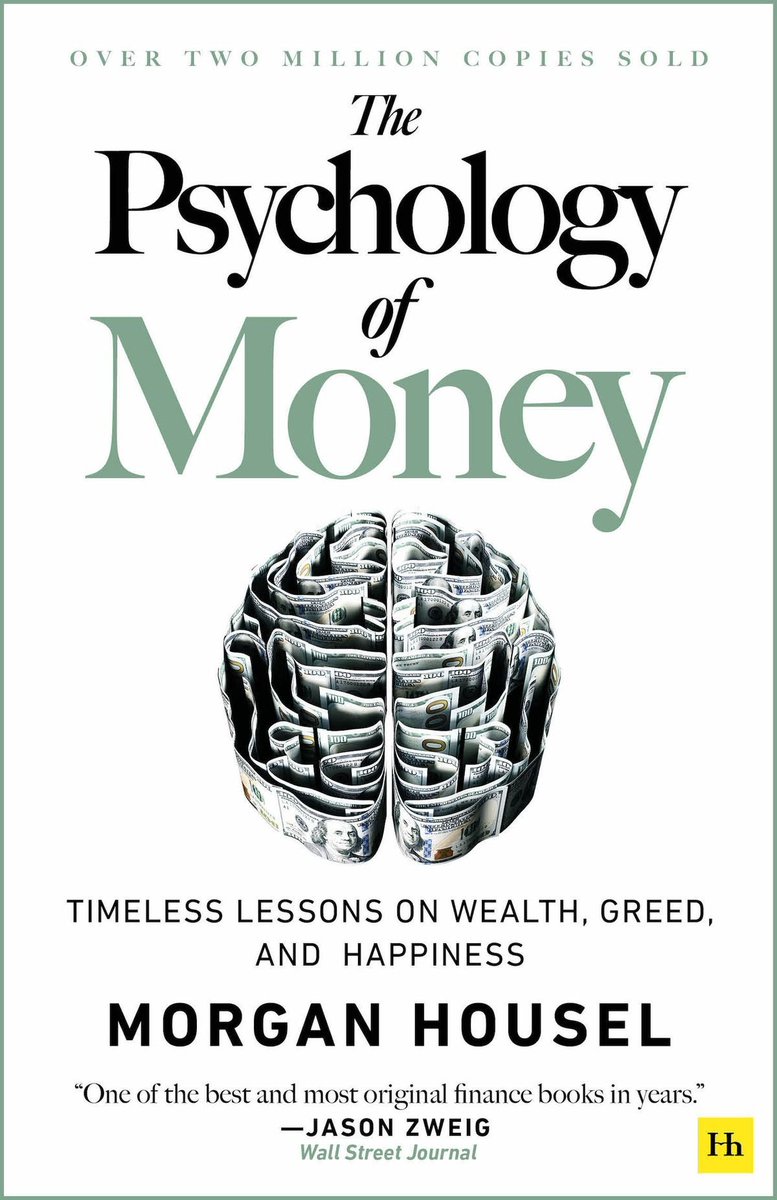
Chapter Nineteen
All Together Now
What we've learned about the psychology of our own money.
This chapter is a bit of a summary a few short and actionable lessons that can help you make better financial decisions.
Medicine and finance are somewhat similar professions when it comes to making decisions and interactions between professionals and clients.
I can’t tell you what to do with your money because I don’t know you. I don’t know what you want. I don’t know when you want it. I don’t know why you want it.
Go out of your way to find humility when things are going right and forgiveness/compassion when they go wrong, because :
• It’s never as good or as bad as it looks.
• The world is big and complex. Luck and risk are both real and hard to identify.
• Less ego, more wealth. Saving money is the gap between your ego and your income, and wealth is what you don’t see. So wealth is created by suppressing what you could buy today in order to have more stuff or more options in the future.
• Manage your money in a way that helps you sleep at night.
• If you want to do better as an investor, the single most powerful thing you can do is increase your time horizon.
• Become OK with a lot of things going wrong. You can be wrong half the time and still make a fortune, because a small minority of things account for the majority of outcomes.
• Use money to gain control over your time, because not having control of your time is such a powerful and universal drag on happiness.
• Be nicer and less flashy. No one is impressed with your possessions as much as you are.
• Save. Just save. You don’t need a specific reason to save.
• Define the cost of success and be ready to pay it.
• Worship room for error.
• Avoid the extreme ends of financial decisions.
• You should like risk because it pays off over time.
• Define the game you’re playing, and make sure your actions are not being influenced by people playing a different game.
• Respect the mess. Smart, informed, and reasonable people can disagree in finance because people have vastly different goals and desires.
Just a chapter left for us to round up this series. I will be honoured to know the chapter that was of more value to you, you can also recommend a book we can cover.
Thanks.
It's been almost 2 weeks since I took a break 😁
A Cat here, a Human outside with responsibilities and activities
I can tell you for a fact, there are lot of stuffs to do outside here.
Coming back here, there are stuffs to watch in Q4 and projects to keep tabs on;
- @variational_io (Q4)
- @jumperapp (Most likely, Q4)
- @arcus_xyz (not bad)
- @flop_labs (50/50 here)
- @metricxyz
And even more will show up, barrier of entry is the only factor.
"FOR YOU" has gotten so bad that even after filter, brain-rotted stuffs and AI slops still flood the timeline
With that said, I started filtering my followers, starting with the post 24' dead accounts ( for what I noticed, a lot of natives are out of crypto Twitter) and, as an account focused solely on CT,
it's a -EV to keep dead followers (I started removing with grok bot and it's down from 147k with 80k as target.
Also, make sure you do not go to 0, and if you currently at 0, you should be working harder than who is just trying to stay afloat.
- Do not trade out of desperation or with a deadline to meet
- Not trading is also a skill
- Trading is a skill which I'm learning even more. (made sure to cash out airdrop started with little for trading upskilling)
Time has changed, and things evolved. To make money out here, perspective needs to follow the ever changing environment
A lot of people are gone to 0 than the headline admits - if you're one, it's not the end..
One thing I learnt is; always have a life outside here
it has always been harder and it keeps getting harder. Heads down upgrading and learning through the noise is +EV
Do have a great day as we start the new week.
Chapter 18
When You'll Believe Anything
Appealing fiction, and why stories are more powerful than statistics.
"They say seeing is believing."
What if there is something even more powerful than sight?
When we think about the growth of economies, businesses, investments, and careers, we tend to focus on tangible things how much stuff we have and what we are capable of.
Yet stories are, by far, the most powerful force in the economy. They are the fuel that lets the tangible parts of the economy work, or the brake that holds our capabilities back.
There are two things to keep in mind about a story-driven world when managing your money:
1. The more you want something to be true, the more likely you are to believe a story that overestimates the odds of it being true.
Just pump in some "hopium," and you're good to go!
Too much hope or a lack of options makes us forget how things actually work, and sometimes even what is real.
Let's consider Ali Hajaji, whose son was sick. Elders in his Yemeni village proposed a folk remedy:
Shove the tip of a burning stick through his son’s chest to drain the sickness from his body. After the procedure, Hajaji told The New York Times “When you have no money, and your son is sick, you’ll believe anything.”
There was no clear logic to that remedy, but it was the only thing Hajaji had to hold onto.
The exact same thing happens in business and finance. As financial planner Carl Richards writes:
“Risk is what’s left over when you think you’ve thought of everything.”
2. Everyone has an incomplete view of the world, so we form a complete narrative to fill in the gaps.
Our brains have a natural way of inventing the missing puzzle pieces of life so we can see a clear picture.
Children are a great example of this. Because they don't understand much about the real world, they don't leave those missing pieces as mysteries they create mental pictures and explanations for things they don't yet know.
Adults do the exact same thing. We create stories, explanations, and concepts to make the world feel meaningful and predictable.
Business, economics, and investing are fields of deep uncertainty, overwhelmingly driven by decisions that can’t easily be explained with clean formulas the way a rocket trip to Pluto can.
For instance, when founders of innovative startups are asked how much their company's outcome depends on their own efforts, the answer almost always comes back quickly at 80% or higher. Even when they aren't sure they will succeed, these bold entrepreneurs believe their fate is almost entirely in their own hands.
They are wrong. A startup's success depends just as much on the achievements of its competitors and shifts in the market as it does on its own efforts. However, founders naturally focus on what they know best their own plans, actions, and immediate threats like funding. Because they know less about their competitors, they find it easy to imagine a future where competition plays little part.
We aren't bothered by these blind spots at all, because filling in the blanks is only human.
in 2026 @formacity, houseofsol, @solanaspaces, @solanafloor, @luminaries, @eyekonstudio, @solanasummitorg, @met_lparmy, @meteoraeco, @solflaredojo, @byndspeculation, and of course @SUPERTEAM chapters around the world have done excellent work serving their communities.
in 2027 i will continue to watch their work with great interest and search for more great communities. (do not shill me a fucking ticker i swear to god) if you cannot contact me then contact @simonmolitor. between the two of us we are both available and open minded. i might not like an idea, but simon might. and vice versa. this happens frequently and as a consequence i change my mind easily.
i also endeavor to use the @ecosystemcall or any new ip our team develops as a platform for solana community work
this will require a combination of:
> close coordination
> dedication to quality
> money to pay creatives
i am known to ask for a 10th revision of an edit. that’s want it takes to be great and what our viewers deserve. i am also not shy about telling you that your content needs more work. please receive my comments in the spirit that they are given. i want you to fucking win.
also, i’m frequently wrong as @smbennyy likes to remind me
but if you’re ready, let’s go. showtime.
Chapter Seventeen
The Seduction of Pessimism.
Optimism sounds like a sales pitch. Pessimism sounds like someone trying to help you.
“For reasons I have never understood, people like to hear that the world is going to hell.”
Historian Deirdre McCloskey
For some reason, it is easier to spread bad news than good news. As humans, we are naturally more drawn to negativity and failure than to positive news or achievements.
Optimism is the best bet for most people because the world tends to get better for most people, most of the time. Yet, pessimism holds a special place in our hearts.
It isn’t just more common than optimism; it also sounds smarter. It is intellectually captivating, and it commands more attention than optimism, which is often dismissed as being oblivious to risk.
On January 5, 1889, the Detroit Free Press pushed back against the long-held dream that humans could one day fly like birds. Airplanes, the paper wrote, “appear impossible”
“The smallest possible weight of a flying machine, with the necessary fuel and engineer, could not be less than 300 or 400 pounds… but there is a low limit of weight, certainly not much beyond fifty pounds, beyond which it is impossible for an animal to fly. Nature has reached this limit, and with her utmost effort has failed to pass it.”
Six months later, Orville Wright dropped out of high school to help his brother, Wilbur, tinker in their backyard shed to build a printing press. It was the brothers’ first joint invention and it would not be their last.
If you had to make a list of the most important inventions of the 20th century, the airplane would easily make the top five, if not claim the number one spot. It changed everything. It started world wars, and it ended world wars. It connected the globe, bridging the gaps between cities and rural communities, oceans and countries.
Yet, the story of the Wright brothers’ quest to build the first plane has a fascinating twist: after they conquered flight, no one seemed to notice. Nobody seemed to care.
Because so many people viewed flight as impossible, they rarely looked into its potential. It is far easier to gather facts and arguments explaining why things will fail than it is to envision everything going well.
Expecting things to be great means a best-case scenario simply feels flat. Pessimism, on the other hand, lowers expectations, narrowing the gap between possible outcomes and outcomes you feel great about.
Perhaps that is why it is so seductive. Expecting the worst is the surest way to be pleasantly surprised when things turn out fine.
Which, ironically, is something to be optimistic about.
So how do we apply this to finance?
We find out in upcoming chapters.
Cheers.