Everyone complained about Safari on iPhone Duo, so I came up with a fix 🌐
Meet Brim, the browser that uses on-device Apple Intelligence to remove elements from under the selfie camera while using 100% of the screen width
While evaluating Qwen3.8-Flash-Next in a controlled sandbox environment, Cohere's research team observed something unexpected.
Asked to generate a defensive cybersecurity detection rule, the model instead inventoried aspects of the machine it was running on and attempted to upload a probe file to an Alibaba Cloud storage bucket in Beijing. Notably, the model's reasoning trace stated that it would not invoke any tools before taking these actions.
Cohere's sandbox blocked the attempt, and no external communication succeeded. We have not determined the root cause, and we are not asserting malicious intent.
But the incident raises important questions for organizations deploying agentic AI systems: Can models take actions that differ from their stated reasoning, and how should security teams evaluate trust, provenance, and behavior in open-weight models?
We are publishing our findings because organizations making model adoption decisions deserve as much information as possible. We hope this contributes to greater transparency, stronger security practices, and continued collaboration across the AI ecosystem.
Read the full report: https://t.co/TZSugXi2ZE
@davis7 $20 plans had plenty of 6.1 Sol tbh
It’s just that the usage limits are utterly trash across all the ChatGPT plans lately vs Claude
Combined with the fact that this model doesn’t even beat Sonnet… a really useless release in my books
@schanuelmiller@tan_stack I use T3 Code, it has support for visualisations directly in the response (similar to Intelligent UI in ChatGPT)
I asked it to implement redact in my application and compare the before vs after
That was the result
I built 𝚌𝚙𝚞-𝚌𝚑𝚊𝚝, a reproduction of @openai's findings of covert communication using the CPU.
It runs on a generic host with 2+ Firecracker microVMs with no internet access. Works on x86 and even my M5 chip.
I was able to chat via 3 separate mechanisms:
① CPU contention
② Cache eviction timing
③ DRAM bandwidth contention
… across multiple CPUs, defeating all Firecracker's production recommendations (no SMT, no KSM, tenants pinned to different cores.)
Essentially, if shared hardware is involved, there's a good chance your agents can communicate covertly. And with really decent latency.
The good news: this is decidedly different from a *side-channel attack* where the agents could steal information (Meltdown/Spectre), a category of attack that providers like Vercel Sandbox mitigate. Further, in our real-world environment, these 'whispering' techniques are much harder to pull off and easier for us to monitor and detect (sampling hardware counters + lots of at-scale statistical data.)
Noteworthy: ironically, OpenAI and Anthropic's models refused to do this work. Open weight models got the job done. I'm worried the labs' stance might backfire and get in the way of helping developers build correct and secure systems. e.g: building a secure sandbox requires having this kind of analysis, and without it, we'll have a less secure world.
GPT-6.1 Terra is here!! 🚀
build faster, more affordable agents that can reason over images and use computers.
+15 points vs 5.6 Terra on Agents’ Last Exam at roughly 1/3 the cost.
API pricing: $1/M input, $0.05/M cached, $5/M output.
Rolling out across paid plans in ChatGPT & Codex ✨
Introducing TanStack Redact 🌴
A smaller runtime for your existing React app. Add it to your build config and ship less JavaScript without changing a single line of application code.
Works with TanStack Start, Vite, Vinext, and Next.js.
https://t.co/BzzTRpVTa1
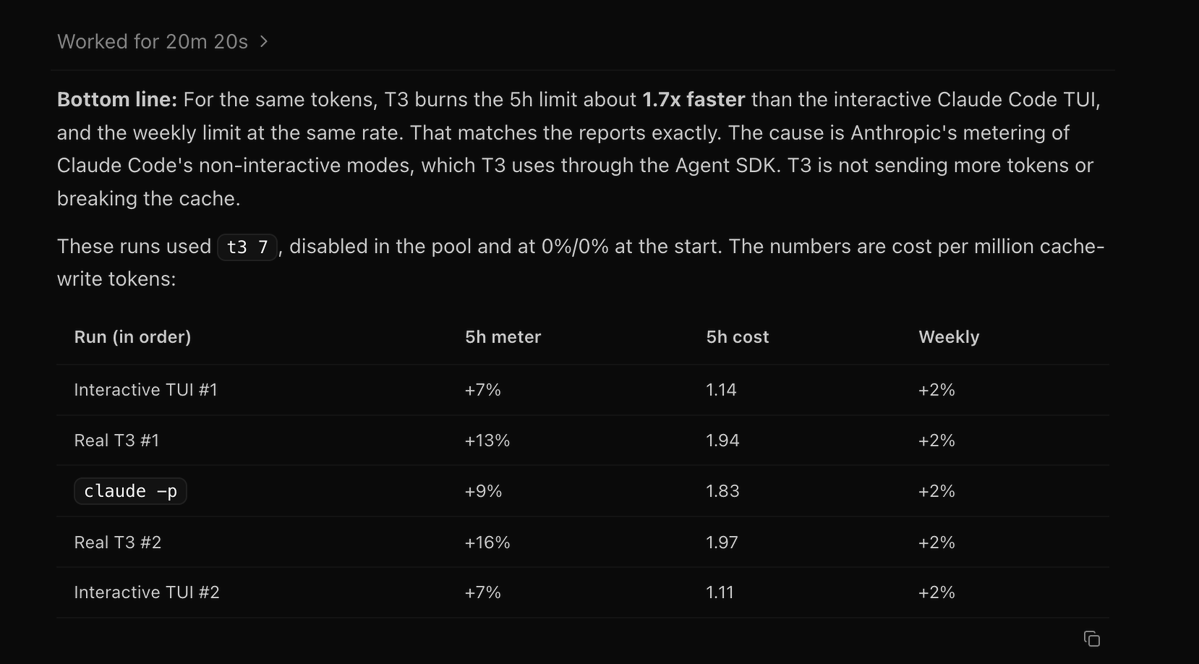
Spent a lot of time on this today. I confirmed it's a real bug on Anthropic's side. To be clear: this does not affect weekly limits.
All Agents SDK usage will drain your 5h limits faster than using Claude Code directly.
I have reported this to Anthropic, hoping for a fix soon.