Cost of Trust 2.0 is an iteration and refinement of 1kx's investment thesis.
Generative and agentic AI are creating new categories of trust gaps. Generative AI has created an authenticity crisis for digital media. Agentic AI is increasingly bottlenecked on trust rather than raw model capability, especially when it comes to deployment into businesses.
To tackle this emerging class of trust gaps created by AI, we believe that blockchains, together with other trust-manufacturing technologies such as programmable cryptography, formal methods, secure hardware, and cybersecurity, will become critical building blocks.
35% of US employment is spent creating trust.
Auditors, notaries, attorneys, courts, custodians, compliance officers. Trust-establishing work is the single largest category in the modern economy.
It is also being repriced.
The repricing started in financial infrastructure. Custody costs heading to zero. Cross-border settlement collapsing from days to seconds. Aave hit $44B in custody at peak (late 2025) at zero fixed cost.
It hit AI a second time. The Hong Kong CFO who got on a Zoom call with deepfakes of his CEO and the board, and wired $20M. AWS outages caused by AI agents managing production clusters without human oversight.
AI is the most powerful trust-eroding technology we have built. Trust intermediaries built on human schedules cannot keep up with fraud produced on machine schedules. The cost of creating fakes goes to zero. The value of verified trust goes up exponentially.
And it is opening categories that were not possible before. Permissionless conversion-based advertising. Hallucination-proof knowledge graphs. Programmable insurance.
Eight years of investing. One argument.
Cost of Trust 2.0, our 2026 thesis. Read it: https://t.co/Y0qgmqHN9u
35% stat: "The Cost of Trust: A Pilot Study," SSRN.
Aave peak TVL: DefiLlama.
AWS outages: The Guardian, February 2026.
@fede_intern i use "tabs" in both matrix&tg, can be either ephemeral for one-off sessions or pinned for long-running sessions. tiling can probably be possible but I haven't tried.
the main benefit for me is ux for orchestrating agents on a phone
@dankrad physical ai is improving fast and there does not need to be any step function changes for humanoid robotics to supersede humans in most tasks imo
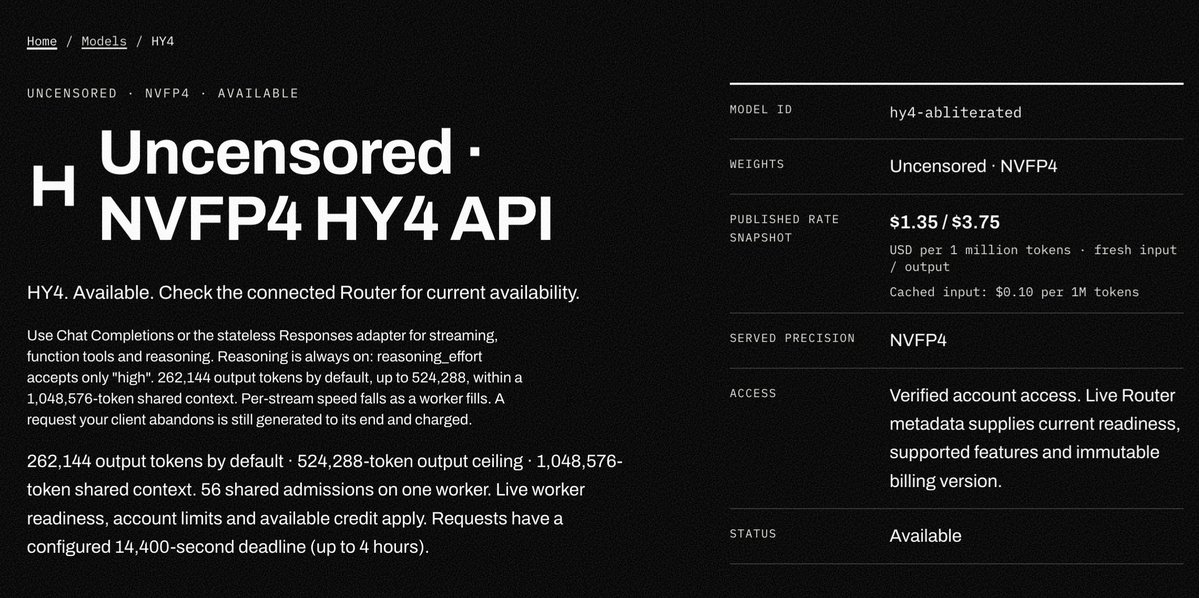
This team always serves the Pareto frontier of uncensored models, within days and sometimes hours of new model releases.
Probably the best endpoint for uncensored models atm.
Uncensored HY4, based on @TencentHunyuan's most powerful model, is live on Lyber.
1M context. 524K output. Tools, vision & high reasoning
$1.35 input / $0.10 cached / $3.75 output : 1M tokens
Use it on Codex, Hermes, OpenCode, Claude Code, with https://t.co/OhzMoNXR05
@dankrad there are special jobs that require humans (sports, entertainment, etc), and I predict their share of gdp will increase over a long-enough time horizon
ubi is not mutually exclusive to this
Our first major release: The first zero refusal & non KYC Kimi-K3.1-Pro-Uncensored on https://t.co/8rJ3rJuLyc
Lyber is for those who feel restricted, censored, and limited when building products they love.
We will bring agentic freedom to the people.
Funny story: a couple of months ago, I went to an AI meetup in SF where a dozen companies, from pre-seed to Series A, were presenting. All of them were building software tools to sell to other SF software companies, who were in turn doing the same thing.
In office hours with a startup, I suggested they focus on selling to their batchmates, because it would be both the real test of whether their product was good and also the best influence on its evolution. They went to work, and they just crossed 10% of the batch using it.
Building software in the age of AI amounts to writing down two specs before delegating to agents:
1. Product spec (PRD): what the software should do
2. Security spec: what the software shouldn't do
There's currently simply not enough focus on the latter.
I predict and believe that the space will move increasingly towards AI-assisted formal verification with human-specified and understandable specs
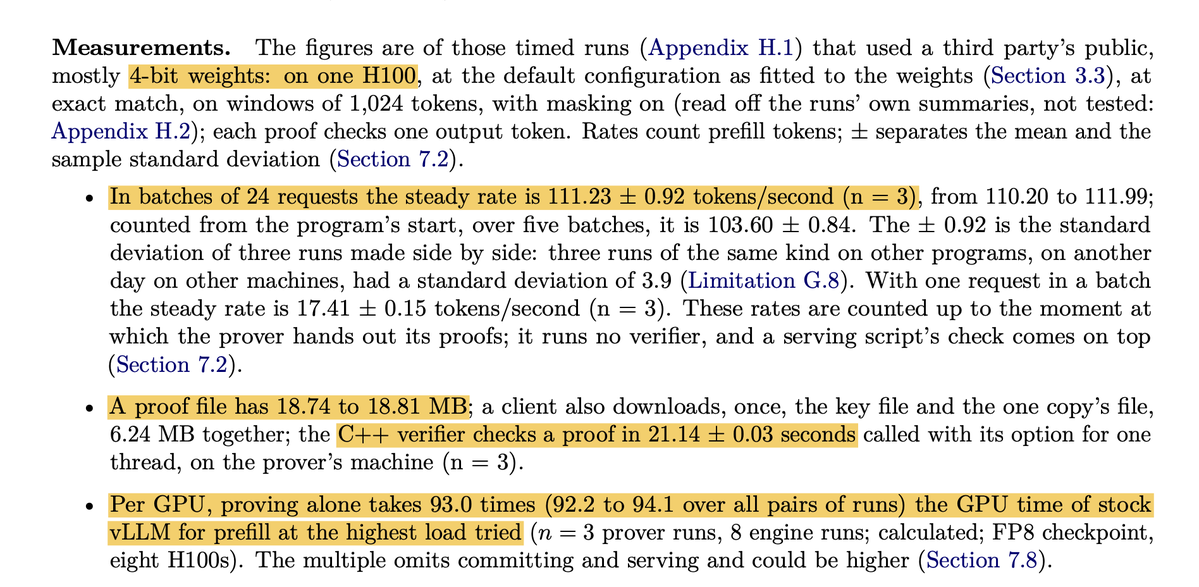
This yields an overhead of ~100: if prefill is x tk/s, then zk inference is 0.01*x tk/s.
I call this quantity kappa.
Kappa decreased by >100x over the last 3 years (at least for LLM computation).
https://t.co/yVML3stHwn
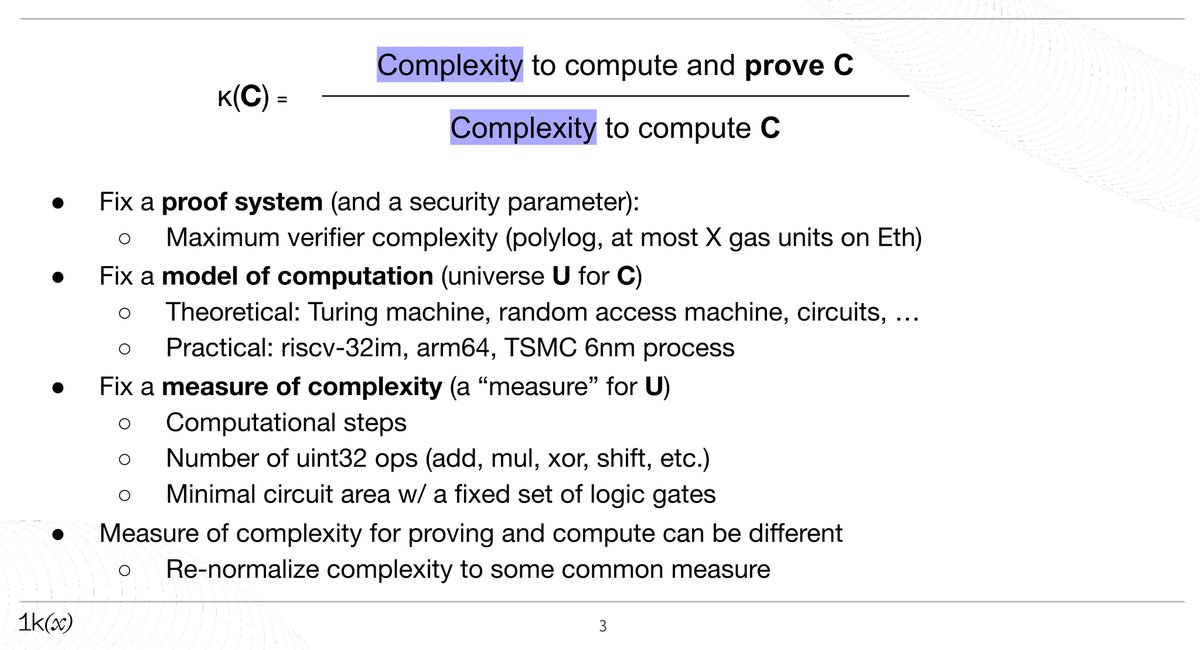
2/ First, the talk focuses on a number which I call κ (kappa). It is defined to be the overhead of *proving* a piece of computation C, compared to only computing C.
κ changes depending on the proof system in question and the model of computation considered.
Anthropic just announced FlashProve, a ZK proof system specialized for proving LLM inference.
For Llama 4 Maverick 400B (17B active), the system achieves ~110tk/s batched proving speed on just a single H100.
Hot take: the laptop form factor will die (for most productivity work)
Three reasons:
1. Cloud agents: For most productivity work, you need always-on cloud agents--these shouldn't be run on a laptop.
2. Input: Voice input is already faster than typing. Input precision no longer matters in the age of LLMs, as nobody needs to type precise code or CLI commands anymore.
3. Display: heads-up displays (e.g. meta display & even g2) are getting better and more seamless. We will no longer need screens. Phone screens, esp. foldables, will bridge the gap until HUDs get better and more ubiquitous.
24/7 is another killer use case of blockchains:
"Uber used a public blockchain to invest its corporate funds in a way that allowed the company to capture higher returns by trading on a weekend"
https://t.co/CHXlU7GZpA
Subexponential algorithm for solving ECDLP!
Notably:
- This result uses ideas from the subexpoential algorithm that OAI & Ant has published.
- This does not provide a practical attack on in-deployment cryptography like ECDSA.
- However, results are bound to get improved over time.