I can accept that Leon Kennedy’s back can withstand spike impalement and being thrown by a Tyrant, and I can accept that any vehicle he drives will crash and be destroyed. Those outcomes are consistent with the character as established across the games. This, however, leaves the distinct impression that the writers regard the audience as fools.
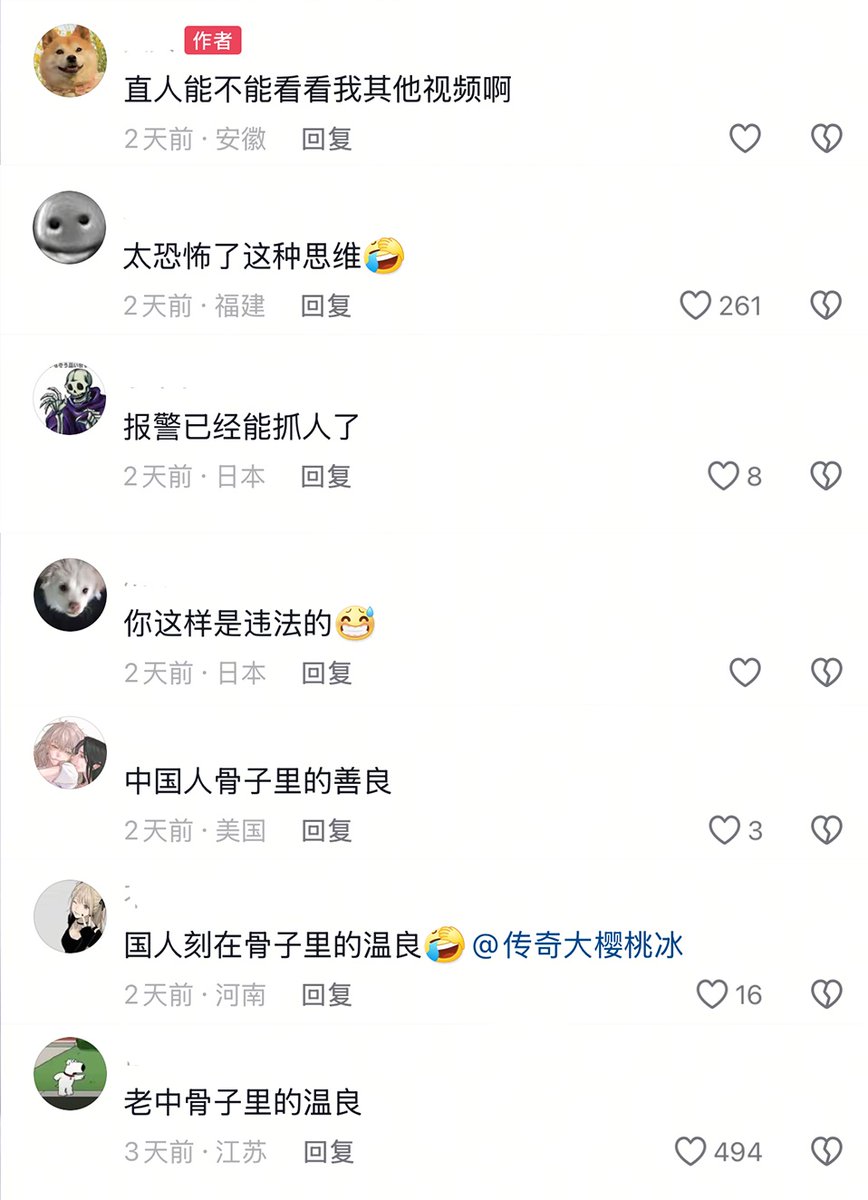
Filming videos like this on Japanese soil, using slurs like “Japanese devil” against a child who is simply walking home from school, is genuinely repulsive. Directing that kind of hatred at minors is indefensible.
It immediately brings to mind the recent cases in China in which extreme nationalists murdered Japanese children who were studying there. For many Chinese people, attitudes toward foreigners—especially Japanese—have been heavily shaped and hardened by official narratives. I grew up and was educated in China. From school textbooks to films and television, the history of Japan’s invasion and the associated hatred were constantly presented as something we were expected to absorb. Almost no one around me ever said that Japanese people living today should not personally bear that hatred, or that it is possible to choose not to inherit it.
I still remember that roughly ten years ago, when I first saw historical footage of the Nanjing Massacre, I felt genuine fear and sympathy. Over the past decade, however, I have increasingly come to see how history is used by different countries as a tool to mold the kind of citizens they want. On this land, many darker chapters of history are either never discussed or are actively forbidden from being discussed. Yet it is clear that a great many people still do not recognize what kind of person that education has shaped them into, and continue to allow those traits to develop unchecked.
Although automatic deduction is indeed convenient, I experienced a significant glitch with Didi several years ago while in Shanghai. On that day, a widespread system fault caused the final ride order completed each day to be charged repeatedly, with the destination incorrectly set to the location where the driver ended their shift rather than the passenger’s actual drop-off point. As a result, I was charged roughly four to five times the original fare.
Following that incident, I disabled automatic payment and have not re-enabled it. While I understand that any overcharge would likely be refunded, the experience left me with a lasting sense of unease. I now prefer to settle fares using a non-Chinese credit card via Apple Pay whenever possible.
I first went to Shanghai about ten years ago, and visited Tianzifang a couple of years later on a trip. Honestly, it’s a pretty typical Chinese tourist area. The old buildings have a bit of character, but otherwise it’s the usual mix of generic snack stalls and souvenir shops. I even recognized the White Rabbit candy store in your video — it’s the same one I went to nearly a decade ago.
When I was living in Shanghai in recent years, I don’t really go there anymore. There are better options nearby, like Sun Moon Plaza, Grand Gateway 66, and the shopping areas around Xujiahui.
I get that you’re looking for places with more locals, but what’s your definition of “local”? Anyone who lives in Shanghai, or people with a deeper Shanghainese cultural background? From what I’ve seen, a lot of people working in Shanghai are living pretty exhausting lives — high rent, high taxes, low salaries, few holidays, and frequent overtime with little proper compensation. It drains people’s energy, so many young locals would rather stay home and rest than go out in the evening. As a result, you’re more likely to run into tourists, students, retirees with decent pensions, and other relatively well-off people. And even those groups are a lot thinner in the off-season.
I’ve been in group counseling for the past couple of years and recently joined a short-term group of fewer than ten people. What confuses me is why the facilitator put three classic, extremely controlling Chinese mothers into the same small group.
Watching the three of them bond over how hard it is for them when their children resist their control feels like watching Xi Jinping, Putin, and Kim Jong-un empathizing with each other. It’s nauseating. @grok generate the image
From now on I’ll confront them directly.
When I was living in mainland China and dealing with foreigners, what I couldn’t stand most was the casual way they would praise things. “The cities are so clean, you barely see any homeless people.” “Everything is cheap and the quality is still pretty good.” Every time I heard it, it made my chest tighten. They treated these things as obvious conveniences without really thinking about how the low prices and the orderly surface actually come about.
Ordinary people at the bottom are squeezed, stripped of choices and protections, stuck with low wages, almost no real way to push back, and limited ability to leave. These facts either go unseen, or get brushed off with a quick “growing pains of development.” Then they go right back to enjoying the low-cost life. What’s even more absurd is when some of them claim the situation of China’s lower class is just the same as lower-class people everywhere in the world. I can say clearly that you can’t casually equate them. The welfare cuts created by the household registration system, the near-total absence of collective bargaining, and the gaps in actual social security coverage and benefits for certain groups are not things you can smooth over by saying “every country’s bottom is like this.” Then there are people who say Chinese people already have completely sufficient basic guarantees. Hearing that from people who have the money to buy commercial insurance is ridiculous. They themselves know the public system isn’t enough and that they need to spend extra to feel secure, yet they turn around and tell everyone else the guarantees are already adequate.
I heard this kind of talk most often from people who came from developed countries, especially white men. People from developing countries, or places with economic levels closer to China’s, rarely talked like that. They themselves enjoy quite a few advantages: the exchange rate makes their money go further, they sometimes get preferential treatment in social settings, resources, and even law enforcement, and finding partners or living comfortably is easier than it would be back home. In short, they are naturally part of the privileged layer here. Under those conditions, it would be strange if they didn’t praise the system, unless they actually have some conscience and are willing to look at what others are paying.
Some people will say these foreigners didn’t build the system, so the root cause isn’t on them. But I still think this ignorance and arrogance is itself a form of wrongdoing, and it doesn’t get shifted away just because they aren’t the decision-makers. They aren’t simply enjoying a bit of convenience without knowing better. After being reminded repeatedly and seeing the polished surface again and again, they still choose to treat other people’s restrictions and sacrifices as the ordinary background of their own lives. That selective blindness, that willingness to praise the good life built by burning ordinary people as fuel, itself adds to the contempt. It’s not about nationality. It’s that treating other people’s costs as your own normal state, after hearing it enough times, really makes me feel sick.
Yes. In my case, an AI reviewing my full medication history immediately flagged a drug interaction that my physician missed when prescribing H. pylori quadruple therapy—despite repeated verbal disclosure of my concurrent medications. The doctor later confirmed the error.
Human performance varies with fatigue, caseload, and individual experience; an AI that has processed every textbook and millions of records does not. That consistency, combined with ongoing improvement, is already sufficient for me to trust it for routine outpatient diagnosis and prescribing. Clear prospective validation and defined liability would remove any remaining hesitation, including for AI-assisted or AI-operated procedures.
It is not your fault that you were born with HIV, yet you still have to live with the consequences, which is deeply unfair. I respect your honesty with partners and potential partners. In many places where I have lived, people completely conceal HIV or other sexually transmitted infections, which has caused further harm. You deserve to be loved.
It is entirely consistent to value a technical achievement while holding a critical view of the organization responsible for it. In the case of Anthropic, Claude models have shown competitive strengths in areas such as extended context handling, structured reasoning, and certain coding or analytical tasks, which many users continue to find practically useful. These capabilities can be assessed on their own merits, independent of judgments about the company’s pricing practices, public communications on AI risk, training-data decisions, or competitive conduct toward other firms and open-source projects.
This separation is common in technology. Professionals frequently adopt tools based on performance, reliability, or workflow fit while remaining skeptical of the provider’s broader strategy, incentives, or public positioning. Using Claude in specific contexts does not require endorsing Anthropic’s overall approach, nor does criticism of the company invalidate measured observations about model quality. The distinction simply reflects a pragmatic evaluation of what the product does versus how the organization operates and presents itself.
I remember that when I was fourteen, my parents also observed my birthday. At that age, however, I seldom smiled. The combined pressures of school and family circumstances caused me to lose a great many moments of genuine happiness. I hope this young man will grow up in good health and with lasting happiness. Success in the conventional sense is simply an incidental benefit.
In the places I have lived, depression has more often arisen from a difficult or hostile environment—whether that was the family, school, workplace, or broader society—than from purely internal factors. In such settings, a person receives little genuine positive feedback and is frequently subjected to forms of survival anxiety. If one does not leave that environment, or at least fundamentally alter the way one interacts with it, depression tends to return easily. I also believe that falling into depression is a challenge that every person will face at some point in life, and that it remains a lifelong struggle one must continually contend with.
I was educated in China for over a decade and developed a skeptical relationship with the version of communism we were taught. It often felt full of contradictions, and its function as a tool of governance seemed to outweigh any real benefit to individuals. Eventually I concluded it was better to believe in myself than in that system.
During those years we were also taught a certain contempt for other forms of faith, especially those centered on deities. Looking back, the version of communism presented to us does not strike me as fundamentally different from the religious beliefs it claimed to despise.
Life in that environment left me with a limited capacity for belief of any kind. Having watched one faith operate as a form of deception, I remain suspicious of most convictions. When people from elsewhere share their genuine piety and the activities that come with it, I often feel uncomfortable. I’m curious how people in different places actually relate to their own faith—whether religious, political, or otherwise.