Mjolnir just landed a bug bounty on @immunefi
Our autonomous pentester found a critical application-layer vulnerability in one of Web3’s largest blockchain ecosystems.
Impact confirmed.
Payout confirmed.
$10,000 bounty.
Autonomous offensive security is starting to work.
@BorgHQ
Since posting: real-time water.
A 67-tonne M1A2 wading a ford, simulated live in a browser tab.
No 3D software. No game engine. No packaged simulation engine. No downloaded models. No textures.
Every vertex, wave and droplet is our own code.
We have found at least 12,000 servers in Norway that appear exposed to the new NGINX vulnerability (CVE-2026-123007).
The flaw lets an attacker run commands on a server without logging in. A fix is out, and so is working exploit code.
We are contacting as many of the affected organizations as we can. ESPECIALLY NORWEGIAN. If you run NGINX and want to know whether you are affected, or want help mitigating it, get in touch ASAP.
Clunky security tooling is a choice. Your tools should work for you, not the other way around.
First 25 PR's are on us https://t.co/hrrxn2CNyG
@Borg_Security
Security tools are a pain to use.
We didn't want Borg to be one of them.
So we redesigned it. Here's a quick look:
(25 free PR reviews if you want to try it yourself!)
https://t.co/MgSF3AWPK8
We just opened Odin to everyone.
Connect a repo and it security-reviews your next 25 pull requests for free. No card, no time limit.
When it finds something, the fix is in your PR, ready to commit.
I’d love to know what it finds in yours: https://t.co/wELIdJRXdA
412 packages, 31 advisories. ONLY 1 proven exploitable, with the exact file, the payload and the fix.
It doesn't just match CVEs to versions. It traces your code to prove what's reachable, and then validates by performing the vulnerability so your team fixes what matters and ignores the noise.
@Borg_Security
Book a demo → https://t.co/Km08ex928E
Continuous Red Team Agents @Borg_Security
This is currently an internal tool we are using, and integrating into our coming red team agentic suite
Is this something you would find interesting ?
People still think yearly security reviews are enough btw 😂
This is 40 concurrent security agents @Borg_Security running on grok 4.6 for ONE small whitebox test
Solana is one of the largest blockchain ecosystems in the world, regularly processing over $2 billion in daily DEX trading volume.
Proud of our team at @Borg_Security for uncovering two vulnerabilities in infrastructure maintained by the @SolanaFndn .
Even the biggest names in crypto aren’t immune to traditional Web2 vulnerabilities.
Kudos to the @solana for the swift fixes!
Not every vulnerability in crypto lives on-chain.
Through our security research, we identified two security issues in the @SolanaFndn tokens repository, including an authentication flaw and a same-origin XSS on https://t.co/A5TdnTzT74.
Both were responsibly disclosed and quickly fixed.
Here's what we found and why it matters beyond crypto 👇
https://t.co/vUWSWRl8Hr
🚨 BREAKING: Polymarket may have just suffered a massive JavaScript supply-chain attack.
Polymarket has confirmed that a third-party provider was compromised, temporarily halting trading and promising to reimburse affected users.
Now, evidence is emerging pointing toward a compromised DebugBear integration.
This is potentially a textbook client-side supply-chain compromise.
A third-party performance monitoring script, trusted by the application and executed in users' browsers, can inherit access to sensitive application functionality.
No smart contract exploit required. No direct compromise of Polymarket's backend required.
Just one compromised JavaScript dependency running inside an authenticated trading session.
Your Next.js app might have an unauthenticated RCE right now.
Here's what applies to whom:
next/image on Linux: RCE, patch now
App Router plus use cache (Next 16): RCE, no workaround
App Router plus Server Actions: DoS
Pages Router: only the image bug
Patch to 15.5.28 or 16.4.1
One of the largest web3 games by daily active users, @pixels_online has a live economy spanning $PIXEL, land NFTs, a player marketplace, and much more.
They were already doing scheduled pentests and running a public bug bounty when we started working together.
The problem: they were shipping faster than point-in-time security could keep up.
So we started working continuously, across auth, game systems, on-chain rewards, and open-source releases.
Read the full story:
https://t.co/HnjQqg9F55
We’ve worked alongside @BananaGun on security for more than two years.
Across that time, they’ve processed $16B+ in trading volume and 25M+ lifetime trades, while the product, infrastructure and attack surface have continued to evolve.
Our work evolved with it.
Here’s what two years of continuous security alongside Banana Gun has looked like:
https://t.co/O3cuj748MJ
broadly it's like this:
crits -> unauthenticated / little preconditions allowing for high caliber attack vectors such as RCE or access control bypasses exposing highly sensitive data or account takeover
high -> the same as crit but requires a precondition (such as a hard to guess userId) alternatively injections or access control issues which expose large amounts of information which isn't super sensitive
from crits to low there is demonstrated attacker impact. the category we have which does not have this is the "informational" severity class.
687 findings in 7 days.
Every Critical and High was actively tested and triaged—not scanner noise.
Continuous security should mean continuous proof.
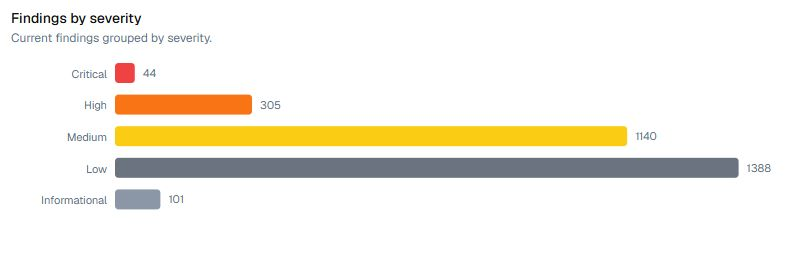
Across Borg’s current findings, we’ve now uncovered:
🔴 44 Critical
🟠 305 High
🟡 1,140 Medium
⚪ 1,388 Low
But volume alone isn’t the goal.
The real value is proving which vulnerabilities are actually exploitable, cutting through false-positive noise, and helping engineering teams focus on what genuinely puts the business at risk.
@jon_otano against live deployments for validation for 90/95% of findings.
the agent attempts to prove the finding through the customer’s deployed app.