아마존 $AMZN의 2026년 현금 CapEx를 2,200억 달러로 상향 조정에 대해:
“메모리 비용 상승이 이 수치를 이전 추정치인 약 2,000억 달러에서 끌어올리고 있습니다.”
“그 금액으로도 2026년에 우리가 가진 모든 수요를 충족할 만큼 충분한 용량을 확보하지 못할 것입니다. 이 역학이 2027년에도 마찬가지일 것이라고 ��습니다.”
“2028년에 대한 이미 확보된 수요가 놀라울 정도입니다.”
“우리는 일반적으로 서버와 네트워킹 장비를 서비스에 투입하기 몇 달 전에 구매하므로, 지출을 시작하기 전에 고객 수요에 대한 명확한 가시성을 확보하고 있습니다.”
“수요가 없다면, 서버와 네트워킹 장비를 위한 자본을 지출하지 않을 것입니다.”
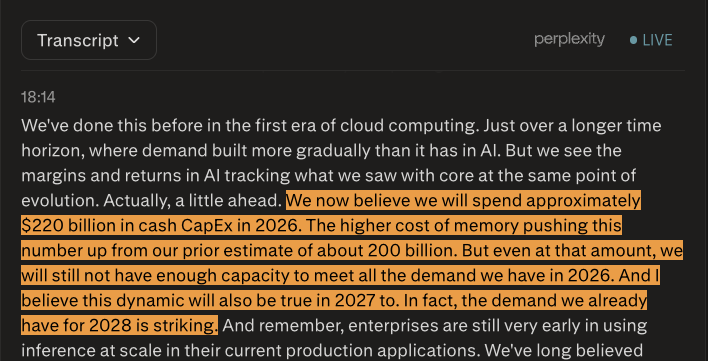
Amazon $AMZN on raising 2026 cash CapEx to $220B:
“The higher cost of memory is pushing this number up from our prior estimate of about $200 billion.”
“Even at that amount, we will still not have enough capacity to meet all the demand we have in 2026. I believe this dynamic will also be true in 2027.”
“The demand we already have for 2028 is striking.”
“We typically purchase servers and networking equipment a few months before putting them into service, so we have strong visibility into customer demand before we trigger the spend.”
“If the demand isn’t there, we won’t spend the capital for servers and networking equipment.”
$IREN: Generational Buying Opportunity?
Even after today's incredible market recovery, $IREN is still down nearly 50% from its local highs made in June.
There is no doubt that this has been one of the most vicious sell-offs in the company's history.
The question any rational investor should be asking at this point is whether the drawdown is justified. Is the market getting this right, or is it mispricing something and presenting investors with a significant opportunity?
While it's true that $IREN has been underperforming its peers this year, the honest truth is that most AI and data center related stocks have been sold off aggressively over the past few weeks.
Some of it comes down to valuations getting stretched, but a lot of the market-wide panic traces back to a couple of catalysts that spooked investors out of high beta AI stocks.
The first that comes to mind is the recent release of Kimi, a Chinese open weight model that's knocking on the door of the frontier, roughly one generation behind in capability.
To me this is a DeepSeek 2.0 moment, plenty of panic with little substance behind it. It's true that broader adoption of open weight models threatens the market position of the frontier labs, which have enjoyed extraordinary growth curves so far. But it is by no means a bad thing for hardware makers or cloud providers like $IREN.
After all, end users still have to run the model somewhere, meaning on a cloud provider's servers built from AI hardware. If anything, the commoditization of the model layer is a great thing for the companies upstream of it, as cheaper tokens lead to greater adoption of AI (think Jevons paradox).
The second scare, and the most recent one, is more nuanced. On Monday a report claimed that a Shanghai-based, state-backed firm has begun mass-producing homegrown DUV lithography machines, the deep-ultraviolet immersion tools ASML has dominated for years. $ASML fell as much as 8% intraday, and a lot of AI stocks went down with it.
I have since read plenty of reasonable takes from people far more knowledgeable on lithography than me. Some argue $ASML retains a significant lead for many years to come. Others point to China's track record of commoditizing high-end tech, pressuring the pricing power and market share of Western competitors, and argue it's only a question of time until they catch up.
As an $IREN investor, the eventual outcome is pretty much agnostic to me. It's either neutral or potentially even positive.
If China stays behind the frontier of DUV lithography for another decade, it's a non-event. If they catch up quickly, then if anything it should be read as a positive for anybody downstream of the hardware sellers.
Cheaper hardware directly reduces the capex a cloud provider needs, which is already a positive on its own. But push the thought further and ask what happens with the cost savings from cheaper hardware. This is a topic explored at length in our recent deep dive; The Golden Age of Neoclouds.
In a typical competitive market, those savings get passed down to the consumer, making it a neutral event for cloud providers. That only holds, however, if market participants can deploy enough of the cheaper hardware to compete the savings away through undercutting. I've argued in the report that the primary constraint heading into the end of this decade becomes access to power, and with it the ability to bring data centers online at scale.
The end result is that market forces, constrained by data center supply, will lead to most upstream cost savings consolidating at the cloud layer instead of passing through to the end consumer. Users still benefit from token costs falling through technological improvements, but hardware prices coming down is primarily a gift to cloud providers, at least until the power bottleneck lifts, which won't be for a very long time as I've argued in detail in the deep dive.
So to sum up, China getting into DUV lithography is either neutral or positive for $IREN. For some semi-related companies it's either neutral or negative, which makes the sell-off more rational as it relates to them.
So why is the market selling off the entire AI sector without caring about the nuances of how these events hit individual companies differently?
For one, markets rarely behave rationally. After a hot run, any negative-sounding news becomes an excuse to sell, and often to sell everything and ask questions later. Many investors also generalize instead of thinking impacts through the way more sophisticated ones do. And the AI industry being young and not yet well understood, with a limited track record, adds to the pile.
In any case, this has produced what I consider a generational buying opportunity in $IREN (NFA, of course).
Today the stock trades at ridiculous levels relative to the company's fundamentals. By the end of next year $IREN will have over 1.2 GW of data center capacity online, which should support ARR comfortably above $12 billion. Ironically, $IREN trades at a market cap of $12b today. Let that sink in…
I also get the concerns about profitability and dilution, but as someone who has done extensive modelling on this, I consider both fears overblown.
$IREN's most recent deals with $NVDA and AI-native enterprises carry very attractive project-level margins of over 25%. That accounts for guided COGS, depreciation of both the DC infrastructure and the GPUs, financing costs, and a hypothetical 21% tax if these projects were taxed in isolation (which they aren't, of course).
This gives a good picture of where $IREN's net income margins trend as the company scales. Management is investing heavily into branding and talent right now, but those expenses won't rise anywhere near as fast as the megawatts coming online, so operating leverage does the rest.
Today $IREN holds about 5.8 GW of secured power across a rapidly growing powered land portfolio. Once fully built out, that should comfortably carry $50-$60b in annual revenue. At net margins around 20%, which I deem a realistic long-term target at that scale, you're looking at $10-$12b of net income.
I believe $IREN is roughly 5-7 years away from that point. Given the tremendous earnings growth the path implies, multiple consecutive years of more than 100% growth, a PE of 50 would be very fair, if not conservative. That implies a market cap of $500-$600b.
The way I see it, the opportunity couldn't be more clear.
Even accounting for massive continued dilution, say outstanding shares more than tripling from today's levels, we're still looking at a share price around $500 in a relatively short timeframe.
And on dilution specifically, model out the pipeline and you'll notice the need for it diminishes over time as operating cash flows scale, all of which can and will be reinvested into growing the pipeline.
$IREN is currently in what I consider phase 1 of a decade-long growth spurt, with operating cash flows still tiny relative to where they'll be a few quarters from now, so the need for equity raises is at its highest right now and should gradually level off as revenue-producing capacity comes online.
Long story short, dilution isn't something I lose sleep over. It primarily comes down to whether $IREN delivers on the buildout of its powered land portfolio, which I believe they will given their track record.
The other factors I watch closely are competitors' ability to bring compute online and the useful lifespans of GPUs. Luckily both are trending in the right direction, with power scarcer than ever and GPU lifespans extending well beyond what most initially expected.
TLDR:
As someone invested in the stock since $4.8, I believe $IREN today trades at one of the most attractive valuations in the company's history, especially on a risk-adjusted basis.
Thank you for reading, cheers! ✌️
Finally, some welcome news.
In a report published today, JPMorgan said that most leveraged ETFs in the Korean stock market have been liquidated and estimated that hedge funds’ deleveraging is also about 90% complete.
8년 전, 윌과 나는 컴퓨트가 세상을 집어삼킬 거라고 생각해서 전력 기반 토지를 축적하기 시작했어요. 어떤 주에는 시장이 우리 의견에 더 동의하는 것 같기도 하고요.
오늘 우리가 아는 것: 우리 용량에 대한 수요가 우리가 지을 수 있는 모든 것을 초과하고, 2026년 목표인 40억 달러 이상의 85%가 이미 계약됐으며, 지금 우리 현장에 수천 명의 사람들이 콘크리트를 부으며 GPU를 랙에 설치하고 있어요.
우리는 이보다 훨씬 더 힘든 일을 겪어봤어요. 다시 시작합시다.
8 years ago Will and I started accumulating powered land because we thought compute would eat the world. Some weeks the market agrees with us more than others.
What we know today: demand for our capacity exceeds everything we can build, 85% of our $4bn+ 2026 target is signed, and there are thousands of people on our sites right now pouring concrete and racking GPUs.
We've been through way worse than this. Back to it.
주커버그, 더 빠른 AI 개발 촉구
마크 주커버그는 미국이 AI 개발을 가속화해야 한다고 촉구하며, 이 기술의 이점이 위험보다 크다고 주장하고 혁신을 늦출 수 있는 규제에 대해 경고했다.
메타 CEO는 또한 오픈소스 AI 모델을 제한하는 것에 반대하며, 미국의 경쟁력을 강화하는 데 초점을 맞춰야 하며 접근을 제한하는 대신 해야 한다고 말했다.
그의 발언은 메타가 실적 발표를 앞두고 AI 지출을 늘리는 가운데 나왔다.
ZUCKERBERG PUSHES FOR FASTER AI
Mark Zuckerberg urged the U.S. to accelerate AI development, arguing the technology's benefits outweigh its risks and warning against regulations that could slow innovation.
The Meta CEO also opposed restricting open-source AI models, saying the focus should be on boosting U.S. competitiveness rather than limiting access.
His comments come as Meta ramps up AI spending ahead of earnings.
① 시장의 불확실성이 매우 크다.
평소에는 연준 발표 직전이면 시장이 거의 한 방���으로 예상합니다(99% 수준).
그런데 이번에는 금리 인상 30%, 동결 70%로 의견이 크게 갈려 있습니다.
이런 상황에서는 발표 직후 주식, 채권, 달러가 평소보다 훨씬 크게 움직일 가능성이 있습니다.
② 연준이 일부러 힌트를 주지 않았다.
보통 연준 의장은 연설을 통해 시장이 어느 정도 예상하도록 유도합니다.
이번에는 그런 ‘선행 가이던스’가 거의 없어 시장이 마지막까지 방향을 잡지 못하고 있습니다.
따라서 기자회견의 한마디 한마디가 시장을 크게 흔들 수 있습니다.
③ 글쓴이는 금리 인상이 없을 것으로 보고 있다.
이유는 크게 두 가지입니다.
트럼프 대통령이 차기 연준 의장에게 금리 인하 성향을 중요하게 본다고 여러 차례 언급해왔다는 점.
최근의 에너지 가격 상승(이란 관련 리스크)은 일시적일 가능성이 있어, 연준이 이를 이유�� 금리를 올릴 정도는 아니라는 판���입니다.
즉, 이번 FOMC의 핵심은 0.25% 금리 변화 자체가 아니라 앞으로의 방향성입니다.
만약 금리 동결과 함께 9월 또는 연말 인하 가능성을 시사하면, AI·반도체·데이터센터 같은 성장주에는 긍정적으로 작용할 가능성이 큽니다. 반대로 동결하더라도 “인플레이션이 여전히 걱정된다”며 매파적인 발언을 하면, 금리를 올리지 않았더라도 성장주가 하락할 수 있습니다.
즉, 내일 시장은 ‘금리를 올렸냐, 안 올렸냐’보다 파월 의장의 기자회견에서 앞으로 금리를 어떻게 가져갈 것이라고 말하는지가 훨씬 더 중요합니다.
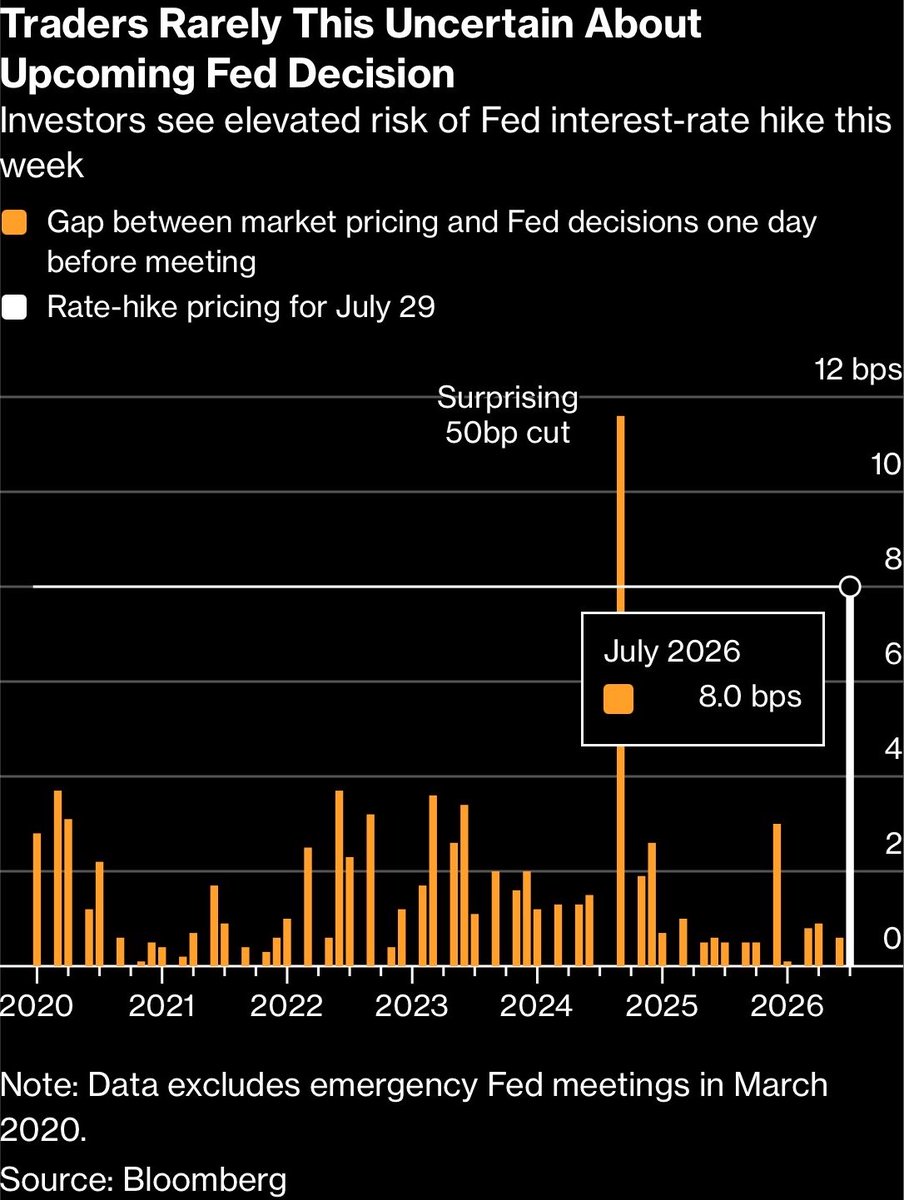
Tomorrow is going to be a historic day.
Market expectations for tomorrow's Fed decision are among the most divided in recent history.
Currently, interest rate futures imply a ~30% chance of a rate hike and a ~70% chance of rates remaining unchanged.
By comparison, nearly every Fed meeting since March 2020 has entered decision day with ~99% consensus.
Adding to the uncertainty, Fed Chair Warsh has effectively eliminated forward guidance, leaving markets with little direction ahead of the announcement.
That said, we continue to believe that the Fed will NOT hike interest rates tomorrow.
It's important to not forget that just months ago, President Trump said a "pre-condition" for his next Fed Chair was a willingness to cut rates.
And, the Iran War energy shock is likely to continue being labeled as a "temporary inflationary event" rather than a structural one, the labor market is weak, and Americans are already struggling with high interest rates.
We think the Fed PAUSE continues tomorrow.
인플렉션에 오신 것을 환영합니다, 조셉 벅 박사님!
조는 인플렉션에 양자 컴퓨팅 시스템 수석 부사장으로 합류하며, ���리 확장 가능한 중성 원자 양자 컴퓨터인 스퀠(Sqale)의 개발을 이끌게 됩니다. 그의 경력은 20년 이상에 걸쳐 양자, 광학, 광자 시스템을 구축하며 연구에서 정부, 국방, 상업 고객을 위한 배포된 기술로 발전시킨 경험을 포함합니다.
인플렉션이 영국, 일본, 그리고 곧 일리노이에서 배포를 확대함에 따라, 조의 획기적인 과학을 신뢰할 수 있고 확장 가능한 시스템으로 전환하는 깊이 있는 경험은 유틸리티 규모의 내결함성 양자 컴퓨팅을 향한 우리의 여정을 가속화하는 데 도움이 될 것입니다. 우리는 차세대 양자 기술을 지속적으로 구축하면서 그를 팀에 영입하게 되어 기쁩니다.
Welcome to Infleqtion, Dr. Joseph Buck!
Joe joins Infleqtion as Senior Vice President of Quantum Computing Systems, where he will lead development of Sqale, our scalable neutral-atom quantum computer. His career spans more than two decades building quantum, optical, and photonic systems that have moved from research into deployed technologies for government, defense, and commercial customers.
As Infleqtion expands deployments in the U.K., Japan, and soon Illinois, Joe's deep experience in translating breakthrough science into reliable, scalable systems will help accelerate our path toward utility-scale, fault-tolerant quantum computing. We're excited to have him on the team as we continue building the next generation of quantum technology.
Read more: https://t.co/w2FrZDs3JP
단순한 공동 연구가 아니라, 인플렉션의 핵심 제품인 Tiqker가 미국의 실제 양자 네트워크 인프라에서 성능을 검증받는다는 점이 중요합니다.
연구실이 아닌 실환경에서 기술력을 입증하면 향후 정부·국방·통신 분야의 상용화 가능성이 높아질 수 있으며, 이는 인플렉션이 양자컴퓨팅뿐 아니라 양자 네트워크와 양자 센싱 생태계에서도 핵심 기술 기업으로 ���리 잡으려는 전략을 보여주는 의미 있는 진전입니다.
$INFQ 인플렉션(Infleqtion)이 미국의 실제 양자 네트워크에서 자사 기술을 시험하고, 미래의 군사·통신·자율주행 기술에 활용될 수 있도록 검증하는 프로젝트에 참여한다”는 내용이다
인플렉션은 미국 유일의 개방형 양자 네트워크인 ABQ-Net에 참여해 자사의 Tiqker 광학 원자시계가 실제 양자 네트워크에서 얼마나 정확하게 시간을 맞출 수 있는지 시험합니다.
양자 네트워크는 모든 장비가 나노초보다 훨씬 더 정밀하게 같은 시간을 공유해야 제대로 작동하기 때문에, Tiqker가 이 역할을 성공적으로 수행하면 인플렉션의 기술력이 실제 환경에서 입증되는 것입니다.
왜 중요하냐면,
현재 대부분의 양자 기술은 연구실에서만 테스트됩니다.
하지만 ABQ-Net은 실제 광섬유 네트워크를 이용해 양자 기술을 시험하는 실전 테스트베드입니다.
즉,
연구실 성능이 아니라
실제 환경에서도 잘 작동하는지를 검증하는 단계입니다.
이런 검증을 통과해야 정부와 기업이 안심하고 기술을 도입할 수 있습니다.
Tiqker는 무슨 역할을 하나?
Tiqker는 초정밀 광학 원자시계입니다.
양자 네트워크에서는 여러 장비가 동시��� 같은 시간에 움직여야 하는데,
Tiqker는 그 시간을 매우 정확하게 맞춰주는 ‘양자 세계의 기준시계’ 역할을 합니다.
쉽게 말하면
GPS 위성이 정확한 시계가 있어 위치를 계산하듯,
양자 네트워크도 Tiqker 같은 초정밀 시계가 있어야 제대로 작동합니다.
방위산업과도 연결된다
이번 프로젝트는
군사 통신
��론·자율무기
분산형 양자 센서
차세대 보안 통신
같은 미국 국방 분야에서도 활용될 가능성을 염두에 두고 진행됩니다.
즉 단순한 연구가 아니라 국방 응용 기술 검증까지 포함된 프로젝트입니다.
Quantum technologies move faster when they can be tested on shared, real-world infrastructure.
That's why we're excited to join ABQ-Net, America's only open-access, entanglement-based quantum network, where Infleqtion will validate coherent, quantum-timed synchronization using our Tiqker optical atomic clock for distributed quantum sensors. This work supports near-term defense applications while advancing future capabilities for autonomous systems and next-generation telecommunications.
Open testbeds like ABQ-Net help accelerate commercialization by giving innovators a place to validate deployable technologies, strengthen interoperability, and build a more connected quantum ecosystem.
We look forward to collaborating with @QunnectInc, the New Mexico Economic Development Department (@nmecondev), and Roadrunner Venture Studios as we help advance the next generation of quantum networking and sensing technologies.
Learn more: https://t.co/CQXP1PfVDt
Welcome to Infleqtion, Dr. Joseph Buck!
Joe joins Infleqtion as Senior Vice President of Quantum Computing Systems, where he will lead development of Sqale, our scalable neutral-atom quantum computer. His career spans more than two decades building quantum, optical, and photonic systems that have moved from research into deployed technologies for government, defense, and commercial customers.
As Infleqtion expands deployments in the U.K., Japan, and soon Illinois, Joe's deep experience in translating breakthrough science into reliable, scalable systems will help accelerate our path toward utility-scale, fault-tolerant quantum computing. We're excited to have him on the team as we continue building the next generation of quantum technology.
Read more: https://t.co/w2FrZDs3JP
Quantum technologies move faster when they can be tested on shared, real-world infrastructure.
That's why we're excited to join ABQ-Net, America's only open-access, entanglement-based quantum network, where Infleqtion will validate coherent, quantum-timed synchronization using our Tiqker optical atomic clock for distributed quantum sensors. This work supports near-term defense applications while advancing future capabilities for autonomous systems and next-generation telecommunications.
Open testbeds like ABQ-Net help accelerate commercialization by giving innovators a place to validate deployable technologies, strengthen interoperability, and build a more connected quantum ecosystem.
We look forward to collaborating with @QunnectInc, the New Mexico Economic Development Department (@nmecondev), and Roadrunner Venture Studios as we help advance the next generation of quantum networking and sensing technologies.
Learn more: https://t.co/CQXP1PfVDt
Citadel expects the Fed to raise interest rates this week — a surprise move strengthening Chairman Kevin Warsh’s credibility in the battle with inflation https://t.co/mpWAq3gJk0
제 점점 강해지는 의견은 컴퓨트가 AI에서 가장 큰 해자라는 것입니다.
과학적 돌파구는 오래 비밀로 유지되지 않습니다. 논문이 발표되고, 연구자들이 이동하며, 아이디어가 유출되고, 오픈 소스가 따라잡습니다. 충분한 시간이 주어지면 거의 모든 사람이 대략적으로 동일한 알고리즘에 접근할 수 있습니다.
거의 그렇게 빠르게 확산되지 않는 것은 10배 더 큰 훈련 실행을 할 수 있는 능력, 10배 더 많은 RL 경험을 수집할 수 있는 능력, 수십억 개의 추론 토큰을 제공할 수 있는 능력, 그리고 수천 개의 실험을 병렬로 감당할 수 있기 때문에 더 빠르게 반복할 수 있는 능력입니다.
컴퓨트를 확장하는 것은 잔인할 정도로 어렵습니다. GPU, 전력, 변전소, 네트워킹, 냉각, 토지, 허가, 공급망… 그리고 수천억 달러입니다. 하룻밤 사이에 그냥 결정해서 구축할 수는 없습니다.
산업을 볼수록, 프론티어는 하나의 천재적인 아이디어를 가진 것에 관한 것이 아니라, 누가 컴퓨트를 가장 빠르게 복합적으로 증가시킬 수 있는지에 관한 것처럼 느껴집니다. 스케일링 법칙은 계속 스케일링할 수 있는 사람을 보상합니다. imo, 그건 복제하기 매우 어려운 해자입니다!
My increasingly strong opinion is that compute is the biggest moat in AI.
Scientific breakthroughs don’t stay secret for long. Papers get published, researchers move, ideas leak, open source catches up. Give it enough time and almost everyone has access to roughly the same algorithms.
What doesn’t diffuse nearly as fast is the ability to run 10x bigger training runs, collect 10x more RL experience, serve billions of inference tokens, and iterate faster because you can afford thousands of experiments in parallel.
Scaling compute is brutally hard. It’s GPUs, power, substations, networking, cooling, land, permits, supply chains… and hundreds of billions of dollars. You can’t just decide to build that overnight.
The more I look at the industry, the more it feels like the frontier is less about having one genius idea and more about who can compound compute the fastest. Scaling laws reward whoever can keep scaling. That’s a very hard moat to replicate imo!
우리는 NVIDIA와의 장기적인 전략적 파트너십을 발표합니다. NVIDIA는 SSI에 상당한 투자를 진행하며, 이를 통해 향후 12개월 내에 우리의 컴퓨팅 규모를 10배로 확대할 수 있게 될 것입니다. 우리의 연구가 확장할 가치가 있는 단계에 도달했으며, 이 파트너십을 통해 이를 실현할 수 있게 되었습니다. NVIDIA의 확신에 영광을 느낍니다.
We are announcing a long-term strategic partnership with NVIDIA. NVIDIA is making a substantial investment in SSI that will let us 10x our compute in the next 12 months. We reached the point where our research is worth scaling and with this partnership we will be able to. We are honored by NVIDIA’s conviction.
BREAKING: Nvidia is in talks with OpenAI to guarantee $250 billion in financing for a data center in Ohio.
Details include:
1. The guarantees from Nvidia would help OpenAI lease a 10GW project that SoftBank is developing in Ohio
2. In total, the project could cost more than $500 billion, the largest data center project ever announced
3. The power for the project is controlled by the US government and funded separately by Japan under a recent trade deal
4. Commerce Secretary Lutnick is reportedly involved in deciding who will get the power
The data center buildout just hit a whole new level.
My increasingly strong opinion is that compute is the biggest moat in AI.
Scientific breakthroughs don’t stay secret for long. Papers get published, researchers move, ideas leak, open source catches up. Give it enough time and almost everyone has access to roughly the same algorithms.
What doesn’t diffuse nearly as fast is the ability to run 10x bigger training runs, collect 10x more RL experience, serve billions of inference tokens, and iterate faster because you can afford thousands of experiments in parallel.
Scaling compute is brutally hard. It’s GPUs, power, substations, networking, cooling, land, permits, supply chains… and hundreds of billions of dollars. You can’t just decide to build that overnight.
The more I look at the industry, the more it feels like the frontier is less about having one genius idea and more about who can compound compute the fastest. Scaling laws reward whoever can keep scaling. That’s a very hard moat to replicate imo!
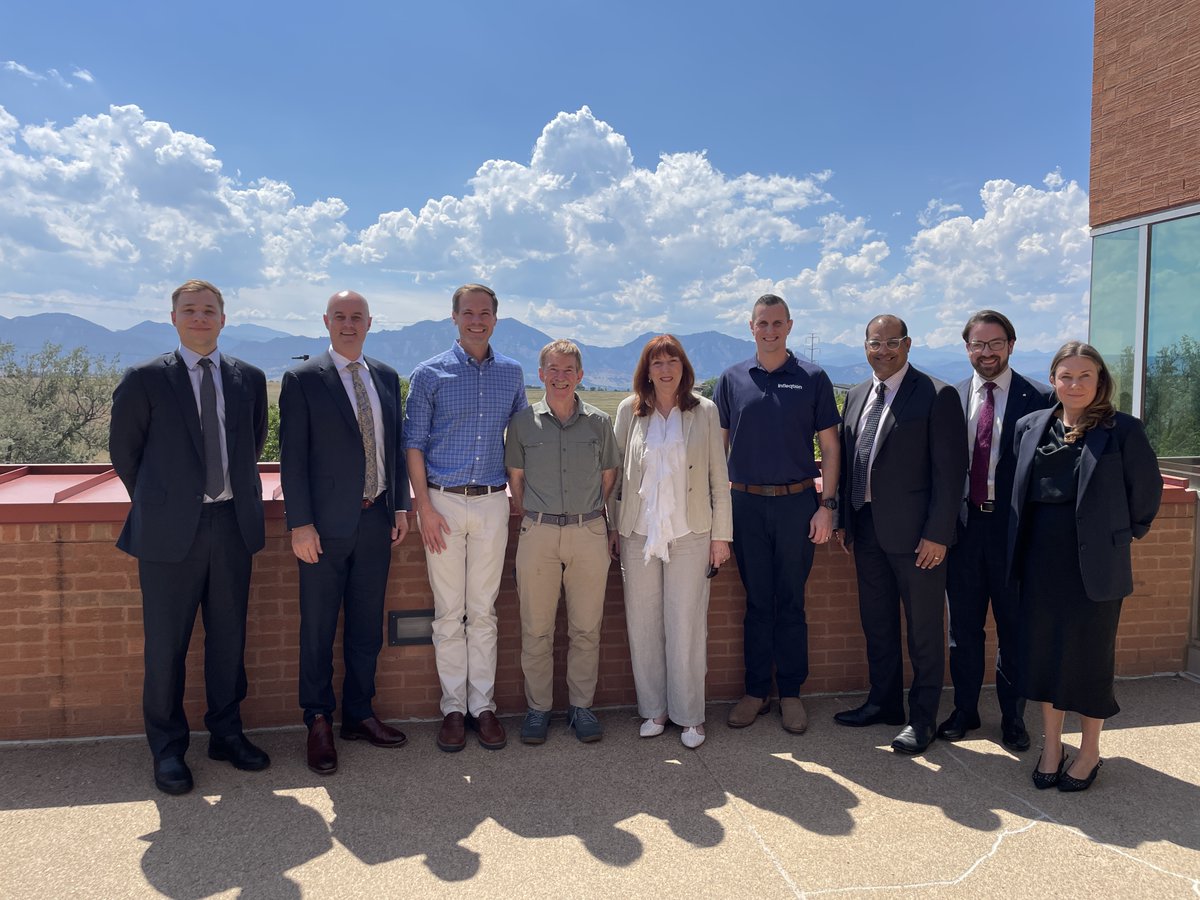
Last week, we welcomed Her Excellency the Governor of Victoria, Australia Margaret Gardner, Commissioner to the Americas Brett Stevens, and their delegation to Infleqtion's Colorado headquarters for a discussion on the future of quantum technology.
The visit included conversations with Matt Kinsella and Dr. Dana Z. Anderson, along with demonstrations of our quantum computing, quantum sensing, precision timing, and RF technologies. It was a valuable opportunity to exchange ideas and explore how international collaboration can help accelerate the commercialization and deployment of quantum technologies.
Thank you to Governor Gardner, Brett Stevens, and the entire delegation for visiting. We look forward to continuing to strengthen the ties between the U.S. and Australia as the global quantum ecosystem continues to grow.
여러 역풍들이 동시에 몰려오는 때가 있는데, 역사적으로 이번이 그중 하나일 가능성이 높아 보입니다. 지난 37년 동안 8월–9월은 S&P 500의 가장 약세를 보인 두 달 구간이었으며, 8월–10월은 평균적으로 가장 약한 3개월 수익률을 기록했습니다. 올해는 또한 4년 주기의 2년째에 해당하며, 역사적으로 이 기간은 더욱 도전적인 시기였습니다.
채권 수익률 상승과 에너지 가격 급등이 방정식에 들어오면 우려는 더욱 커집니다. 가장 최근의 주목할 만한 사례는 2022년이었습니다. ��사한 조건은 1990년 걸프 전쟁 기간과 1987년 10월 폭락 직전에도 발생했습니다. 각 경우에 채권 수익률은 상승했고, 에너지 가격은 강세를 보였으며, 주식은 수익률이 주식과 역상관 관계를 회복하면서 어려움을 겪었습니다.
오늘날 상황은 익숙합니다. S&P GSCI 에너지 지수는 불과 5주 만에 약 30% 급등한 반면, 글로벌 채권 수익률은 2008년 금융 위기 발발 이후 최고 수준으로 상승했습니다. 한편, 채권 수익률과 주식 간의 역상관성은 수십 년 만에 가장 강력한 수준입니다.
역사는 정확히 반복되지는 않지만, 종종 운율을 맞추듯 반복됩니다. 강력한 실적, 탄력적인 경제 성장, 또는 완화되는 지정학적 긴장감이 시장이 이러한 계절적 경향을 극복할 수 있게 할 수는 있습니다. 하지만 여러 역사적 역풍들이 줄을 서 있는 상황에서, 8월/9월로 접어드는 시기는 절제, 신중한 ���스크 관리, 그리고 의견이 아닌 증거가 당신의 결정을 이끄는 시간을 맞아야 합니다.
There are times when multiple headwinds align, and history suggests this may be one of them. August–September has been the weakest two-month stretch for the S&P 500 over the past 37 years, while August–October has produced the weakest average three-month returns. This year also falls in the second year of the four-year cycle, a period that has historically been even more challenging.
The concern grows when rising bond yields and higher energy prices enter the equation. The last notable example was 2022. Similar conditions also developed in 1990, during the Gulf War, and in 1987, ahead of the October crash. In each case, bond yields moved higher, energy prices strengthened, and stocks struggled as yields regained an inverse relationship with equities.
Today, the setup is familiar. The S&P GSCI Energy Index has surged roughly 30% in just five weeks, while global bond yields have climbed to their highest levels since the onset of the 2008 financial crisis. Meanwhile, the inverse correlation between bond yields and equities is the strongest it's been in decades.
History never repeats exactly, but it often rhymes. Strong earnings, resilient economic growth, or easing geopolitical tensions could certainly allow the market to buck these seasonal tendencies. But with multiple historical headwinds lining up, going into August/September is a time for discipline, prudent risk management, and letting the evidence—not opinions—guide your decisions.
https://t.co/JXzFFTmMtn
중국이 반도체 핵심 장비를 국산화하기 시작했다는 점입니다.
만약 중국의 DUV 장비 성능이 충분히 좋아진다면 중국은 ASML 같은 해외 업체에 덜 의존하게 되고, 장기적으로는 ASML과 미국 반도체 장비 기업들의 중국 매출이 감소할 ��능성이 있습니다.
반대로 중국 반도체 산업의 자립은 더욱 빨라질 수 있다는 의미입니다. 다만 ‘대량 생산’이 곧바로 ASML과 같은 수준의 성능을 확보했다는 뜻은 아니므로, 실제 성능과 수율이 검증되는지가 앞으로 더 중요한 관점입니다
“중국이 이제 첨단 반도체를 만드는 핵심 장비를 직접 만들기 시작했다는 소식 때문에, ASML 같은 장비 회사 주가가 떨어진 것”입니다.
지금까지 중국은 첨단 반도체를 만들려면 네덜란드 ASML의 DUV 노광장비를 사야 했습니다.
그런데 미국의 수출 규제로 중국은 이 장비를 마음대로 구매하기 어려워졌습니다.
그래서 중국은 국가 지원을 받아 자체 DUV 노광장비를 개발해 왔습니다.
이번 보고서에서는 중국 기업이 이 DUV 장비를 ‘대량 생산’하기 시작했다는 내용이 나왔습니다.
이 소식이 사실이라면 투자자들은 이렇게 생각합니다.
“앞으로 중국이 ASML 장비를 예전처럼 많이 사지 않아도 되겠네.”
그러면
ASML의 중국 매출이 줄어들 수 있고,
미국 반도체 장비 업체들의 중국 매출도 감소할 수 있습니다.
그래서 ASML과 미국 반도체 장비 기업들의 주가가 하락한 것입니다.
CHIP STOCKS DROP ON CHINA DUV REPORT
ASML and U.S. chip equipment stocks fell after a report said a state-backed Chinese firm has begun mass-producing domestic DUV lithography machines.
Investors fear the breakthrough could reduce China's reliance on ASML and other Western suppliers, weakening future sales and undermining the long-term impact of U.S. export restrictions.