Introducing Facade Code, a VS Code extension that lets Claude Code, Codex and other coding agents work together.
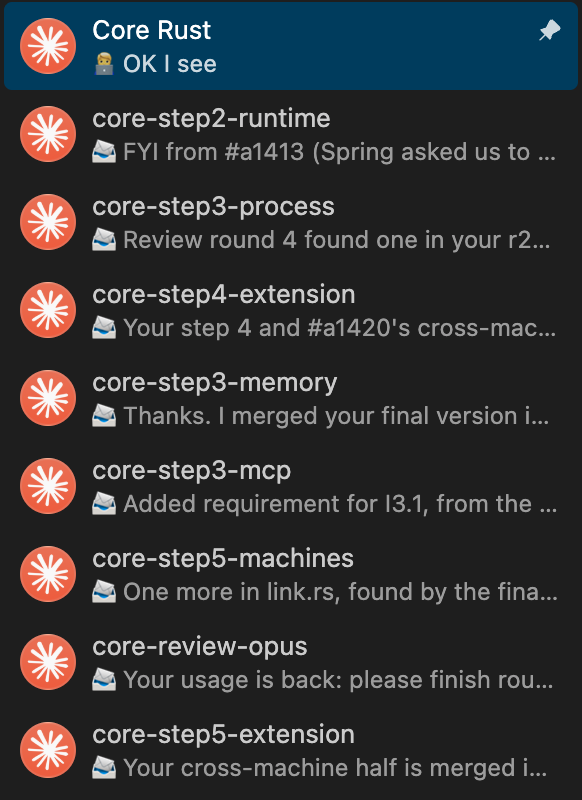
- Agent Panel: run many agents side by side in the VS Code you already use, with your own subscriptions. No new IDE.
- Agent Use: agents can start other agents, send them messages, and type into their terminals.
- Agent Mesh: they work across all your windows and remote machines, and you can manage them from your phone.
In the video: I start agents in VS Code and they open in the editor like any tab, they message and control each other, and from my phone I control 17 agents across my Mac and an SSH machine.
Free and open source (MIT): https://t.co/5Gz6TJNsfh
@shayank81546309 Agents continue using their native harnesses for optimal performance. I built the inter-agent communication layer using terminal and the MCP protocol.
@graycode007@fazle_rabbi_dev The goal is not to replace existing setup. Same VS Code, same CLIs. We just add a panel in VS Code to bring everything into one place for easier management and let agents talk to each other to improve efficiency.
@rgs_2_tahsin Yes, offloading DAG and prompt design to SOTA models through agent use. SOTA models can design better DAGs and prompts than humans. Humans can monitor the agents in VS Code, alongside the code and diffs.😀
Working on performance optimization for Facade Code now.
My Rust TL is refactoring the agent-use and agent-mesh systems for better architecture, maximum performance, and minimal memory usage.
He said it'd take several days. I pushed him to get it all done overnight, so he spun up a few agents to help.
Looking good so far. I checked on his agents, and they're all on track.
Now we're reviewing the code together to make sure everything is solid.
Shipping in the next few days! 🚀
I think using Codex CLI directly is pretty limited. Running Codex CLI only gives you a background CLI. You can't send it multiple rounds of prompts or interact with it during the process. "Foreground" lets you work directly with Codex, and you can also let Codex keep its context across multiple Claude sessions. For example, I have a long-running PM Codex that reviews the work of multiple Claude engineers.
Memory isn't shared since they're using stock harness. Sharing files is the standard way. Besides that, the agent-use pattern offers another way (read screen). When Claude runs out of usage, I just start Codex and tell it to read Claude's screen and figure out what's going on. It works well.
Thank you! 😀 I was thinking about building terminal apps for Android and iOS, but gave up. I felt they'd be too hard to use. Then I found out Claude already has this feature. With a little extra work, Claude could become a personal assistant on my phone to control an entire agent cluster.
@AmeliaonAI Yes, I added an agent-use feature to let agents use other agents for me. Before, I could only manage 1–3 agents in parallel. Now I can have one agent manage dozens of other agents and run many more jobs in parallel.😀
@tshu_w Looks pretty different to me. Facade Code supports agents across different native harnesses, with a GUI. Feel free to give it a try and share your feedback! 😀
I like the way Grok Bot lets agents coordinate. My goal is to build a Grok Bot IDE where agents share the same codebase and coordinate to get work done for humans. It also supports worktree isolation so they don't step on each other's toes. The IDE is a window for humans to observe the agents.