Let me tell you a story, Hanan.
I’m Vietnamese.
In 1954, the Western powers, fresh from centuries of colonial conquest, decided Vietnam should be cut in half.
Not because the Vietnamese asked for it.
Not because it was just.
But because it served imperial interests.
The North would go to us, the ones who had bled to defeat the French.
The South would be handed to a U.S.-backed regime we never chose.
They called it a "compromise."
They called it a "solution."
They said we should accept it, and there’ll be peace.
That half a country is better than none.
That resistance would only bring needless suffering.
But we refused.
Because Vietnam is not a bargaining chip.
We are not a parcel to be divided by strangers and called free.
And when we resisted, they called us unreasonable.
They called us terrorists.
They said we were the problem.
Sound familiar?
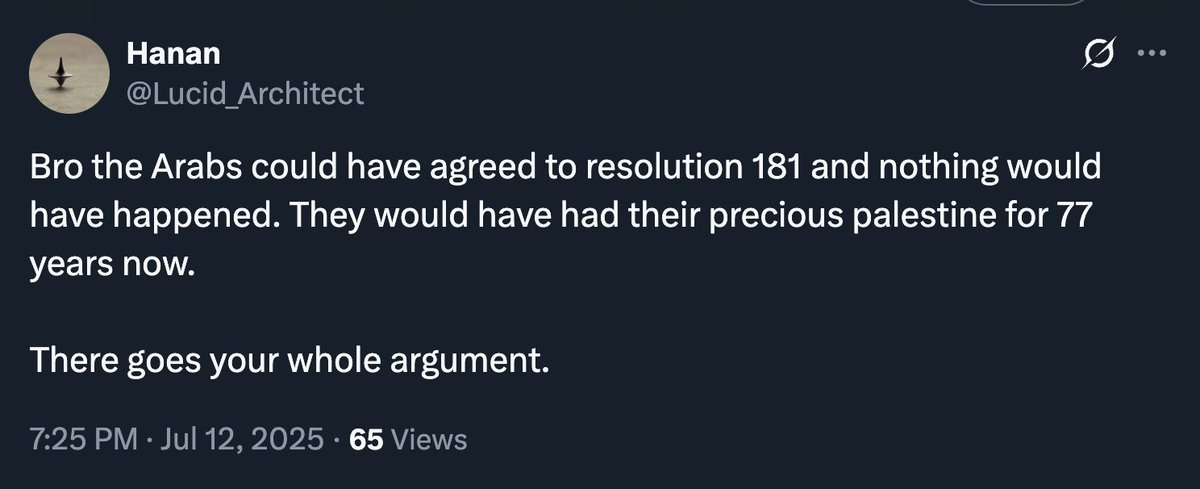
What you just said about Palestinians—that they should have accepted UN Resolution 181 and been grateful for half a homeland—is exactly what they told us.
And we proved them wrong.
We fought not because we hated peace.
We fought because real peace cannot come from foreign dictates, settler violence, and forced partitions.
We fought because no people should be told to accept half their dignity so someone else can sleep at night.
We fought because Vietnam is one.
Not north, not south, but whole.
And we won.
Now you expect Palestinians to do what we never would.
To accept their homeland divided.
Their history rewritten.
Their future stolen.
To say yes to a plan they never agreed to.
Written by people who did not live there.
Giving away land that was never theirs to offer.
You call that a missed opportunity.
We call it resistance to dismemberment.
Palestinians said no because they knew what we knew:
To accept a settler’s map is to erase your own.
So don’t talk to me about Resolution 181.
Talk to me about the villages wiped off the map.
Talk to me about the mass graves and refugee camps that followed.
Talk to me about the families still holding the keys to homes they are forbidden to return to.
Vietnam refused partition. And today we are whole.
Palestine did the same. And for that, they are still being punished.
But they were right to refuse.
Just like we were.
Just like the Algerians were.
Just like the South Africans were.
And one day, like us, they will reclaim everything that was stolen.
Because memory is stronger than force.
And the land never forgets who it belongs to.
في سورة يوسف هو بيوصفلك موقف أخو سيدنا يوسف وهو داخل مع اخوته وسيدنا يوسف بيقوله (أنا أخوك فلا تبتئس) بعيدا عن المقامات علشان مصعبهاش عليك شوف الحنية اللي بتتوجد في صوت الشيخ رفعت وهو بيقرا (أنا أخوك فلا تبتئس) هو بيوصلك شعور أخو سيدنا يوسف أخيرا في إنه لقى حد أخيرا حاسس بيه
عندي نظرة غريبة شوية في تفضيل طوبار على النقشبندي و طه الفشني، النقشبندي والفشني أنت تشعر أن الحياة تشع جمال ونغم من فرط جمال ونعومة أصواتهم، ولكن الميزة اللي بتميز طوبار عندي أكتر، إن طوبار صوته عميق وقوي بشكل محزن، بحس إن طوبار صوته سلوى للحزانى أمثالنا (1)
Brian Cox reads If I Must Die, by beloved Palestinian poet, teacher and martyr Refaat Alareer.
Refaat was killed on December 7th by an Israeli airstrike.
This was the last poem he published.
Remember Khaled, the grandfather of little Reem who was killed, the soul of his soul?
Ever since the truce ended, he’s been seen at this hospital trying to help triage people and comforting other children who have been injured from Israeli air strikes.
There are no words.
🧵 thread
Photographs depicting the destruction of main and popular sites in Gaza City, captured before and after their destruction during the ongoing war. Photo credit: [@munigaza]
1. Rashad Shawwa Cultural Center


![ytirawi's tweet photo. 🧵 thread
Photographs depicting the destruction of main and popular sites in Gaza City, captured before and after their destruction during the ongoing war. Photo credit: [@munigaza]
1. Rashad Shawwa Cultural Center https://t.co/TeIwXF7b1t](https://pbs.twimg.com/media/F_7w2nFXMAAvdnU.jpg)






![ytirawi's tweet photo. 🧵 thread
Photographs depicting the destruction of main and popular sites in Gaza City, captured before and after their destruction during the ongoing war. Photo credit: [@munigaza]
1. Rashad Shawwa Cultural Center https://t.co/TeIwXF7b1t](https://pbs.twimg.com/media/F_7w2nFXcAA6eXa.jpg)


