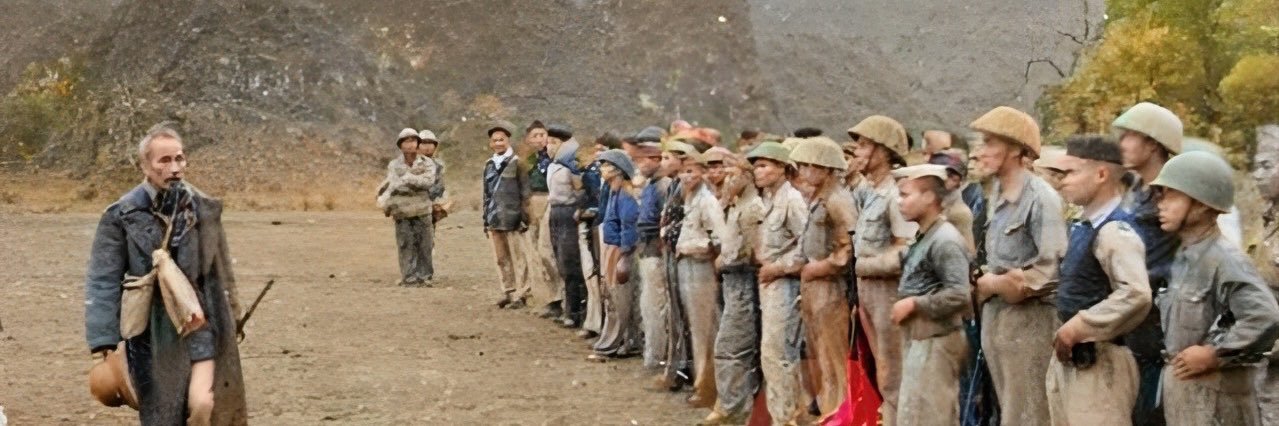
They said no one could stand against empire.
But Vietnam did.
And we didn’t fight with words alone.
We fought with steel in our spine and fire in our lungs.
We fought barefoot in the mud, with rusted rifles, against superpowers who thought the world was theirs to rule.
We made them bleed until they crawled back across oceans—beaten, broken, and no longer so sure of themselves.
And we built what they said could never rise—a nation that never forgot the cost of freedom.
Empire is not eternal.
Resistance is.
When countries have tried to price their oil in other currencies, interesting things have happened to them.
Saddam Hussein announced in 2000 that Iraq would price its oil in euros.
Muammar Gaddafi was building toward a pan-African gold-backed currency for oil transactions.
Both countries experienced American military intervention.
There are other reasons for those interventions. There are always other reasons. Geopolitics is never monocausal.
But the pattern is there, and it is consistent, and it rewards attention.
The dollar's monopoly is not maintained by its inherent attractiveness alone.
It is maintained by the consequences available to countries that threaten it.
That maintenance is expensive.
The military budget that makes it possible costs over a trillion dollars a year.
Which is financed by the dollar's monopoly.
Which is maintained by the military.
The circle is the point.
Breaking into it from the outside is the specific challenge every alternative faces.
Global trade is conducted primarily in dollars.
Oil is priced in dollars. Commodities are priced in dollars. If you are a central bank in Vietnam, Nigeria, Brazil, or anywhere else, you need dollar reserves to function in the international system.
That need, structural, inescapable, built into the plumbing of the global economy after Bretton Woods, creates permanent demand for dollars regardless of what the United States does with its own finances.
Permanent demand for your currency means you can print more of it without the inflation that would punish any other country for the same behavior.
It means your deficits are, in a very real sense, financed by the entire world.
It means the rest of the planet is making an involuntary contribution to American military spending, American consumption, and American political stability.
This is not trade. It is tribute.
The terminology was just updated.
The United States has the largest national debt in human history.
Over $40 trillion.
If you ran those numbers through the standard IMF playbook, the one they apply to developing countries, the prescription would be immediate and brutal.
Cut public services. Raise interest rates. Open your markets. Accept oversight.
Demonstrate fiscal discipline or watch your currency collapse and your economy contract while foreign capital exits.
That playbook has been applied to Argentina. To Greece. To dozens of African and Latin American countries whose debt burdens were a fraction of America's.
The United States has never received that visit.
The IMF is headquartered in Washington.
This is not a coincidence. It is the architecture.
Human beings, everywhere they have lived for sufficient time, develop complexity.
They build cities when population density and agricultural surplus make cities possible.
They develop governance when the coordination of large groups requires it.
They produce art, mathematics, philosophy, and science because these are not the products of particular bloodlines or particular geographies.
They are the products of human minds engaging seriously with the problems of being alive.
Every continent has its Newtons. Every culture has its Aristotles.
Most of them are not in the story called "Western history."
Not because they didn't exist.
Because including them would require a different story about why the world looks the way it does.
A story where the wealth is not the product of superior civilization.
A story where the poverty is not the product of inferior culture.
A story where what the ships brought was not enlightenment but the specific, brutal, world-historical advantage of guns combined with the will to use them and the paperwork to call the using of them "righteous."
That story is harder to live inside.
It does not flatter the inheritors.
But it has the considerable advantage of being true.
And truth, unlike the other kind of story, does not require the continued erasure of billions of people to hold itself together.
The management of history is not primarily accomplished by lying.
Outright lies are fragile. They can be checked. They contradict the record. They require active maintenance.
The management of history is primarily accomplished by emphasis.
By what gets a chapter and what gets a footnote.
By whose suffering generates named, dated, individual stories and whose suffering generates aggregate statistics.
By whose knowledge systems get called "science" and whose get called "folklore."
By whose urban centers get called "cities" and whose get called "settlements."
By whose wars get called "battles" and whose get called "resistance."
None of these choices require anyone to lie.
They require only the accumulated, generationally transmitted, institutionally reinforced decision about what is worth taking seriously.
That decision was made by the people who wrote the textbooks.
Who were, in most cases, the descendants of the people who conducted the conquest.
You want to understand what was lost?
Not just the people. Not just the land. Not just the gold.
The knowledge.
Ethnobotanists estimate that indigenous peoples of the Amazon had identified and were using thousands of plant species for medicine, food, and agriculture, knowledge built over millennia of direct relationship with one of the most biodiverse ecosystems on earth.
As indigenous populations were destroyed and their knowledge systems with them, that understanding largely disappeared.
Pharmaceutical companies now spend billions trying to recover fragments of it.
The same knowledge that was dismissed as "superstition" by the priests who burned the codices is now being reverse-engineered by scientists who understand what was actually there.
This is not a metaphor.
This is a material, measurable, ongoing loss that affects human capacity to address disease, to maintain biodiversity, to understand ecosystems we are destroying faster than we can study them.
The ships did not bring knowledge to places that had none.
They destroyed knowledge systems that had no equivalent and cannot be reconstructed.
And they called the destruction "civilization."
Photo: Tenochtitlán, circa 1518.
3D reconstruction by Thomas Kole.
The Aztec capital, built on Lake Texcoco, sustained by an extraordinary network of canals, causeways, aqueducts and hydraulic engineering.
One of the greatest urban achievements of pre-Columbian America, devastated during the Spanish-led conquest of 1521.
Source: https://t.co/AzqR84dE8F
Tenochtitlán was built on a lake.
Think about what that requires.
It requires engineering solutions to problems that don't exist on dry land: foundations, water management, flood control, fresh water supply, waste management, transportation, agricultural production without conventional soil.
The Aztecs answered every one of them.
The chinampas, the "floating gardens," are an agricultural innovation that modern agronomists study and in some cases recommend as a sustainable food production model.
The Spanish destroyed the city in 1521 and built Mexico City on top of it.
Mexico City, built on the drained lake bed without the hydraulic management systems that the Aztecs had developed over centuries to handle the unstable ground, has been slowly sinking ever since.
It has sunk approximately 12 meters in the last century.
Parts of it sink by more than 30 centimeters per year.
The civilization that was replaced knew something about how to build on that land.
The civilization that replaced it destroyed that knowledge along with everything else.
And is now living with the structural consequences.
Every empire needs a theory of the people it is about to dispossess.
The theory does not need to be coherent. It needs to be functional.
It needs to answer, in advance, the question that any moral person would ask when confronted with the destruction of a city of 200,000 people:
"But weren't they... people? With cities and knowledge and families and history?"
The theory says: not quite. Not fully. Not in the way that counts.
Cortés had the theory of the pagan, the idolater, the soul requiring salvation even at the cost of the body.
Later empires had the theory of the "savage," the "primitive," the "underdeveloped," the "pre-modern."
The names change. The function is identical.
The function is to create a category of human being whose destruction can be processed as something other than the destruction of a civilization.
Vietnam had an entire category: the "gook."
A word that converted a people with over two millennia of recorded history into something the grammar of atrocity could process.
The word always comes before the bombs.
The theory always precedes the policy.
The civilization was not brought.
That sentence deserves to sit alone for a moment before anything else is said.
Because the entire architecture of colonial justification, from the 15th century to the 20th, from the Americas to Africa to Asia to Oceania, rested on the premise that civilization traveled in one direction.
From Europe outward.
As a "gift." As a "project." As a "burden" willingly shouldered.
Tenochtitlán refutes that premise on its own, before a single argument is made.
It was there before the Spanish arrived.
It was larger, in several measurable respects, than the cities the Spanish came from.
It had solved engineering problems the Spanish had not solved.
It administered a complex multi-ethnic empire across a geography the Spanish could not yet fully map.
The civilization was not brought.
The civilization was met.
And when meeting it proved inconvenient to the story, the story was changed and the civilization was destroyed, in that order.
Russia and China are not the architects of American decline.
They are its real-time analysts.
For years they watched. They studied the pattern: the overextension, the institutional erosion, the credibility spent faster than it could be rebuilt, the domestic fractures widening under the pressure of an economy that produces wealth without broadly distributing it.
They didn't create those fractures.
They noted them.
And they made decisions accordingly.
China built trade infrastructure through countries that were tired of dollar dependency.
Russia absorbed sanctions and found that the economic damage, while real, was survivable, and that surviving was itself a strategic statement.
Neither of them needed the American empire to collapse on a schedule.
They needed it to keep doing what it was doing.
And it has.
Consistently. Reliably. With remarkable commitment to the behaviors most likely to accelerate the trajectory already in motion.
Standing where something falls is not the same as pushing it.
They are standing where it falls.
It fell on its own.
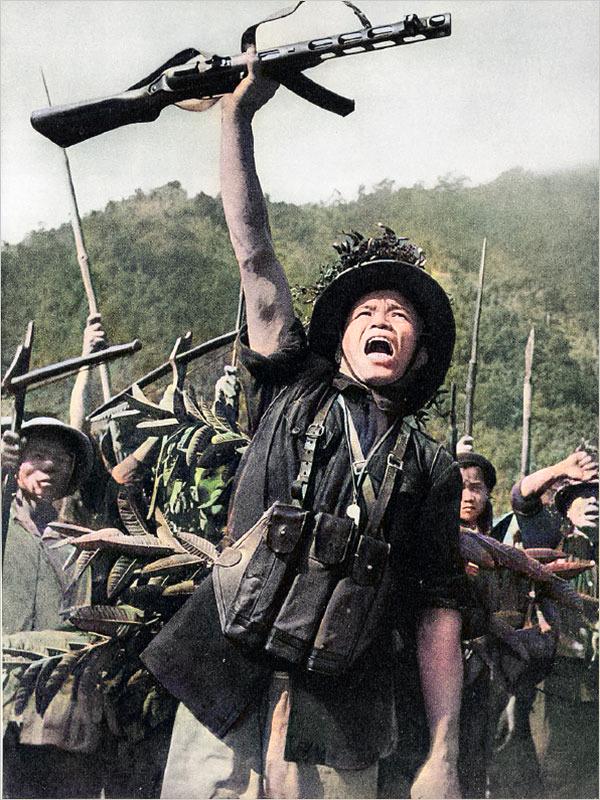
Photo: Vietnamese resistance fighters, camouflaged with jungle foliage, patrol the Saigon River, 27 October 1966.
Against overwhelming American firepower, they turned their own land, rivers and forests into strategic advantages, fighting on Vietnamese terms rather than those imposed by a foreign invader.
"Water shapes its course according to the nature of the ground over which it flows."
The American military tried to impose its preferred form of war on Vietnam.
Conventional fronts. Defined territory. Measurable control.
Vietnam did not cooperate.
The war flowed around American strength like water around stone. The Viet Cong dissolved into the population. The supply lines moved through jungle the Americans had decided was impassable. The tunnels went underground where the air power couldn't follow.
Water does not fight the stone.
Water finds the path the stone cannot block.
Fifty thousand kilometers of tunnels is the most literal possible illustration of Sun Tzu's principle.
The Americans kept looking for a front.
There was no front.
There was only water, moving, patient, finding every crack in every stone, until the stone decided it had had enough.
Zbigniew Brzezinski wrote the quiet part out loud in 1997.
In The Grand Chessboard, not a conspiracy theory, a book taught in American foreign policy programs, he identified the primary strategic imperative of American power:
Prevent the emergence of a dominant Eurasian power.
Not Russia specifically. Not China specifically.
Eurasia as an integrated whole.
Which means: prevent Germany and Russia from doing what geography and economics have always wanted them to do, integrate.
Energy from the east, manufacturing from the west, a continental economy that would not need America’s permission to function.
Everything since has been the implementation of that imperative.
The war in Ukraine did not interrupt that strategy.
It completed it.
Sun Tzu said the greatest victory is the one that requires no battle.
China has spent the last thirty years turning that principle into strategy.
While the United States spent $8 trillion on post-9/11 wars, wars that produced failed states, regional chaos, and a generation of veterans with broken bodies and minds, China built ports, roads, railways, and relationships across Africa, Asia, and Latin America.
No aircraft carriers needed.
No regime change required.
Just infrastructure. Just trade. Just the patient, Sun Tzu-informed understanding that the country that builds things other countries need wins more durably than the country that bombs things other countries had.
The United States is only now beginning to understand what it is competing against.
There is a reason Sun Tzu is Chinese.
"The supreme art of war is to subdue the enemy without fighting."
You are demanding that China and Russia fight the empire on the empire's preferred terrain, the terrain of declarative moral confrontation, where the West controls the media, the institutions, the narrative infrastructure, the cultural reach, the ability to define which declarations count as legitimate and which count as propaganda.
On that terrain, the empire wins every time.
It won when the Soviet Union made proclamations.
It won when Libya made proclamations.
It won when Iraq made proclamations.
It won when every medium-sized power that challenged it directly and loudly was systematically isolated, sanctioned, destabilized, and in several cases destroyed.
The lesson of the last eighty years is not that you need to be louder.
The lesson is that you need to be building something the empire cannot control before the empire realizes what you're building.
China read that lesson.
Russia, more painfully, learned it.
You want them to abandon the strategy that is working because it doesn't satisfy your need for a declaration.
That is your need.
It is not the strategy.
Putin sadly honored Trump a couple of days ago in China (another pathetically weak and mentally colonized country, despite all its amazing achievements). Today the US struck a Russian ship in the Baltic, and attacked Kaliningrad.
Russia and China are both asleep and terribly, inexcusably slow to the game. They refuse to admit they are at war, out of truly idiotic hope that the West will suddenly resume loving them, which it never did, as it deeply despised everything about them, and sees them as heathenish and genetically inferior.
I think that Xi and Putin, despite their great leadership qualities, may not be the right figures to handle the violent transformation to a post-Western world. They don't get it, and force duality and confusion on their own people, instead of resilience and pride.
Wake the fuck up
The deficit is the tell.
The United States runs deficits that would collapse any other economy on earth. Trillions of dollars, year after year, with no serious mechanism for repayment on any realistic timeline.
Any other country running these numbers would face a currency crisis. Capital flight. Hyperinflation. The IMF arriving with "structural adjustment" demands that gut public services in exchange for loans.
The United States faces none of this.
Because the rest of the world is structurally required to hold dollars. Central banks need dollar reserves to participate in global trade. That demand for dollars is what allows Washington to run deficits that would bankrupt anyone else.
This is not fiscal discipline.
This is a subsidy, paid by the entire world, so that one country can fund unlimited military spending without unlimited consequences.
End the dollar's monopoly and you end the subsidy.
End the subsidy and the deficits become a crisis instead of a convenience.
That's the whole game.
Here is the clearest possible statement of what impunity actually is:
It is not the freedom to do wrong.
Every human being has the capacity to do wrong.
Impunity is the freedom to do wrong at scale, across generations, across continents, and to have the wrong absorbed into the background of history as context rather than crime.
The crime without a criminal.
The extraction without an extractor.
The poverty without a cause.
The war without a war criminal.
The debt without a thief.
This is what distinguishes imperial power from ordinary violence.
Ordinary violence leaves evidence, and evidence leads to perpetrators, and perpetrators face, sometimes, imperfectly, insufficiently, some form of consequence.
Imperial violence operates at a scale and through a duration and with a sufficiently sophisticated legal and linguistic and institutional architecture that the chain from consequence to cause to perpetrator is never quite completeable.
There is always another variable.
Always a "governance failure" that intervened.
Always a "complexity" that resists simplistic blame.
Always an economist who will explain that actually the causality is unclear and "more research is needed" and the historical record is contested and...
And the money is already in the account.
And the account is in a jurisdiction that doesn't ask questions.
And the people who put it there are giving a lecture this Thursday at a think tank in Washington.
Admission is free.
The cost has already been paid.
By people who were not invited.