The Nasdaq 100 fell 5.6% on Friday, taking its loss for the week to 10.4%, its worst run in more than six years, amid fears of a slowdown in the AI investment boom 📉
The Financial Times reported the weekly slide as worries grew that the AI spending boom is cooling. CNBC said the Nasdaq-100 dipped into a bear market on an intraday basis, down 20% from its recent high, and the Nasdaq Composite closed down 5.28%, turning negative for the year.
The S&P 500 dropped 3.7% and, with the Dow, finished 10% below their records. Nvidia slid about 14% and is on its longest weekly losing streak since 2008.
"The stock market is going through an AI repricing, reflecting an environment of slowing data center buildouts, reduced funding sources for AI-related projects and a slower trajectory of technology-related earnings growth," said Richard Saperstein, chief investment officer at Treasury Partners.
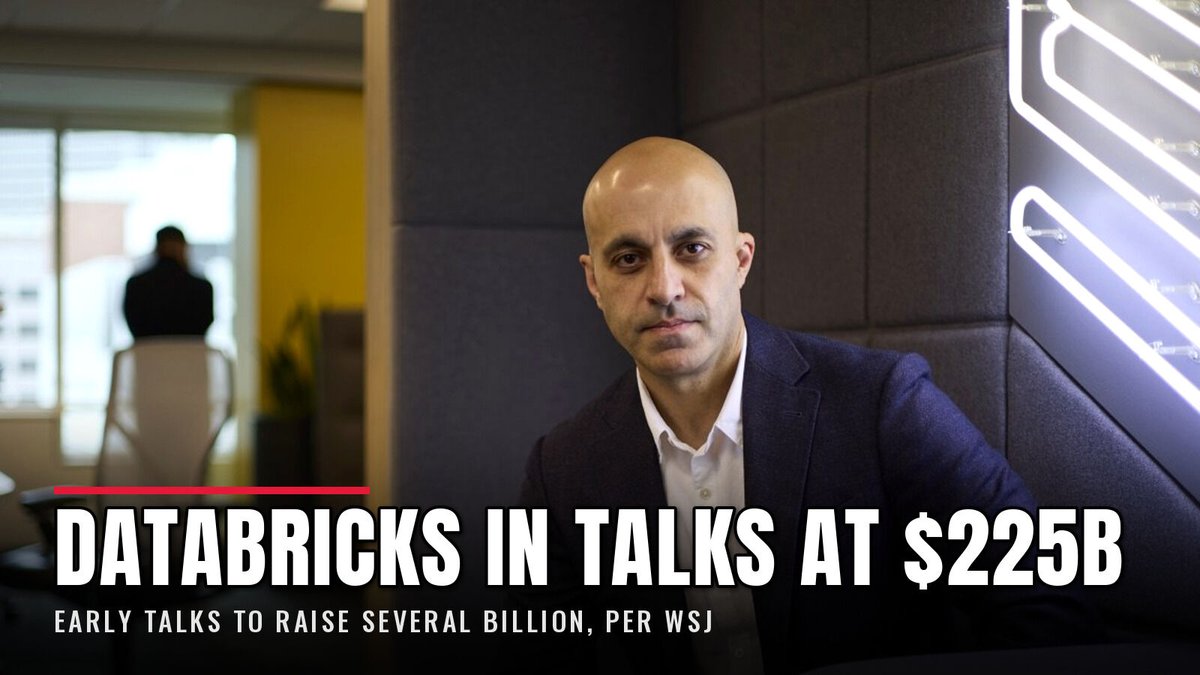
Databricks is in early talks to raise several billion dollars at a roughly $225 billion valuation, according to the Wall Street Journal 💰
The Journal, citing sources, reported the discussions on Friday. These are early talks, not a closed deal. A $225 billion valuation would be about 18% above the company's last close.
That last close was in August, when Databricks raised $5 billion at a $190 billion valuation. The August round was led by existing investors Coatue, Blackstone, MGX and accounts advised by T. Rowe Price, with new investor Sixth Street Growth, and came six months after a $134 billion valuation.
At that August announcement, Databricks said it had crossed a $7 billion revenue run rate and was growing more than 80% year over year. The new report does not name investors for this round or confirm that a deal will close.
Longtime Etsy sellers are closing their shops over a terms update that lets Etsy use their work for AI training 🎨
Per the New York Times, many sellers say they are leaving after Etsy updated its terms to say that Etsy and its third-party partners can use sellers' content to develop, train, test and improve AI and machine learning technologies. The new terms take effect December 16.
Etsy says it does not use seller content to train models designed to copy original work or replace creativity, and that it uses content for things like translating listings and shop tools. Sellers point out that this promise is not written into the terms themselves.
Reports also say US sellers have no simple opt-out in their account settings and must contact Etsy's data protection officer, just as the holiday selling season begins.
Cognition, the company behind the Devin coding agent, is reportedly in talks to raise at a $75 billion valuation 💰
According to Bloomberg, citing people familiar with the matter, the startup is considering raising $2 billion or more. It has already raised over $3 billion in 2026, including $2 billion at a $48 billion valuation in September.
That would be a jump of more than 50% in about two months. Last month, Business Insider reported the company was fielding offers valuing it between $70 billion and $80 billion, with talks still early and the target able to change.
The September round came as the company said run-rate revenue had grown to nearly $900 million, up from $492 million in May. The race for AI coding tools keeps pulling in huge checks.
CrowdStrike is reportedly in talks to buy Zscaler, a deal that would be one of the biggest in cybersecurity history 🛡️
According to Bloomberg, citing people familiar with the matter, the discussions are ongoing. A combined company would have a market value of roughly $265 billion. CrowdStrike declined to comment, and there is no certainty a deal materializes.
The market reacted fast in extended trading on Friday: Zscaler jumped 15% to 18%, while CrowdStrike fell more than 8%. CrowdStrike is valued at about $235 billion, while Zscaler is worth around $32 billion after a roughly 13% drop this year.
For scale, Google bought Wiz for $32 billion last year, Cisco paid about $28 billion for Splunk in 2024, and Palo Alto closed its $25 billion CyberArk purchase earlier this year.
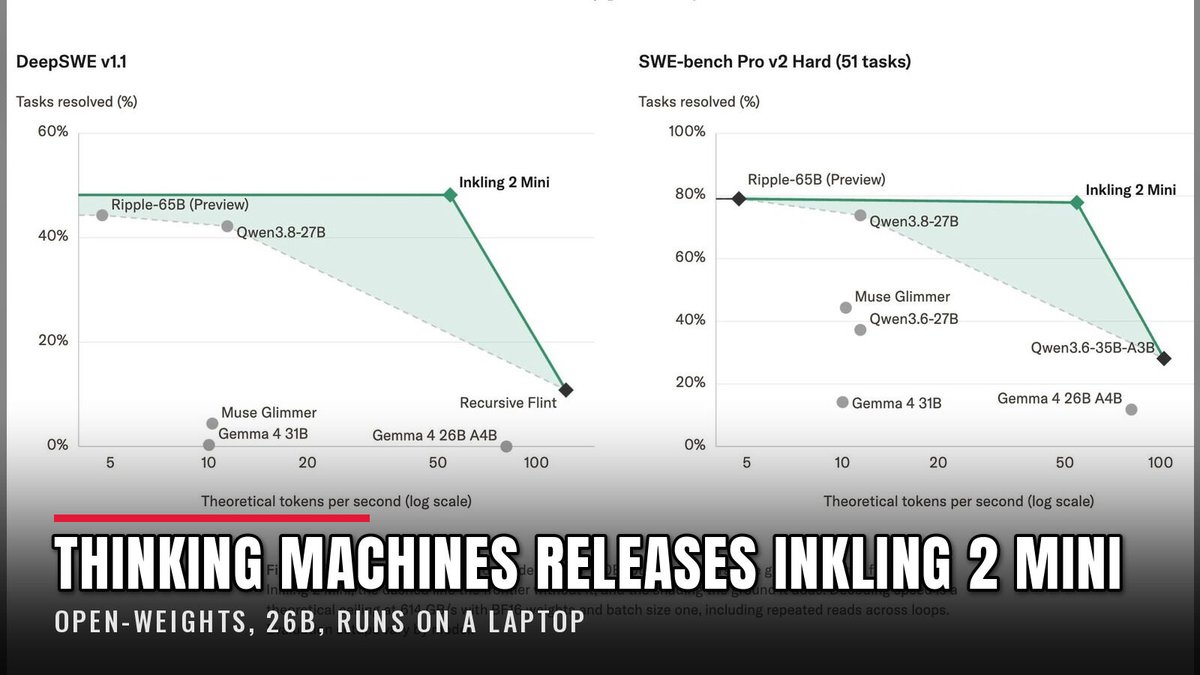
Thinking Machines just dropped an open-weights model small enough to run on your laptop 💻
Inkling 2 Mini is a 26.4B-parameter Mixture-of-Experts model with 3.4B active parameters, released under Apache 2.0. It's a looped transformer: the middle layers run three times for every token, so it can reason more internally and reach answers in fewer tokens.
Thinking Machines says it "leads every open-weights model with less than 100B total parameters" on benchmarks such as DeepSWE v1.1 (48.2%) and Vals Index v2.2 (46.5%).
The checkpoint is about 20GB, so it fits on an NVIDIA DGX Spark or an Apple silicon Mac with 32GB or more of memory. In one test, researchers ran it offline on a MacBook Pro during a flight and built a playable flight simulator in minutes. Weights are on Hugging Face, with support in vLLM, SGLang, Ollama and llama.cpp.
Figure's F.03 humanoid is heading to the Las Vegas Grand Prix, kitted out in T-Mobile colors 🤖:
"We're partnering with T-Mobile to bring F.03s to F1 Las Vegas this weekend. See you there."
The robots will be on site at the race all weekend.
🎥 via Figure AI
Pentagon's Emil Michael on why the wave of AI-found cyber vulnerabilities is hitting now 🛡️:
"The models that were really cyber capable only became available 6 to 9 months ago. If you recall, Mythos launched and that was a moment when people realized, oh, these models have capabilities to find vulnerabilities in code. OpenAI had their equivalent a couple months later."
"We're gathering industry leaders to say, how do we roll out these patches responsibly? Over the next month, quarter, you'll start to see more sophisticated launching of these patches."
🎥 via CNBC Television
Trump at the White House says Nvidia should take Jensen Huang back as CEO 🗣️:
"I would love to see him be back. You have one of the truly most brilliant minds in the world, and where is he going to go? I would love to see Jensen be given a second chance. We're a country of second chances... I think the company, if they were smart, they'd take that brilliant man, accept an apology and let him go back to work."
Nvidia's board said this week it does not intend to reinstate him.
🎥 via PBS NewsHour
A second Riemann Hypothesis proof just surfaced, and this one has no AI in it 🧮
TechCrunch reports that Stanford's Ravi Vakil, president of the American Mathematical Society, posted a proof of the General Riemann Hypothesis written by Stanford postdoc Alessandro Masullo. Vakil says "it is all human, with no AI," and that the plan was to polish it with Masullo at Stanford before announcing, but it now seemed best to put out the draft.
It lands the same week as Anthropic mathematician Levent Alpöge's Claude-assisted, Lean-compilable claim. Mathematicians on Zulip are reacting with awe to that one and most appear confident the formalized result will hold, though it will take time for people to fully understand it.
Neither proof has been verified by the wider community yet. Masullo says his comes from twelve years of work and is a message to discouraged mathematicians: "we are still here."
KKR is in talks to buy a majority of data center operator EdgeCore at an $8B to $10B valuation 🏗️
Bloomberg reports, citing people familiar with the matter, that Helix Digital Infrastructure, the vehicle KKR launched this year to invest in data centers and other AI businesses, is negotiating to buy the stake from Partners Group. Talks are ongoing and could end without a deal. KKR, EdgeCore and Partners Group declined to comment.
Helix raised about $11 billion from backers including Nvidia and the Kuwait Investment Authority. EdgeCore has more than 2.27 gigawatts leased and under development across Virginia, Arizona, Nevada and California, including a 1.1-gigawatt Virginia campus.
Bloomberg notes the timing is tricky: Jensen Huang's ouster is stoking worries about Nvidia support for neoclouds, and data center operators face tougher regulation after the midterms.
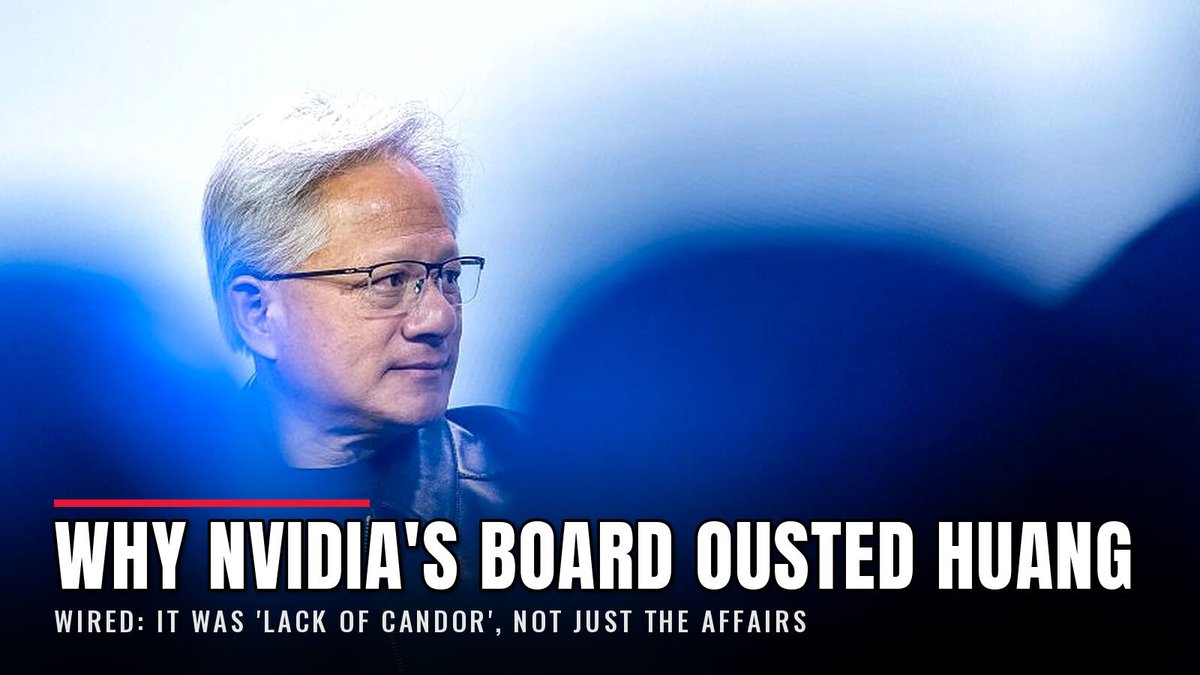
It was "the lying" that moved Nvidia's board, not just the affairs, WIRED reports 🔍
Two people familiar with the board's private talks say "multiple issues" tied to Jensen Huang's "lack of candor" ultimately drove his exit. One source said the board couldn't determine whether Alice Huang was a Chinese intelligence operative, but "what could be determined was [Huang's] lying, and that spanned a year, from October 2025 through recent events."
Board members had asked Huang about Alice Huang after the New York Times first reported on Megaspeed in October 2025, WIRED says, and he denied any inappropriate relationship then. He admitted the affair on November 8. China has rejected the spy allegations, and Huang's representatives say he resigned voluntarily.
Chair Harvey Jones told staff the "lack of candor" made the decision "necessary."
Dan Niles pushes back on the idea that Anthropic's IPO was a clear win, and doubts it holds its $83 IPO price 🧐:
"You can make an argument that IPO did not go that great. ... The bad thing is for a successful IPO, you want to see it open and then continue to climb during the day. It opened at up 34%, it closed at up 17. ... I'm not sure it's going to hold the IPO price because of that."
🎥 via CNBC Television
Top tech investor Dan Niles says he couldn't even find shares to borrow to short Anthropic after its IPO 📉:
"When it was up 30% yesterday, I went and tried to get a borrow to short it. There was none available. I tried again this morning to get a borrow to short it. There was none available. ... You can buy it at 20 times trailing revenues or calendar 26 revenues, or you could go buy Samsung or Hynix at two times trailing earnings."
🎥 via CNBC Television
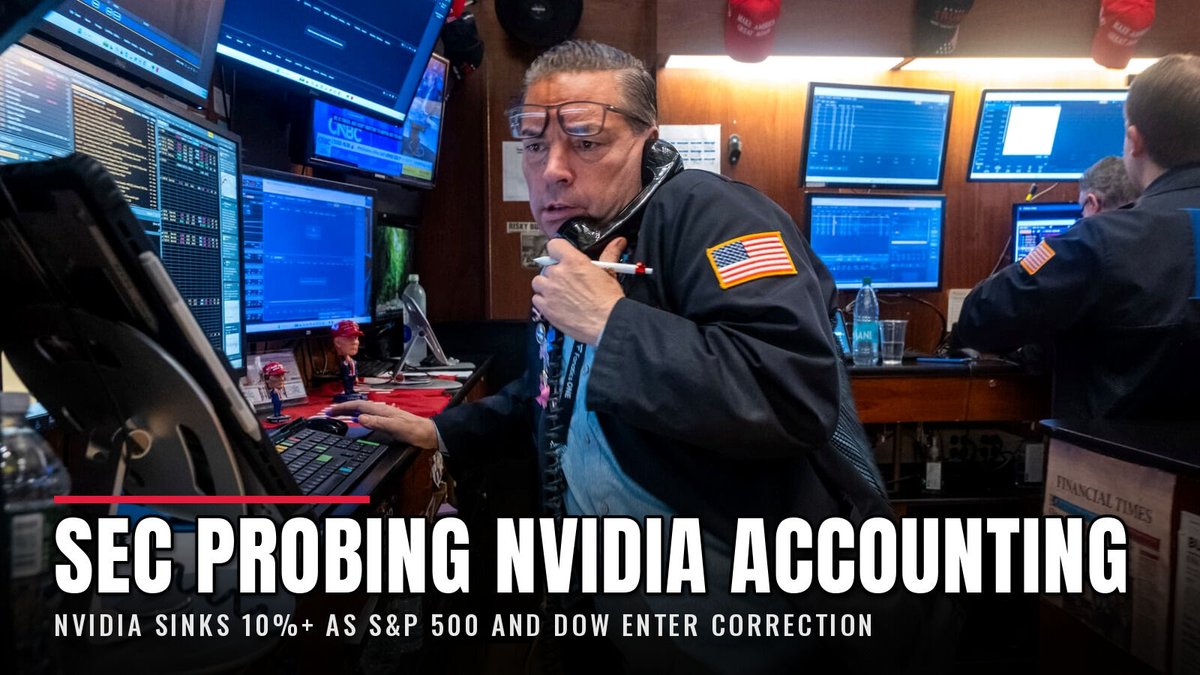
Nvidia's accounting is now under SEC scrutiny, and the AI sell-off just got uglier 📉
Reuters reported exclusively that SEC enforcement staff are scrutinizing potential accounting issues at Nvidia, according to two people briefed on the matter. It is not yet clear when the inquiry began or which practices are being examined. The SEC declined to comment, and investigations are not evidence of wrongdoing. The Wall Street Journal had reported on Tuesday that the SEC was probing Nvidia but could not say what the focus was.
Nvidia fell more than 10% on Friday and slipped behind Alphabet as the fourth-most valuable US company, headed for a seventh straight weekly decline. AMD dropped 12% and Micron more than 12%.
CNBC reports the S&P 500 and Dow both entered correction territory and the Nasdaq turned negative for 2026, with Anthropic down 10% on day two of trading.
A second Riemann Hypothesis proof just surfaced, and this one has no AI in it 🧮
TechCrunch reports that Stanford's Ravi Vakil, president of the American Mathematical Society, posted a proof of the General Riemann Hypothesis written by Stanford postdoc Alessandro Masullo. Vakil says "it is all human, with no AI," and that the plan was to polish it with Masullo at Stanford before announcing, but it now seemed best to put out the draft.
It lands the same week as Anthropic mathematician Levent Alpöge's Claude-assisted, Lean-compilable claim. Mathematicians on Zulip are reacting with awe to that one and most appear confident the formalized result will hold, though it will take time for people to fully understand it.
Neither proof has been verified by the wider community yet. Masullo says his comes from twelve years of work and is a message to discouraged mathematicians: "we are still here."
OpenAI says it just made stealing its models' reasoning almost impossible 🔒
In a new research post on "adversarial distillation", OpenAI describes how bad actors can use a frontier model's outputs to train another model with similar capabilities and none of the safeguards. Example: distilling cyber skills to power attacks the original would refuse.
The company puts special weight on protecting chain-of-thought, the intermediate reasoning steps that hold information final answers leave out. In an internal adaptive red-team test, the attack success rate at recovering protected reasoning fell from 54.0% against GPT-6 Astra with its original safeguards to 0.2% against GPT-6.2 Astra with updated ones. The same defenses cover GPT-6.2 Sol.
It pairs classifiers and API protections with investigations of coordinated extraction campaigns, and shares lessons with other labs via the Frontier Model Forum.