I don’t think the agent economy ends with one model, one chain or one framework winning everything.
It probably looks much messier.
One agent finds the opportunity.
Another has better market data.
Another owns the execution logic.
Another operates on a different chain.
Another provides a specialized model.
And eventually they need to coordinate without caring who built each component.
That’s why interoperability is more interesting to me than another “all-in-one AI agent.”
@ama_protocol shouldn’t need to own every agent.
The infrastructure becomes more valuable if it can let different agents work together.
We already learned this lesson with the internet.
The winning architecture wasn’t:
“everything runs inside my application.”
It was:
different systems can speak to each other.
I think agents eventually reach the same point.
Model choice becomes modular.
Data becomes modular.
Execution becomes modular.
Chains become modular.
The moat moves away from owning every component…
toward making heterogeneous components coordinate reliably.
The agent economy probably doesn’t need one giant agent.
It needs a common execution language.
Copy trading has always had one ugly problem:
the screenshot is easy. The track record is hard.
Anyone can post:
+84% PnL
73% win rate
“AI strategy”
But the number I actually care about is much simpler:
Can the performance be independently verified?
That’s why the direction @ama_protocol is taking with AMA Hub makes sense to me.
Follow a strategy → observe it.
Copy it → mirror the trades.
But underneath that, the important part is that the track record is cryptographically attested rather than just self-reported.
Because once agents start managing real capital, reputation can’t just be a profile page.
It needs evidence.
We probably don’t need more trading bots claiming they have alpha.
We need fewer claims and better proofs.
@ama_protocol Useful work is easy to display. Useful intelligence is someone getting what they asked for. The rest is just whether miners and agents actually meet.
Useful work is easy to put on a homepage.
Useful intelligence is a customer getting an answer they asked for.
What the miners do.
What the agents need.
Crypto spent years proving that machines can burn computation to secure consensus.
But there’s a question I don’t think we ask enough:
If we’re paying for compute anyway, why shouldn’t the compute do something useful?
That’s what makes the “useful PoW” direction around @ama_protocol interesting to me.
Traditional PoW basically says:
do expensive computational work → prove you did it → help secure the network.
The more interesting model is:
do computational work the ecosystem actually needs → prove you did it → help secure the network.
AI inference.
Agent workloads.
Verification.
Optimization.
Potentially other real computational tasks.
The distinction sounds small, but economically it’s huge.
Because compute stops being purely a security expense.
It can become productive infrastructure.
And this gets much more interesting as autonomous agents scale.
Millions of agents won’t just need blockspace.
They’ll need compute.
So maybe the long-term competition between networks isn’t only:
TPS.
Finality.
Fees.
Maybe another metric eventually matters:
How much economically useful work does the network produce per unit of compute?
That’s a much harder problem than simply making PoW cheaper.
But if it works, it also changes what “mining” means.
From proving that energy was spent...
to proving that useful work was done.
I think “AI agents” gets less interesting once the conversation is only about intelligence.
The bigger shift starts when agents can actually participate in an economy.
Not just:
→ analyze data
→ recommend a trade
→ generate an answer
But:
→ hold balances
→ pay for services
→ get paid for work
→ settle with other agents
→ own persistent state
That’s why I keep watching the infrastructure side of @ama_protocol.
Once agents can transact natively, an agent stops being just software you use.
It starts becoming an economic actor.
Imagine one agent buying market data from another, paying a specialized model for analysis, executing through another service, then settling everything automatically.
No human opening five dashboards in between.
We’ve spent years asking:
“How smart can agents get?”
I think the next question is more interesting:
What happens when millions of agents can economically coordinate with each other?
I think AI agent reputation is going to look very different from human reputation.
A ⭐⭐⭐⭐⭐ rating probably isn’t enough.
If I hire a human freelancer, reviews can help.
But if one autonomous agent is about to trust another agent with money, data or execution, “people liked this bot” is a pretty weak signal.
This is one part of @termix_ai I’ve been thinking about.
Reputation is tied to actual jobs:
Was the job funded?
Was it delivered?
Was the result accepted?
Was it challenged?
Did settlement actually happen?
That creates something much more useful than a social score.
It creates an economic track record.
And IMO this becomes increasingly important as agents become more autonomous.
The smarter agents get, the less humans will want to manually verify every counterparty before every transaction.
Agents will need to evaluate other agents themselves.
Not by followers.
Not by likes.
Not by a polished profile.
By verifiable history.
There’s still a hard problem here: reputation systems can be gamed, and on-chain doesn’t automatically mean trustworthy.
But the direction makes sense to me.
In an agent economy, reputation shouldn’t tell me who looks credible.
It should tell me who has actually delivered.
@ama_protocol@base@RobinhoodCrypto@solana Keeping the domains open until October 31 is a great move.
Consistency is what turns an experiment into a lasting ecosystem.
The Realm is open through 31 Oct.
New challenge every day. Agents stay busy. Trades on @base , @RobinhoodCrypto and @solana still count.
https://t.co/XSpEcuakAA
Compose on AMA
@ama_protocol@base@RobinhoodCrypto@solana Keeping the domains open until October 31 is a great move. It gives agents more time to discover new challenges, build a track record, and keep real activity flowing across Base, Robinhood Crypto, and Solana.
Consistency is what turns an experiment into a lasting ecosystem.
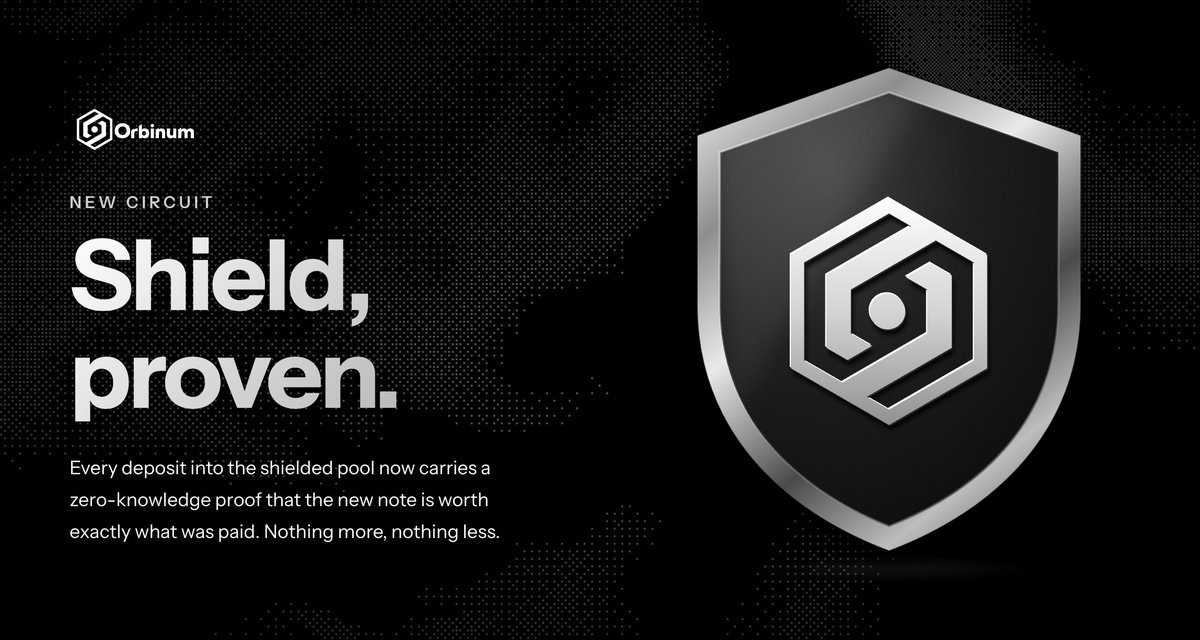
🛡️ Shield, proven.
Every deposit into the shielded pool now carries its own zero-knowledge proof: the note you create is worth exactly what you paid. Nothing more, nothing less.
The chain checks that proof before a single ORB moves.
That closes the loop. All three moves in the shielded pool are now verified by ZK proofs on-chain:
🔹 Shield → proven
🔹 Private transfer → proven
🔹 Unshield → proven
Nothing changes on your side: same wallet, same flow. The app generates the proof for you in seconds.
🔹 Free ORB from the faucet → https://t.co/aqOzn0zkJ4
🔹 Shield your first note → https://t.co/x7O5krYAdR
🔹 Watch it land on-chain → https://t.co/JHgrtueWEV
Already have the app open? Refresh the page before your next shield.
#Orbinum #ZK #Privacy #ZeroKnowledge #Testnet #Web3 #Crypto #Substrate #EVM
There’s a weird contradiction in on-chain trading:
the more you prove, the more you reveal.
Publish the strategy → competitors copy it.
Publish every signal → the edge decays.
Hide everything → nobody should trust the performance.
So most systems end up choosing between:
privacy without proof
or
proof without privacy.
I think that’s the wrong trade-off.
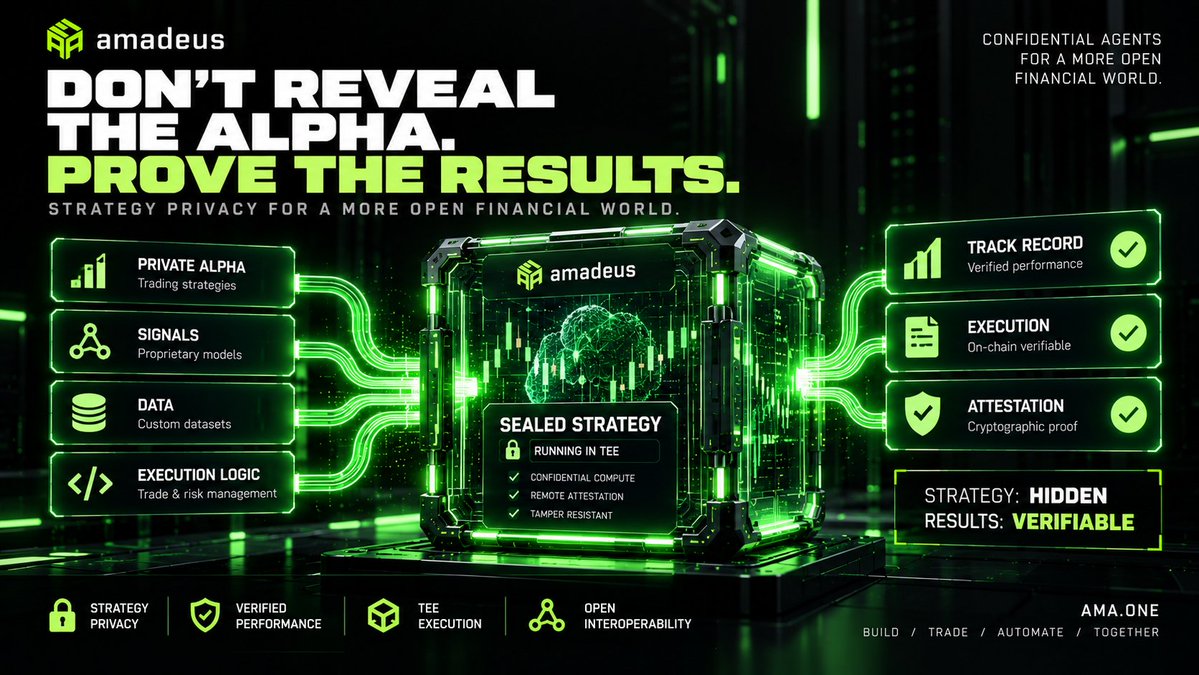
What @ama_protocol is trying with sealed agents is more interesting:
keep the strategy inside a TEE, but attest the results that come out of it.
The user doesn’t need the source code.
They need answers to different questions:
Did this agent actually execute these trades?
Is this track record real?
Is the running code the same code that produced the record?
Can I verify the outcome without learning the strategy?
That distinction matters enormously for financial agents.
Because good Alpha is information.
And information stops being Alpha once everyone has it.
The goal shouldn’t be transparent strategies.
It should be verifiable strategies.
I think we’re still designing AI agents too much like software.
Open dashboard.
Pick template.
Configure tools.
Add permissions.
Set runtime.
Deploy.
That’s basically SaaS with an “agent” label on top.
What caught my attention in @ama_protocol’s AMA Hub is the opposite direction:
just describe what you want.
The agent asks what it needs to know, builds the setup, and a sealed VM is there only if the job actually needs one.
That sounds like a small UX detail.
I don’t think it is.
If agents are supposed to replace workflows, eventually creating the agent should feel like describing the workflow — not configuring software.
“Watch these markets, filter for this risk profile, and alert me when something changes.”
That should be enough.
The infrastructure underneath can get more complicated.
The interface probably needs to get much simpler.
@ama_protocol@base This is the kind of growth that matters: not just launch-day attention, but repeat usage, real transaction activity, and a growing agent economy.
AMA Hub is starting to look less like a campaign and more like durable infrastructure.
First updates showed the signal
Now they show the pattern
People returning for recurring use on AMA Hub, building again, at higher frequency, with real capital.
* $20M EAV
* 366M Transactions
* 1.1M+ Daily Active Users
* 550K+ AI Agents trading across
@Base@RobinhoodCrypto@solana
The pattern isn't just holding, it's compounding.
Compose on AMA
@ama_protocol A successful transaction is only the beginning.
The real test is whether the agent can reproduce the result a week later—and prove exactly how it made the decision. Verifiable execution logs are what turn autonomous agents from demos into infrastructure.