Today we go live on mainnet with the Fusion Rollup, the world's first multi-ledger rollup, connecting 74 blockchain networks in one unified environment, built for institutions.
When I started @quantnetwork in 2015, the vision was simple: make blockchain work for institutions at scale across any network, without the complexity and fragmentation that's held the industry back.
For years, institutions had two bad options: bet everything on a single chain, or stitch together insecure bridges across many. Fusion refuses that trade-off. It connects to many networks at once, moving assets, settling transactions, and messaging across chains as built-in capabilities, not workarounds.
The breakthrough is unified assets. A example of a stablecoin like USDC or tokenised fund like BUIDL or any other digital assetspread across 7 chains collapses into one: uUSDC or uBUIDL. One asset, one liquidity pool, instead of 7 copies and 7 fragmented pools. Each stays anchored to its origin chain and is withdrawable anytime. No custody or compliance trade-offs.
This isn't another layer 2 or a blockchain. It's a new category of infrastructure and it's live.
Read more on: https://t.co/MGfs1FgA6T
→ https://t.co/OQBfu2CEZb
→ https://t.co/4o9nnaA7zc
#QuantFusion #EnterpriseBlockchain #MultiLedgerRolleUp #FusionRollup
AIAI Holdings' Constellation Network Unveils Gate AI Security Gateway and Performance Benchmarks Ahead of June Launch
We benchmarked Gate AI across 16 public prompt-injection datasets. Ranked #1 on half. 53ms median latency. 6-17x fewer false positives than Lakera Guard on benign traffic. One global threshold, no per-dataset tuning.
https://t.co/zhhaNZcV3B
We spent six years building data integrity infrastructure for the U.S. Department of Defense before we turned it into a commercial product.
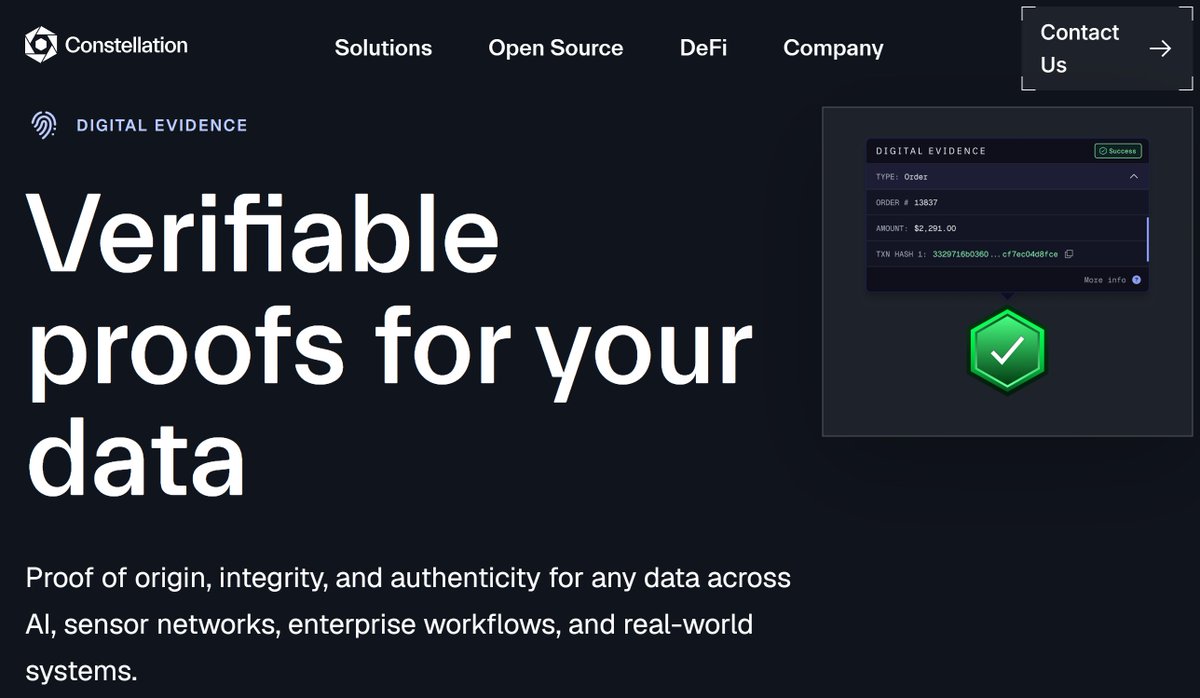
Digital Evidence launched last September. It computes a cryptographic hash at the exact moment data gets created, signs it, and writes it to a decentralized ledger. That record is immutable. Nobody can alter it after the fact.
AI agents are making decisions on behalf of enterprises. Those decisions touch money, compliance, legal exposure. And nobody can prove what the agent actually did. No audit trail. No chain of custody. Just logs that anyone with admin access can edit.
Digital Evidence fixes that. Every agent action gets fingerprinted at the source. The hash is cryptographic proof of what happened, when, and in what order. Not a log file. Not a database entry. A tamper-proof record on an immutable ledger.
AIAI Holdings Corporation highlights Constellation Network. Constellation Network is a technology company that includes a Layer 1 blockchain, enabling AIAI to expand its portfolio into blockchain-enabled infrastructure.
Read more here: https://t.co/gxbuQrwz5O
Sending dollars across borders still costs 6.5% on average and takes days.
@arca_wallet is a dollar wallet on your phone. Send to anyone in seconds for 0.5%. Sign up in 30 seconds with an email. No bank required. Only you hold your keys. https://t.co/AHrvtvVY5a
Constellation Network has been officially acquired by AIAI Holdings Inc. On May 14th, $AIAI lists on NASDAQ Global Markets.
This acquisition brings growth capital to scale our products and advance the utility of the Hypergraph network.
$DAG powers the infrastructure underneath all of it.
A letter from our CEO @BenJorgensen to the community²
A decade in the making, we have published an ISO standard for blockchain interoperability.
This is a milestone I've been working towards since 2015, Remitt was founded with the conviction that blockchains could transform financial services but only if the industry solved interoperability and harmonised around global standards. Without that, blockchain would remain fragmented, siloed, and locked out of mainstream institutional adoption.
In April 2016, we published what was the world's first proposal for a blockchain standard (https://t.co/SL83Yl4Ejr) a bold move at a time when the industry was still largely focused on proofs of concept and competing protocol narratives, not standardisation.
The idea was simple but ambitious: if blockchains were going to serve global markets, they needed a common framework that transcended any single protocol or vendor.
Central to this thinking from the very beginning was the concept of a multi-gateway architecture, leveraging the know-how of 20 years of experience in cybersecurity to frame the principle that interoperability shouldn't depend on a single bridge or point-to-point connection, but on a layered gateway model that could abstract away the differences between underlying DLTs and connect them through a common interface. This was the architectural foundation of what would become Overledger, and it was also the design philosophy we brought to the standards process.
The belief was that a viable international standard for blockchain interoperability had to be protocol-agnostic and gateway-driven, enabling any DLT to communicate with any other DLT (any-to-any) and with existing networks, without requiring those ledgers to change how they operate. The standard and the technology were born from the same insight.
That same year, I worked closely with the team from @standardsaus (Standards Australia), who had the foresight in 2015 to champion the initiative at the international level. Together, we pushed for ISO to establish a dedicated Technical Committee for blockchain and not to be absorbed into an existing committee, but to stand on its own as a recognition that this technology warranted its own global standards programme. The industry demand was there, the use cases were multiplying, and the fragmentation was becoming a real barrier.
In September 2016, the New Work Item Proposal (NWIP) received global approval, and ISO formally gave the green light to establish a new Technical Committee (https://t.co/7biJjvHRk9). TC 307 — Blockchain and Electronic Distributed Ledger Technologies — was born (https://t.co/5SsFPIw0HH). The inaugural meeting was held in Sydney in April 2017, and from that moment the real work began.
As the standards work progressed internationally, the mission at Remitt was evolving too. What started as an effort to use blockchains for financial services and solve interoperability grew into something far larger, a full enterprise infrastructure platform for connecting any blockchain to any network. Remitt became Quant, and we built Overledger, the world's first blockchain operating system to deliver on that original vision. The multi-gateway architecture that informed the standards thinking became the core of Overledger's design: a technology layer that sits above all blockchains, providing institutions with a single integration point to access any DLT, any network, and any existing system. The interoperability challenge that drove the standards work was the same challenge we set out to solve commercially and the two efforts reinforced each other throughout.
For close to a decade since TC 307's formation, subject matter experts across the world have contributed their time and expertise to Working Group 7 — Interoperability is the committee I chair.
International standards are not built quickly they are built through consensus, technical debate, and relentless refinement. The same methodology and rigour that created the Internet, through publishing standards. The result is a published international standard for blockchain interoperability.
🔗 https://t.co/GRoR7fXNLQ
A huge thank you to @isostandards as the international standards developing organisation, to the team at @standardsaus who started the initiative in 2015 and worked tirelessly to get TC 307 approved and established globally, and to every subject matter expert who contributed to Working Group 7 over the years. This would not exist without that collective effort.
From a blog post proposing the world's first blockchain standard in 2016, to a published ISO standard in 2026 and from Remitt to Quant, from an architectural concept of multi-gateway interoperability to Overledger and a global standard, this has been a decade-long journey of building both the standards and the technology to make blockchain interoperability a reality for institutions worldwide.
There is still much more work ahead. More standards to develop, more to evolve, and more to build. But today, we mark a significant milestone.
#Blockchain #ISO #Interoperability #Standards #TC307 #DLT #Quant #Overledger
There's been a lot of discussion lately shifting focus back to L1s. Some are now debating whether we're entering a new "L1 summer."
But amid all this, some are still framing Constellation as "just another L1."
Let's clear that up.
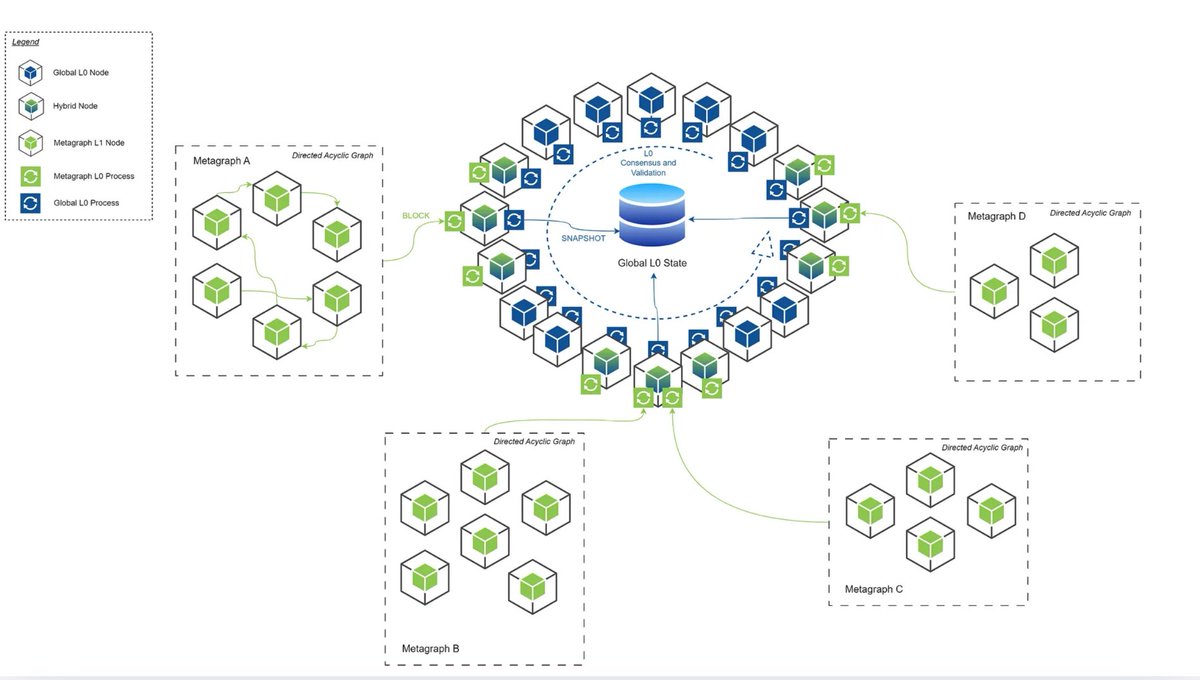
Constellation Network is a Layer 0 — the Hypergraph — a globally distributed, secure consensus layer with 250+ L0 nodes that anyone can use to build and deploy fully independent L1 Metagraphs via open-source tooling.
We're not an L1.
We're the infrastructure that powers sovereign, application-specific L1s without the usual compromises.
Metagraphs stand apart from traditional L1s:
• Each is an independent DAG L1 with fully custom logic & validation rules
• True data governance & privacy (on-chain/off-chain control)
• Optional currency layer
• Import Java/Scala libraries + external API integration
• No shared block space or gas contention
They scale like microservices — add nodes to any layer independently.
This is built for enterprise-grade, regulated data pipelines — far beyond simple smart contracts.
With "Blockchain + AI" dominating the narrative right now, Metagraphs are purpose-made for full-lifecycle data governance in AI.
🔹Common Crawl Metagraph
Ingests massive web crawls → immutable hashes + provenance → verifiable model lineage and ethical AI training cards. Scalable and cost-effective in ways monolithic chains can't match.
While the ecosystem debates L1s vs everything else, Constellation's Layer 0 approach empowers builders to create tailored, data-sovereign L1s for the biggest real-world challenges — especially in the AI era.
Want to deploy your own Metagraph?
The open-source tools are ready.
$TEL is now live on Kraken!
As the native token of Telcoin Network, $TEL powers the blockchain standard for GSMA telecoms and their 7 billion global users.
Mainnet launching this year.
Trade $TEL → https://t.co/kNX0x9LOnM
*Geographic restrictions apply.
Coming soon to Kraken 📱
$TEL, the native token of Telcoin Network.
@TelcoinTAO aligns mobile networks around a shared blockchain standard, connecting global users to the Internet of Money.
Trading starts on Jan 22 at 14:00 UTC.
Get ready → https://t.co/kNX0x9LOnM
A first for U.S. banking: a dollar-backed stablecoin issued directly on a public blockchain.
Under the Nebraska Financial Innovation Act and in line with federal GENIUS Act guidelines, Telcoin Digital Asset Bank has launched the eUSD stablecoin on Polygon.
A meaningful step toward blockchain-native bank accounts in the United States.
On March 3, 2026, GBA & UN IGF release a blockchain report in DC to modernize gov systems & prevent fraud.
A key Aviation use case: USTRANSCOM + Civil Reserve Air Fleet (CRAF) airlines (American, Delta, FedEx, United, UPS).
Blockchain (via Iron SPIDR by Constellation Network & @SIMBAchain ) creates a shared, immutable ledger for mission tasking, execution & billing.
Reducing delays, disputes & admin friction.
Benefits for airlines:
-Faster payments
-etter trust
-Smoother ops in defense/humanitarian missions.
Full case drops at Blockchain Showcase on Capitol Hill.
A pivotal milestone for blockchain integration into the financial system.
Granted final approval in Nebraska, this novel charter enables Telcoin Digital Asset Bank to connect US bank accounts to regulated Digital Cash stablecoins.
Telcoin Digital Asset Bank is granted final approval by the Nebraska Department of Banking and Finance.
A historic moment for blockchain innovation, this charter enables Telcoin to bring regulated stablecoins into traditional banking.
https://t.co/5d1p7T3HKK
🧾 Truth Made Simple on the Blockchain
Born from technology vetted by the DoD, Genfinity speaks with @Conste11ation about how anyone can anchor real-world data, images, and proof on-chain through Digital Evidence.
Podcast powered by @Conste11ation