@ndtv We Indians need to learn road rules the right way... no reversing if the turn is missed...Period. Take the next turn. So many lives lost/destroyed due to a stupid decision. No justification will be enough to the families of the deceased.
@mssakshinarula@ndtv Your driving license should be cancelled and you should be probed for how you got the license. This response is exactly why such accidents happen. No sense of driving but among the first to comment in favour of the reversing driver. Sorry for the passengers in the SUV.
@AvmNews7 I am 49 yrs old and even today if Ior my kid has to appear for an exam or an interview or any event, I plan to reach the place a day in advance, check the venue, and be at the venue atleast an hour before. If something is important to you, make extra effort and not excuses.
@NaughtyHimachal Nobody will fall off a clip just because someone wishes them to fall off. However, driving on the wrong side and forcing people to accomodate them on such challenging roads surely is a shortcut to tragedy. The post is absurd and senseless. Wrong side drivers risk everybody else
@SantaniSubhajit This 2 hours limit actually seems very mechanical rather than realistic. The tkt should atleast be valid upto 30 min after train departure OR railways should allow station entry only 2 hrs prior to the expected time of arrival (accomodating delay time). Something needs to be done
@themodernhp Well the Taxis do have a differentiator as in the colour of their number plates and their qualifications for a commercial license. Yes the law should always be upheld but the responsibility should be owned by the locals more than the tourists wrt such rash/uncivil moves on road.
@thehill_news I wonder how the hefty entry fee will deter such nuances from their misadventures. If you are suggesting punishment for such people why should all tourists be burdened with hefty entry fees. Such people should bear all the burden of their misdeeds.
@PMOIndia PMNRF should not cover for man-made calamities, but the culprit should pocket the cost and the ex-gratia. While the incident of course is tragic, government should fix the system to prevent this in future. Zero action happens and these tragedies continue to repeat themselves. RIP
@outofofficedaku Your post reflects how shamelessly unapologetic you are despite you being at fault. Why on earth should the shopkeeper give you a discount if the terms were explained beforehand.
@iamharunkhan@VishalDadlani Not that I do not agree with you Vishal but there is another perspective to why the debate stretched for 10 hours. The issue, as naive as it sounds, could simply have been ignored by the opposition to save the precious time of the Parliament. Opposition is equally responsible.
@TonyLaneNV Since she paid for the seat, it was entirely her choice whether to give it away or not. Moreover, it was not as if there was only that one single window seat in the entire flight.
@officeofssbadal The attacker is behaving as if he has rabies. Onlookers had to literally drag him by his shirt to save the unfortunate elderly couple. Such attackers need to be caged or treated as would one do to a rabies infected dog.
A new paper, published in PNAS, suggests that "large groups of editors and authors...cooperated to facilitate publishing fraud." The authors used statistical analyses and huge databases of papers to figure this out.
But first, some context on paper mills. There is a well-known industry in science where companies (called paper mills) sell fake science papers. They mass-produce bogus research papers and sell them to desperate scientists who need publications to get jobs, grants, or promotions. For a fee, you can buy your name on a paper, or get a paper custom-written to match what a journal might accept. The fraud is all-encompassing: there are brokers, middlemen, editors, and even entire journals working on this scam.
An Indian company, ARDA, charges between $250 and $500 for a paper. Scientists submit a paper on ARDA's website (anything will do) and ARDA coordinates with editors at journals to get it published quickly. ARDA is so brazen, in fact, that they openly publicize the journals they work with on their website.
So here is what this new PNAS paper shows:
First, the authors used statistical tests to figure out whether certain editors are likely to be working with paper mills. They wanted to use statistics to find traces of coordination between paper mills and editors.
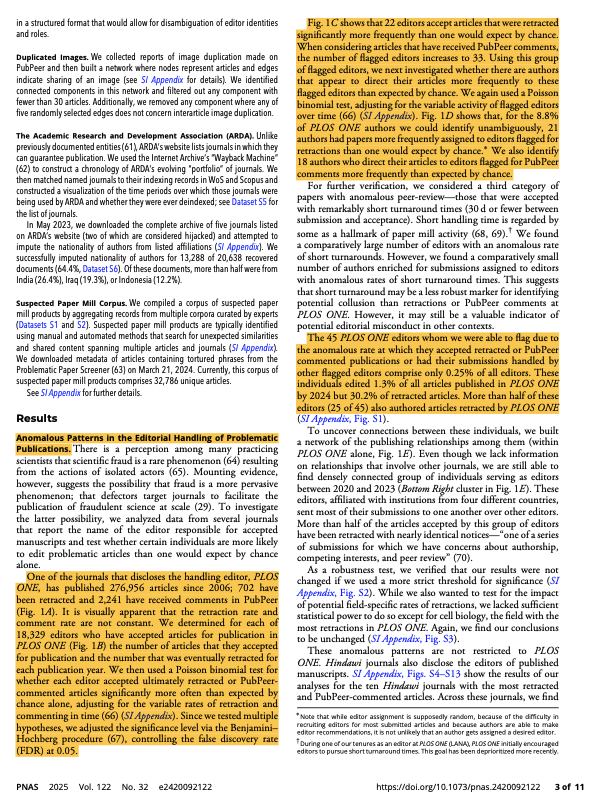
They used PLOS One as a case study because it discloses which editor accepted each paper. PLOS One has published more than 276,000 articles since 2006, 702 of which have been retracted. During that time, a total of 18,329 editors have accepted articles for publication.
Using a Poisson binomial test, the authors of this PNAS paper calculated "whether each editor accepted ultimately retracted...articles significantly more often than expected by chance alone." The answer was yes: 22 editors at PLOS One accepted articles "that were retracted
significantly more frequently than one would expect by chance."
This tiny portion of editors were responsible for just 1.3% of all articles published in the journal, and yet those articles accounted for 30.2% of all retractions! This is not proof of coordination, of course, but it seems pretty damning.
Here are some other surprising takeaways from the paper:
1. ARDA is growing fast, expanding from 14 journals in Jan 2018 to 86 journals by Mar 2024. "Seventeen (9.0%) of these journals are suspected to be 'hijacked journals,' where a journal was once legitimate but a
paper mill has gained complete editorial control over the journal
and its indexed content."
2. Many articles published in the journals listed by ARDA are well outside the journal’s stated scope (e.g. an article about roasting hazelnuts in a journal about HIV/AIDS care). In a sample of five journals, 34% to 98.7% of articles were out of scope.
3. "...the number of retracted articles has been doubling every 3.3 years...while the total number of publications has been doubling every 15.0 years." Suspected paper mill outputs are doubling every ~1.5 years.
Did a walkthrough of the upcoming state-of-the-art, first-of-its-kind “Medical Research Centre” (MRC) at Translational Health Science & Technology Institute (THSTI), Faridabad — a flagship initiative supported by @DBTIndia.
This 50-bed facility will facilitate translational research, especially in early clinical trials, precision medicine and public health innovation.
It features South Asia’s first and one of Asia’s few Controlled Human Infection Study Centres, alongside cutting-edge Cell & Gene Therapy units, DMPK labs, and a world-class Biorepository.
Indeed, a milestone for India’s biotech and research ecosystem.
#ScienceForNewIndia
Took stock of the ongoing work at the first-of- its- kind upcoming “Medical Research Centre” #MRC at India's premier Translational Health Science & Technology Institute (#THSTI) Faridabad.
A key infrastructure project aimed at strengthening India’s clinical research capabilities. Possibly the first in Southeast Asia.
In its final stages —the multi-storeyed facility is designed to support advanced clinical studies with separate exclusive sections dedicated to the study of Enteric infections, Respiratory infections etc.
The new centre will house specialized sections for research in focus areas. Once operational, it is expected to facilitate clinical observation studies and trials, including work on diagnostics and therapeutics. The MRC will also feature a Controlled Human Infection Facility aimed at accelerating infectious disease research.
@paysitions@nocapmedia Child was at the wrong place and the responsibility is to be shared by the parents who should be looking after him. Runner did not run over purposefully but just couldn't avoid the crash