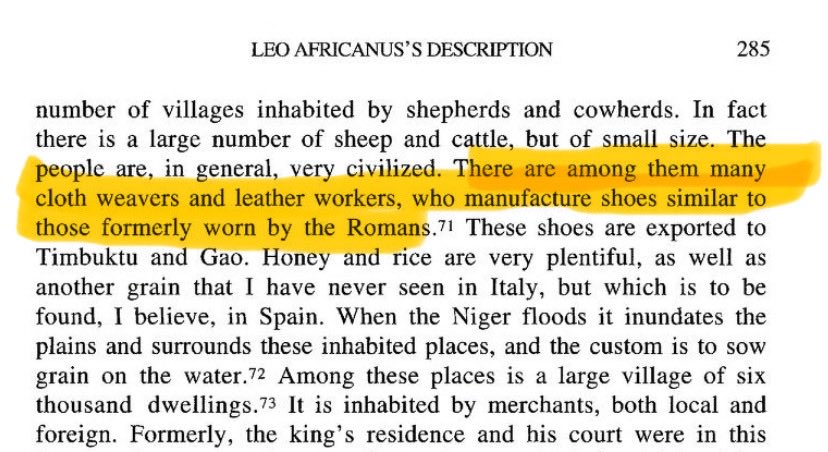
According to the 16th Century Historian Leo Africans
He says the Hausa Kingdom of Gobir manufacture shoes similar to those worn by the Romans. And that these shoes are exported to Timbuktu and Gao.
This is Hausa Traditional Dye Pits which was established 1498 over 600 years ago! Hausa people are advanced in ginning, spinning, knitting and dyeing of clothing materials. They design and supply dyed clothes to Tuaregs, Kanuri and fulani in addition to Nupe.
For 38 years, the US paid farmers NOT to grow too much corn. In 1971, one guy killed that rule. Within 13 years your Coke had corn syrup instead of sugar, food was the cheapest it had ever been, and Americans were getting heavier every year.
Since the Great Depression, US farm policy ran on simple supply and demand. If everyone planted everything, prices would crash and farmers would go broke. So the government paid farmers to leave a chunk of their land empty, and held big stockpiles of grain like an emergency fund.
Then Nixon picked Earl Butz to run the Department of Agriculture. Butz was a farm-economy professor from Indiana who also sat on the boards of giant food companies. He told farmers to "get big or get out" and to plant every inch of land they owned. In 1972, when the Soviet Union had a bad harvest and came shopping, Butz quietly sold them 30 million tons of grain in one deal. The US emergency stockpile was gone overnight. By 1976 he had killed the entire 38-year-old system.
By the late 1970s, the country was drowning in corn, and Washington kept guaranteeing the prices anyway. Corn became the cheapest ingredient in the American grocery store. The government still hands corn farmers about 3.2 billion dollars a year, more than any other crop.
That cheap corn went two places. The first was your soda. Scientists had recently figured out how to turn corn starch into a syrup that tasted almost like sugar. With corn this cheap, that syrup (high-fructose corn syrup, or HFCS) was way cheaper than cane sugar. Coca-Cola started swapping it in by 1980. By 1984, Coke and Pepsi had ditched cane sugar entirely in the US. The average American went from eating zero corn syrup in 1970 to almost 38 pounds of it a year by 1999.
The second place was everything else. That same cheap corn fed the cows, pigs, and chickens packed into industrial farms. It also became the base ingredient or sweetener in most processed food on the shelf. Americans went from spending 17 percent of their take-home pay on food in 1960 to under 10 percent by 2000, one of the lowest rates in the world. Daily calories per person climbed from about 2,054 in 1970 to over 2,500 by 2010. The extra 500 came mostly from added fats, refined grains, and corn syrup. When Butz took office in 1971, about 15 percent of American adults were obese; today the CDC says it's 40.3 percent. Severely obese, defined as way past overweight, used to be under 1 percent. Now it's nearly 1 in 10.
Butz's policy did exactly what it promised. Productivity, exports, and grocery prices all moved the way he said they would, year after year for three decades. The right photo is just what happens to the average American body after fifty years of policy designed to make calories as cheap as possible.
Za ku iya koyon rubutu, sannan kuma akwai tatsuniyoyi, waƙoƙi, tarihi, labarai, takardu da duk wani abu da ya shafi hausa, da Adabin Hausa a shafin Rumbun Ilimi.
We spent years in the South West shouting ourselves hoarse about “Fulani hegemony.” Now, in a twist of irony, we are busy constructing a Yoruba version of the same thing.
Let’s be honest: this has absolutely nothing to do with Yoruba self determination. Nothing.
In fact, the very actors now parading as defenders of “Yoruba interests” systematically dismantled genuine self-determination movements, groups that could challenge them on ideological grounds. In their place, they empowered loyalists and opportunists, people more interested in pleasing the political establishment than questioning why a region’s commonwealth is being funneled to a select few.
The same playbook. A different cast.
Those waving the banners of “Fulani” yesterday and “Yoruba” today are not fighting for their people. They are fighting for themselves, for power, access, and wealth. That’s the real agenda.
Ethnicity is just the costume. The script is class self enrichment.
What we are witnessing is not liberation. It is elite capture, dressed up as tribal solidarity, packaged as destiny, and sold to the masses.
And once again, ordinary people are expected to clap. Guess what? There are no subsided market for the Yoruba, the rain is falling on everyone with or without tribal marks.
1. People are paying over ₦1.7 million to process a China visa through agents.
2. The actual visa processing fee when you do it yourself can be around ₦170,000–₦200,000 depending on visa type and processing speed.
3. Many agents bundle unnecessary charges like:
“Invitation letter fee”
“Processing fee”
“Connection fee”
“Embassy assurance fee”
4. For the Canton Fair, the official invitation letter is FREE.
5. To get the invitation yourself:
Visit the official Canton Fair website.
Register as an overseas buyer.
Apply for the invitation letter.
Receive approval in about 4 days in many cases.
6. Filling the application form yourself can take about 30 minutes if your documents are ready.
7. Documents usually required:
International passport
Passport photograph
Bank statement
Hotel booking
Flight reservation
Invitation letter
Completed visa application form
8. If your documents are genuine and complete, approval can come within a few working days.
9. Agents often use fear tactics like:
“It is difficult.”
“You need connection.”
“Embassy will reject you.”
“Invitation is expensive.”
10. Most people pay because they don’t know the process.
11. Before paying an agent huge money, at least try yourself first.
12. What may cost under ₦300,000 is being sold for over ₦1.7 million.
13. People should stop being exploited because of ignorance.
14. The internet has made many of these processes easier and more transparent.
15. The best approach: Apply yourself first; if it becomes complicated, then seek professional help not exploitation.