"Be the change you wish to see in the world"
Becoming a modern minuteman and going through some training with a few like minded individuals is relatively easy.
Reach out and talk to people.
Read some field manuals.
Don't let the pillars that founded this nation waste away.
I truly believe that the optimal way forward is embracing a Dark Age Mindset. This means:
- Embracing Decline as Opportunity. When the foundations of familiar institutions are shaken, it's a signal to us to stop investing so much effort and dependence on those things, and create new alternatives that actually serve us as people and communities.
-Cultivating Resilient Character and Faith. The folks who did this before were not weak, fragile, or wishy-washy. Get hard.
-Preserve and Transmit Knowledge. If institutions that have historically been responsible for this (looking at you, media and schools) are failing, then it's another opportunity for us to step into decentralized roles as stewards of cultural patrimony, preserving literacy, classical texts, and traditions and educating our own children with this heritage to ensure continuity in a potentially post-literate or tech-degraded world.
-Pursuing Self-Sufficiency and Simplicity. "Ora et labora" was the motto that drove that age forward and upward. But they showed us that simplicity needn't be minimalist or ugly; some of the most durable and beautiful things ever made came from these times.
-Reject Dooming and Be Proactive. No despair. Instead, simplify your processes, improve your skills, and meet your challenges vigorously.
-Foster Creativity in Adversity. Necessity is the mother of invention. But the human person is not merely mechanical; we need beauty, music, good stories, living rituals, significance... Cultivate these things especially in the face of monopolized artificiality.
-Focus on Local and Subsidiarist Action. Subsidiarity is handling matters at the smallest, most local level possible; create "schools for service" (as Benedict did) that prioritize family, home culture, nature, and education over distant, failing institutions. The more responsibility you take up over all the spheres of your living experience, the more you step into sovereignty.
> be Nayib Bukele
> take over the most dangerous country in world
> fix crime within 12 months
> literally safest country now
> all the georgetown policy kids lose their minds
> call you a mean dictator
> "this is so messed up"
> "don't people realize they're oppressed!?"
> can't belive that you have 91% approval
> build a free public hospital
> georgetown policy kids in absolute shambles
Ive come to realise I havent actually posted anything in quite a long while, just reposted stuff.
Perhaps I should finally post some photos of places Ive been to during my lack of meaningful activity here
At their peak, white boys controlled 80% of the Earth's landmass.
The cape was simply too powerful, augmenting his aura to supernatural levels.
That's why the communists stole it from him.
Enjoy!
"SignalTrace is designed to help law enforcement identify people of interest by the signals emitted from their electronic devices they travel with, such as fitness trackers, smartwatches, RFID tags, and local signals from their mobile phones...
There are 100,000+ cameras bolted to poles and stoplights across America, photographing your license plate, logging where you were and when, and handing that record to any cop in any state who wants it.
That number comes from DeFlock, a volunteer effort mapping the cameras one by one, and it climbs every week. Nobody really knows the true count. Some estimates run three times higher. A surveillance net too large to count is one no one can rein in, and the not knowing is part of the problem.
A school district in Georgia ran 375 of those searches to figure out where children sleep at night. "Residency verification," the officers typed in the box. They pointed a tool sold to "catch carjackers" at six-year-olds, to check whether a kid lived in the right zip code.
Police in more than 50 departments searched the network to track people at protests, some hunting named activist groups. Immigration agents with no legal access of their own had local cops run searches on their behalf, 4,000 of them in a single year.
The cameras do not care what they are aimed at. A net that catches the carjacker catches the churchgoer, the patient leaving the clinic, the gun owner, the man driving to a meeting he would rather keep quiet. It was built to catch everyone, because a camera cannot tell the guilty from the rest and was never asked to.
The men who sell these cameras know this. They market the carjacker and deliver the dragnet. Every plate. Every dent. Every Tuesday you drove past the same corner at the same hour. Filed, timestamped, and searchable by strangers with badges for as long as they care to keep it, which is forever.
This is what a police state looks like when it arrives.
I’m going to identify and then refute the underlying premises behind this assertion from Bahler, partly for my own leisure here, because I am frankly exhausted by this fallacious, hypocritical, and self-righteous anti-fantasy sentiment in online American “Orthodoxy.” It should have died yesterday.
The argument essentially runs as follows:
i) Man is made in the image of God and called to bear the likeness of Christ, so his self-presentation should reflect the dignity of rational human nature; ii) A pfp, avatar, or roleplay persona is a meaningful form of self-presentation, not a merely external decoration; iii) To present oneself under the likeness of a brute beast, hybrid creature, or fantasy identity is to symbolically step beneath one’s proper human dignity and into unreality; iv) Voluntarily adopting such a lower or unreal persona is spiritually disordered, because it is not fruitful for salvation and risks insulting the human nature Christ assumed; v) Therefore, using fantasy personas or living out such roleplay degrades the image of God in man, insults Christ, and should not be excused as harmless fantasy.
The first premise is broadly acceptable here, albeit with some qualification. Man should not present themselves in ways that deny their dignity, glorify sin, or encourage self-contempt.
But you do not get from there to “every form of self-presentation must directly and visibly display rational human nature.” Human dignity isn’t erased by metaphor, costume, fiction, art & play. Man can dress as an animal, use a dragon avatar in a video or roleplaying game, write from the perspective of a “brute” beast, or use a fictional persona online without subsequently denying that he is a rational creature made in the image of God.
So the premise is acceptable only in its muted form:
a) Human self-presentation should not contradict human dignity.
But the argument requires a much stronger claim:
b) Human self-presentation cannot use non-human or fantastical form.
That harsher premise lacks support.
The second premise overstates itself. An avatar can be meaningful of course, but it is hardly always a profound statement about self-identity. It can be aesthetic, decorative, practical, humorous... A profile picture using a real animal, a fictional knight, a robot, a dragon, or the like does not necessarily say, “This is what I believe I am.” At minimum, it may simply say, “I like this image,” “this reflects a mood I want to set,” or “this is a symbol I enjoy.”
The argument falsely treats all symbolic presentation as full personal identification. A better distinction would be:
a) Some avatars express identity seriously; others are playful, artistic, symbolic, or merely decorative.
I could honestly capitalise on this point and leave it there, since I personally do not identify with any of my OCs on that level, much less as full personal identifiers. I do not believe I am them, nor do I present them as my true self in any serious ontological sense. Identification is not identical to association.
However, the third premise is the weakest link in the chain, and therefore should be assessed. It falsely assumes that using a non-human likeness means lowering oneself beneath humanity. Symbols, however, do not work in this way.
A lion can symbolise courage. A lamb can symbolise innocence. A dove can symbolise peace. An eagle can symbolise nobility. A dragon can symbolise power, mystery, danger, or imagination.
None of this requires the person to deny being human. In fact, using animal or mythical imagery is a distinctly human act: it depends upon reason, imagination, analogy, and symbolic thought. Beasts do not create avatars; rational beings do.
Nor does fantasy necessarily mean “unreality” in a sinful sense. Fiction is not the same as falsehood. Anyone reading mythology, acting in a play, writing fantasy, or roleplaying a fictional character isn’t necessarily rejecting reality. He is knowingly engaging in make-believe.
This premise collapses symbolic representation into literal self-degradation and delusion.
The fourth premise relies on the third, so I could leave it there, but it also contains another harmful inference: “not directly fruitful for salvation = spiritually disordered.” This is a laughably caricatured standard of scruple.
Many ordinary human activities are not explicitly salvific in themselves, including almost all hobbies, occupations, and day-to-day duties—including the ones Bahler presumably observes. I doubt he only paints icons all day. Such things can be innocent when ordered by moderation, truth, charity, and virtue.
Furthermore, using a fictional or animal image does not automatically insult the human nature Christ assumed. Christ assumed human nature; therefore, human nature must not be despised. But a person does not despise human nature merely by using metaphor, fiction, costume, or symbolic art.
Neither Christendom, nor any saint who has commented directly on this issue, has treated the attribution of rationality to fantasy forms—or to anthropomorphic animal forms specifically—as a degradation of human nature or an insult to the Incarnation. This newer sentiment is therefore hardly Christian in origin.
Some uses of fantasy can be spiritually disordered. It does not follow that all uses are.
So we reach a conclusion that simply does not follow. The argument needs to prove that online avatars necessarily make statements of self-identity, and that fantasy personas necessarily involve contempt for human nature, denial of reality, and rejection of Christ. It proves none of this. It merely asserts it.
There are two dangerous ways of approaching the Church Fathers. One turns them into rigid monuments of the past. The other dismisses them as outdated voices irrelevant to modern life. Both misunderstand them...
Patent for Flock Cameras, they're not only tracking license plates.
U.S. patent 11,416,545 B1
Patented Aug 16, 2022
By Garret Langley and Matt Fuery of FLOCK Safety, based in Atlanta GA (next tweet)
According to Figure 5A, it can detect pedestrians and bicyclists down to clothing, height/weight and color of clothing.
The system also has an auto-alert when it "detects a target" with high confidence.
Along with the most seen and known FLOCK Camera "Falcon", they now have a family of cameras called "Condor, Raven," an aerial surveillance drone "AreoDome" and its linked to a system called "Wing"
#Throwback
Here's the web page with 29 pages of the patent.
https://t.co/2yIALJzVeM
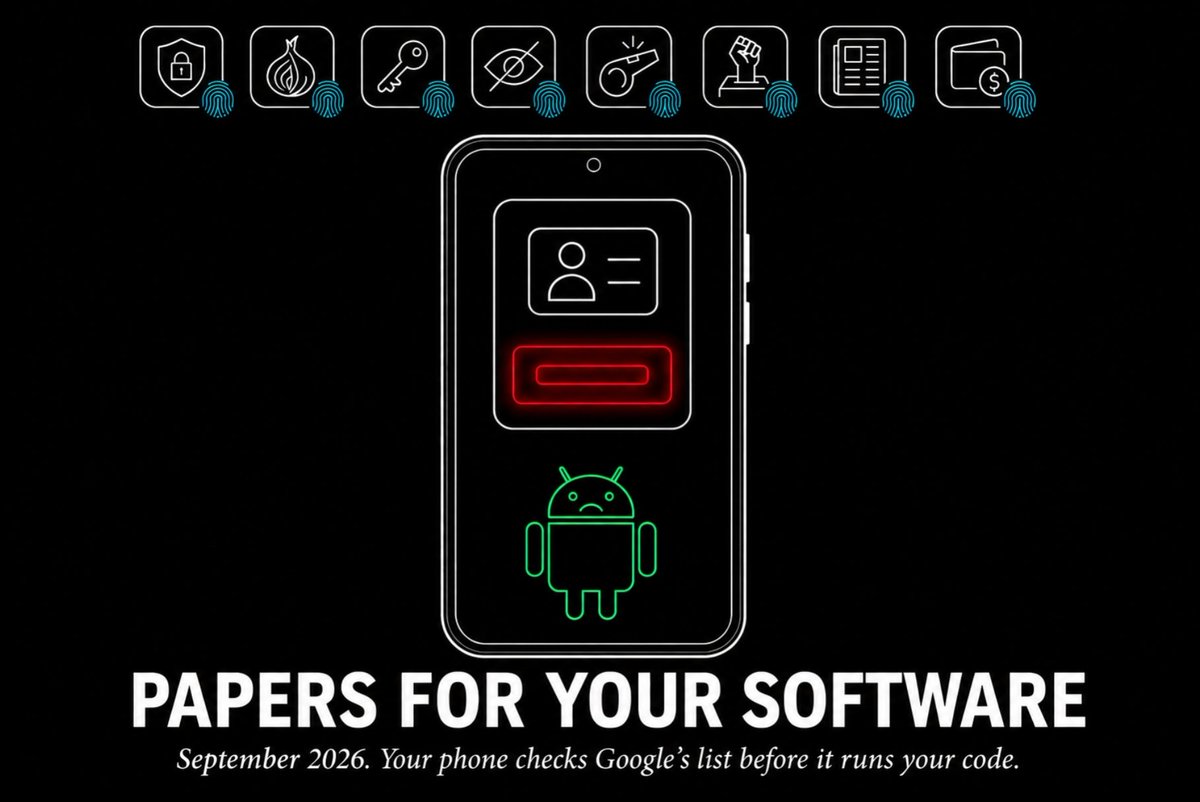
Google is building a registry that ties every piece of Android software to a government ID, and your phone will soon refuse to run anything that is not on it.
Starting September 2026, an app will not install on a certified Android phone unless its maker has handed Google a government photo ID, paid a fee, registered a payment profile, and signed over the keys to their own code. And not just apps from the Play Store. Every app. The one a friend builds you. The one a stranger across the world wrote and gave away. The one you wrote yourself, for your own phone, in your own home.
Your hardware will check it against Google's list, and if the name is not on file, the door stays shut.
Android was the open one. For fifteen years that was the entire pitch, the one phone where you owned the device and chose the software and no one stood at the gate. That is what is ending.
The phone goes from a thing that runs what you tell it to a thing that runs what Google has approved, and approval now means a legal name in a database.
A malware author will buy a stolen identity for $40 and ship his poison the same as ever. He always has. The registry does not touch him. What it touches is the developer who cannot put his real name on his work. The one building a secure messenger for people a government wants dead. The one shipping a tool that embarrasses the powerful. The one who writes under a handle because the alternative is a knock at the door.
The purpose, in Google's own words, is to "remove the cover of anonymity."
The mask is the oldest tool the free press ever held. The pamphlet with no printer's name. The essay signed with a fake one. Every government that ever feared what its people might read started by demanding to know who set the type. Google has volunteered to be the one who keeps the list.
If you want to install software from a maker who refused the registry, you can, after you enable developer mode, swear to your phone that no one is forcing you to do this, restart the device, wait a full twenty-four hours, and authenticate again. A day-long cooling-off period and a coercion check, to put a program you chose on a phone you own.
It is the permission slip with enough friction that most people stop trying, which was always the point.
F-Droid, the free software catalogue that has handed out unsigned, unregistered, no-name software for over fifteen years, called it existential and refused to comply.
67 organizations told Google to kill the plan. Google moved the date for no one.
So learn the way out now, while the door is still open. The stores that answer to no registry. The phones that were never on Google's list. The skill of putting what you choose onto the machine you own, before that skill becomes a thing you have to wait a day and swear an oath to use.
A phone that asks permission before it runs your software was never your phone. It was theirs, parked in your pocket, billed to your name.
Take it back while taking it back is still allowed.