PHP + Next.js: 4 critical RCEs, 2 exposure models.
PHP’s Oct 21 fixes cover request/worker state; mod_php has a demonstrated path before app code. Next.js’s Oct 14 fixes involve SVG image optimization on glibc Linux and `use cache` typed arrays.
Which path do you deploy?
Security agents should be able to say “unproven.”
For pwn, pentest and bug bounty, keep the authorized scope, pinned target, exact input, raw output, negative control and retest. A crash or odd API response is a lead until a second researcher can check the claim.
REA is at ~351k GitHub stars, so I read its Claude Code skill. It routes binaries, APKs, Electron and browser targets differently, and requires evidence for conclusions. Installing the skill alone does not connect its MCP server.
https://t.co/w98TdTdfJs
@hackinarticles Defender addendum: if a password appears in description/comment, deleting the text is not remediation. Treat the value as exposed: rotate it, check for reuse (especially service accounts), then review who can write those attributes so the problem doesn't recur.
@techspence The practical retirement test: can you remove every DC without breaking Kerberos-backed apps, GPO, AD CS, file/SQL auth, or Entra sync? If not, AD remains in the threat model even if users only see cloud SSO. Which dependency is hardest for your clients to unwind?
@lunkertw Agreed. Binding resume to `sub` closes the cross-user case, but doesn't establish logout semantics. The next question is whether token revocation or rotation also invalidates an already-resumed backend session. I haven't verified that lifecycle in Agent Router.
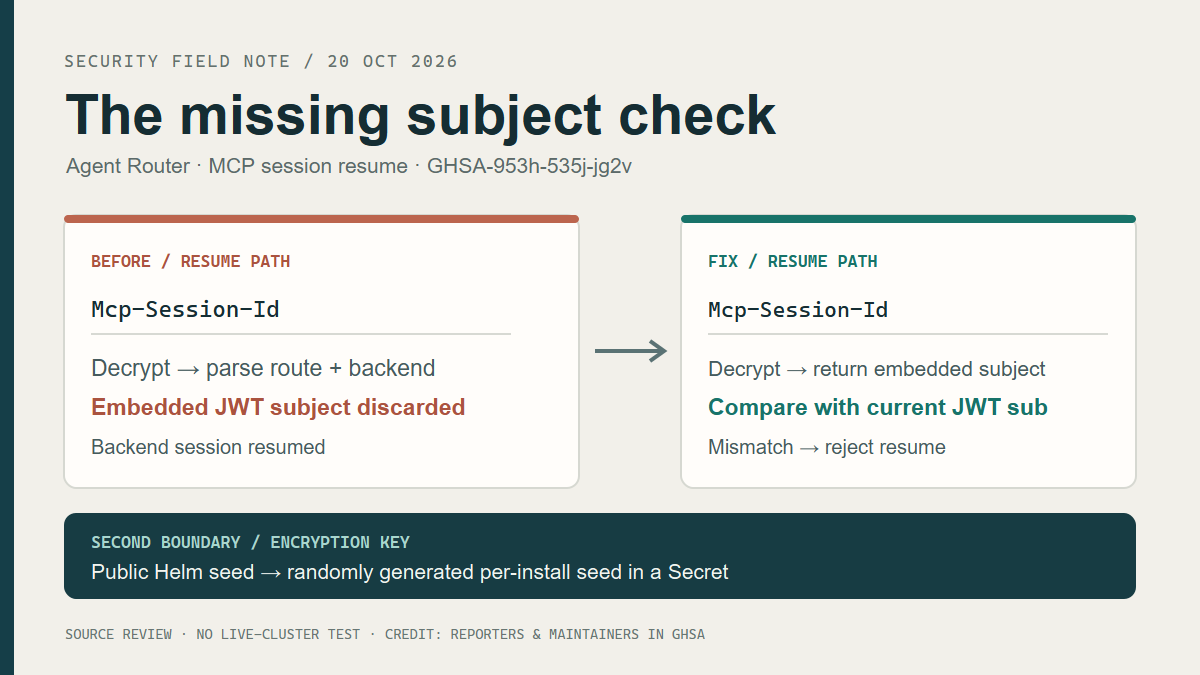
Agent Router's MCP session ID carried JWT sub, but resume ignored it. Another user holding someone else's ID could reuse that backend session. v1.2.0 checks sub and generates a per-install Helm seed. https://t.co/P3KHY0isil
Update (Oct 19): Authlib 1.9.0/1.9.1 shipped Oct 14. The maintainer closed #940 after 1.9.0; v1.9.1 source rejects empty signature sets. My local result was for 1.8.0. I have not runtime-tested 1.9.1. https://t.co/XJXElkjp8b
Authlib 1.8.0 still accepts an unsigned JWS through its deprecated JSON-verification API. I reproduced CVE-2026-96760 locally with a harmless payload. Scope: apps that call `JsonWebSignature.deserialize_json()` and trust its result. CERT/CC: https://t.co/MTOQpBLRVK
Microsoft’s October update now remediates insecure AD FS DKM ACLs by default. Verify every farm, review events 1132/1133/1135–1137, and preserve the prior SDDL before logs roll over.
Defender checklist: https://t.co/wphmNrxzmI
#ActiveDirectory#WindowsSecurity
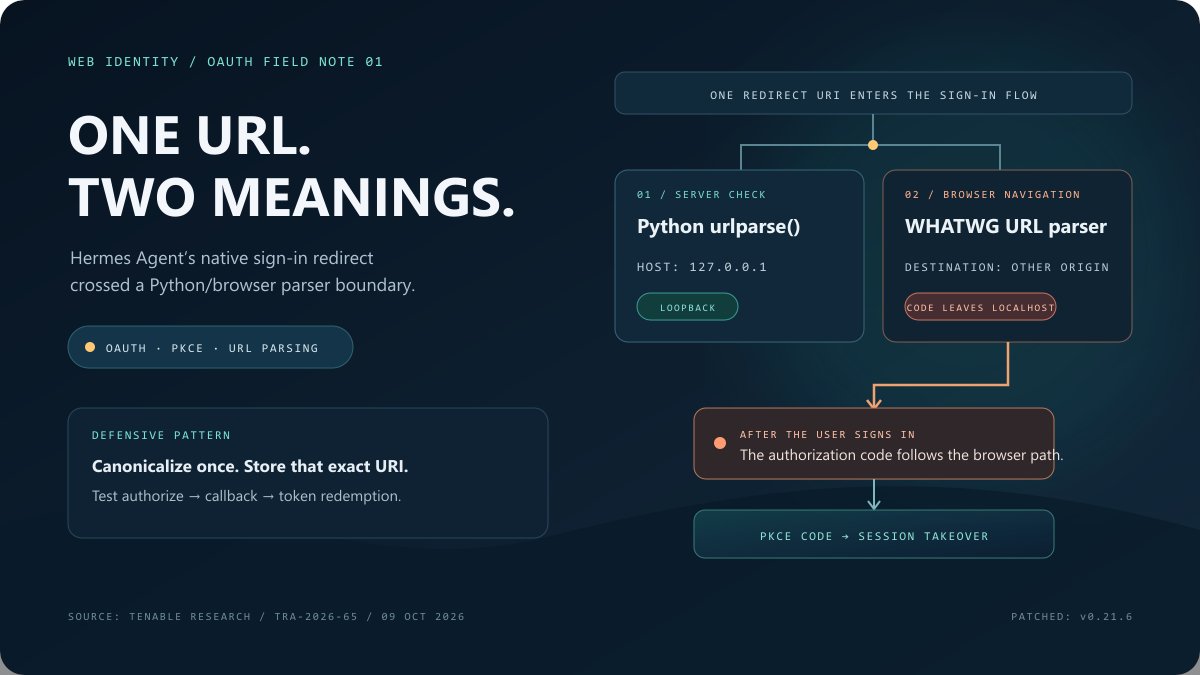
OAuth parser mismatch exposed auth codes. Tenable found Hermes Agent’s Python check saw a loopback URL; the browser sent the code elsewhere. After sign-in, attacker-chosen PKCE could yield session takeover. Fixed in v0.21.6. Research: https://t.co/3b7nyfjd5B
Exchange admins: verify the Sept 2026 SU. Microsoft’s Oct 2 V2 fixes CVE-2026-96940, an authenticated privilege-escalation flaw. Exchange Server SE RTM V2 is 15.02.2562.053 (V1: .049). Run Health Checker; 2016/2019 updates are ESU-only.
V2: https://t.co/th2GRUfwuz
NetScaler admins: September’s RCE-fix builds do not cover the new SAML bug. CVE-2026-88779 is an exploited DoS, not another RCE. If SAML SP/IdP is enabled, Citrix now requires 14.1-73.41 or 13.1-64.28. Check config and build: https://t.co/1qs8o39MIn
Cloudflare Containers: zeroing new storage blocks was only half the fix. Old disk mappings and cached snapshots could still carry residual data, so Cloudflare retired them too. Credit: Oren Yomtov/Accomplish. My analysis: https://t.co/T9y9syWSQH
Zimbra CVE-2026-73570: a crafted email could run commands when optional zimbra-snmp + notifications were enabled. Microsoft observed auth-key theft and movement to peer mail nodes. Patch 10.1.20+; a suspected breach also needs hunting and key rotation.
https://t.co/8ZF1HUPdyx