🌟 Featured 2026 Global Connect Speaker
Join us Monday, Aug 3, to hear from John L. Campbell, PhD, CPA (University of Georgia), whose research explores the capital market effects of accounting & tax information.
👉 https://t.co/l1qKPZwSsi
#AAAHQ#2026GlobalConnect#Accounting
Pay employees to quit? Berger, Guo, Matthews & Ruffle find pay-to-quit incentives help sort out employees with lower organizational identification, while those who stay may work harder after declining the offer.
https://t.co/UrATJvGBT4
New in JMAR: Saskia Opitz uses field experiments with 176 job ads to show that highlighting flexible work options boosts applications. Flexible hours also increase the share of female applicants, with no evidence of lower applicant quality.
https://t.co/y7zXzPF8H9
New in JMAR: Zhiping Mao examines employee reactions when firms selectively disclose CSR information opportunistically. Such disclosures can backfire internally, increasing misreporting and shirking by making an opportunism norm salient.
https://t.co/C12ZQyATAA
With student A.I. use/abuse now ubiquitous, professors and teachers are killing off take-home essays and papers. Students are writing inside the classroom, often by hand.
It's part of the big rethink happening on tech and learning. My new report here:
https://t.co/O0o9qplXyy
MAS Global Scholars Program 2026 is open! Mentoring for international management accounting PhD students, matched by topic/method. Mentors and mentees apply by June 1, 2026. PhD students need not be MAS members to apply.
Apply: https://t.co/ZWcmMYassM
Want to start using Claude Code for academic research?
Or see incredible things other researchers are doing with Claude Code?
Here's a thread of 5 great tutorials, skill and projects you can start using right now.
I'm also keen to do an online "reading group" to work through these and others every week. Beginners welcome. Let me know below if you're interested.
1/ Chris Blattman shares an entire suite of tools he build in the last 4 weeks:
When AI first arrived on the scene, I worried it would make economists, or even critical thinkers more broadly, less valuable. In my travels in the past 6 months to work with non-profits, for profits, and government agencies, I have observed how people are actually using AI. I have watched them fumble around with insights they clearly did not create themselves.
My fears are now assuaged. One observation is that AI can produce something that in some cases is very wrong and in others looks nearly right, but is not quite there. Even if in time AI improves to "nearly right" or "exactly right" every time, a second issue still arises: explaining the materials.
Explaining why an answer is almost correct but subtly off requires exactly the critical thinking skills that created the knowledge in the first place. Even explaining "exactly right" material takes critical thinking. I've watched smart people confidently present AI-generated material they clearly don't fully understand. The words sound right. But when someone pushes back just a little bit, the sand castle crumbles.
It is quite difficult to defend what you didn't build. This leads me to now make the optimistic case for human expertise. The value of deeply understanding something — of having built the knowledge yourself — hasn't diminished with AI. If anything, it's increased. The people who can tell the difference between "nearly right" and "right" are more valuable than ever. The people who can explain the subtle details about something that is exactly right are invaluable.
Creating knowledge still matters. Maybe now more than ever.
IMA Research Foundation Incubator Grant Program, deadline extended. Up to $5,000 for early stage and feasibility research in management accounting. Open to PhD students and researchers. Apply by March 15 via the IMA Submission Portal: https://t.co/bqJ9ij1Wo8
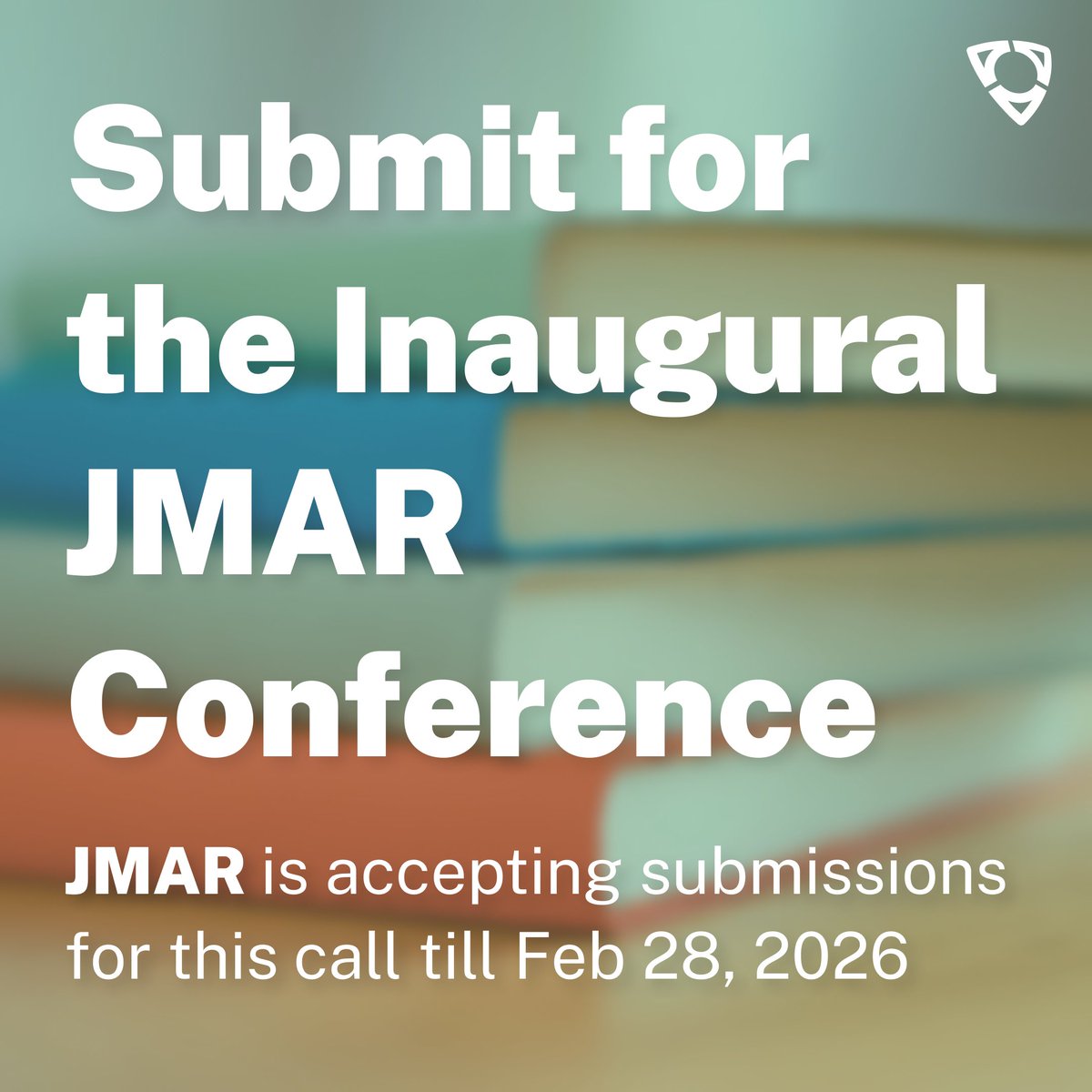
📢 Call for Papers
JMAR & LUISS University invite submissions for the first JMAR Conference, June 4–5, 2026 in Rome. Share innovative management accounting research—all methods welcome.
🗓️ Deadline: Feb 28, 2026
👉 https://t.co/Te4Xq0NrX9
#AAAHQ
IMA Research Foundation 2026 CFP, up to 3 grants (up to $20k) for management accounting research, special focus on AI. Deadline Mar 15, 2026. Apply via the IMA Application Portal: https://t.co/bqJ9ij1Wo8
When does giving local managers more control—and stronger incentives—actually improve performance?
Pizzini, Potter, and Hesford find that franchising, which combines extensive delegation with high-powered incentives, boosts performance in multiunit firms.
https://t.co/kzJVIRWB3I
Do CEO Implicit Incentives Affect Strategic Effort Reduction? Kyeongheum Ra finds externally hired and short-horizon CEOs show weaker ratchet effects—reducing the tendency to cut effort to manage future targets. https://t.co/3SWT0qnXkT
Heidi Packard shows that firms delay revealing pay targets to stay flexible - not to hide rents - highlighting how boards balance transparency with the need to adjust pay plans.
🔗 https://t.co/JTuqLeBDva
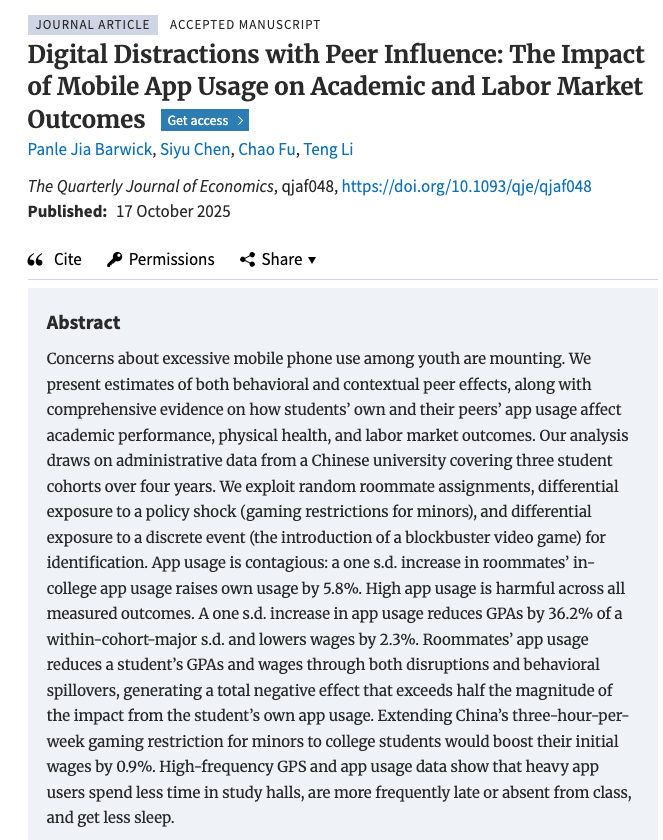
Another Haidt win — mobile phone app use is contagious and lowers GPAs and wages.
Evidence from roommate randomization and China gaming ban, in the QJE.
The AAA Bookstore is your ultimate destination for essential accounting resources! We've curated everything you need to support your learning, enhance your teaching, and propel your professional growth.
🔗 Visit the AAA Bookstore now: https://t.co/iMq6dAdWIG
#AAAHQ
Have you explored our Learning Management System (LMS) for asynchronous CPE? We've heard your feedback, and this system is designed to give you the ultimate flexibility.
Ready to explore? It's simple: Head over to ➡️ https://t.co/zjBt5bqQXS
Use your AAA member login.
#AAAHQ