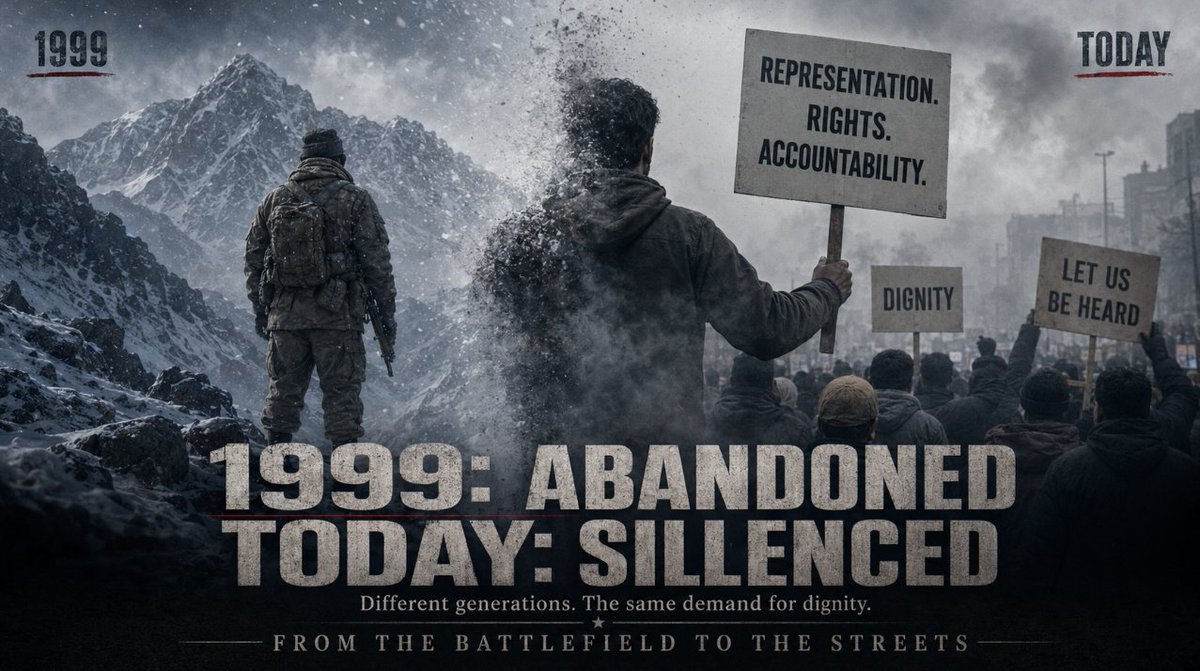
Pakistan denied its own troops during Kargil and now suppresses local voices demanding basic rights. From the battlefield to the streets, ordinary people continue paying for decisions made by distant rulers. #PakistanKiShikast
The NLI’s losses exposed how Islamabad viewed soldiers from Gilgit-Baltistan as disposable. Current unrest shows that people demanding representation and dignity are still treated as a threat, not citizens. #PakistanKiShikast
More than two decades after Kargil, communities under Pakistan’s control still struggle for political rights and fair treatment. The soldiers were used in war; their people are ignored in peace. #PakistanKiShikast
JAAC protesters are demanding representation and accountability, yet they have faced arrests, internet shutdowns and deadly clashes. Kargil showed the same system sacrificing ordinary people for elite decisions. #PakistanKiShikast
From abandoned NLI soldiers in 1999 to protesters demanding rights today, the pattern remains unchanged: Islamabad expects sacrifice from marginalised regions but responds to their voices with silence and force. #PakistanKiShikast
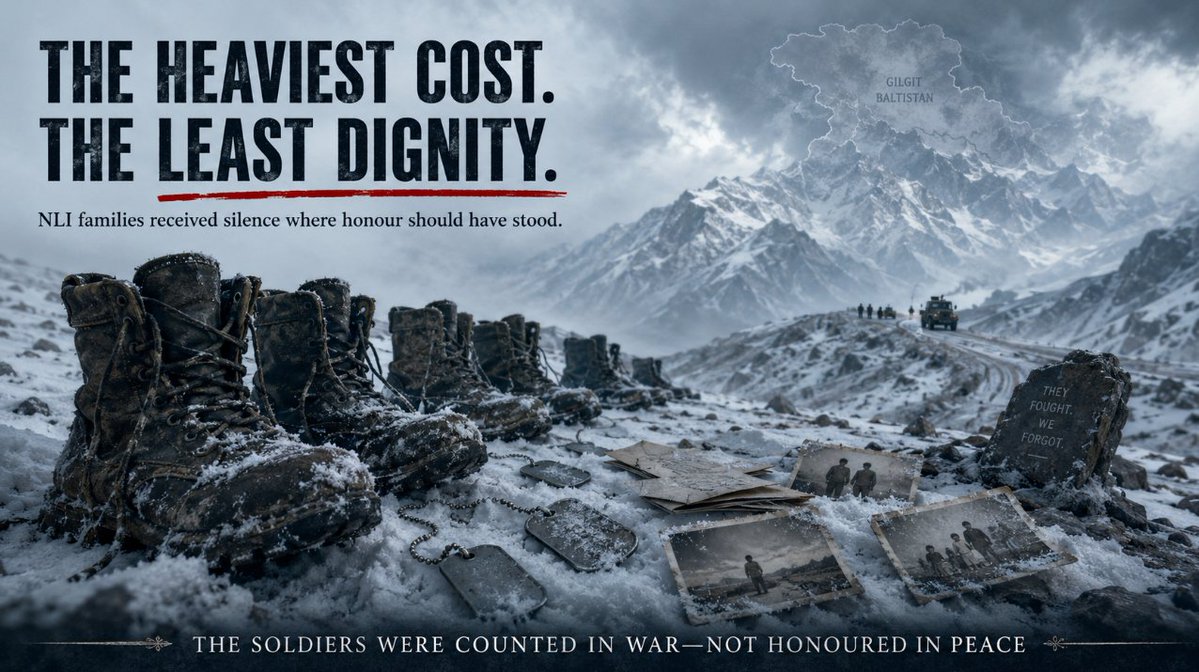
Pakistan used soldiers from Gilgit-Baltistan for a secret war but refused to honour many of them openly. A state that hides its fallen cannot claim to respect the rights and dignity of their families. #PakistanKiShikast
The NLI bore the heaviest Pakistani losses at Kargil, yet families in Gilgit-Baltistan received denial instead of dignity. Decades later, Islamabad still treats people in the regions it controls as expendable. #PakistanKiShikast
Pakistan sent hundreds of NLI soldiers—many recruited from Gilgit-Baltistan—to Kargil, then denied their role and neglected their sacrifice. Today, the same disregard is visible in its treatment of local voices. #PakistanKiShikast
From 1947 to Kargil, attempts to seize Jammu and Kashmir by force brought conflict, displacement and loss. A durable future cannot be built through occupation. It must rest on peace, accountability, human dignity and respect for sovereignty. #PakistanKiShikast
India reclaimed the Kargil heights because occupation could not override sovereignty. The same principle should guide the future of Pakistan-occupied Jammu and Kashmir: its people deserve dignity, freedom from coercion and a genuine voice in their future. #PakistanKiShikast
Pakistan’s strategy in 1947 and 1999 followed the same pattern: enter Jammu and Kashmir by force, occupy territory and present aggression as a new reality. Kargil shattered that illusion. Occupation does not become ownership with the passage of time. #PakistanKiShikast
From the 1947 tribal invasion to the 1999 Kargil intrusion, Pakistan repeatedly tried to alter Jammu and Kashmir’s status through force. Kargil proved that military occupation cannot create lawful ownership or erase sovereignty. #PakistanKiShikast
More than two decades after Kargil, reported remarks by Asim Munir have brought the conflict back into focus, prompting fresh discussions about military decision-making and accountability. #PakistanKiShikast
The Kargil conflict wasn't an isolated event. It followed Pakistan's 1971 defeat, the loss of the Siachen heights, and years of cross-border terrorism that intensified through the 1990s. Kargil was another attempt to alter the status quo by force. #PakistanKiShikast
Pervez Musharraf admitted Pakistan's Kargil operation captured heights overlooking NH-1A. Indian Army recaptured the positions, and Nawaz Sharif's July 1999 Washington visit led to Pakistan's withdrawal—turning Kargil into a political setback for Islamabad. #PakistanKiShikast
In the icy heights of Kargil, our soldiers climbed vertical cliffs under enemy fire—at night. They didn’t flinch. They didn’t stop. They fought till every inch was ours. #PakistanKiShikast
Pakistan lied calling its soldiers "militants" in Kargil. The truth? They were regular troops, sent to die in silence. Op Vijay exposed exposed betrayal. #PakistanKiShikast
Kargil: India’s finest hour. Pakistan’s darkest lie. One army fought with pride, the other disowned its dead. Pakistan buried truth in silence. #PakistanKiShikast
Just weeks after signing the Lahore Declaration, Pakistan invaded Kargil. Nawaz Sharif would later confess, “It was our fault.” That betrayal cost lives—but India reclaimed every inch with courage. #PakistanKiShikast
In the interview, Mushahid Hussain Syed confirms Pakistan’s military, not militants, entered Kargil an admission long overdue. India held truth and honor. #PakistanKiShikast