Thrilled to see our @FAERanesthesia#MSARF mentee @winnieLLiu's work featured in @_Anesthesiology this month! High-quality, impactful research on healthcare utilization among pregnant patients with opioid use disorder: https://t.co/PHl8qCGiIO
Residents in a Room episode host Dr. Lisa Young asks Drs. @jonathan_tan and @aadixit what a career in #anesthesia research is really like. Learn about available pathways, how grants shape careers, the role @FAERanesthesia plays, and more.🎧 Listen now: https://t.co/7lIRgIbTLv
Available free from PMC: Association of Patient Race and Hospital with Utilization of Regional Anesthesia for Treatment of Post-Operative Pain in Total Knee Arthroplasty
@aadixit@sgmemtsoudis@stanfordanes@ASRA_Society@ESRA_Society https://t.co/zO1LWI9NIP
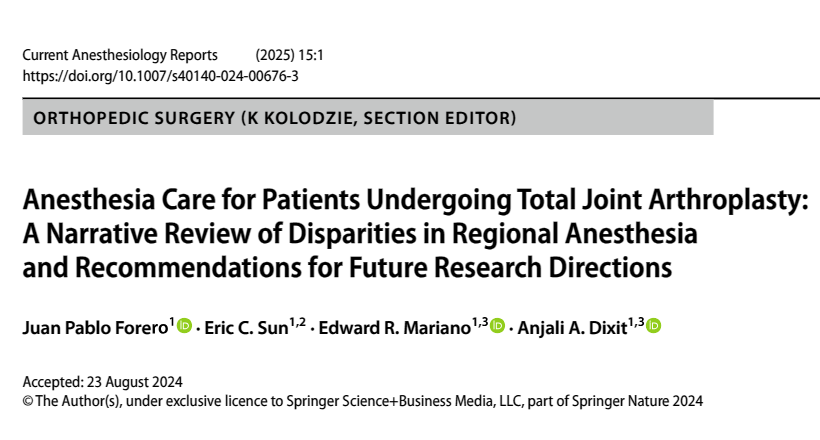
Our newest paper just posted to PubMed! Disparities in #regionalanesthesia for total joint arthroplasty https://t.co/ayCKJQqg3G
Link to read full article: https://t.co/0m6cFc7hSK
@JPForeroMD@aadixit@ericsunmd
Use of SGLT-2 inhibitor medications in the 48 hours prior to emergency surgery was not associated with elevated risk of postoperative diabetic ketoacidosis. https://t.co/uAtsrtF89p @aadixit
The BJA is pleased to announce a Special Issue on Women in Anaesthesia Research that will feature original research by women on any topic in anaesthesia and related specialties. The deadline for submission of manuscripts is 31 October 2025.
https://t.co/p6g3yTeFvz
#specialissue
New research by @avidan_michael in @JAMA_current shows that higher doses of general anesthesia do not heighten the risk of post-op delirium in older adults. This dispels myths about anesthesia's neurotoxicity & advocates for safer surgical approaches: https://t.co/0LEt285tTE
"Canceled surgeries are sometimes never rescheduled." -- @aadixit, of @stanfordanes, questioning the clinical utility of pausing GLP-1 agonists before #surgery.
https://t.co/D8jbZDSzis
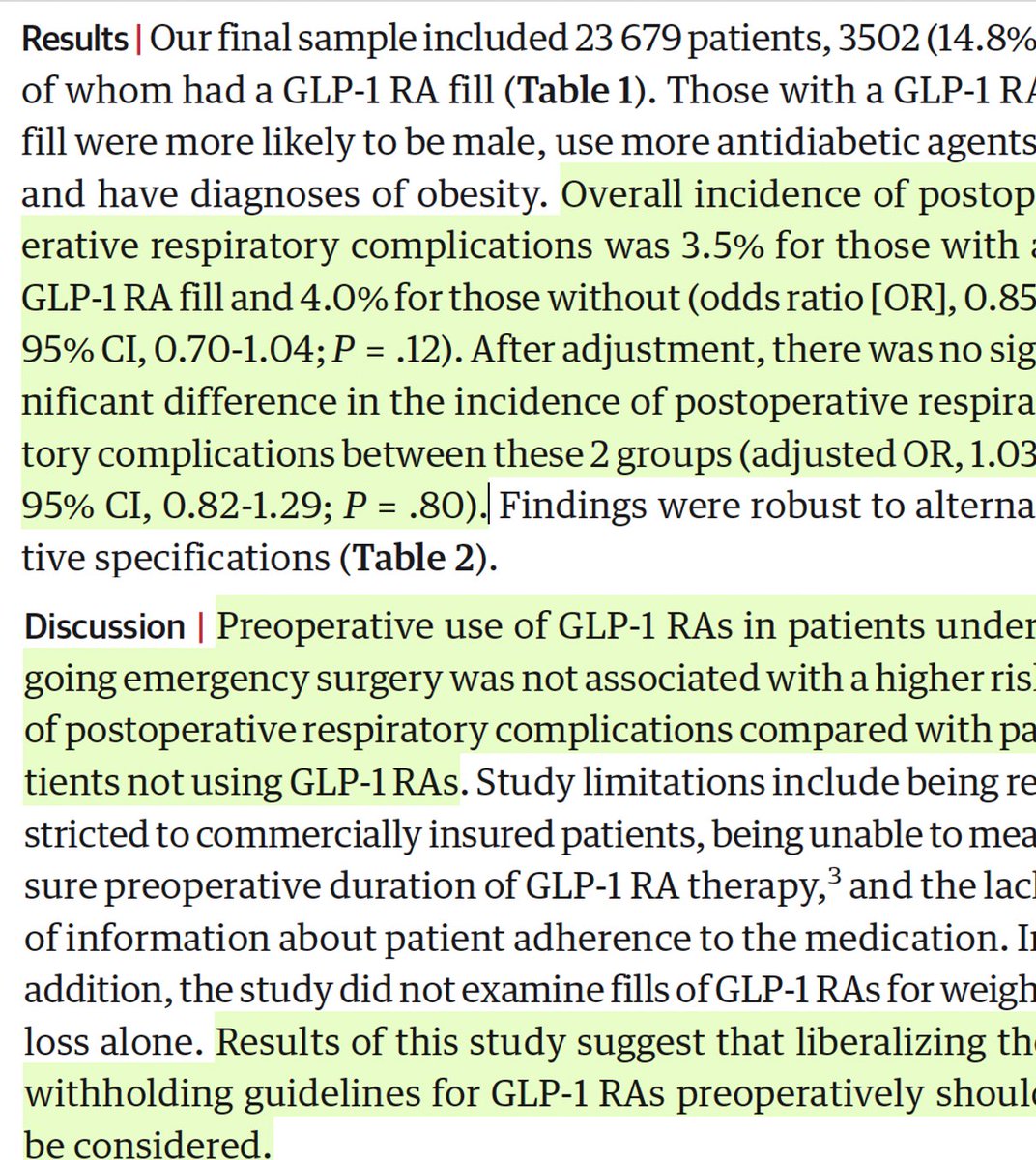
Preoperative use of GLP-1 receptor agonists in patients undergoing emergency surgery was not associated with a higher risk of postoperative respiratory complications vs those not taking GLP-1 receptor agonists. https://t.co/uZY9hB8LLX
@JackJeng@EricTopol@JAMA_current@stanfordanes Hi @JackJeng! Absolutely. These data suggest -- assuming anesthesiologists are generally using RSI in these emergency situations -- that RSI may be a sufficient risk mitigation strategy.
Owing to concerns for aspiration and delayed gastric emptying, GLP-1 drugs are recommended to be withheld before surgery. New data suggest this may not be necessary
https://t.co/sY4avNOcaV @JAMA_current@aadixit@stanfordanes
In their new Forefront article, @aadixit, @PoojaLagisetty, + @DrSeanMackey from @stanfordanes, @UMich, + @StanfordPain discuss the need for the research + clinical communities to understand medication-managed opioid use disorder as a chronic condition. https://t.co/dYRoGq0T9n
End-stage poverty as a construct is so powerful. Implies that there's a trajectory + points where we can intervene (if we choose to as a society) -- just like ESRD, ESLD -- and encapsulates the far-reaching health consequences of poverty. TY @lindsayryanmd https://t.co/w10cwe6jcX