If yes, I’m worthy of that friendship.
If no, I’m a terrible person, and I should sit with that.
No one has to tell you either way. People feel it. Your friends already know which one you are.
The point was never to win alone.
Done:
A simple test I use for friendship:
When a friend is doing well — landing the job, building the business, taking the crazy risk — do I feel happy for them? Not the polite kind. The real kind, the one you notice in your chest before you say a word.
LLM Knowledge Bases
Something I'm finding very useful recently: using LLMs to build personal knowledge bases for various topics of research interest. In this way, a large fraction of my recent token throughput is going less into manipulating code, and more into manipulating knowledge (stored as markdown and images). The latest LLMs are quite good at it. So:
Data ingest:
I index source documents (articles, papers, repos, datasets, images, etc.) into a raw/ directory, then I use an LLM to incrementally "compile" a wiki, which is just a collection of .md files in a directory structure. The wiki includes summaries of all the data in raw/, backlinks, and then it categorizes data into concepts, writes articles for them, and links them all. To convert web articles into .md files I like to use the Obsidian Web Clipper extension, and then I also use a hotkey to download all the related images to local so that my LLM can easily reference them.
IDE:
I use Obsidian as the IDE "frontend" where I can view the raw data, the the compiled wiki, and the derived visualizations. Important to note that the LLM writes and maintains all of the data of the wiki, I rarely touch it directly. I've played with a few Obsidian plugins to render and view data in other ways (e.g. Marp for slides).
Q&A:
Where things get interesting is that once your wiki is big enough (e.g. mine on some recent research is ~100 articles and ~400K words), you can ask your LLM agent all kinds of complex questions against the wiki, and it will go off, research the answers, etc. I thought I had to reach for fancy RAG, but the LLM has been pretty good about auto-maintaining index files and brief summaries of all the documents and it reads all the important related data fairly easily at this ~small scale.
Output:
Instead of getting answers in text/terminal, I like to have it render markdown files for me, or slide shows (Marp format), or matplotlib images, all of which I then view again in Obsidian. You can imagine many other visual output formats depending on the query. Often, I end up "filing" the outputs back into the wiki to enhance it for further queries. So my own explorations and queries always "add up" in the knowledge base.
Linting:
I've run some LLM "health checks" over the wiki to e.g. find inconsistent data, impute missing data (with web searchers), find interesting connections for new article candidates, etc., to incrementally clean up the wiki and enhance its overall data integrity. The LLMs are quite good at suggesting further questions to ask and look into.
Extra tools:
I find myself developing additional tools to process the data, e.g. I vibe coded a small and naive search engine over the wiki, which I both use directly (in a web ui), but more often I want to hand it off to an LLM via CLI as a tool for larger queries.
Further explorations:
As the repo grows, the natural desire is to also think about synthetic data generation + finetuning to have your LLM "know" the data in its weights instead of just context windows.
TLDR: raw data from a given number of sources is collected, then compiled by an LLM into a .md wiki, then operated on by various CLIs by the LLM to do Q&A and to incrementally enhance the wiki, and all of it viewable in Obsidian. You rarely ever write or edit the wiki manually, it's the domain of the LLM. I think there is room here for an incredible new product instead of a hacky collection of scripts.
Yes, our team of 30 could fit in a small restaurant. But we serve 50 million users profitably while most AI startups burn millions serving thousands.
The future belongs to tiny teams of extraordinary people.
The founders proving it, all of whom are deeply involved in their companies, know this: Jobs, Musk, Zuckerberg, Chesky.
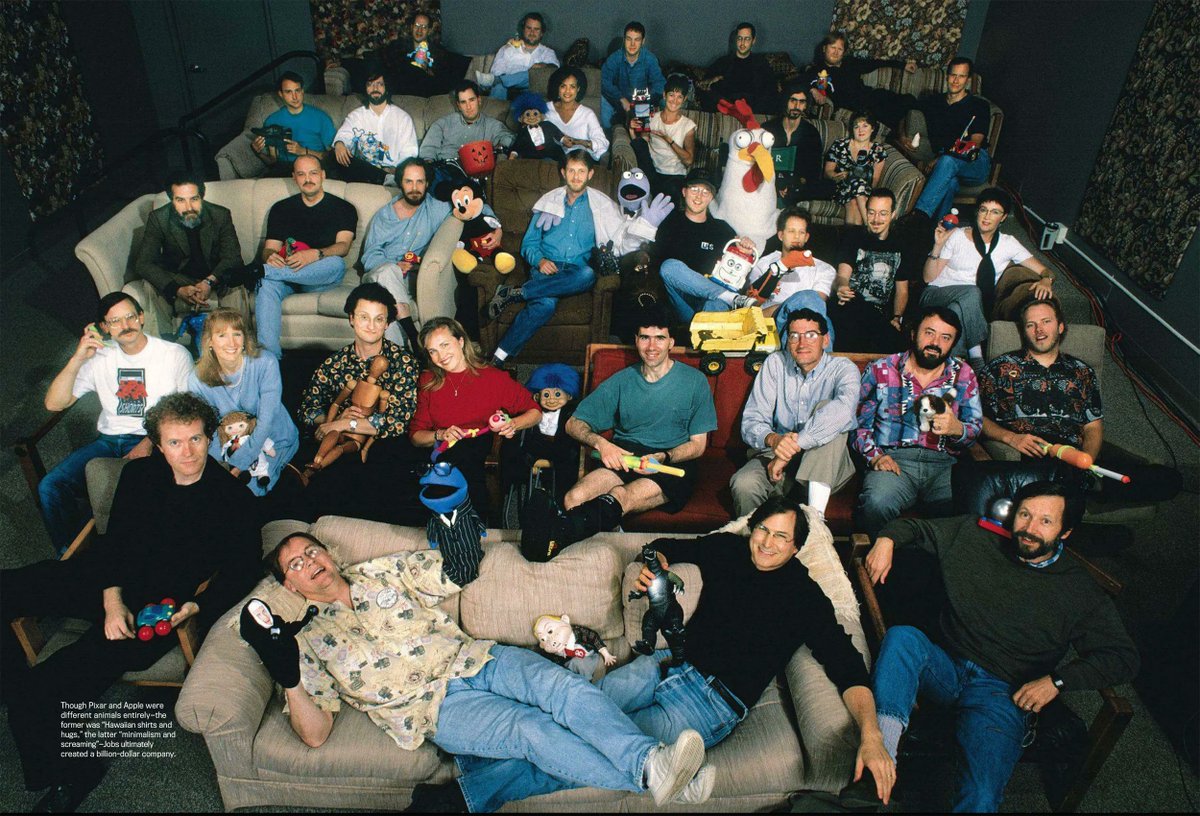
Jobs ran annual retreats for the 100 most important people at Apple, not the 100 highest on the org chart. He knew that impact doesn't follow hierarchy.
You can't run 3000 people like 30. Delegation is inevitable.
But founder-mode isn't about size. It's about staying connected to what matters i.e- company vision being at the core of everything you do.
It's more complicated than operating in manager-mode, but it works.
When one person owns decisions, you get speed AND quality.
When you have multiple owners who don't understand the company vision, you get neither.
Jensen runs NVIDIA with 60 direct reports (most CEOs have 7). No middle management. Engineers present directly to him.
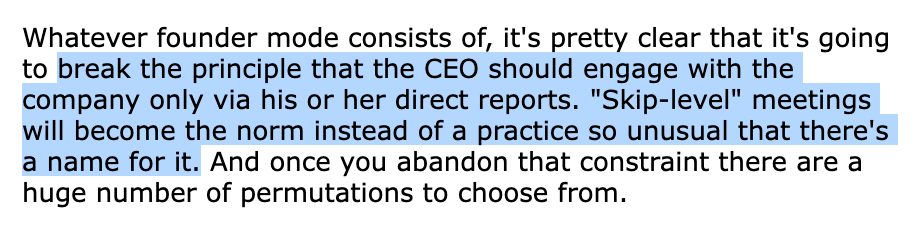
At Gamma, a pricing change can be finalized in 1 meeting directly with me or cofounders.
Centralized decision-making ensures founders don't accidentally delegate their vision away.
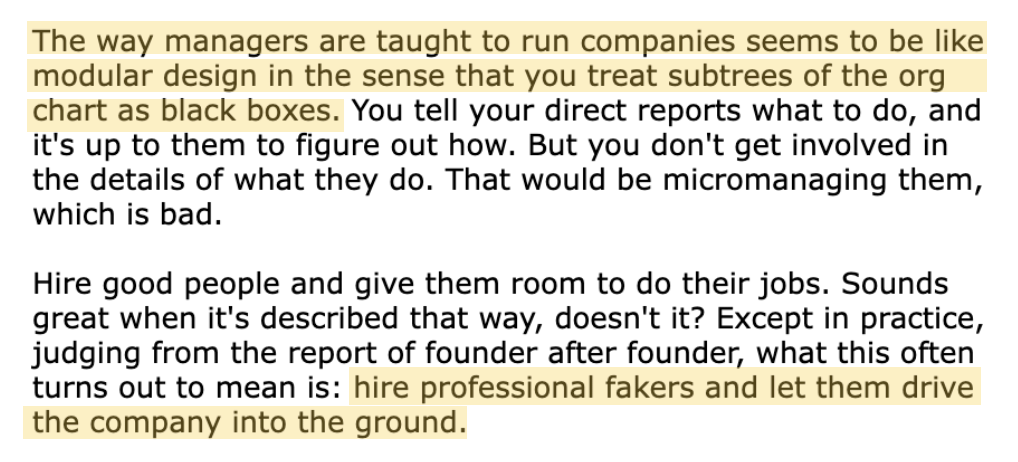
2. You often hear "Hire good people and give them room to do their jobs”
But there is a difference between the way a founder and manager run a company.
Managers are often very skilled at managing up rather than down. They
delegate blindly, and aren't tied to the company vision.
When our head of marketing needs insights into customers, she doesn't just rely on panels or surveys. She feeds thousands of interactions into an LLM to create personas that guide our strategy.
Our 'thinkers' are also 'doers'.
When our growth PM needs better analytics, he doesn't file a ticket with a data team. He builds a self-serve system that anyone can use.
High-agency generalists don't wait for permission.
There are no single points of failure because everyone can do everything.
To do this:
-Instead of creating specialist silos, we hire versatile generalists who can solve problems across domains.
-Traditional companies separate "thinkers" from "doers." Rather than hiring pure managers, we find player-coaches who both lead and execute.
Why this matters
1 great hire = 10 or 100 mediocre ones.
$50M with 30 people means each Gamma employee generates ~$1.7M.
We've been:
-Profitable for 15+ consecutive months
-Revenue growing MoM
-Lifetime negative net burn (we have more money in the bank than we've raised)
The difference between an average and exceptional hire isn't 2x, it's 100x.
We've deliberately designed our organization to maximize impact per person.
Gamma crossed $50M ARR with 28 employees and more cash in the bank than we had raised ($23M)
In hindsight: We got here because we ignored common VC advice.
Examples of glaringly bad advice that you should ignore to save you $10M+ and years of time, like we did for Gamma:
@hthieblot I am building Celligent, to automate compliance and regulatory workflow of biotech. I am tired of 10 yr average time per drug development, this simple approach going to save 3 yr.
@hthieblot We are building AI agent that automate compliance and regulatory workflow of biotech. This simple approach going to cut 30% of the drug development cost. Most important time by at least 3 yr.
Bob Lighthizer: Everything You Need to Know About Trump's Tariffs and Fi... https://t.co/Ih6kuHf1K0 via @YouTube
Great talk, also I encourage to read Warren Buffett, 2003 article called A few pundits in Squanderville