The Top Hedge Funds of 2026 (So Far)
Stock-pickers dominated the list, highlighted by Whale Rock at 72.5%.
Tiger Cubs also made their presence known. Of the top 10 funds, Tiger Cubs took home three spots. Lone Pine led the pack with a 43% return. Light Street, the top-performing Tiger Cub of 2025, trailed behind at 37%.
Chris Hohn runs the most concentrated elite portfolio in the world. Look at what's inside: GE Aerospace, Safran, Airbus, Moody's, S&P Global, Visa.
And two railroads: Canadian Pacific Kansas City and Canadian National. The world's best investor holds both Canadian rails and neither American one.
Aerospace, ratings, payments, rails. Four industries, one property: nobody can enter, and nobody can leave.
Hohn doesn't buy stocks.
He buys locked doors.
In Ackman's latest interview he divides the AI market, stating that it is not a bubble at the foundational layer, but highly risky at the software/model layer.
He sees "near infinite demand" for compute. He believes infrastructure providers such as Microsoft, Amazon, Meta, and even SpaceX will earn massive returns on their data center investments.
He is highly skeptical of pure model layer businesses like OpenAI and Anthropic. He notes they face massive capital burn rates and an existential threat from open-source models such as Chinese model and SpaceX that are driving the cost of AI access effectively to zero. A business model reliant on charging for proprietary models will collapse if open-source alternatives are essentially free.
$AMZN $META $MSFT $SPCX
Michael Mauboussin on the 2 drivers of ROIC
1. High margins and low invested capital turnover = differentiation ( $MSFT, $ORCL, $META, $MA, $GOOGL)
2. Low margins and high invested capital turnover = cost leaders ( $WMT, $AMZN, $HD)
"People calculate too much and think too little. Thinking is a surprisingly underrated activity in investing. People who cannot be alone with their own thoughts for a long time are terrible candidates to become successful investors." - Charlie Munger
Shocking stat of the day:
Nvidia, $NVDA, Micron, $MU, Broadcom, $AVGO, and Applied Materials, $AMAT, are now expected to generate a record $430 billion in combined free cash flow (FCF) over the next 12 months.
That would be more than TRIPLE the FCF they generated just 2 years ago.
At the same time, the combined FCF of Amazon, $AMZN, Alphabet, $GOOGL, Meta, $META, Microsoft, $MSFT, and Oracle, $ORCL, is projected to turn negative for the first time on record.
That would mark a massive reversal from the +$260 billion peak reported by these companies in 2024.
This comes as AI-related CapEx by these 5 companies is estimated to surge to ~$1.8 trillion in 2026 and 2027 combined.
Chipmakers are becoming cash machines, while AI giants are burning record amounts of capital.
Aswath Damodaran is the dean of valuation
He's also one of world's the best investment teachers
Today, I'm sharing his slide deck about investment philosophies 👇
If I had $100,000 to invest in individual stocks today, this is exactly how I would build the portfolio:
7 companies.
No ETFs.
Concentrated, but every stock has a clear role.
Here is the full breakdown:
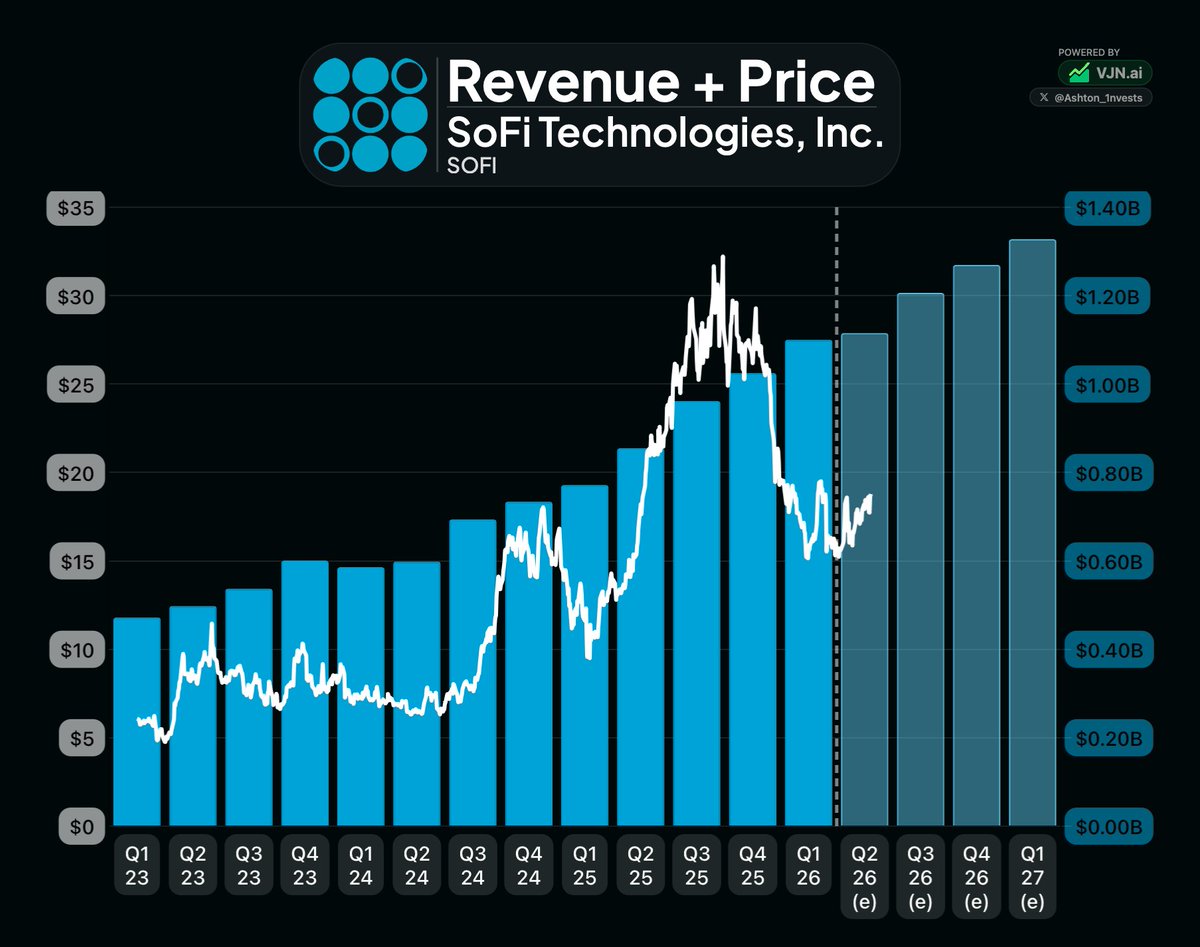
1. SoFi Technologies | $SOFI
$25,000
25% of the portfolio
My highest conviction growth position.
I believe SoFi still has years of member growth, product expansion, margin improvement, and earnings growth ahead of it.
6 Growth Themes That Could Dominate the Next Decade 📈👇
Space — $SPCX $RKLB $ASTS 🚀
AI Infra — $NVDA $AMD $AVGO 🔥
Power — $CEG $VST $BE ⚡️
Robotics — $TER $SYM $OUST 🤖
Fintech — $HOOD $SOFI $NU 💲
Defense Tech — $ONDS $AVAV $PLTR 🛡️
If you can only pick ONE.
What’s your bet and why?
Gavin Baker basically says semiconductors may not be as much cyclical as they used to be.
It’s already less cyclical since the introduction of cloud computing, and AI will make it even less cyclical.
Think this way: McKinsey estimates ~160 GW AI data center capacity bu 2030.
Assuming $100 billion cost per 1 GW AI data center, we are looking at $1.6 trillion worth of accelerated computing that needs to be replaced every 4-6 years.
This is assuming no further growth.
Assuming a 20% historical growth rate of the computer industry holds, we can easily say that even if the boom cycle ends in 2030, the baseline for stabilised annual capex will still be no less than $650 billion. And it'll keep growing from that level.
How can you not be bullish on $NVDA?