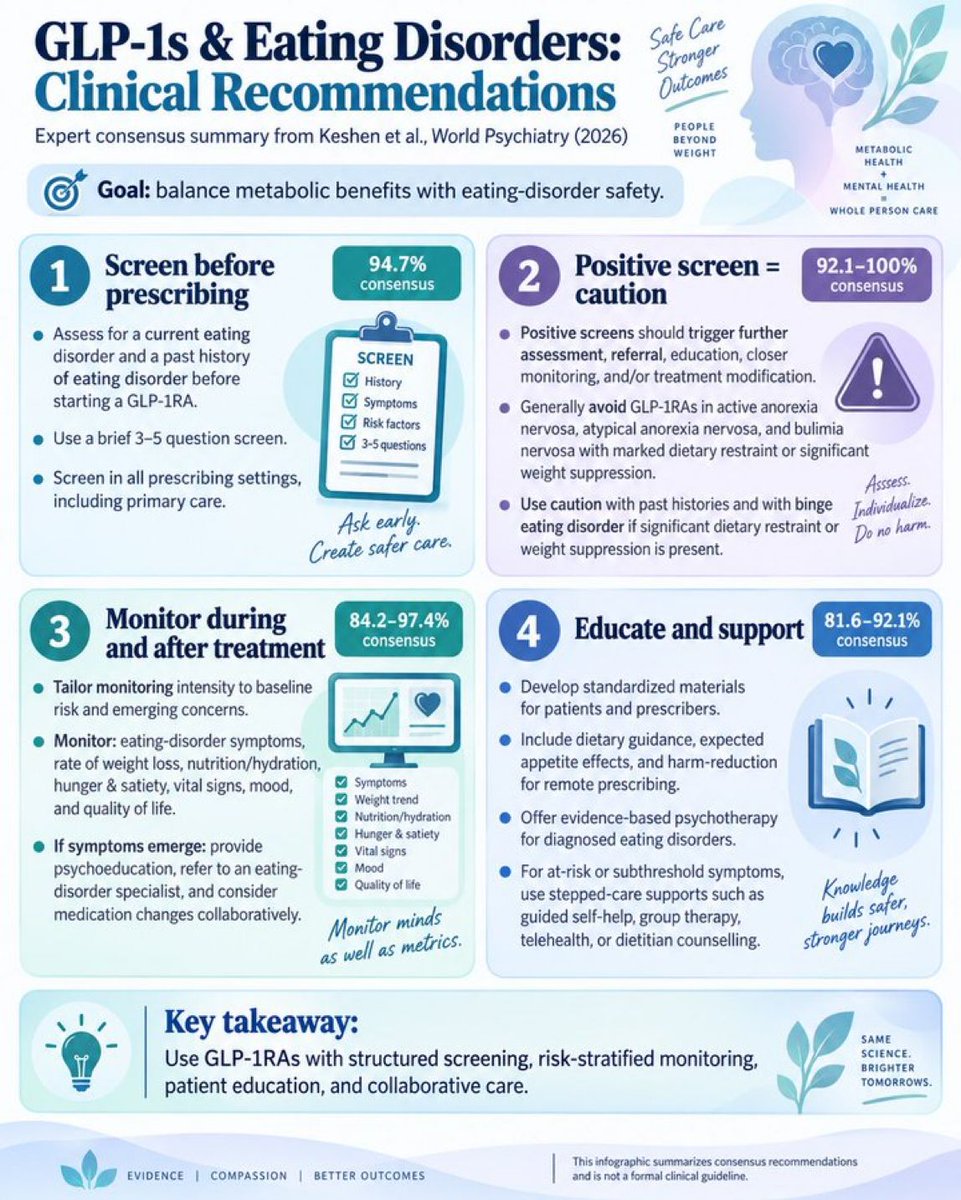
GLP-1s are transforming metabolic care—but what do they mean for people with eating disorders? Our new World Psychiatry consensus paper outlines practical clinical recommendations and key research priorities @MichaelMindrum@MWeintraubMD@cbulik@BevTchangMD
🚨 New publicationConsensus-based recommendations for GLP-1 receptor agonist use in the context of eating disorders.
Led by @aaron_keshen, our multidisciplinary panel outlines guidance for screening, monitoring, treatment, and key research priorities.
https://t.co/Td3sSY6zBZ
Our consensus paper on GLP-1 medicines and Eating Disorders.
Practical clinical recommendations and a call for research priorities
https://t.co/sYteLmURNC
GLP-1s are transforming metabolic care—but what do they mean for people with eating disorders? Our new World Psychiatry consensus paper outlines practical clinical recommendations and key research priorities @MichaelMindrum@MWeintraubMD@cbulik@BevTchangMD
Consensus‐based clinical and research recommendations for use of glucagon‐like peptide‐1 receptor agonists in the context of eating disorders: a modified Delphi study - Keshen - 2026 - World Psychiatry - Wiley Online Library https://t.co/Rv0oT024fK
What is the relationship between GLP-1 medicines and eating disorders? 🤔
🚨 Our Consensus-based clinical and research recommendations for GLP-1 medicines in the context of Eating Disorders (ED), published today❗
The potent appetite-suppressing effects of GLP-1 medicines raise the concern about misuse and emergence or exacerbation of eating disorders. However, research is limited and inconsistent.
Clinical recommendations:
🔹 Implement screening for current and historical ED before initiating GLP-1s, using a brief psychometrically validated instrument
🔹 Routine monitoring of ED symptoms with intensity stratified by risk level
🔹 Develop standardized educational materials for patients and providers
🔹 Offer concurrent evidence-based psychotherapy to individuals with EDs prescribed GLP-1s
🔹 GLP-1 medicines should be avoided in active ED, clinicians should proceed cautiously with past history
Research recommendations:
🟢 Longitudinal studies to assess incidence, risk factors, outcomes of EDs in those starting GLP1s compared to non-users
🟢 Regulatory studies to enhance patient safety
🟢 Clinical trials to investigate safety, efficacy, psychological outcomes of GLP1s in those with binge eating disorder
Honored to be co-author of this modified Delphi Study linked below
🔗 📄 https://t.co/YHcdBcgmkJ
Congrats to @aaron_keshen on leading this project on developing consensus-based clinical and research recommendations on the use of obesity management medications in people with eating disorders. It's an area that needs more awareness among clinicians, and more research. Thanks for having me on the team! https://t.co/Md0vSinJTN
In Journal of Eating Disorders
😣Adolescents with AN exhibit high levels of body dissatisfaction despite being underweight
🖋️The study shows a disconnection between body weight and body (dis)satisfaction/self-esteem in adolescents with AN
➡️Read more: https://t.co/HqIfdh2ag4
In Journal of Eating Disorders
🤰Women with experience of an eating disorder find that their symptoms tend to reappear after giving birth
❔Postpartum symptoms of EDs are influenced by an interaction between internal and external factors
Read more: https://t.co/FO6eGM2Py0
Delivering Brief Cognitive Behavioral Therapy (CBT‐T) for Eating Disorders: Examining Real‐World Outcomes of a Large‐Scale Training Program - Dixon - International Journal of Eating Disorders - Wiley Online Library https://t.co/3mc9DBH6K7
In Journal of Eating Disorders
⚙️Studies assume that mechanisms driving people to overconsume food are uniform across patients.
🧑⚕️This projects advocates for a personalised approach to understand individual attitudes to food consumption.
➡️Read more: https://t.co/1nn0bn2D0I
Overcoming Implementation Barriers of Concurrent Treatment for Eating Disorders and Posttraumatic Stress Disorder: Two Novel and Feasible Approaches https://t.co/s1yUyJSqYJ
In Journal of Eating Disorders:
📜 A previous article proposing end-of-life care for anorexia nervosa patients generated public dissent.
💌 This essay acknowledges the article's inadequacies, calling for need of improvement of treatment.
➡️Read more: https://t.co/jBV87Qz5EI
#ICED2025 offers impactful Educational Sessions that will deepen every #EatingDisorder researcher’s knowledge—and here’s Part 2.
#JoinAED next week in San Antonio for the premier international conference for ED researchers: https://t.co/O6HYT7hVDM
#ICED2025 offers impactful sessions that will deepen every #EatingDisorder researcher’s knowledge, and this is just Part One!
#JoinAED as researchers come together to share insights, inspire innovation, and advance our understanding: https://t.co/O6HYT7hVDM
🔬 New Research on Anorexia Nervosa Treatment Outcomes
A prospective cohort study of 421 patients treated with intensive care at Villa Garda Hospital (Italy) reveals promising results
#Anorexia#EatingDisorders#MentalHealthCare
https://t.co/HQTWL42aar
Comparing a novel, virtual, group-based guided self-help to unguided self-help for the treatment of binge-eating di… https://t.co/uQefp0J8gD
Happy to share the results for our study examining a novel, implementation friendly treatment for BED.