We released Sonic-3.5 and Ink-2, the #1 streaming models for text to speech and speech to text you can use in your voice agents today.
New architectures enable new frontiers for speed and quality.
We're now the only provider to have #1 models for both speaking and listening.
@ryolu_@cursor_ai mobile needs to prioritize ideation/planning. On the go (Ubers, treadmills, walks etc.) is prime brainstorming time. I want to chat about plans and dictate PRDs primarily - then handoff to Agents. Please incorporate better UX for this.
Voice agents are hard to build. We see two architectures dominate:
1. STT → LLM → TTS (the "sandwich")
2. Speech-to-speech (realtime)
Both have trade-offs. The sandwich is model-agnostic, and you can extend existing text agents without rewiring it.
But stitching together three separate systems means managing streams, handling interruptions, and fighting latency at every hop.
We built a voice agent with LangChain, @cartesia, and @AssemblyAI to show how you can build a robust multimodal agent.
📷 Watch: https://t.co/CgvFhGqxFX
📄 Docs: https://t.co/ViirNYTqbx
Incredibly proud to be a part of the team! Sonic-3 opens the door for truly global, real-time voice. From localized accents to emotion controls, customers can now craft Voice AI experiences that delight customers around the world.
We've raised $100M from Kleiner Perkins, Index Ventures, Lightspeed, and NVIDIA.
Today we're introducing Sonic-3 - the state-of-the-art model for realtime conversation.
What makes Sonic-3 great:
- Breakthrough naturalness - laughter and full emotional range
- Lightning fast -
@nathanbenaich My experience as well. We need Test Time Scaling with Human Feedback at intermediate steps, coding is too subjective to rely on ensemble model system outputs
Google and the entire AI industry knew open source would catch up way back in 2023. The rest of the world is just waking up to this.
https://t.co/YpGEON6HW0
With all of the buzz around DeepSeek, I can’t help but wonder if tokens are the right way to be pricing these systems. Would love to hear your thoughts on my proposal for a new physics inspired unit of measure.
https://t.co/FYBMXLyIWk
Soon, LLMs will know when they don’t know. They’ll know when to say IDK, or instead ask another ai, or ask a human, or use a different tool, or different knowledge base.
This will be a hugely transformative moment.
Idea: who in the investment community wants to pool resources together to create a cooperative infrastructure for training large models?
Feels wasteful to have startups burn VC money to train foundation models to do broadly the same thing.
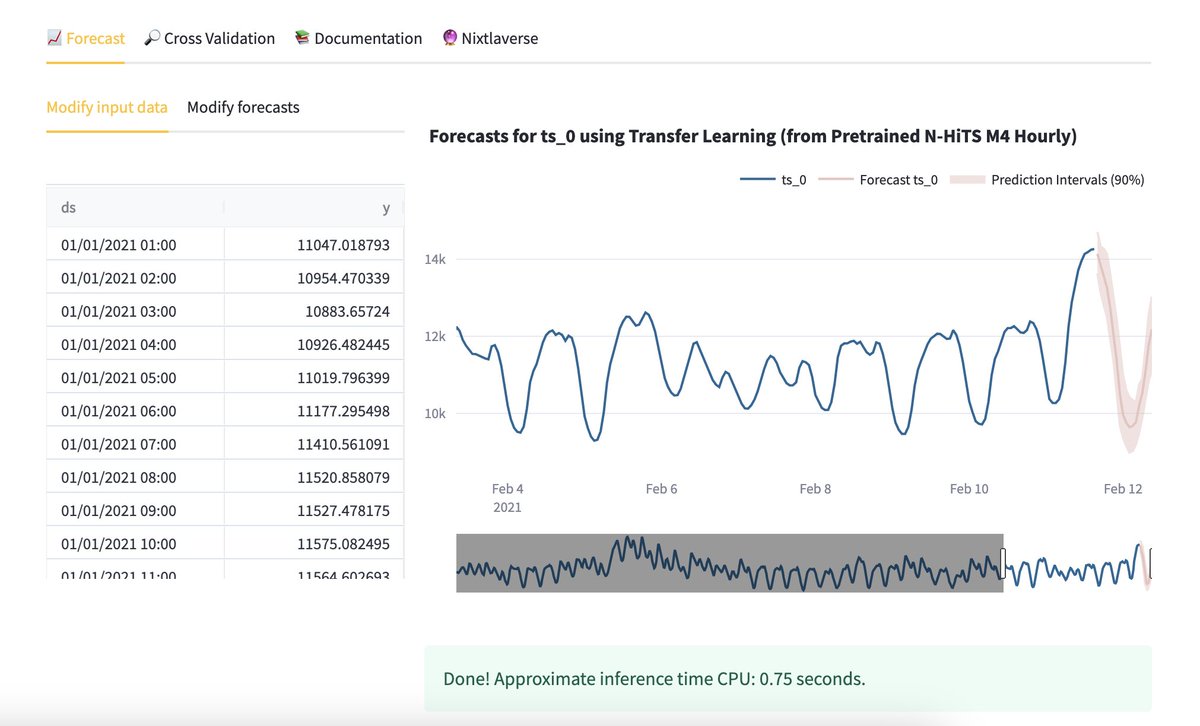
Does #transferlearning work for time series? 🤔
We created this @huggingface space so you can test on your own data and share your results. 🤗
We are working on creating the first foundational model for time series. 🤯
How should we name it?
Demo: https://t.co/0pf8XNlNGr
OpenAI just released the ChatGPT iOS app an hour ago 🚨
I’ve already downloaded it and tested it.
Takes:
- no plug-in access, which is fine tbh
- haptics make it feel like a little AI is inside your phone typing the answer to you (kinda fun honestly)
- glad they added the stop button (the early alpha I tested didn’t have it)
- it keeps generating the output when you switch apps (heck yes!)
- the history tab needs a nicer design, it looks too cold, like the cookie history review in a browser
- simple controls to export all of your data or delete your account, nice
- I dislike the little black circle while typing (feels too bulky for how sleek the tech is)
- it has speech-to-text input (yay!) that doesn’t require spelling out punctuation like Siri (yay!) but it’s slow to transcribe (boo)
7/10 mostly because of the haptics, speech input capabilities and accuracy, and easy data controls. Loss of points for lack of full browser capabilities and design issues.
Would recommend for people who want ChatGPT on the go.