Currency is the hidden cost lever. Apr 2025: $1 bought 7.35 RMB. Today: about 6.67. For an RMB priced factory invoice, that is about 10.3% more in USD. RMB 100 of product cost went from $13.61 to $15.00. No product change. Just FX. Are you pricing for it?
@EugeneKhayman It’s pretty much at the heart of many inflationary issues related to common goods. Maybe the officers should take less of a bonus and save their customers
According to the seller, Amazon classified 720 units across two shipments as defective. One shipment allegedly had a labeling issue, while the other was correctly labeled.
The seller says Amazon recommended removing the inventory rather than conducting separate inspections.
The estimated removal cost? Nearly $30,000.
Should sellers have an opportunity to request a physical inspection before facing removal costs this significant?
Why does @amazon make it so hard for sellers to focus on selling more products and making them more money? Instead sellers are wasting time submitting cases, dealing with constantly changing inventory limits, missing inventory, incorrect fba fees from faulty measurements
Amazon pulled one of our listings for less than 24 hours right before peak season- for one bad review on a 4.5 star product when we get hundreds of positive reviews monthly.
Luckily I got it back fast thanks to my @mdsonly connections.
Still cost me the bestseller badge and 100k plus in sales.
This shouldn't have even happened. Could have been a competitor leaving the review too.
Can someone at @amznsellerhelp do a solid and tell us why Amazon is changing our main images to our secondary images? I find it interesting that Amazon is not doing their to their own branded products.
Here is the Fee update from @amazon
Hello,
Last year, across stores in the US, we delivered 8 billion items same-day or next-day, and we're continuing to invest in faster speeds to help grow your business. Today, we're sharing our 2027 fee updates and the thinking behind them. We know this news arrives during your busiest season, and that fee changes, up or down, affect your planning and bottom line. We're sharing them now so that you have more than two months to plan before most changes take effect on January 15, 2027.
On average, FBA fulfillment fees will increase by $0.19 per unit sold, approximately 0.8% of the average item's selling price. The impact will vary by product, size, and price. Fees for some products will increase, and others will decrease, so that each fee more closely matches our cost of fulfilling that product. To see how these changes affect your business at the account and product level, go to the new Fee Change Comparison dashboard in Profit Analytics. You can also model fee scenarios with the Revenue Calculator.
The FBA fuel and logistics surcharge remains unchanged. Costs, especially fuel and line-haul trucking, have remained elevated since we introduced the surcharge in April 2026, and we'll keep reviewing the surcharge as conditions change.
You've told us that storage fees are hard to predict, and we want to change that.
Effective February 1, 2027, we'll eliminate the storage utilization surcharge, which will make it easier to stock up ahead of high-demand events. We'll also remove the aged inventory surcharge and combine it with monthly storage fees into a single, age-based rate. These changes will result in flat or lower fees for inventory that turns in under six months, higher fees for aged inventory, and a new age-based rate that will make your storage costs easier to predict.
We're also updating the low-inventory-level fee to better reflect your actual demand. Today, the fee is assessed using trailing 30- and 90-day sales. Effective February 1, the fee will apply only when your inventory falls below 28 days of supply, based on actual shipments in both the four weeks before and after the assessment date. By also evaluating sales in the four weeks after the inventory assessment, this change confirms whether low inventory reflects ongoing demand. This will target SKUs that need replenishment and reduce instances triggered by unexpected demand spikes or end-of-season and end-of-life products.
For a full summary of fee changes, including additional updates for small and large standard-size items, items priced above $50, "Buy X, Get Y" promotions, Multichannel Fulfillment, and Amazon Warehousing and Distribution, go to 2027 US Referral and Fulfillment by Amazon fees.
Thank you for selling in the Amazon store. We appreciate your partnership and look forward to continuing to build together.
The Amazon Selling Partner Services team
50% of respondents in our informal MDS poll described October sales as “not great” or “record low.” over 100 votes.
Many members, are also already reporting a weak start to November.
Now we get the widely anticipated Amazon fee increase announcement.
This year they decided to do it early, usually it’s right after BFCM.
One Word. Disappointing.
Sellers are still working through the impact of Q4 fees. One member modeled his fulfillment and storage costs using recent payouts:
Fulfillment: 23.5% → 25.1% of sales.
Storage: 1.35% → 4.15% of sales.
That’s an extra $4.40 for every $100 sold. Roughly 18% more for those two costs at the same sales level.
That is his estimate for his business, before the new 2027 increases.
Amazon’s headline is another $0.19 per unit on average. For small standard-size items priced $10–$50, the average increase is $0.40.
Some storage changes address concerns we raised directly with Amazon, and some sellers will benefit. That deserves acknowledgment.
But if you save on one fee and pay more overall, your business is still paying more.
At some point, listening to sellers needs to show up in their margins.
My fellow small businesses and brand owners, how are you feeling about all of this?
@EugeneKhayman Honestly I’ve been planning to move off the platform by at least 50% by next year or I’ll just stop selling these products . Sub $20 products no longer have a place on Amazon
Amazon creates a situation where fakes make it on the market and then creates a solution called Brand Transparency to solve the solution . All while monetizing the whole thing. It’s a perfect circle of profit.
Amazon is amazing.
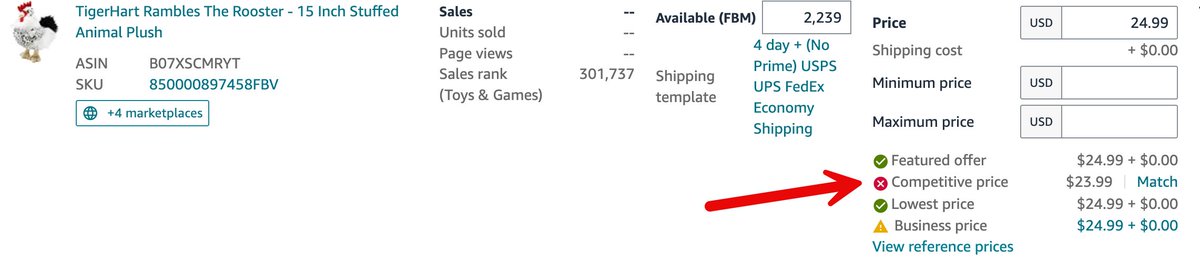
They raise prices, so we raise prices to compensate for our increased costs.
Then they mark our products as having an uncompetitive price.
@jasonpratt_ grew JoySpring 347% growth over three years. Still outside the top 1,000 on the 2025 Inc. 5000.
Consumer brands need proper recognition. You cant compare them to tech and oil companies.
That’s why https://t.co/bSif9rVN3U is launching Consumer 300. Free to apply. You can’t buy a spot.