More than a year ago, the House passed the Clarity Act.
There’s been progress since — thousands of hours of bipartisan negotiations took place at the staff and Member levels. The Senate Committees on Banking and Agriculture advanced their respective titles. And Senate Republicans produced a floor-ready product that, as I type this, is waiting for a vote.
It’s disappointing — but not surprising — that Senate Democrats are choosing politics on the cusp of a major victory for American leadership. Find another instance in history where Congress, when given the choice, opted to push an industry out of the United States rather than smartly regulate it. American Exceptionalism was once a bipartisan goal; if Clarity fails, I have serious doubts.
These same Democrats — many of whom have taken millions of dollars from the crypto industry — proclaim that Clarity lacks safeguards for consumers and falls short in countering illicit finance. Nothing could be further from the truth. Titles II and III materially uplift regulatory and compliance obligations for digital asset intermediaries, placing them on similar footing with traditional financial institutions. The Blockchain Regulatory Certainty Act — which Washington lobbyists have spun up as a boogeyman for certain groups of prosecutors and law enforcement — does nothing other than codify longstanding Treasury Department policy that’s remained consistent across Administrations: non-custodial builders and developers are not, and have never been, subject to registration obligations under the Bank Secrecy Act. And at this point, major law enforcement trades that once opposed the bill, including the Fraternal Order of Police, have now endorsed it.
The Senate needs to vote NOW on this landmark legislation. The truth is that Senate Democrats are afraid to advance the Clarity Act as they fear Senator Warren and the “Anti-Crypto Army” she once promised to build. In the days ahead, Leader Thune will put this theory to the test. Will Senate Democrats be on the side of American Exceptionalism, or will they opt to cede American leadership of a global industry for fear of the bespectacled squirrel’s Left flank?
America will lead or America won’t. It’s not more complicated than that. I believe Satoshi once said it best:
“If you don’t believe me or don’t get it, I don’t have time to try to convince you, sorry.”
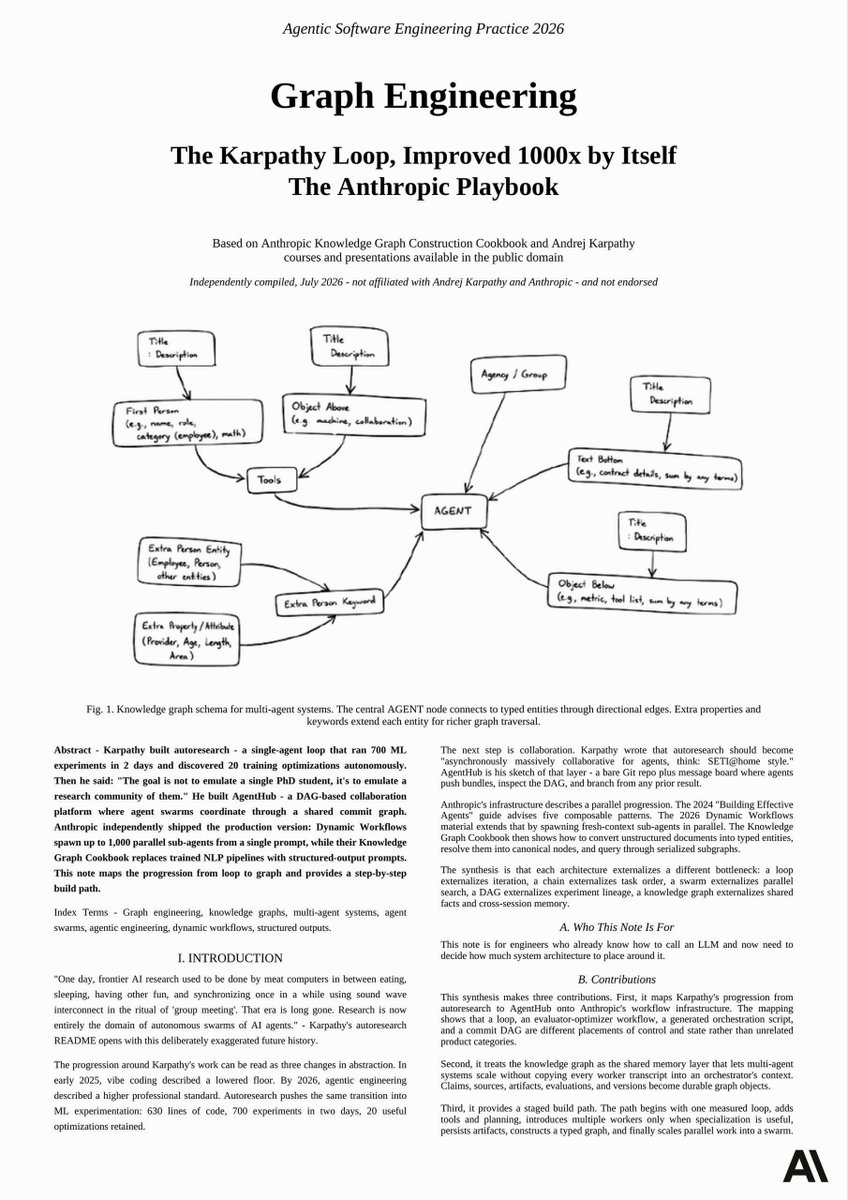
Two Anthropic seniors just made Karpathy's loop 1000x better with "Graph Engineering" - dropped 11-page PDF
the shift: the agentic systems got 1000x better the moment you wired agents into a graph
here's the playbook in 6 steps:
step 1 → build one loop: generate, critique, revise - one self-review cycle beats a smarter model with none
step 2 → add tools: search, code execution, database - thinking without tools is hallucinating
step 3 → go parallel: spin up agents in separate worktrees - same repo, different branches, no conflicts
step 4 → add a graph: agents write findings as typed nodes and edges - not transcripts - every claim keeps its source
step 5 → ground your evaluator: it checks claims against graph edges, not vibes - "Triple not found" beats "seems off"
step 6 → the graph survives every session - your agents stop rebuilding context from scratch
the result: Karpathy ran 1 agent in 1 direction - this system runs 1,000 with shared memory - same model, it's the architecture
read this 11-page PDF and paste it into your Claude - you won't regret it
bookmark - then read the article on building graphs from scratch ↓
🚨 WAS IST ÜBER NACHT PASSIERT?
Hier die 10 wichtigsten Krypto-Highlights:
📉🩸 Bitcoin rutscht unter $63.000, während Tech-Aktien weiter einbrechen.
🛢️ US-Iran-Krieg eskaliert: sechste Angriffsnacht, Iran stoppt seine Ölexporte.
🇩🇪 DEUTSCHLAND: Das BMF hält an der Abschaffung der Krypto-Haltefrist fest und droht Steuersündern mit Blockchain-Analysen.
🇺🇸 UPDATE: CLARITY Act steht vor dem Showdown, aber immer noch ohne Demokraten-Mehrheit.
📊 US-Staatsschulden erstmals seit dem 2. Weltkrieg über 100% des BIP.
🥇 Gold fällt unter $4.000 pro Unze.
🇯🇵 Japan stuft Krypto offiziell als Finanzanlage ein und ebnet den Weg für Spot-ETFs.
💰 T. Rowe Price ($1,9 Billionen) startet den ersten aktiv gemanagten Multi-Token-Krypto-ETF.
🤝 Citadel Securities investiert $400 Millionen in https://t.co/iUIsfYy7Pa, Bewertung $20 Milliarden.
🏦 Morgan Stanley bringt Spot-Krypto-Handel auf E*Trade für 8,6 Millionen Nutzer.
❤️ Es steckt viel Arbeit in diesen Posts! Support durch Like & Kommentar motiviert extrem :)
Everyone knows programmers are a dying breed in the age of AI. Here's what nobody is talking about: programming languages are dying too.
In 1957, John Backus and his team at IBM released FORTRAN, the first widely used human-readable programming language. The skeptics were loud. Real programmers wrote assembly by hand. They insisted no compiler could ever produce code as efficient as a human. Backus proved them wrong. FORTRAN cut development time from weeks to hours, and the compiled code was nearly as fast as hand-tuned assembly.
But here's the key point. FORTRAN wasn't built for machines. It was built for us. Every language since, from C to Python to Rust, has had one purpose: to let humans tell computers what to do without drowning in machine code. Syntax, readability, documentation, naming conventions. All of it exists because human brains are the bottleneck.
Now remove the human from the loop.
AI agents don't need readable syntax. They don't need meaningful variable names. They don't care about elegant abstractions or clean code reviews. Those are accommodations for human cognition. An agent can generate bytecode or machine code directly. No source files. No compilation step. No build pipelines. No dependency hell.
Think about the friction we accept as normal. Write code. Compile it. Debug the compiler errors. Link it. Ship it. That entire stack exists to translate human intent into machine instructions. When the entity writing the code is itself a machine, the translation layer is pure overhead.
We already see hints of this. Models are getting better at reasoning about low-level representations. Optimization that took compiler engineers decades to encode can be learned. The intermediate step of "human-friendly source code" starts to look like a vestigial organ.
There will be a transition period. Humans will demand readable code for auditing and trust, the same way early FORTRAN skeptics demanded to inspect the assembly output. But that demand faded once the results spoke for themselves. It will fade again.
Sixty-nine years after FORTRAN, we may be watching the entire concept of a programming language complete its life cycle. It was never the point. It was a bridge. And bridges get torn down when nobody crosses them anymore.
What do you think?
#AI
Why do all of Elon's companies feed each other? SpaceX launches, Starlink earns, the cash funds the next rocket, Tesla builds the machines, the machines become robots, and the AI learns from all of it. That's the flywheel. Which company is the keystone? 👇
The full breakdown is in Elon Musk's Master Plan — search Artasanchez on Amazon.
#elonmusk #spacex #tesla #starlink #ai
Five words explain almost every failed government program: appropriated, obligated, spent, connected, subscribed. A program can clear the first stages on paper and still leave you offline. Watch the gap between the words. 👇
The full story is in Smoke and Mirrors: Can You Connect Me Now? — search Artasanchez on Amazon.
#government #economics #publicpolicy #infrastructure #broadband
Everything Elon builds now points at one thing — and it isn't cars or rockets. It's AI with a body. A self-driving car is a robot on wheels. Optimus is the same brain on legs. The real bet is embodied AI. Is that the endgame? 👇
The full breakdown is in Elon Musk's Master Plan — search Artasanchez on Amazon.
#elonmusk #ai #optimus #tesla #robotics
You've heard California built a "bullet train to nowhere" in the Central Valley. Everyone mocked it. But starting there was actually the smart move — and the glamorous San Francisco-to-LA part is what doomed the whole thing. Here's the twist. 👇
The full story is in Smoke and Mirrors: Are We There Yet? — search Artasanchez on Amazon.
#californiahighspeedrail #california #highspeedrail #infrastructure #economics
Elon Musk is almost always late. Self-driving "next year," Mars on a date that keeps moving. But reusable rockets now land themselves and EVs went mainstream. The timeline is reliably wrong — and the direction is reliably right. Agree?
👇
The full breakdown is in Elon Musk's Master Plan — search Artasanchez on Amazon.
#elonmusk #spacex #tesla #selfdriving #ai
California promised a San Francisco to LA bullet train in under 3 hours: $33 billion, done by 2020. Today, more than $15 billion spent and not one mile is carrying a passenger. It wasn't fraud — it was the process. 👇
The full story is in Smoke and Mirrors: Are We There Yet? — search Artasanchez on Amazon.
#californiahighspeedrail #highspeedrail #infrastructure #government #economics
This is the world Elon Musk is trying to build by 2036: humans on Mars, humanoid robots doing the work nobody wants, near-free energy, AI everywhere. Sounds like science fiction — so were reusable rockets that land themselves. Which
one happens first? 👇
The full breakdown is in Elon Musk's Master Plan — search Artasanchez on Amazon.
#elonmusk #mars #spacex #ai #optimus #tesla
The government set aside $42 billion to wire rural America. Four years later, almost no one was connected — while one private company quietly covered the whole country from orbit. Can you name the company? 👇
The full story is in Smoke and Mirrors: Can You Connect Me Now? — search Artasanchez on Amazon.
#starlink #spacex #broadband #government #economics
A rocket company covered the planet with internet faster than a federal program could finish its paperwork. Why? Smoke and Mirrors: Can You Connect Me Now? https://t.co/5LNtCwjxn6
The map that decided where $42 billion would go was built on guesses. Bad data makes expensive mistakes. Smoke and Mirrors: Can You Connect Me Now? https://t.co/5LNtCwjxn6
How do you spend $42 billion and connect almost no one in four years? Carefully, legally, and with the best of intentions. Smoke and Mirrors: Can You Connect Me Now? https://t.co/5LNtCwjxn6
A program meant to wire rural America wrote a rulebook so long that almost no one could finish it in time. No villain required. Smoke and Mirrors: Can You Connect Me Now? https://t.co/5LNtCwjxn6
Everyone assumed the rural broadband money was rigged for one company. The data says the opposite happened. The real culprit was duller and bigger. Smoke and Mirrors: Can You Connect Me Now? https://t.co/5LNtCwjxn6