Ok, so Codex can literally port any model to @huggingface Transformers 🤯
In today's challenge, it implemented @roboflow's RF-DETR in about 600 LOC
It did everything: elegant use of modular (inheritance) to build on top of LW-DETR, support for instance segmentation, fast/slow image processors, tests, ...
We changed the behaviour of Co-DETR to perform the task of hand-object interaction detection, fine-tuning on high-quality annotations w/ interaction head.
The model surpassed all expectations - zero-shot performance on web, ego &wild benchmarks.
Try demo: https://t.co/4EPeEFhGTp
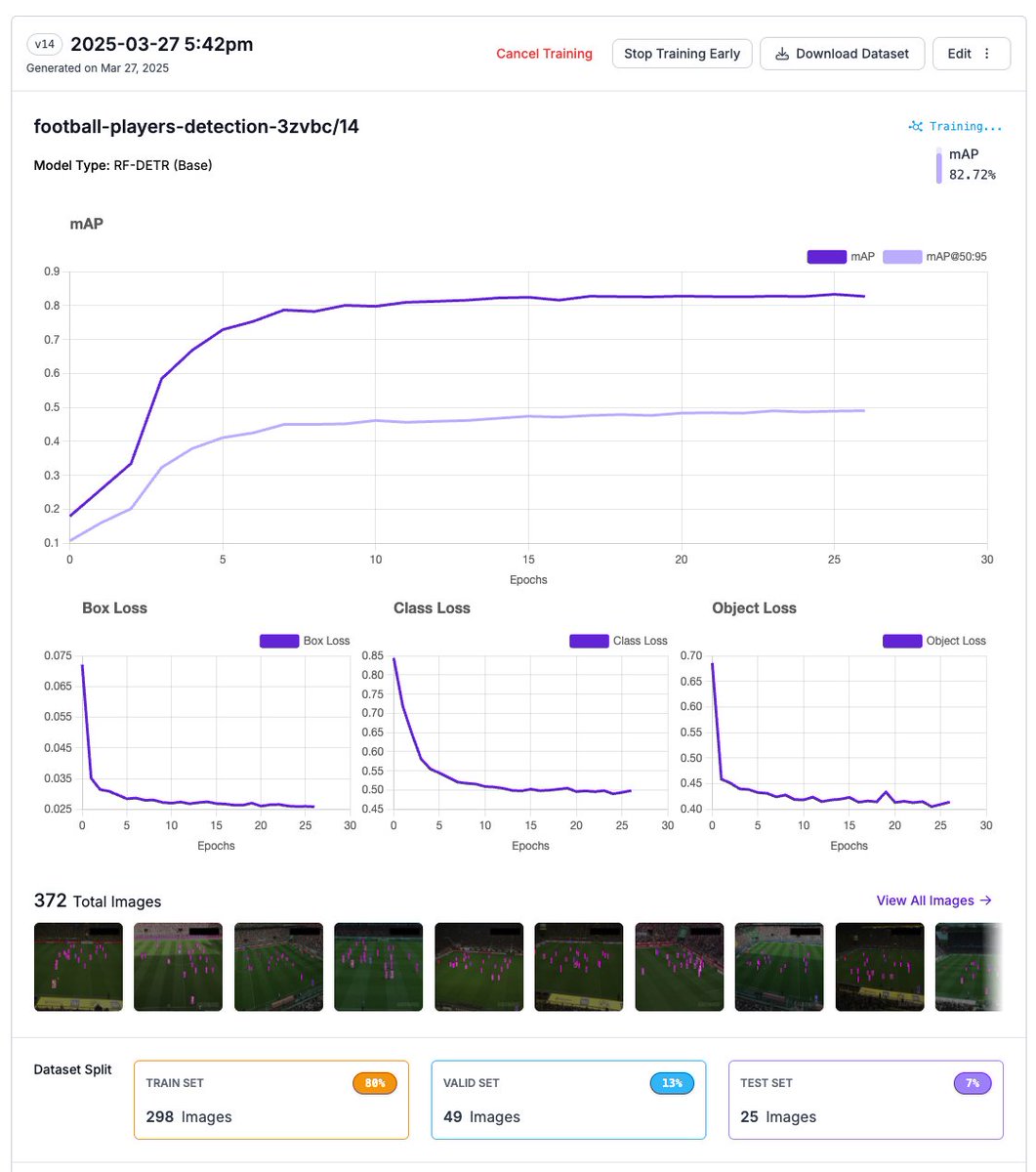
🚀 RF-DETR also converges faster than other detectors when fine-tuning
check out the notebook to fine-tune RF-DETR by @skalskip92
🔗 📚 → https://t.co/oY9AX3aIMA
(3/3)🧵🏁
What if your drone could see and understand what is below it in real time?
RF-DETR can be a strong fit for drone vision, especially when you fine-tune it on aerial imagery.
You could use it to detect people, cars, trucks, bikes and other objects from a drone camera. Roboflow recently demonstrated exactly this with RF-DETR trained on around 7,000 aerial images and 120,000+ annotations.
That opens up applications like traffic monitoring, infrastructure inspection, disaster assessment and wildlife monitoring.
For a real drone, the smaller RF-DETR models are especially interesting because the family ranges from Nano to 2XL, giving you a trade-off between accuracy and inference speed. The models can also be deployed to targets such as ONNX, TensorRT and TFLite.
That's where a drone starts becoming more than just a flying camera.
Repo:
https://t.co/Gglv9eCPWe
You can read the full guide on
https://t.co/doMLq0dbwZ
we just released RF-DETR 1.6, making fine-tuning 30% faster without losing any accuracy.
what started as humble research code is now starting to look a lot more serious. that's not the end of performance optimizations, so stay tuned.
link: https://t.co/6tF4mhWkCA
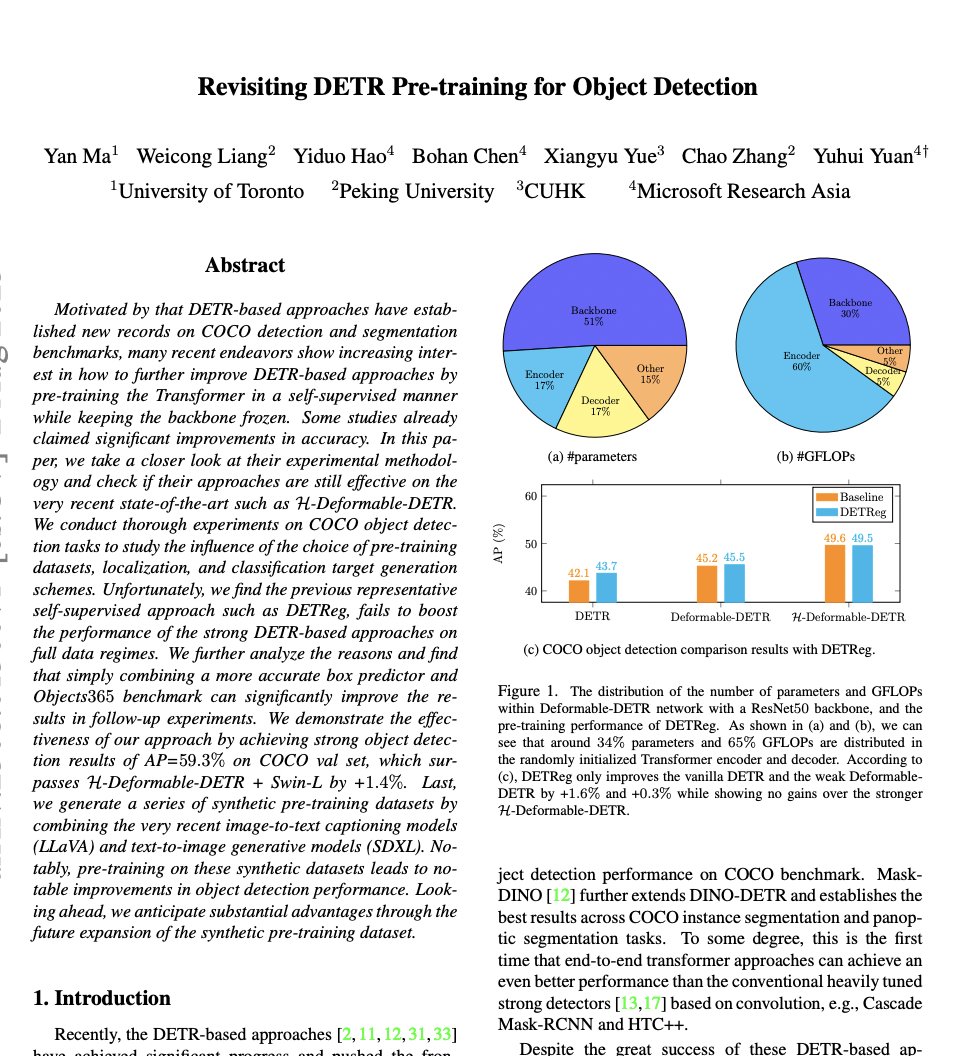
Revisiting DETR Pre-training for Object Detection
paper page: https://t.co/70YThNHMmA
Motivated by that DETR-based approaches have established new records on COCO detection and segmentation benchmarks, many recent endeavors show increasing interest in how to further improve DETR-based approaches by pre-training the Transformer in a self-supervised manner while keeping the backbone frozen. Some studies already claimed significant improvements in accuracy. In this paper, we take a closer look at their experimental methodology and check if their approaches are still effective on the very recent state-of-the-art such as H-Deformable-DETR. We conduct thorough experiments on COCO object detection tasks to study the influence of the choice of pre-training datasets, localization, and classification target generation schemes. Unfortunately, we find the previous representative self-supervised approach such as DETReg, fails to boost the performance of the strong DETR-based approaches on full data regimes. We further analyze the reasons and find that simply combining a more accurate box predictor and Objects365 benchmark can significantly improve the results in follow-up experiments. We demonstrate the effectiveness of our approach by achieving strong object detection results of AP=59.3% on COCO val set, which surpasses H-Deformable-DETR + Swin-L by +1.4%. Last, we generate a series of synthetic pre-training datasets by combining the very recent image-to-text captioning models (LLaVA) and text-to-image generative models (SDXL). Notably, pre-training on these synthetic datasets leads to notable improvements in object detection performance. Looking ahead, we anticipate substantial advantages through the future expansion of the synthetic pre-training dataset.
RT-DETR is now supported in @huggingface Transformers! 🔥
RT-DETR is an Apache 2.0 licensed model capable of real-time object detection. The authors claim better performance than YOLO variants.
Demo notebooks (fine-tuning + inference) here: https://t.co/NDhfcFhU4o
new transformers tutorials just dropped for vision 🔥
🛰️ segmentation on satellite imagery: fine-tune RF-DETR-Seg segment buildings
📱 object detection on mobile UI: fine-tune RF-DETR on screenshots
runs on toaster, converges fast, give to your agent for your use cases🫡
RF-DETR just landed to @huggingface transformers 🥵🔥
sota real-time detection & segmentation models by @roboflow 💜
> play with our real-time demo
> fine-tune the models on your use case with our tutorials (takes a toaster's VRAM)
> or just hand them to your agents 😄
we just released RF-DETR segmentation preview
RF-DETR is 3x faster and more accurate than the largest YOLO11 when evaluated COCO segmentation benchmark
we plan to launch full family of models by the end of October
↓ fine-tuning notebook below
repo: https://t.co/6tF4mhWSs8
RT-DETR - probably the best combination of speed, accuracy, and license for real-time object detection.
I just released a blog post tutorial on fine-tuning RT-DETR on a custom dataset.
shoutout to @NielsRogge for all the help!
link: https://t.co/IsRxNah3UT
↓ key takeaways
I've been working on Object Detection for the past few weeks - and I am proud to announce "The Annotated DETR" !!
https://t.co/iZFbEm0F0K
In this post, I try to explain all the magic that goes on inside the architecture.
1/n
Nine ways to measure how far apart A and B are.
Minkowski ties three together: d = (|Δx|ᵖ + |Δy|ᵖ)^(1/p). It gives Manhattan, Euclidean or Chebyshev depending on p. The purple shape shows all points at the same distance from A.
Cosine ignores length and keeps only the angle. Hamming counts positions where two strings differ. Jaccard and Dice compare the overlap of two sets.
Haversine gives the great-circle distance on a sphere.
Did you know that you can use @huggingface transformers for computer vision tasks (also audio, video, and more)?
I'm starting 2023 by adding an object detection tutorial to the transformers docs. Learn how to fine-tune DETR on custom data: https://t.co/FhLnr21eHU