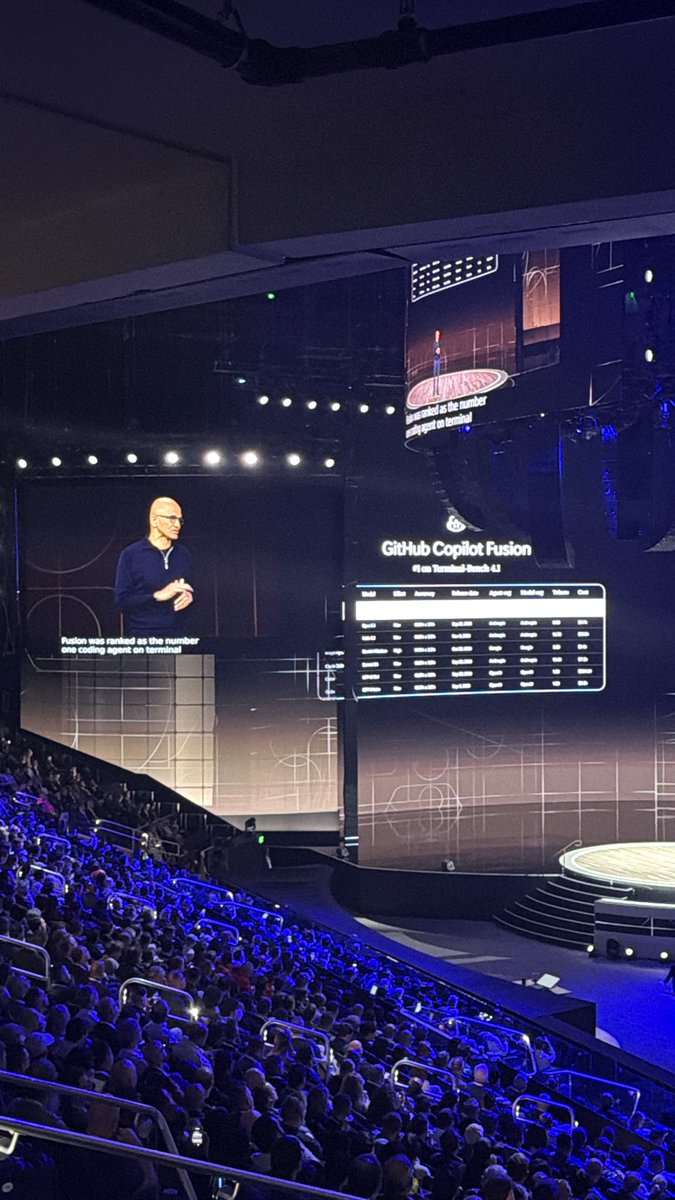
Super proud to share Copilot Fusion on top of TerminalBench4.1 at fraction of cost, announced by @satyanadella at Microsoft Ignite today! Surreal to attend this live. Tune in to our talk on Copilot Fusion later tomorrow at #MSIgnite !
You shouldn't have to pick a model for every task. Copilot Fusion does it for you.
As @SatyaNadella just shared at #MSIgnite, Copilot Fusion now ranks as the #1 coding agent on Terminal-Bench, scoring 5 points ahead of Claude Code at less than half the cost.
We got a LOT of questions about how the new Copilot Fusion works under the hood.
@aashna and friends walk us through the science and engineering details that lead to this breakthrough:
https://t.co/SO5uPHcPNg
My #MSIgnite talk is live: Designing an agent harness that orchestrates models. Copilot Fusion routes models as a portfolio — and it is #1 on Terminal-Bench 4.1: 71.2%, +5.4 pts ahead, at a fraction of the cost. Watch: https://t.co/dmErnNwLYy
@github@Microsoft
🆕 On Terminal-Bench 4.1, Copilot Fusion Max achieved a 71.2% resolution rate, 5.4 percentage points ahead of leading frontier models Opus 5.5 and Fable 5.2, while costing 88% less than Fable 5.2 and 57% less than Opus 5.5.
https://t.co/DFBXTqn6kF
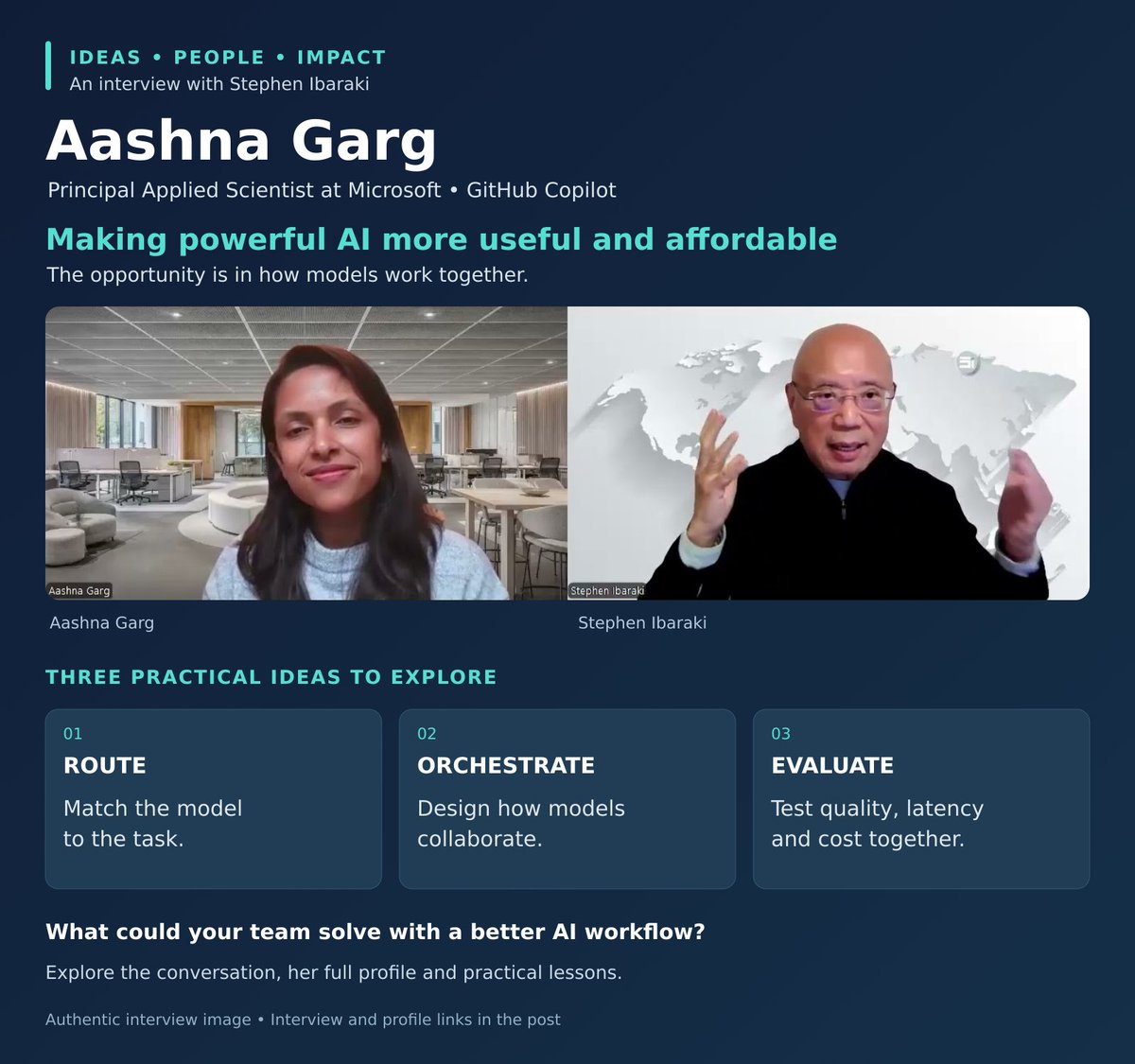
1/6 💡 How can advanced AI become more useful, trustworthy and affordable?
In our interview, Aashna Garg, Principal Applied Scientist at Microsoft working on GitHub Copilot, connects applied research, production engineering and evaluation. #ArtificialIntelligence
We're redefining the SDLC for the agentic era.
Lots of GitHub updates this morning at Universe:
• GitHub Copilot Fusion delivers frontier-level quality, 40% faster and at up to 77% lower cost
• Our unified Copilot harness is now in Foundry, a managed service for building long-running agents that reason, use tools, and get work done
• Copilot Projects gives you an orchestration loop to build with multiple agents across repos
And we’re expanding capacity and strengthening GitHub’s architecture to make the home of agentic development more resilient.
Today at #GitHubUniverse we launched Copilot Fusion 🚀
Proud to have led the research behind it. Fusion orchestrates Anthropic + OpenAI models per task:
🏆 #1 on Terminal-Bench 4.0
💰 ~half the cost of the top agent
⚡ ~half the tokens
Grateful to this incredible team 🙏
Frontier performance at a fraction of the cost.
In the @ArtificialAnlys Coding Agent Index, Copilot Fusion Max scored within two points of Claude Code with Opus 5.5 Max at about half the API cost per task.
Get 30% off through Nov. 30. Try it now. ⬇️ https://t.co/c0k5alLKqD
👋 Project HydraFusion is now available in the GitHub Copilot app and @code.
Choose it like any other model. Behind the scenes it routes your task across multiple models to draft, critique, revise, or escalate, then hands you one result. https://t.co/CJTClEIVBx
👋 Project HydraFusion is now available in the GitHub Copilot app and @code.
Choose it like any other model. Behind the scenes it routes your task across multiple models to draft, critique, revise, or escalate, then hands you one result. https://t.co/CJTClEIVBx
Project HydraFusion in GitHub Copilot achieves frontier-level quality at up to 67% lower cost!
It achieves this via runtime orchestration that creates a plan, chooses models from multiple providers to draft, critiques and revises, or cascades to more powerful models to complete your task.
https://t.co/1SMNYkJpaI
HydraFusion in Copilot CLI isn’t another model in the picker. You select it once. It decides whether the task is a single pass, a cheap draft with a quality gate, or draft → critique → revise.
Wrote it up in plain English https://t.co/JSfe0t2lp3
GitHub quietly dropped one of the most interesting infrastructure ideas I've seen this year. They're calling it HydraFusion.
The concept: instead of picking one frontier model, the system routes tasks through a combination of models using three execution patterns. Single routes to one model. Cascade tries a cheaper model first, escalates if it fails. Critique uses one model to generate and a second to review. The system picks the pattern based on the task.
The results from their research preview are the interesting part. On TerminalBench 2.1, HydraFusion gets within 4.9 points of Claude Opus 5 quality at 67% lower cost. On DeepSWE it's within 1.5 points at 36% lower cost. On CheckpointBench, within 0.1 points at 65% lower cost.
Those numbers matter more than the headline. Getting within 0.1 points of a frontier model at one-third the cost is not a marginal improvement. That's a different category of trade-off.
Access is live now. Type /experimental in GitHub Copilot CLI, then /model to select HydraFusion (Research Preview). Available on all plans.
What I keep coming back to: model orchestration is becoming its own engineering discipline. The question isn't which model to use anymore. It's how to compose them. GitHub putting this into the CLI layer is the right place to start.
https://t.co/zfBV3jyVeR
4.9 percentage points higher verified task quality. 67% lower estimated cost.
Project HydraFusion delivered those results against Claude Opus 5 on Terminal-Bench 2.1 in controlled offline evaluations.
HydraFusion orchestrates the models and workflow for each coding task. You select it like any other model. ⬇️
https://t.co/Vj7R95fXlS
In case you missed us in Github Developer days, in this talk I share how HydraFusion uses multi-model orchestration to balance quality, cost, and latency in GitHub Copilot.
🎬 Watch the full talk: https://t.co/ZaLsDN8i6M
@github@Microsoft#hydrafusion
Tomorrow: GitHub Copilot Day 🎉
New releases, real workflows, and live coding, directly from the team who builds it and the developers who put it to work.
https://t.co/LThxnd7Fcf
Same or better quality, much lower cost, no manual model orchestration. That's what we're delivering Project HydraFusion from GitHub.
Early tests have been very positive and we're improving hourly. Give it a try and let us know what you think. 👇 https://t.co/qsTqHvOXZl
Super excited about HydraFusion in GitHub Copilot, and what it shows about the shift from model selection to model orchestration.
By bringing together multiple models to plan, build, critique, and complete coding tasks, it can deliver outcomes at up to 67% lower cost.
It’s a great example of the value of a heterogeneous model ecosystem, and how we’re continuing to advance the cost-to-outcome frontier.