Only 37% of cold surges ever cross the equator. We dug into 40 winters of data to find out why. The answer? It is not about surge strength. It is about what the tropics are already doing.
Read more: https://t.co/zPlYuiidvH
#AAS#Meteorology#WinterMonsoon#ClimateScience
Cities that cycle more, breathe better. Simple idea. Complex science.
This #WorldBicycleDay, what do you think is the biggest barrier to cycling becoming mainstream? We want to hear from you.👇
#AAS#Bicycleday#Science#AcademicSky
Peatlands store more carbon than all forests combined. But how they respond to sun vs. clouds? Our research sheds light on exactly that. On #WorldPeatlandsDay, the science matters.
Read here: https://t.co/qQYR0lCodK
#AAS#Seaandatmosphere#Climatescience
Soil moisture is quietly shaping summer weather patterns across Eurasia. Our study shows how soil-atmosphere coupling controls the Silk Road Pattern wave train.
https://t.co/RPXlGOuwPT
#AAS#ClimateScience#AtmosphericDynamics#CMIP6
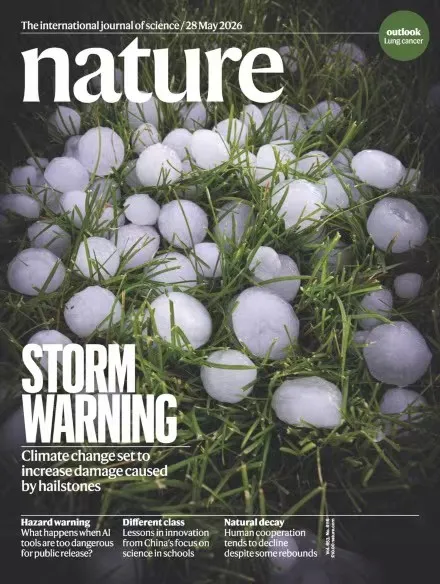
And behind the headlines is years of detailed science. Qinghong Zhang’s team traced how hailstones actually grow inside storm clouds, helping researchers better understand these extreme weather events.
Published in @AASjournal
https://t.co/6ROSV3oUii
Grapefruit-sized hail sounds unreal but it’s becoming more possible in a warming world. This week’s @nature
cover story looks at how climate change may be fuelling larger and more destructive hailstorms, led by Qinghong Zhang at #PekingUniversity.
https://t.co/7iYhXzNvas
Grapefruit-sized hail sounds unreal but it’s becoming more possible in a warming world. This week’s @nature
cover story looks at how climate change may be fuelling larger and more destructive hailstorms, led by Qinghong Zhang at #PekingUniversity.
https://t.co/7iYhXzNvas
How do we track Mars dust storms from space? This research introduces FAMdust, a smart machine learning framework that delivers fast, global dust monitoring to support future space missions. See how it performs with real satellite data:
https://t.co/97W8gDtYuo
#AAS
New @NatureGeosci paper by @zhenzhang_ch4: Wetland CH₄ emissions may rise 50–60% by the 2090s due to warming, potentially offsetting Global Methane Pledge targets. https://t.co/wmCP1ie3UY
Earth harbors an estimated 8.7 million species. Despite this, we have formally described fewer than 2 million of them. Biodiversity is the infrastructure of life and on
#International Day for Biological Diversity
We recommend exploring it with @AASjournal#AAS#AcademicSky
India may face half of global productivity losses from heat stress and that’s only part of the story… Our study reveals how monsoon dynamics are shifting under climate change.
Explore the research: https://t.co/97ZJ4Khzxw
#ClimateScience#India#GauhatiUniversity
Modeling African monsoons is improving but challenges remain. This study explores progress and the gaps that still limit prediction accuracy. @mictomi
Read the full paper: https://t.co/PcjKiJuxHp
#Monsoon#ClimateModels#Africa
Why did the Australian monsoon arrive so late this year? @DrTimboC
At #OMC2026, Matthew Wheeler showed how real-time monitoring connects directly to better forecasts and decisions. Read the research shaping how we predict monsoons:https://t.co/8FP7Xbgjmz
#Monsoon#ClimateScience
Prof. Mu Mu highlights Shanghai Typhoon Institute’s hybrid model: it delivered the smallest track errors for Typhoon Danas (2025), outperforming both physics-based and leading ML models.
Read in AAS: https://t.co/Kit4stSC7v
#Typhoon#HybridAI
Prof. Mu Mu at #OMC2026: AI weather models are powerful, but can we trust the black box?
High skill ≠ physical interpretability. AI needs process-level agreement with observations to be more than a predictor.
Read his paper : https://t.co/T2JFTZImTN
#AI#Weather#Predictability
Participants at #OMC2026 showed great interest in our #WCRP Monsoon Special Issue at the AAS booth.
Excited to see the community engage with monsoon research.
Explore the collection here: https://t.co/VnvGGKcTyA
@WCRP_climate#ClimateScience
Tianjun Zhou's talk on constrained projections of Asian-African monsoon rainfall connects seamlessly to his review on observed and projected changes of global monsoons.@CAS__Science
https://t.co/XDfjL536KV
Watching Dr. Thara Prabhakaran of #IITMPune explain how aircraft fly into monsoon clouds to study aerosols at #OpenMonsoonConference2026 was truly mesmerising.
@aasjournal looks forward to the opportunity of connecting with #IITM and it's fellow researchers. #AAS#WCRP
Ready to share your breakthrough and reach a new audience? Help shape the future of atmospheric science. Submit your manuscript by Sept 10, 2026. Select 'Special issue: Climate and Cryosphere' at checkout.
Guidelines & submit here: https://t.co/OSIy41kFCL
Calling all climate scientists and researchers worldwide! Want to get your work in front of a highly engaged global audience?
@aasjournal is officially open for submissions for our Special Issue: Climate and Cryosphere.
#AAS#AcademicSky#Science
Backed by the WCRP-CliC project , this issue is a key contribution to the Cryosphere Science Decade. We welcome global research on ice-climate interactions, remote sensing, and climate modeling. You do not need to have attended CliC OSC 2026 to submit! #Climatescience