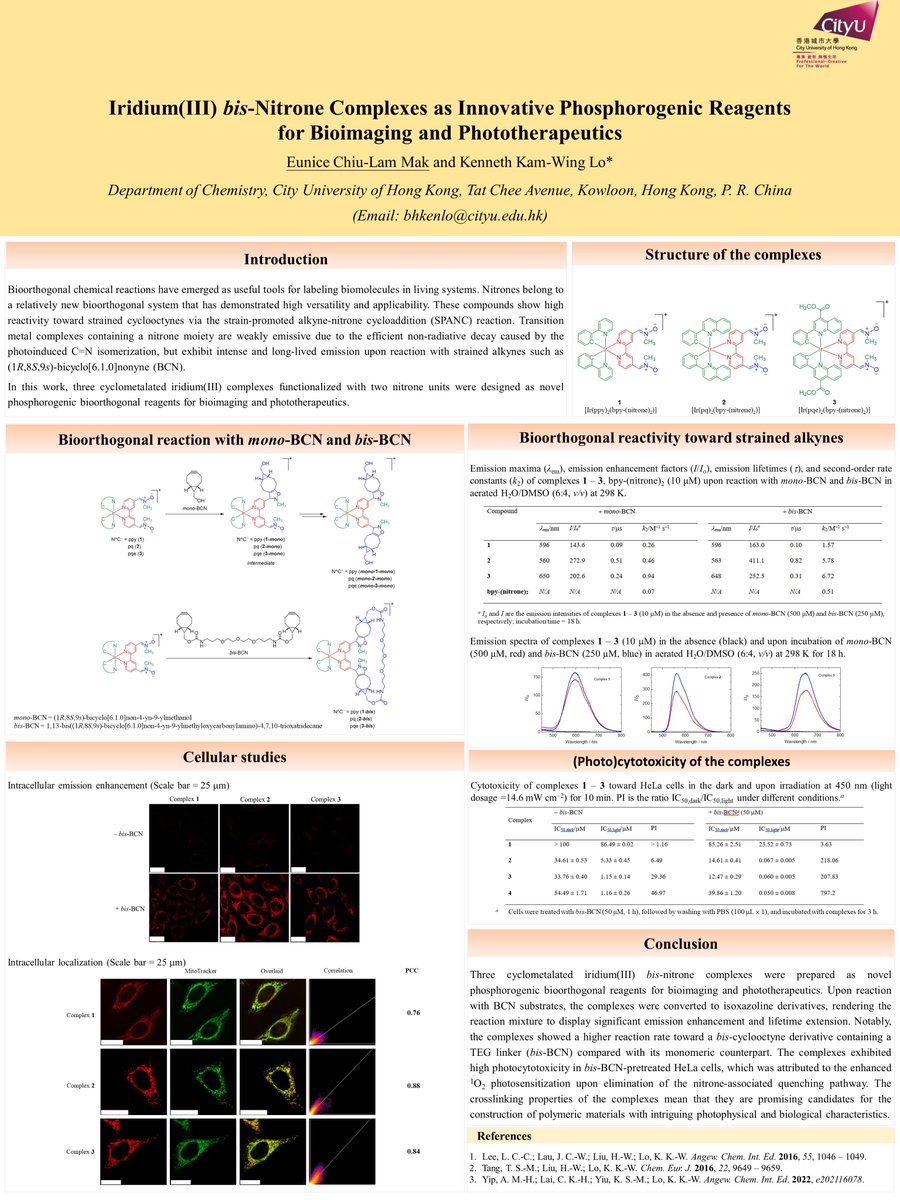
Phosphorogenic Iridium(III) bis-Tetrazine Complexes for Bioorthogonal Peptide Stapling, Bioimaging, Photocytotoxic Applications, and the Construction of Nanosized Hydrogels @InorgChem4Life#IC4LPoster#Bioinorganic
@Abinash_chem iridium(III) complex and the complex accumulated in the tumor cells. Normal cells release less extracellular MMP, therefore, a lower amount of the complex would be accumulated in the normal cells.
@Abinash_chem The tumor cell-specificity was based on the release of MMP-2/9 by the tumor cells. Many types of tumor cells (for example, MCF-7 and MDA-MB-231) release more MMP-2/9, which can cleave the MMP-sensitive peptide implemented in the hydrogels, leading to the release of the cytotoxic
@EdGardner_ iridium(III) complex and the complex accumulated in the tumor cells. Normal cells release less extracellular MMP, therefore, a lower amount of the complex would be accumulated in the normal cells.
@EdGardner_ The tumor cell-specificity was based on the release of MMP-2/9 by the tumor cells. Many types of tumor cells (for example, MCF-7 and MDA-MB-231) release more MMP-2/9, which can cleave the MMP-sensitive peptide implemented in the hydrogels, leading to the release of the cytotoxic
@rsc_medchem We will try to make an injectable MMP-hydrogel containing the iridium(III) complex and study its effect on an MCF-7 xenograft mouse model later.
@rsc_medchem@rsc_medchem Thanks for coming and have a look at my poster! We are now working on the effect of the MMP-hydrogels on cancer cells grown in a 3D extracellular matrix environment.
Phosphorogenic Iridium(III) bis-Tetrazine Complexes for Bioorthogonal Peptide Stapling, Bioimaging, Photocytotoxic Applications, and the Construction of Nanosized Hydrogels (Lo) @CityUHongKong@CityUChem@bhkenlo https://t.co/c90bDi0i7A
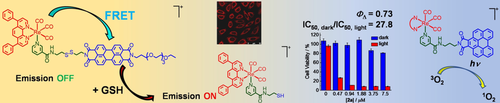
#Photophysics, intracellular sensing, and photocytotoxic activity of #luminescent#rhenium(I)-polypyridine complexes by Kenneth Lo @bhkenlo, Cong Yu, and co-workers https://t.co/AEBaOsN7td