@MIT Alum • EEE Faculty, Imperial College London @imperialeee. Current work: •- Inverse Problems •- Unconventional Sensing/Imaging. (Not so regular on twitter)
On the SIAM News Blog, Ayush Bhandari explains that the unlimited sensing framework improves upon traditional #digitization by treating #quantization noise errors as data and saving bits by folding signals instead of clipping them. Read more here!
https://t.co/OjanHdIFRg
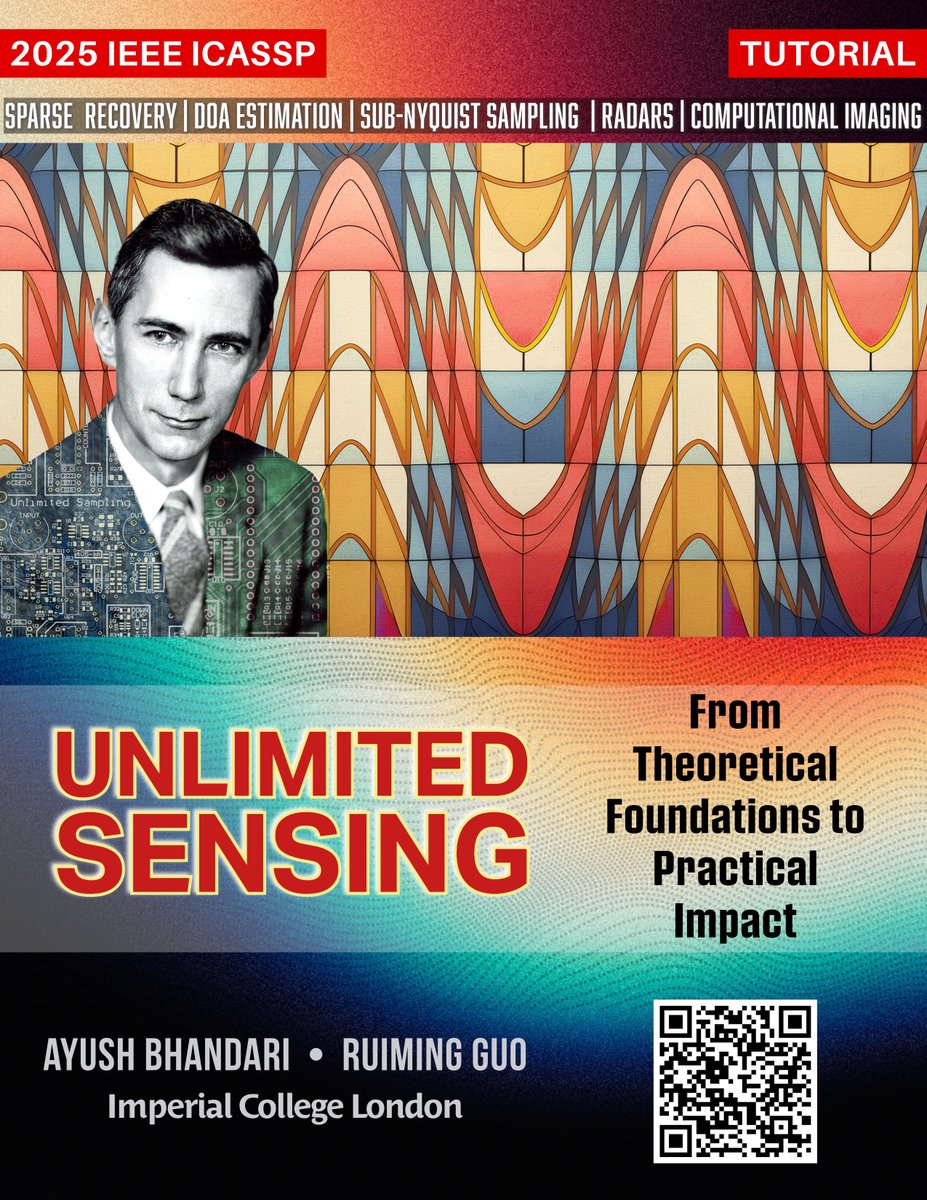
New Tutorial on 𝗨𝗻𝗹𝗶𝗺𝗶𝘁𝗲𝗱 𝗦𝗲𝗻𝘀𝗶𝗻𝗴 at the upcoming @ieeeICASSP w/ @Ruiming999.
We'll cover the pet peeves of @IEEEsps: • Sparse + sub-Nyquist Recovery • Array Sig. Proc. • Computatnal Imging • Communication Sys. etc. from the lens of Modulo Non-linearities.
Feels like a passing of the torch between fields. When I was a teenager in the 1980s, after a half-century of monumental progress powered by theoretical physics, most smart high schoolers wanted to do physics. Upon arriving as an undergrad at MIT in 1988, it quickly became clear that the next big thing was computer science.
Congratulations to @geoffreyhinton and John on this honor. Interestingly, I met John Hopfield a long time before I met Geoff. ( In mid 1990s when he invited me to give a guest lecture in his Princeton ugrad class about my algorithm for traveling salesman. )
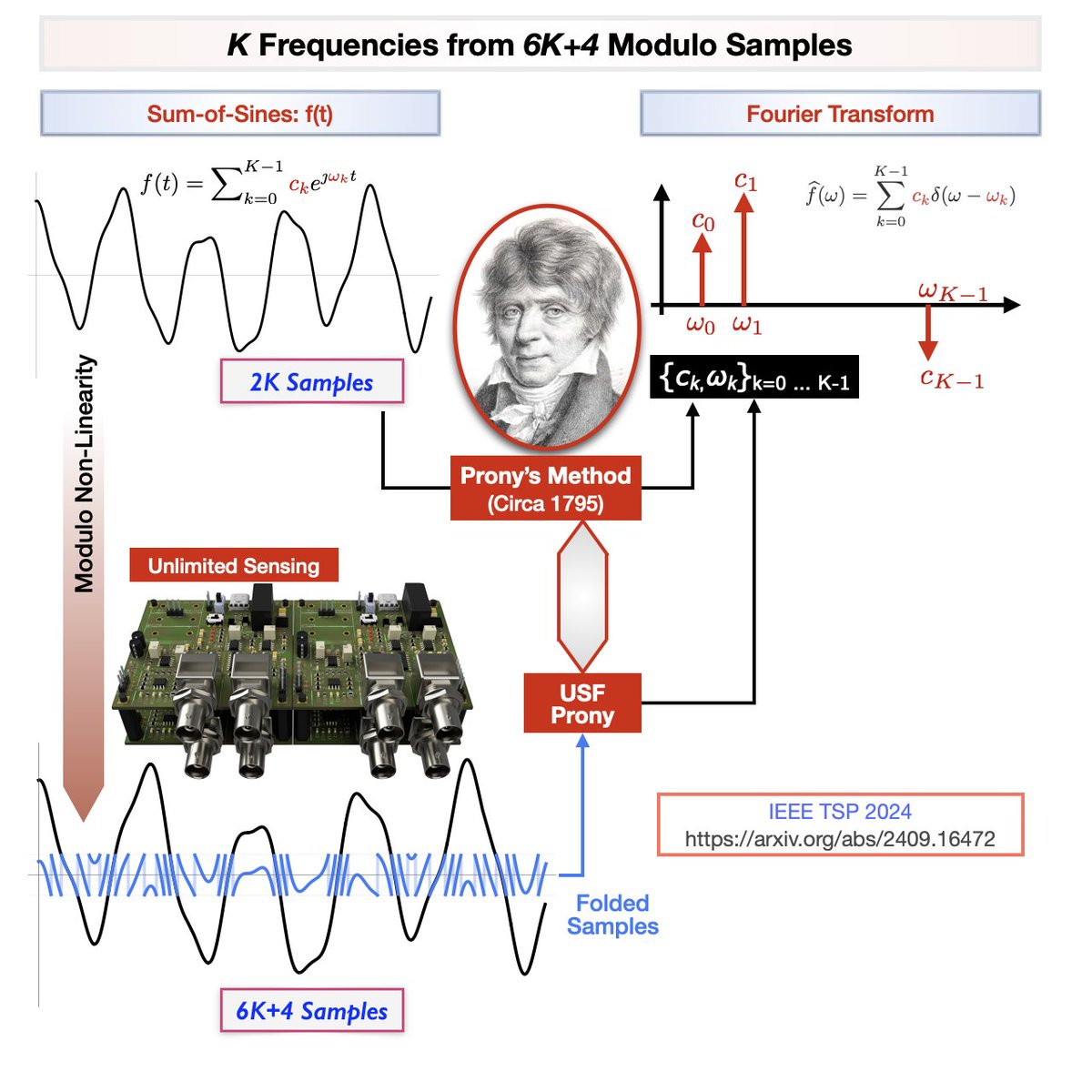
𝗣𝗿𝗼𝗻𝘆'𝘀 𝗠𝗲𝘁𝗵𝗼𝗱 is a widely used, 200 years old technique. It estimates unknown parameters of K sine-waves from 2K samples.
In our new work (IEEE TSP, @IEEEsps) on Unlimited Sensing, we show that same can done with 6K+4 non-linear, modulo samples.
arXiv: 2409.16472
Thank you @ERC_Research.
Our idea is simple: Use 𝗤𝘂𝗮𝗻𝘁𝗶𝘇𝗮𝘁𝗶𝗼𝗻 𝗡𝗼𝗶𝘀𝗲 as the signal.
The gratifying part is that UG/MS students (@ImpEngineering) can get this and have already contributed to publications.
Here's an overview of our scientific vision.
Congrats to Dr Ayush Bhandari for securing a €1.5M @ERC_Research grant.
His research in computational sensing aims to revolutionise digital information capture and will unlock new possibilities for applications across healthcare and communications.
https://t.co/WrIunledvj
@taiyasaki@ERC_Research@ImpEngineering Here's an example to contextualize the idea + link to a paper with an algorithm that shows hardware experiments.
https://t.co/C1dAIgFME8
@taiyasaki@ERC_Research@ImpEngineering Andrea, thank you!
The key idea is: any signal = integer + fractional part. We have already developed hardware that directly captures the frac-part (~quantization noise). Signals are recovered algorithmically.
Interestingly, this can be done at Nyqiust-rate (const. factor).
@WeisiG Thank you. This is very relevant. We have developed hardware that can directly capture "quantization noise" which is just the fractional-part of the signal.
I hope this gives you some idea.
https://t.co/y4rFI0jCmc