Scholar. Author. Entrepreneur.
Founder, Center for Collective Learning & The Observatory of Economic Complexity (OEC).
Latest book: The Infinite Alphabet
How it started/How it's going.
The Infinite Alphabet is out today, globally on Kindle and across bookstores in the UK.
If you are curious about the history of learning curves, disruptive innovation, knowledge diffusion, and economic complexity, this book is for you.
If you are curious about the development of entrepreneurship in Beijing, how Vespa's were born from helicopters, and how a 21-year old started a manufacturing revolution in the US, this book is for you.
It took me years to collect these stories and I hope you enjoy learning from them as much as I did.
Many thanks to the excellent team at @penguinrandom to help turn years of research into a fun and dynamic book.
Get your copy, gift one to a friend, or help me spread the word :-).
I'll be posting snippets, events, and more in the coming days.
Why does the whole world know Napoleon, but not Bernardo O’Higgins? Physicist César Hidalgo @cesifoti explains the four forces that shape collective memory: technology, territory, tongue, and time.
https://t.co/puI6v8dtyt
imagina que ordenamos en una fila a todas las personas que viven en españa, de la que tiene menos renta a la que tiene más. ¿sabes en qué punto de la fila estarías tú?
intenta adivinar tu posición en la distribución de la renta en https://t.co/XfIdbOI7oE 👀
@pablogguz_ Excelente. Quedo a la espera de ver la comparación entre dónde la gente cree que está en la distribución versus donde está.
Excelente micro sitio 👏👏👏
What are the 4Ts of collective memory?
In this interview in Nautilus, I discuss our research agenda uncovering how technology, tongue, time, and territory, shape the information people share about their past.
https://t.co/zmuvgAL45J
Reducing poverty is not only about creating more jobs. It is also about creating better jobs.
A new @WorldBankGroup Policy Research Working Paper by Maurizio Bussolo, @ChristophLakner, and Minh Nguyen provides compelling evidence for this distinction.
Drawing on household survey data from 150 economies covering 96% of the world's population, A Global Profile of Work and Poverty: Two Decades of Evidence examines how employment, education, and the type of work shape poverty outcomes.
One finding stands out: the poor are not necessarily poor because they do not work.
Among workers living on less than $3 a day:
- 79% are self-employed, compared with 35% of nonpoor workers.
- 66% work in agriculture, compared with 20% of nonpoor workers.
- 61% have primary education or less, compared with 25% of nonpoor workers.
The evidence also shows that between 2003 and 2024, improvements in welfare per worker—not increases in employment rates—accounted for the welfare gains among the bottom 60% of the global distribution.
These findings have important implications for development policy. Employment matters, but the quality and productivity of work are central to sustained poverty reduction. Expanding access to education, enabling transitions toward more productive activities, and removing barriers to better-paying jobs are essential. Increasing women's employment also offers significant potential, particularly when considering broader poverty thresholds.
The challenge is not only to bring more people into employment, but to ensure that work becomes a more effective pathway out of poverty.
An important contribution to our understanding of the relationship between jobs, productivity, and poverty reduction—and to the evidence underpinning the The World Bank Group's Poverty, Prosperity, and Planet Report 2026: https://t.co/WukDPs8FQ4
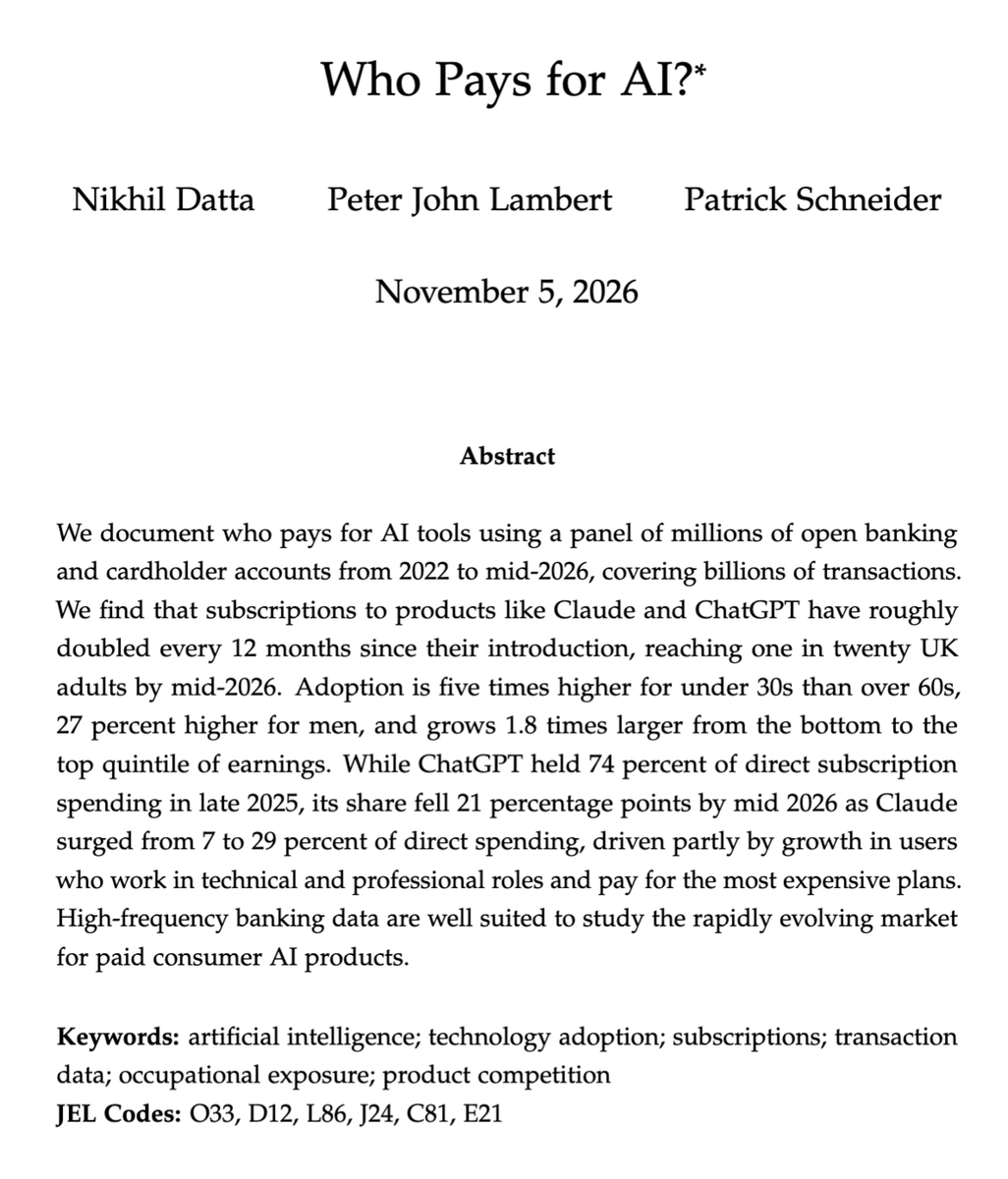
Who pays for AI? In a new working paper, we study this using banking data covering billions of transactions to see who pays for tools like ChatGPT, Claude, Gemini, etc. We find that 1-in-20 UK adults now pay for AI, representing a $1.4 billion market annually. (1/N)
1/n Within 15 months of publication, most of the LLM claims we tested either no longer held or showed substantially diminished effects. How long does our knowledge of AI hold up? In our new study, we revisit 50 findings to see what fades, what persists, and what gets stronger. 🧵
@joefrancis505 Agree. During my PhD I worked with genetic data (mostly c. elegans), CDRs, and international trade data. Trade data was clearly the “cleanest” and genetic data was the messiest (entity resolution was really hard across multiple datasets, organisms, etc.).
These results cut deep.
When students ask me how to choose a research project, I tell them to look at the intersection of three properties: rigor, relevance, and surprise.
Good research is relevant and rigorous, but also unexpected. Otherwise, it just confirms something people already intuit.
But surprise is not just a matter of taste. It is a core idea in information theory. An unexpected yet verifiable result carries more information than one we anticipated.
As scholars, we are trained to argue that our results are at least a bit unexpected in the introduction of our papers. In social science papers, we usually do this using the classical trick of the two-handed economist.
But an LLM forecast is very different from a narrative argument. It provides a quantitative expectation of what a study might find.
Eva's results show that forecasts on treatment effects of pre-registered studies can be quite accurate. This suggests these forecasts could become part of the preregistration.
In other words, we could start preregistering surprise.
Of course, not all valuable research needs to be counterintuitive or surprising (this applies mostly to breakthroughs). Replication and precision matter too. But these forecasts could help us distinguish between results that confirm our expectations and those that challenge them.
Great job on this, Eva! I think there's a lot of potential here.
Europe’s productivity race, 2001–21: capitals +20%, other metros +10%, non-metros +18%. However, @proiettpaola, @DijkstraLewis & @kompilmert show in the Annals of Regional Science that many cities coast on past #productivity while their engines lose speed.
https://t.co/hD2AAjKpbs
“…Nordhaus wanted to know how much of the value created by innovation stays with the innovator. He crunched the numbers for American companies, outside of agriculture, between 1948 and 2001. The answer: about 2.2%. The rest went to society, especially to consumers, in the form of lower prices and better products.
For every 100 euros of value that an innovator creates, they keep just a little over 2. We get the other 98….”
Morreu William Nordhaus, aos 85 anos.
Ganhou o Nobel da Economia em 2018, partilhado com Paul Romer, por trazer as alterações climáticas para a macroeconomia. Gerações de estudantes aprenderam economia pelo manual de Samuelson e Nordhaus. Mas o meu artigo preferido dele é outro: "Schumpeterian Profits in the American Economy: Theory and Measurement", de 2004.
Nordhaus quis saber quanto do valor criado pela inovação fica com quem inova. Fez as contas para as empresas americanas, fora da agricultura, entre 1948 e 2001. A resposta: cerca de 2,2%. O resto foi para a sociedade, sobretudo para os consumidores, em preços mais baixos e produtos melhores.
Por cada 100 euros de valor que um inovador cria, fica com pouco mais de 2. Nós ficamos com os outros 98.
Julian Simon passou a vida a insistir nisto: quem inventa e empreende deixa o mundo muito mais rico do que o encontrou.
Convém lembrá-lo sempre que alguém propõe tributar pesadamente as fortunas dos empreendedores, como se fossem um peso para a sociedade. O inovador já fica com uma fatia mínima do valor que cria. Taxar essa fatia rende pouco e põe em risco tudo o resto.
Quem fez fortuna a inovar não é um fardo social. É o maior benfeitor da sociedade, e cobra por isso pouco mais de 2%.
Those incentives are present already. People tend to overstate novelty (not the same as surprise, but related) and are required to argue why their results are counterintuitive.
As I said in the post, not all research must be surprising, but breakthroughs tend to be. So the bar of surprise, rigor, and relevance is high, and are not required for every research project.