The eternal boomer, mind rotting and balls in steep decline,
Wouldn’t consider the youth’s condition even if he could design
Their ruin himself he’s a profound and stubborn coward to the bone.
Sissified by his wife, he turns a particularly savage tyrant on his throne,
Lashing out at the young men he envies and despises with venomous hate,
Especially when the Cialis dies and his impotent fury detonates.
Breaking: Where are the REAL men in America?
Too many men have quit the workforce. They simply have decided not to work, not provide for their families, or offer leadership for their sons.
The family unit has been collapsing in America for decades now partially because the man in the house decided comfort was more important than duty.
They have been spoiled.
Soft hands and weak spines.
A generation of boys are being raised on screens instead of sweat. They know every video game and almost nothing about a job that leaves dirt under their fingernails.
Reality for our nation is coming whether they (we) want it or not. A man who will not carry his load is not a man the country can afford.
Men, GET BACK TO WORK!
It's always funny when the word "controversial" has nothing to do with whether the claim is true or false, but instead with whether it offends people who have no business getting offended.
I know your military indoctrination has trained you to see young men as expendable cattle to be motivated by tough, patronising rhetoric, and that your cognitive decline probably makes it impossible to reconsider a position that deeply ingrained but these statistics aren't men checking out or giving up. They're evidence of systematic discrimination designed to disenfranchise them.
Will you support any initiative promoting the interests of young men and accelerating their access to leadership positions in the S&P 500?
Will you at least support banning DEI initiatives in the military and the public and private sectors, so that young men can at least compete fairly?
Of course you won't because deep down you have too much cowardice to evn fathom it.
The 2018 sampling PISA sampling bias has likely become far worse since.
England missed PISA participation standards in 2022. The OECD estimated scores could still be around 8 points too high in maths and 7 in reading, even after statistical weighting. OECD analysis
In 2025, England met participation targets. But exclusions across the UK excluding Scotland reached 7.6%, up from 4.9% in 2022 and above the 5% standard.
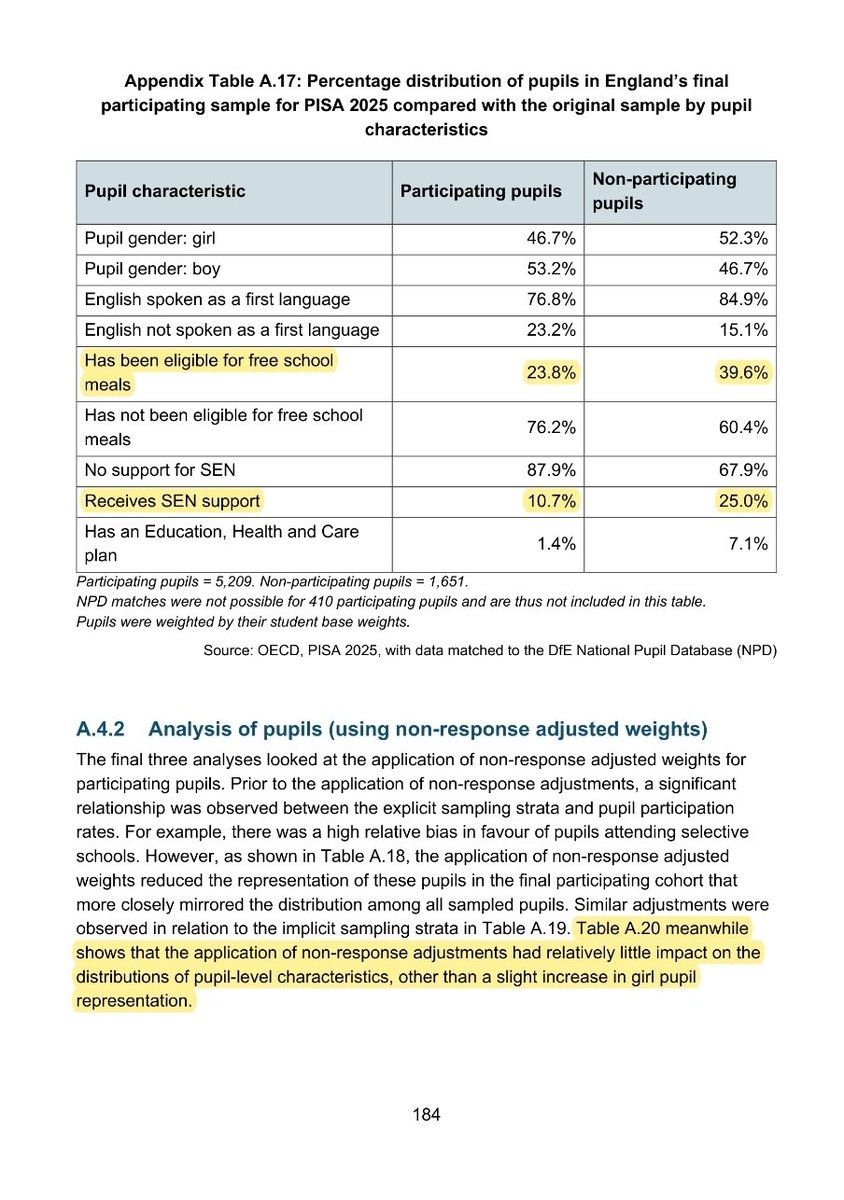
Among matched pupils in participating English schools, 40% of non-participants had been eligible for free school meals, versus 24% of participants. Special educational needs support: 25% versus 11%. Weighting barely changed these imbalances.
https://t.co/m9C7mivcig
@labar0nn3_ C'est évident encore un débat à la con conçu pour concentrer les énergies sur l'application ou pas d'une mesure bidon.
L'intelligence est presque aussi héréditaires que la taille (0.6-0.8 vs 0.8-0.9) or les femmes avec de hautes capacités cognitives ne font pas d'enfants...
C'est une tendance conjecturelle au sein de l'OCDE... inculper le système en particulier français tient de la myopie intellectuelle.
La performance intellectuelle est avant tout démographique dans la mesure ou les capacités cognitives sont quasiment aussi hereditaires que la taille...
Il y a surtout d'énormes magouilles sur la sélection de ceux qui passent le PISA...
Dans son étude sur les résultats PISA 2018 de l'Angleterre, John Jerrim relève que 21,3 % des participants n'ont pas décroché la note 4 au GCSE de mathématiques, alors qu'ils sont 28,5 % à l'échelle nationale. Les élèves les plus faibles étaient donc sous-représentés, et les pondérations officielles n'y ont rien changé. Selon son estimation, ce biais gonfle le score anglais en mathématiques d'une dizaine de points. « Étude » (https://t.co/6ZGG1mHr36)
En 2022, l'Angleterre n'a pas rempli les critères de participation de PISA. Même après redressement statistique, l'OCDE estimait que les scores restaient surévalués d'environ 8 points en mathématiques et 7 en compréhension de l'écrit. « Analyse de l'OCDE » (https://t.co/ZAuKjVZUXW)
En 2025, les objectifs de participation sont atteints. Mais le taux d'exclusion au Royaume-Uni hors Écosse grimpe à 7,6 %, contre 4,9 % en 2022, bien au-delà du seuil de 5 %.
Dans les établissements anglais participants, l'écart saute aux yeux : 40 % des élèves non participants avaient bénéficié de la cantine gratuite, contre 24 % des participants. Pour ceux relevant d'un dispositif de besoins éducatifs particuliers, 25 % contre 11 %. Là encore, les pondérations n'ont presque rien corrigé. « Audit officiel, p. 25-26 et 184-186 » (https://t.co/UmwtJbgypb)
The UK score is inflated systematically by at least 11 points since 2018.
England is likely around the 18th level bellow Austria.
John Jerrim’s study of England’s 2018 PISA results found that 21.3% of participants fell below GCSE maths grade 4, compared with 28.5% nationally. Too few weaker pupils were represented, even after official weighting. His analysis estimated that this inflated England’s maths score by approximately 11 points. "Study" (https://t.co/6ZGG1mGTdy)
In 2022, England missed PISA participation standards. The OECD estimated scores could still be around 8 points too high in maths and 7 in reading, even after statistical weighting. "OECD analysis" (https://t.co/ZAuKjVZn8o)
In 2025, England met participation targets. But exclusions across the UK excluding Scotland reached 7.6%, up from 4.9% in 2022 and above the 5% standard.
Among matched pupils in participating English schools, 40% of non-participants had been eligible for free school meals, versus 24% of participants. Special educational needs support: 25% versus 11%. Weighting barely changed these imbalances. "Official audit, pp. 25–26 and 184–186" (https://t.co/UmwtJbg0zD)
The evidence raises persistent concerns about inflated scores. It does not yet establish whether the bias grew or how much it affected the 2025 results.
The UK scores are inflated though sampling bias and are very probably bellow Austria 🇦🇹.
John Jerrim’s study of England’s 2018 PISA results found that 21.3% of participants fell below GCSE maths grade 4, compared with 28.5% nationally. Too few weaker pupils were represented, even after official weighting. His analysis estimated that this inflated England’s maths score by approximately 11 points. "Study" (https://t.co/6ZGG1mGTdy)
In 2022, England missed PISA participation standards. The OECD estimated scores could still be around 8 points too high in maths and 7 in reading, even after statistical weighting. "OECD analysis" (https://t.co/ZAuKjVZn8o)
In 2025, England met participation targets. But exclusions across the UK excluding Scotland reached 7.6%, up from 4.9% in 2022 and above the 5% standard.
Among matched pupils in participating English schools, 40% of non-participants had been eligible for free school meals, versus 24% of participants. Special educational needs support: 25% versus 11%. Weighting barely changed these imbalances. "Official audit, pp. 25–26 and 184–186" (https://t.co/UmwtJbg0zD)
The evidence raises persistent concerns about inflated scores. It does not yet establish whether the bias grew or how much it affected the 2025 results.
The 2018 sampling PISA sampling bias has likely become far worse since.
England missed PISA participation standards in 2022. The OECD estimated scores could still be around 8 points too high in maths and 7 in reading, even after statistical weighting. OECD analysis
In 2025, England met participation targets. But exclusions across the UK excluding Scotland reached 7.6%, up from 4.9% in 2022 and above the 5% standard.
Among matched pupils in participating English schools, 40% of non-participants had been eligible for free school meals, versus 24% of participants. Special educational needs support: 25% versus 11%. Weighting barely changed these imbalances.
https://t.co/m9C7mivcig
The 2018 sampling PISA sampling bias has likely become far worse since.
England missed PISA participation standards in 2022. The OECD estimated scores could still be around 8 points too high in maths and 7 in reading, even after statistical weighting. OECD analysis
In 2025, England met participation targets. But exclusions across the UK excluding Scotland reached 7.6%, up from 4.9% in 2022 and above the 5% standard.
Among matched pupils in participating English schools, 40% of non-participants had been eligible for free school meals, versus 24% of participants. Special educational needs support: 25% versus 11%. Weighting barely changed these imbalances.
https://t.co/m9C7mivcig
The 2018 sampling PISA sampling bias has likely become far worse since.
England missed PISA participation standards in 2022. The OECD estimated scores could still be around 8 points too high in maths and 7 in reading, even after statistical weighting. OECD analysis
In 2025, England met participation targets. But exclusions across the UK excluding Scotland reached 7.6%, up from 4.9% in 2022 and above the 5% standard.
Among matched pupils in participating English schools, 40% of non-participants had been eligible for free school meals, versus 24% of participants. Special educational needs support: 25% versus 11%. Weighting barely changed these imbalances.
https://t.co/m9C7mivcig
The 2018 sampling PISA sampling bias has likely become far worse since.
England missed PISA participation standards in 2022. The OECD estimated scores could still be around 8 points too high in maths and 7 in reading, even after statistical weighting. OECD analysis
In 2025, England met participation targets. But exclusions across the UK excluding Scotland reached 7.6%, up from 4.9% in 2022 and above the 5% standard.
Among matched pupils in participating English schools, 40% of non-participants had been eligible for free school meals, versus 24% of participants. Special educational needs support: 25% versus 11%. Weighting barely changed these imbalances.
https://t.co/m9C7mivcig
The 2018 sampling PISA sampling bias has likely become far worse since.
England missed PISA participation standards in 2022. The OECD estimated scores could still be around 8 points too high in maths and 7 in reading, even after statistical weighting. OECD analysis
In 2025, England met participation targets. But exclusions across the UK excluding Scotland reached 7.6%, up from 4.9% in 2022 and above the 5% standard.
Among matched pupils in participating English schools, 40% of non-participants had been eligible for free school meals, versus 24% of participants. Special educational needs support: 25% versus 11%. Weighting barely changed these imbalances.
https://t.co/m9C7mivcig
The 2018 sampling PISA sampling bias has likely become far worse since.
England missed PISA participation standards in 2022. The OECD estimated scores could still be around 8 points too high in maths and 7 in reading, even after statistical weighting. OECD analysis
In 2025, England met participation targets. But exclusions across the UK excluding Scotland reached 7.6%, up from 4.9% in 2022 and above the 5% standard.
Among matched pupils in participating English schools, 40% of non-participants had been eligible for free school meals, versus 24% of participants. Special educational needs support: 25% versus 11%. Weighting barely changed these imbalances.
https://t.co/m9C7mivcig
3/3 UCL’s John Jerrim estimated that matching the national GCSE grade mix would lower England’s PISA maths score by about 11 points: roughly 504 to 493.
The 2018 sampling PISA sampling bias has likely become far worse since.
England missed PISA participation standards in 2022. The OECD estimated scores could still be around 8 points too high in maths and 7 in reading, even after statistical weighting. OECD analysis
In 2025, England met participation targets. But exclusions across the UK excluding Scotland reached 7.6%, up from 4.9% in 2022 and above the 5% standard.
Among matched pupils in participating English schools, 40% of non-participants had been eligible for free school meals, versus 24% of participants. Special educational needs support: 25% versus 11%. Weighting barely changed these imbalances.
https://t.co/m9C7mivcig
There is plenty of evidence that sampling bias been at least as bad if not worse since 2018.
The stagnation trend likely doesn't exist and the UK is declining like its OCDE peers
England missed PISA participation standards in 2022. The OECD estimated scores could still be around 8 points too high in maths and 7 in reading, even after statistical weighting.
In 2025, England met participation targets. But exclusions across the UK excluding Scotland reached 7.6%, up from 4.9% in 2022 and above the 5% standard.
Among matched pupils in participating English schools, 40% of non-participants had been eligible for free school meals, versus 24% of participants. Special educational needs support: 25% versus 11%. Weighting barely changed these imbalances.
https://t.co/m9C7mivcig