The geography of global poverty has changed substantially over the past two decades. So has the profile of those who remain in poverty. What does this mean for poverty reduction strategies?
Between 2003 and 2024, the number of people living in extreme poverty declined by approximately 1.2 billion. Yet progress has slowed over the past decade, and poverty has become increasingly concentrated in Sub-Saharan Africa, fragile economies, rural communities, younger populations, and groups with limited educational attainment.
A particularly important finding is that advances in urbanization and education, which were strongly associated with poverty reduction in East and South Asia, have been associated with much smaller gains in Sub-Saharan Africa.
This underscores a fundamental policy challenge: expanding human capital and transforming the spatial structure of economies are important, but their potential to reduce poverty depends on the economic opportunities available to people, particularly access to more and better jobs.
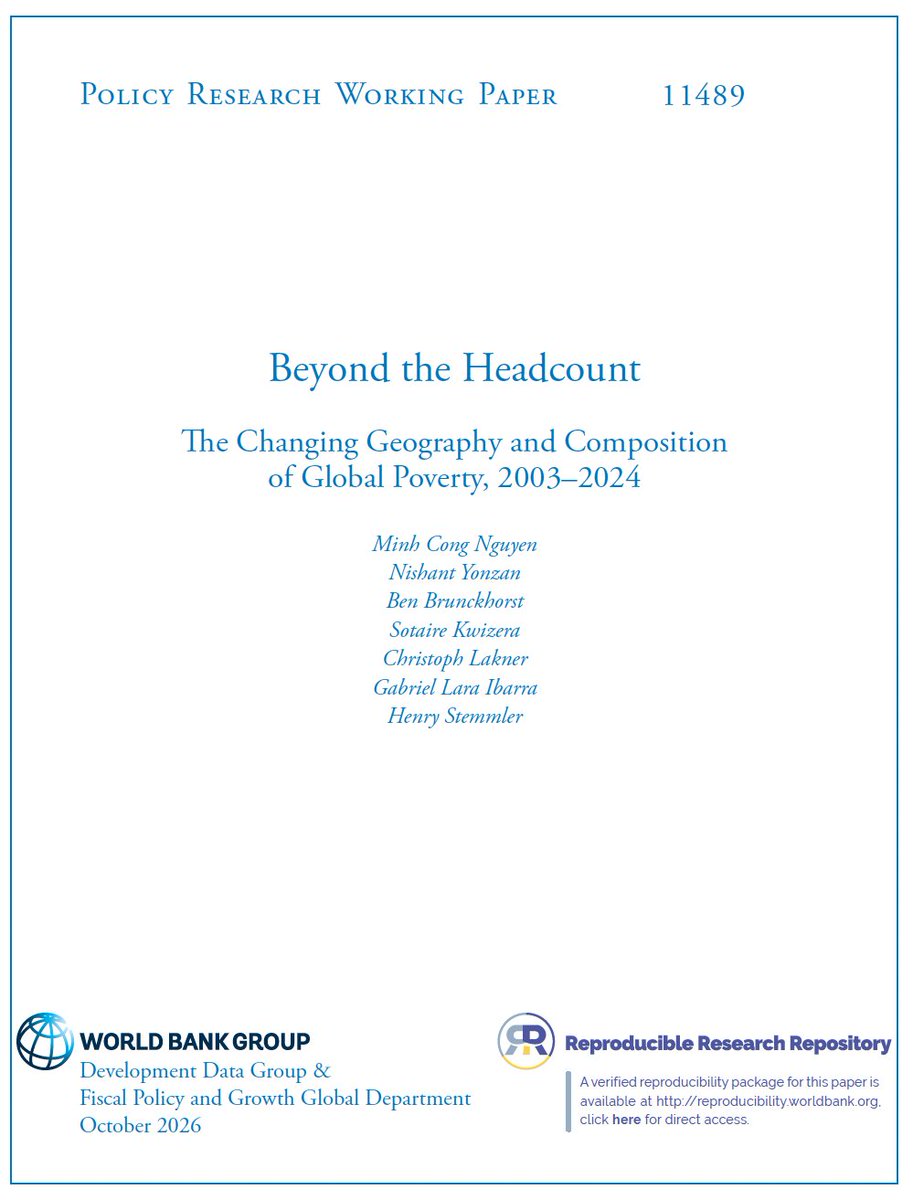
Drawing on harmonized household surveys from 154 countries, covering approximately 96% of the world's population, Minh Cong Nguyen, Nishant Yonzan, Ben Brunckhorst, Sotaire Kwizera, @ChristophLakner, @laraibarra_g, and Henry Stemmler examine these dynamics in their new @WorldBankGroup Policy Research Working Paper, "Beyond the Headcount: The Changing Geography and Composition of Global Poverty, 2003–2024".
Developed as a background paper for the World Bank’s 2026 Poverty, Prosperity, and Planet Report (3PR), this research offers important insights into why understanding who remains poor, where they live, and the constraints they face is essential to accelerating poverty reduction: https://t.co/QS6VW1pYpZ
#Poverty #DevelopmentEconomics
Moving out of poverty does not necessarily mean achieving economic security. Millions of people have increased their incomes but remain one illness, economic shock, or extreme weather event away from losing those gains.
How can public policy help turn progress against poverty into lasting economic security?
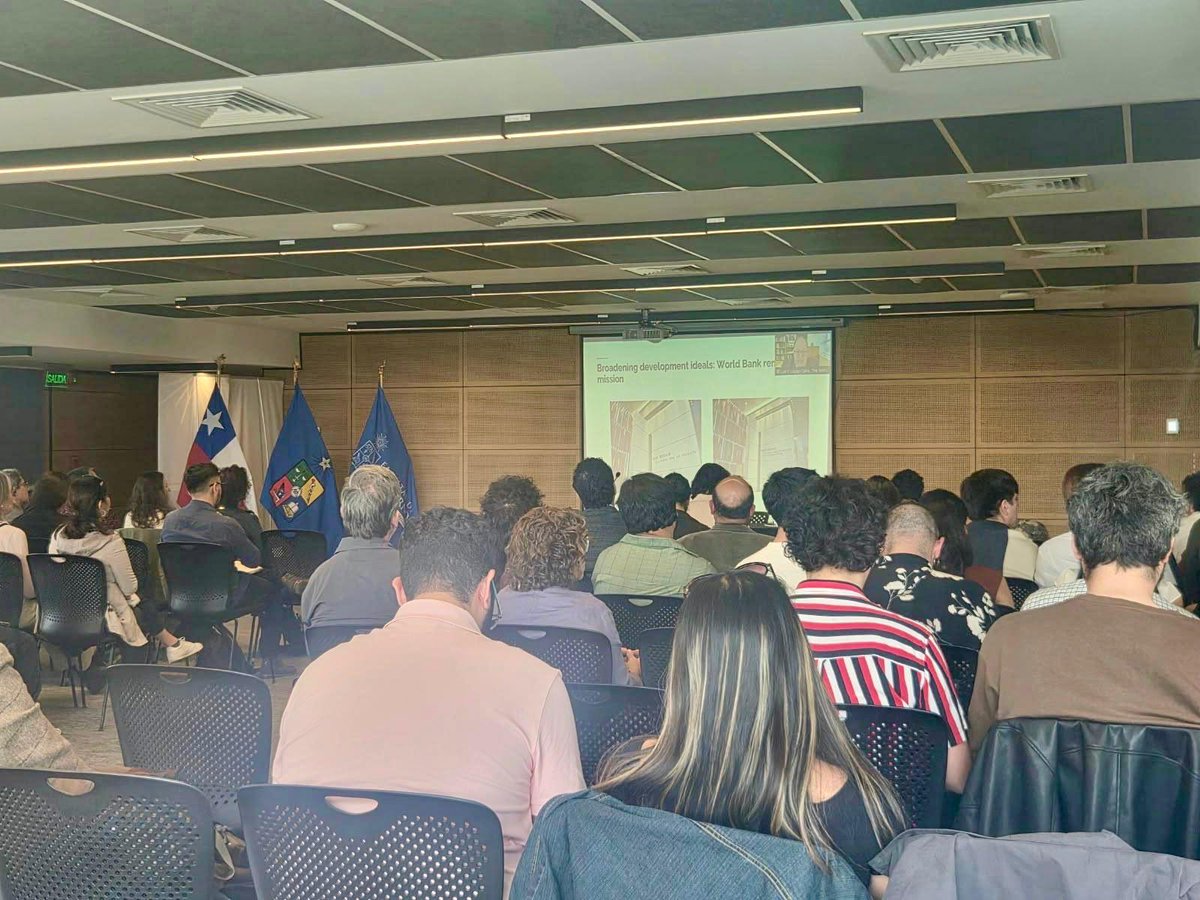
I explored this question in my virtual presentation at the fourth Annual Seminar of the @uchile’s Public Policy Network, “Evaluating to Decide: Overcoming Poverty in Times of Uncertainty.” Thank you for the invitation and for bringing together researchers, policymakers, and civil society for this important discussion.
Reducing poverty requires us to consider growth, inequality, and environmental sustainability together. How much an economy grows, who benefits from that growth, and whether those gains can be sustained.
Investing in the productive capacity of people living in #poverty is central to this agenda. Access to education, infrastructure, finance, and markets enables people to increase their earnings. More and better jobs provide a critical pathway to lasting economic security.
Evidence helps identify the constraints people face and guide #policy choices. Translating that knowledge into results also requires institutions that can implement policies effectively and coalitions that can sustain them.
The challenge is to connect what we know with decisions that expand opportunity and make progress against poverty more resilient.
Reducing poverty is not only about creating more jobs. It is also about creating better jobs.
A new @WorldBankGroup Policy Research Working Paper by Maurizio Bussolo, @ChristophLakner, and Minh Nguyen provides compelling evidence for this distinction.
Drawing on household survey data from 150 economies covering 96% of the world's population, A Global Profile of Work and Poverty: Two Decades of Evidence examines how employment, education, and the type of work shape poverty outcomes.
One finding stands out: the poor are not necessarily poor because they do not work.
Among workers living on less than $3 a day:
- 79% are self-employed, compared with 35% of nonpoor workers.
- 66% work in agriculture, compared with 20% of nonpoor workers.
- 61% have primary education or less, compared with 25% of nonpoor workers.
The evidence also shows that between 2003 and 2024, improvements in welfare per worker—not increases in employment rates—accounted for the welfare gains among the bottom 60% of the global distribution.
These findings have important implications for development policy. Employment matters, but the quality and productivity of work are central to sustained poverty reduction. Expanding access to education, enabling transitions toward more productive activities, and removing barriers to better-paying jobs are essential. Increasing women's employment also offers significant potential, particularly when considering broader poverty thresholds.
The challenge is not only to bring more people into employment, but to ensure that work becomes a more effective pathway out of poverty.
An important contribution to our understanding of the relationship between jobs, productivity, and poverty reduction—and to the evidence underpinning the The World Bank Group's Poverty, Prosperity, and Planet Report 2026: https://t.co/WukDPs8FQ4
It was great to be back in Helsinki at @UNUWIDER to celebrate the anniversary of the World Income Inequality Databae #WIID and discuss with friends and colleagues the challenges in Global Inequality research. @worldbankdata@WBG_Poverty@apvjustino
Which jobs help households escape poverty—and which help them avoid falling into it? The answer changes with a country’s level of development.
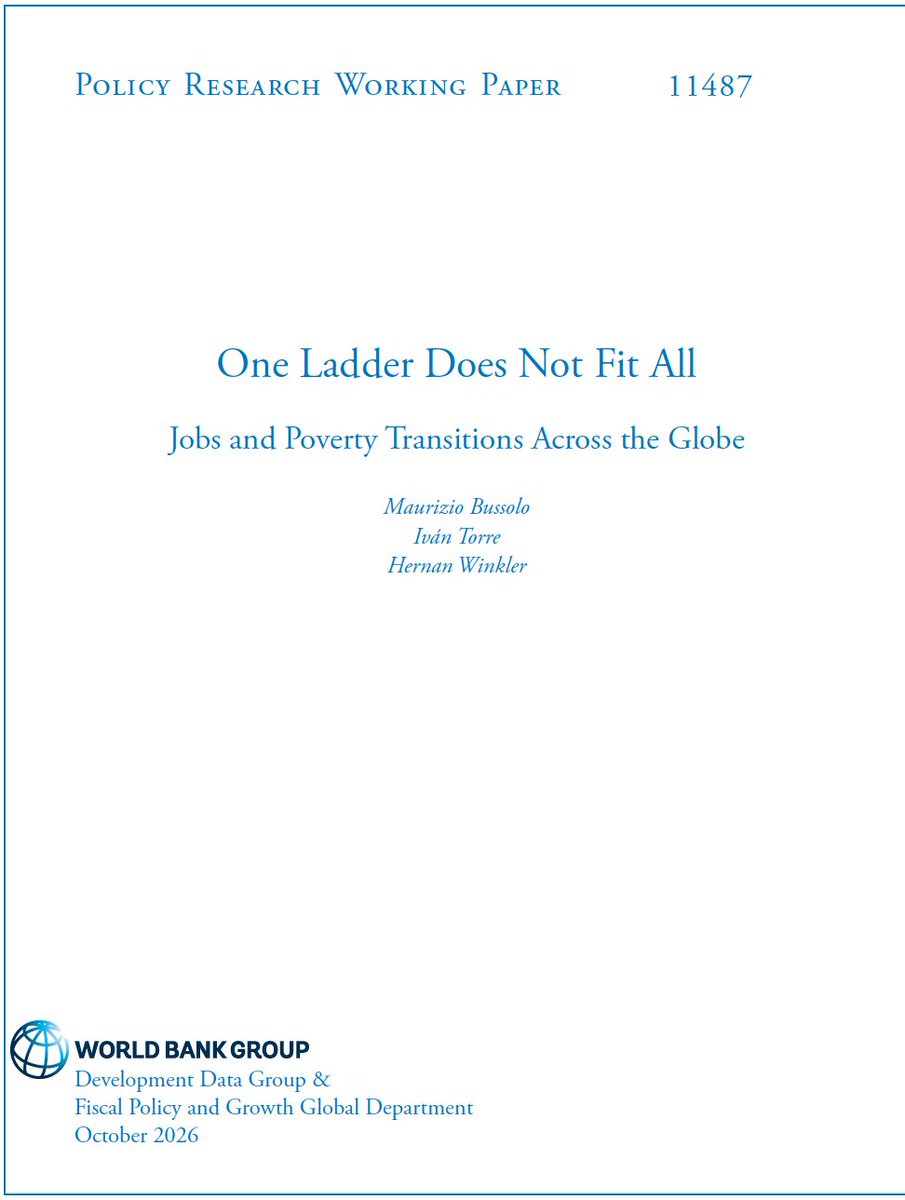
In “One Ladder Does Not Fit All: Jobs and Poverty Transitions Across the Globe,” Maurizio Bussolo, Iván Torre, and Hernan Winkler examine household panel data from 41 countries. This @WorldBankGroup Policy Research Working Paper contributed to the Poverty, Prosperity, and Planet Report 2026.
In the poorest economies, moving into non-agricultural self-employment is at least as strongly associated with escaping poverty as moving into wage employment. As economies develop, the association between wage employment and poverty exit strengthens, while that of non-agricultural self-employment weakens.
The type of employment is closely associated with a household’s chances of escaping poverty, while access to almost any employment is associated with a lower risk of falling into it.
For policy, this means that expanding opportunity requires understanding where people work, the alternatives available to them, and how these change as economies transform.
More and better jobs remain central to lasting poverty reduction. Making that agenda effective requires policies adapted to each economy—and attention to both upward mobility and protection against setbacks.
Read the paper: https://t.co/xMZ7Xi4UCw
Poverty.
Food security.
Jobs.
Governance.
Energy.
Agriculture.
Innovation.
The October 2026 World Development Indicators update brings new and revised data across the development agenda.
See what’s new and explore the data: https://t.co/WeEsi8PmKZ
Extreme poverty is falling—but becoming increasingly concentrated.
New @WorldBankGroup research covering 154 economies and 96% of the global population shows who remains in extreme poverty, where they live, and why progress is becoming harder.
Read: https://t.co/fn9c47JsEg
A job can be a path out of poverty. Understanding what kind of jobs is essential to designing policies that work.
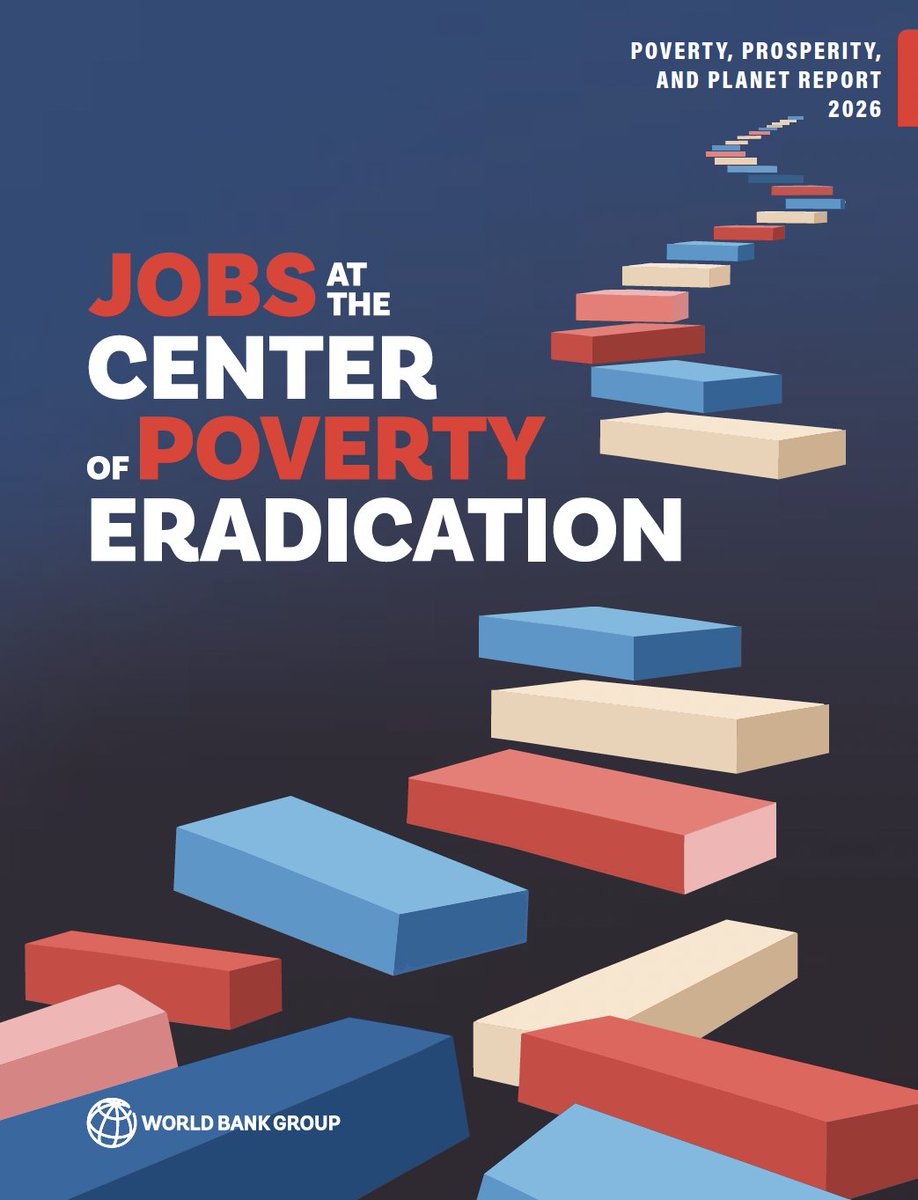
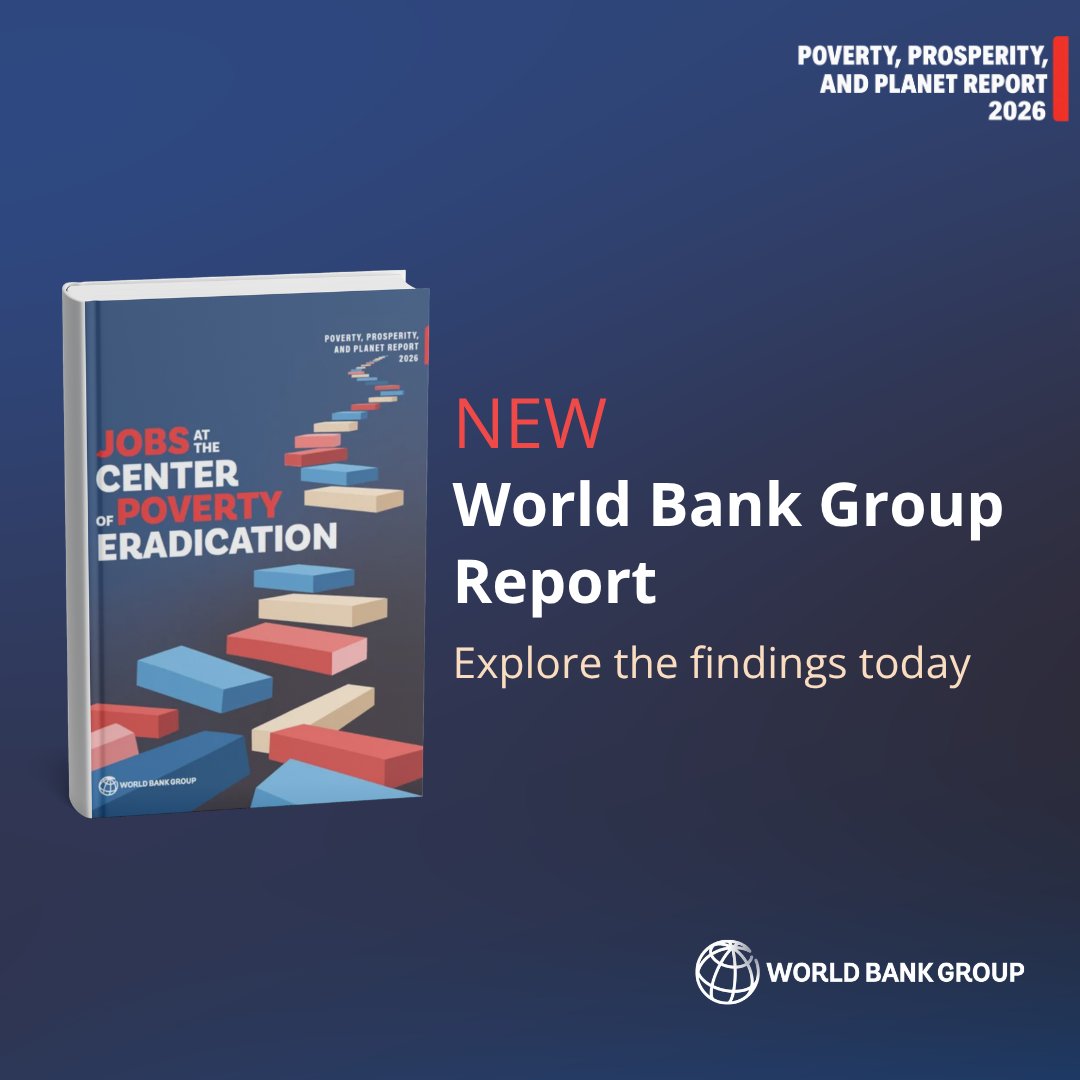
The @WorldBankGroup’s new Poverty, Prosperity, and Planet Report 2026: Jobs at the Center of Poverty Eradication brings this challenge into focus. Adults in poor and nonpoor households are about equally likely to be employed. But those in poor households tend to earn less, work fewer hours, and support more dependents.
This distinction matters for policy. The report finds that higher earnings matter most for the poorest, while expanding employment, particularly among women, offers greater benefits for those near the poverty line. Accelerating poverty reduction therefore requires both more employment opportunities and better returns to the work people already do.
For me, the implication is clear: we need to ask whose productivity is rising, who can access new opportunities, and whether earnings are sufficient to improve household living standards.
More and better #jobs must be at the center of a strategy that connects growth with lasting #poverty reduction. Its success should be measured by people’s ability to build more secure and prosperous lives.
Explore the report: https://t.co/38iW0AqRde
OUT NOW | Poverty reduction has stalled, but that doesn't make it intractable. More jobs, better-paid jobs, and sustained economic growth where poverty is highest can help correct course.
Explore the new @WorldBankGroup's #3PR ➡️ https://t.co/yuiQrYDikx
More and better jobs are essential to turning poverty reduction into lasting prosperity in Latin America and the Caribbean.
The region has made important progress. Poverty reached historic lows in 2025, and the middle class has continued to expand. Yet Latin America and the Caribbean remains a middle-income region without a sufficiently broad middle class.
The evidence points to both progress and a persistent challenge:
* Labor markets have been the main driver of poverty reduction, with their contribution growing since 2022.
* 27 million jobs were created between 2016 and 2024 in the nine countries analyzed. But job quality remains a structural challenge.
* Wages have grown by only around 1% annually since 2016, while productivity has stagnated.
These findings reinforce a central message: creating more jobs is necessary, but creating better jobs is what can make poverty reduction sustainable.
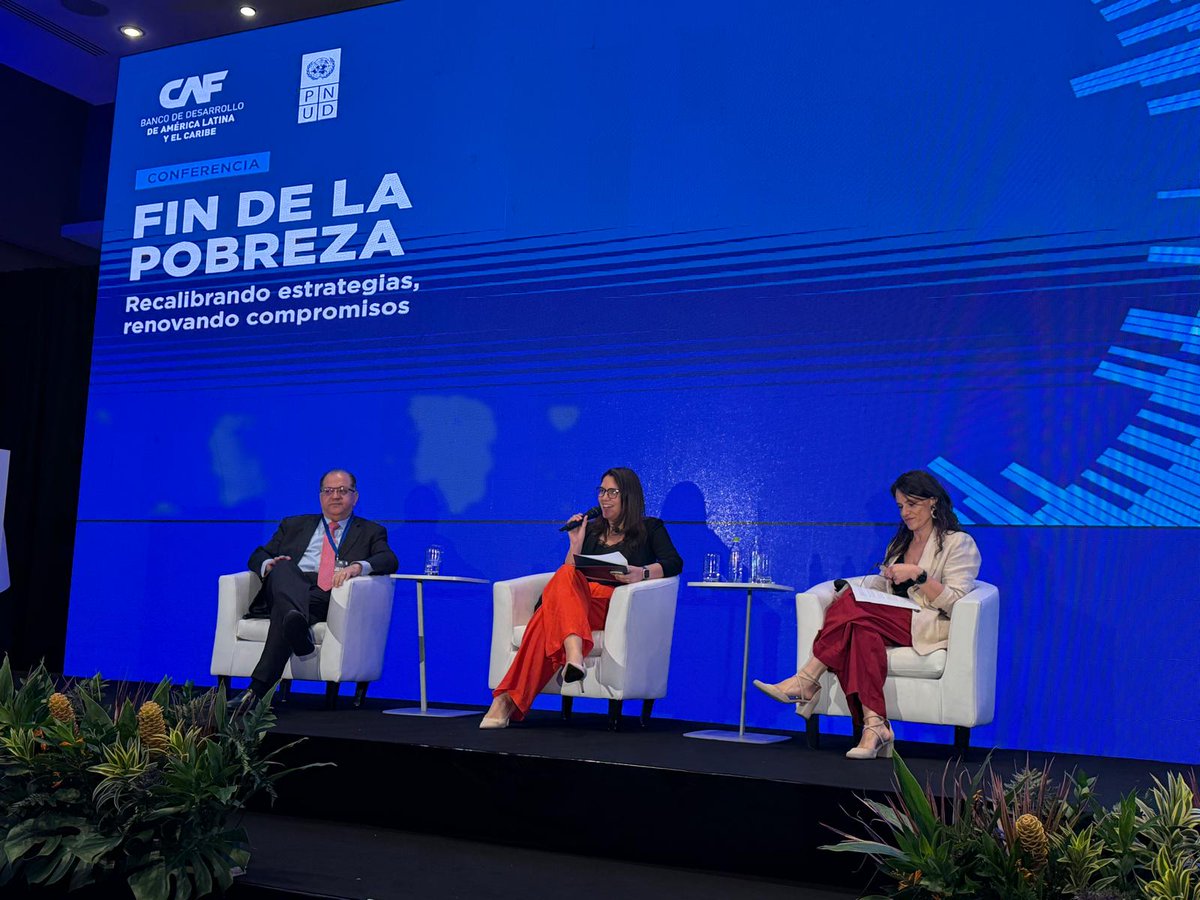
This was at the heart of my presentation at the @PNUDLAC - @AgendaCAF Regional Conference on Ending Poverty in Panama.
I had the pleasure of exchanging perspectives with Andrea Repetto, Director of the School of Government at @ucatolica de Chile, in a discussion moderated by @almudenaf, @UNDP Chief Economist for Latin America and the Caribbean.
Looking ahead, the challenge is to move from pro-poor growth toward pro-growth equity: investing in the productive capacity of lower-income households so they can participate in, contribute to, and benefit from economic growth.
#Labor is the most widely distributed productive asset. Strengthening workers' skills and capabilities, raising productivity, and expanding access to better employment opportunities are therefore central to building a more prosperous and inclusive region.
The goal is not simply to lift people out of #poverty, but to create the conditions that allow them to stay out of poverty and build lasting economic security.
Knowing how many households face each deprivation is not the same as knowing which households face several at once. That distinction matters for poverty policy.
A dashboard may show low incomes, limited schooling, and inadequate access to electricity. But when these indicators come from separate surveys, we may be unable to see whether they describe the same families—and how these disadvantages reinforce one another.
In this @WorldBankGroup blog, Ben Brunckhorst, Sotaire Kwizera, Minh Cong Nguyen, and Nishant Yonzan examine the policy costs of fragmented poverty data. When overlaps remain invisible, governments risk designing interventions in isolation, duplicating delivery costs, and missing opportunities to coordinate services.
Consider the implications for education: where lack of electricity constrains children’s ability to study, improving energy access could be an important part of the response. Education indicators alone may not reveal that constraint.
The policy value of multidimensional poverty measurement lies in making these connections visible. Better understanding how deprivations intersect can help governments identify complementary interventions and use scarce public resources more effectively: https://t.co/qIptWYbl82
What does it take for work to provide a pathway out of poverty when one parent carries the responsibility for both earning and caring?
In Latin America and the Caribbean, more than four in five mothers who are the only adult in their household participate in the labor force. Yet 45.5% of these households live in poverty, compared with an overall regional poverty rate of 26.8%.
A @WorldBankGroup Policy Research Working Paper by Laura Cuesta, Jacobus de Hoop, and @hugonopo highlights this gap between participation and economic security. Their findings point to the constraints mothers face in accessing better-paid, formal employment while raising children alone.
The policy implications extend across childcare, labor markets, and social protection. Reliable childcare can expand employment opportunities. Better-targeted public support can strengthen household security. Effective enforcement of child support obligations can help distribute the costs of raising children more fairly.
These policies need to work together. For poverty reduction, the question is how to ensure that employment translates into adequate incomes and greater security for mothers and their children.
The authors discuss their findings and policy implications in this World Bank blog:
https://t.co/F3T1PYXSVH
Today we launched our Latin America and the Caribbean Economic Update.
The region has the potential to achieve stronger growth. Countries that have maintained sound macroeconomic frameworks, strengthened institutions, and advanced reforms are demonstrating what is possible.
Building on the region’s considerable talent and resources will require sustained policies and investment that raise productivity, create better jobs, and increase incomes.
The @WorldBankGroup is committed to supporting countries across the region in advancing this agenda.
https://t.co/ULR9WdE7ka
Does credit reduce #poverty? The evidence suggests that the answer is not a simple yes or no.
A synthesis of more than 400 studies points to a more nuanced conclusion: the impact of credit depends critically on who borrows, what the financing is used for, and under what conditions it is provided.
#Credit appears to work better when it helps households expand an existing productive activity, invest in income-generating assets, and when repayment terms are aligned with how borrowers actually earn. By contrast, borrowing used mainly to close consumption gaps—or provided without complementary support—may do little to improve welfare and can sometimes increase vulnerability.
This has an important implication for how we think about financial inclusion and poverty reduction. Expanding access to credit is not enough. The objective should be to ensure that financial services help households build productive assets, manage risk, and strengthen their capacity to generate income over time.
And credit rarely works in isolation. Savings, insurance, digital payments, appropriate product design, and complementary support all shape whether borrowing becomes a pathway to greater economic security.
A valuable contribution from Sophie Sirtaine and Karina Broens Nielsen in this new @WorldBankGroup blog, moving the debate beyond whether credit “works” toward the more useful question of when, how, and for whom it works.
Read more: https://t.co/4Yz9303e5d
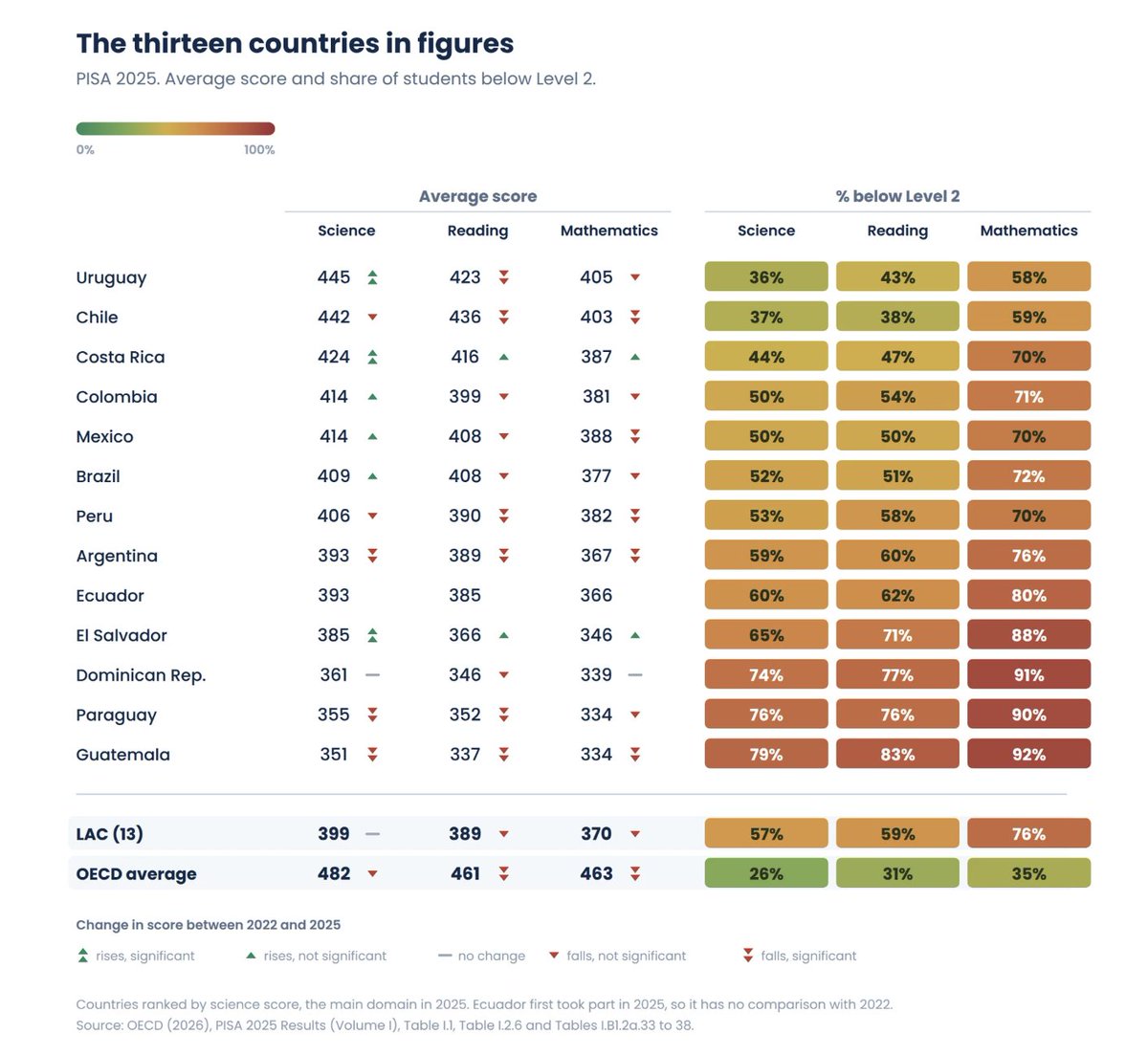
The latest PISA 2025 results send a clear warning for Latin America: the region is not only facing a learning crisis, but a challenge with long-term consequences for productivity, mobility, and economic opportunity.
As Jaime Saavedra, Andreas Blom, and Verónica Díaz highlight in this new @WorldBankGroup blog, more than half of 15-year-olds in the region do not reach the minimum expected level in reading, while three out of four fall below the minimum in mathematics. On average, students in Latin America remain several years of learning behind their OECD peers.
Why does this matter for poverty and inequality? Because secondary school is a critical bridge between foundational learning and the labor market. For many young people, it is the last stage of formal education before entering work. Weak learning outcomes therefore risk becoming weaker skills, lower productivity, and more limited opportunities later in life.
The authors point to an agenda that is both urgent and practical: identify learning gaps early, prevent dropout before it happens, focus curricula on essential skills, strengthen teachers and school leadership, and build stronger connections between secondary education and the world of work.
Improving access to education was a major achievement for the region. The next frontier is ensuring that time spent in school translates into learning—and that learning translates into opportunity.
Read the blog: https://t.co/JjG4IrTEsO
Moving up the income ladder is not always the same story.
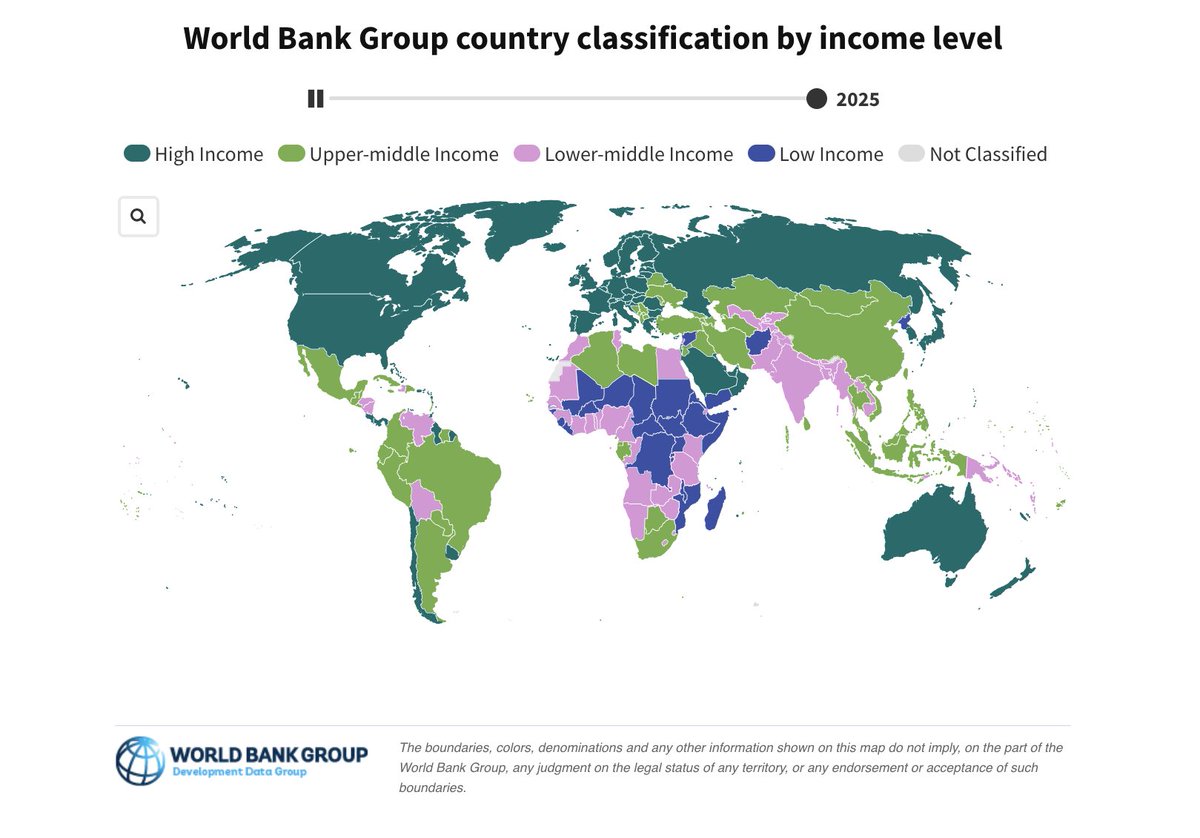
The @WorldBankGroup’s 2026–2027 Country Income Classifications show six economies moving into a higher income group. But the reasons behind those shifts differ substantially: sustained export-led growth in Viet Nam, broad-based expansion in the Philippines, economic recovery in Sri Lanka, statistical revisions in Jordan, and demographic revisions in Togo, among others.
That distinction matters. Country income classifications are a useful global benchmark, but changes in classification need to be interpreted carefully: they can reflect real improvements in economic performance, revisions to the underlying data, demographic changes, or a combination of these factors. And, as the authors emphasize, no single income measure can capture the full complexity of development.
A very useful World Bank Data Blog by Eric Metreau, Kathryn Elizabeth Young, and Shwetha Grace Eapen looks behind the headline classifications and explains what actually drove this year’s movements.
For those working on #poverty, inequality, and development measurement, it is a good reminder that the story behind an indicator is often as important as the indicator itself.
Read the blog: “Who moves up and why? A closer look at the 2026–2027 release of the World Bank Group Country Income Classifications.”: https://t.co/XQ2kgLfCKB
How can we measure multidimensional poverty when the data we need are scattered across different surveys?
A @WorldBankGroup Data Blog by Ben Brunckhorst, Minh Cong Nguyen , Nishant Yonzan, Hai-Anh H. Dang, and @ChristophLakner explores a promising approach: combining indicators from separate datasets to estimate how monetary poverty, education, and infrastructure deprivations overlap.
The challenge is significant. While individual indicators used in the World Bank’s Multidimensional Poverty Measure cover at least 85% of the global population, complete data are available to estimate the full measure for only about two-thirds of the world.
Using more than 570 surveys spanning 1989–2024, the authors show that data fusion can produce credible estimates—particularly when datasets share some overlapping indicators. The approach could help extend multidimensional poverty measurement to countries and years where complete survey data are unavailable, and potentially incorporate additional dimensions such as health and security.
Better poverty measurement depends not only on collecting more data, but also on finding rigorous ways to make better use of the data that already exist.
Read it here: https://t.co/OkM5RMRRGr
“As wars multiply and their consequences spread, the UN’s legitimacy increasingly rests on its ability to meet its peacemaking mandate,” writes Rebeca Grynspan. In a guest essay, the candidate for secretary-general makes her case https://t.co/DeOTlShidC