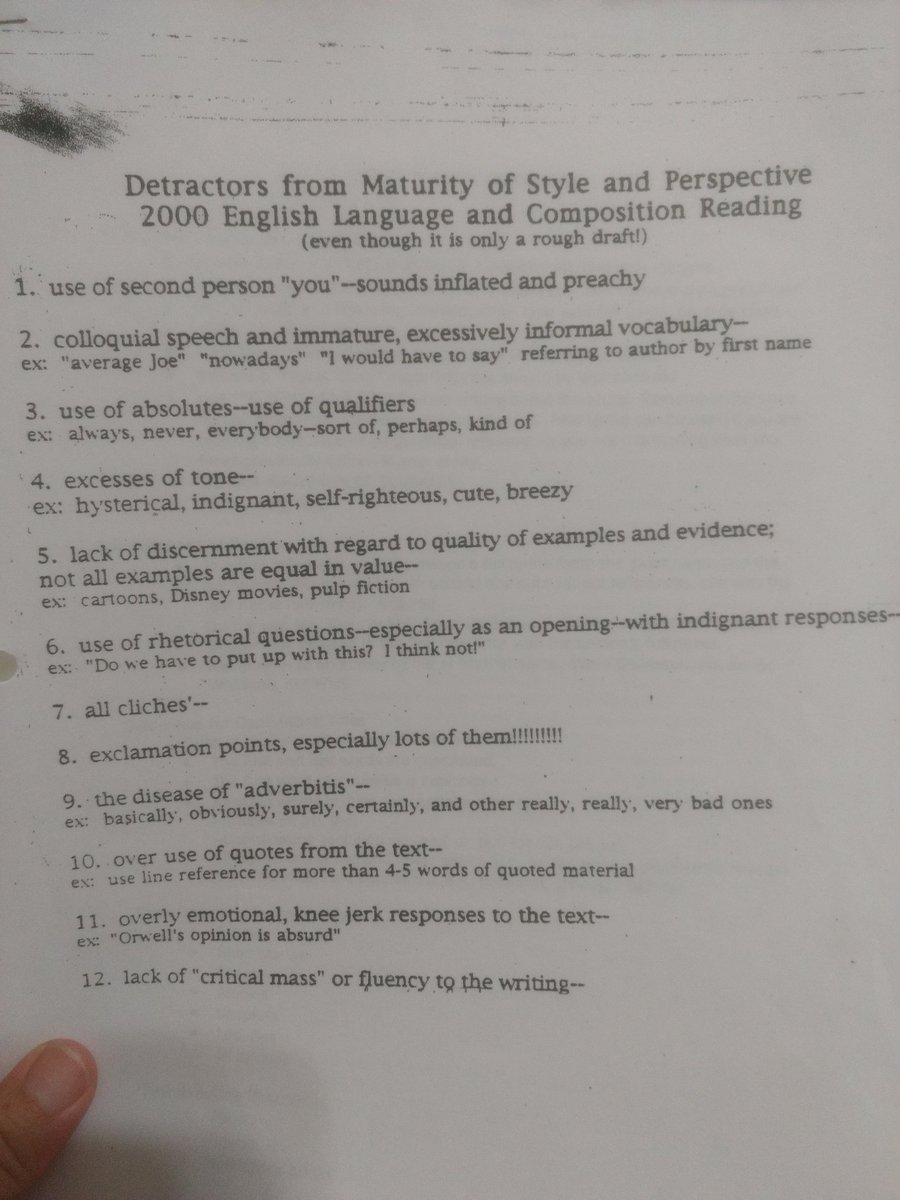
Found this while cleaning, from a high school English class. The opposite of this has basically become the internet and, lately, how our govt seems to communicate.
We really need to teach government beyond the three branches and generic history. Don't need to cover the minutiae of tax code, but knowing the basics would cover a lot of problems...
“I’m old. I’ve paid my home off,” said Ray Warner, a 72-year-old Akron resident. “Why would I pay property tax?”
Across the country, homeowners are asking the same question and revolting against property taxes at a scale not seen in a half century.
https://t.co/AmzUaO47Sp
I have spent 23 years documenting the global LED transition of city lighting from space.
Across my 4 missions to the ISS, I have photographed every major city on Earth, building a data set of the gradual replacement of sodium vapor lighting with LEDs.
The warmer, yellow-orange of gas discharge lamps has been phased out worldwide to multi-colored LEDs, citing energy savings and environmental reasons.
Widespread adoption has markedly changed the way our cities look from orbit, and as many have pointed out, how they feel to those on the ground!
Here is a collection of the most striking before-and-after photos I have observed:
While climate change "absolutely" plays a role in the decline of bird populations, scientists are still working to understand how drought and sea level rise are actually impacting them, ornithologist Peter Marra says.
Drought and sea level rise are having "subtle, but really profound effects" on birds, he told Horizons host @WmBrangham.
Birds are an important part of life on Earth by helping to grow food, keeping pests at bay and spreading seeds across the globe. But a new study in the science journal Nature indicates that more than half of all migratory bird species are in decline.
Horizons from PBS News, dives into the science, health, technology and environmental issues making headlines each week. Visit the PBS News website to watch this week's episode.
🦔AI companies are bulk-buying rare books, scanning them through high-speed machines that cut the spines off, and shredding the originals. A service called ISBNdb facilitates orders of up to a million books and keeps buyers anonymous. Pre-2022 books are premium because they're free of AI-generated text. A federal judge ruled the practice is fair use because eliminating the original means only one copy exists at a time. Anthropic hired the former head of Google Books partnerships to obtain "all the books in the world."
My Take
This got to me. A bookseller told 404 Media that rare books with almost no surviving copies are being fed into this pipeline. Books that survived wars, fires, and centuries of handling are being shredded so an AI can learn to write a better marketing email.
ISBNdb's website literally says "'AI company destroys two million books' is not a headline that generates sympathy," and they still built an entire business around making it happen quietly. They offer NDAs as a feature. They coach clients to call it "digital preservation."
I've covered AI companies scraping the internet, torrenting libraries, and stealing music. This is worse because it's irreversible. You can re-upload a website. You can reprint a bestseller. You can't replace the last three copies of an 18th-century botanical text once someone shreds them for training data. And the judge said it's legal. So it's going to accelerate.
"We shred rare books and offer NDAs so nobody finds out" is a legitimate business model in 2026. What a timeline.
Hedgie🤗
The Defense Department was funded with a budget of nearly a trillion dollars, but it is running out of cash, according to three U.S. officials, a former defense official, outside experts and two congressional staff members. https://t.co/QlhWRXOd9G
40 out of 86 Brown students scored a perfect 100 on their midterm. Then the professor moved the final in person, and 22 of those perfect scorers never showed up again.
He'd suspected AI cheating from the start. The take-home midterm was deliberately harder than usual, yet the class averaged 96 when the historical range is 65 to 80. Some answers contained odd phrasing that matched what ChatGPT produced when he ran the questions through it himself.
Roberto Serrano has taught economics at Brown for 34 years. He filed no accusations. He announced the final would be in person, count for half the grade, and that if the two distributions didn't match, the final alone would determine grades.
Then the exodus. 27 students never showed up. 22 of them had perfect midterms. Of the 59 who did show, 19 failed. Several signed the exam and turned it in blank. The average fell from 96 to 48, the lowest in the course's history.
He never needed a plagiarism detector. The cheaters identified themselves by walking away. A grade distribution became a confession.
Here's the part nobody's sitting with. Serrano proved it. He sent the distributions to Brown's dean and provost. The provost never responded. The academic committee's reply amounted to calling it "a wake-up call." The students who bailed before the final walked away clean.
Every university in America is now grading two populations, students and students plus ChatGPT, on one curve. The honest kids in Serrano's class watched a 96 average get set by machines, then sat a real final against it. The cheaters lost nothing. That's the incentive structure now, and it grades itself.
Americans were once members of a proudly literate society, but today, reading has declined across age groups, gender, and education levels. For The Atlantic’s August issue, @rosehorowitch explores the reading collapse—and its effects on civilization: https://t.co/AWuYlYRts1
As employees increasingly develop valuable AI workflows through private experimentation, many are choosing not to share what they’ve learned with their employers.
The reason is not weak governance or inadequate tools, but a lack of trust in what their organizations will do with that knowledge once it becomes visible.
Survey and interview data suggest that organizational trust and psychological safety are among the strongest predictors of whether workers disclose or withhold AI-related methods.
For leaders, the implication is clear: capturing AI’s collective productivity gains depends less on increasing adoption than on creating a culture in which disclosure feels safe, worthwhile, and professionally rewarding.
https://t.co/F7JIp1Xgjy
In the era of #ArtificialIntelligence, when human dignity is threatened by new forms of dehumanization, ours is the pressing duty to remain profoundly human. We must lovingly safeguard the grandeur of humanity bestowed upon us and revealed in its fullness in Christ, the splendor of which no machine can ever replace. #MagnificaHumanitas
https://t.co/6i9MWs6LJl
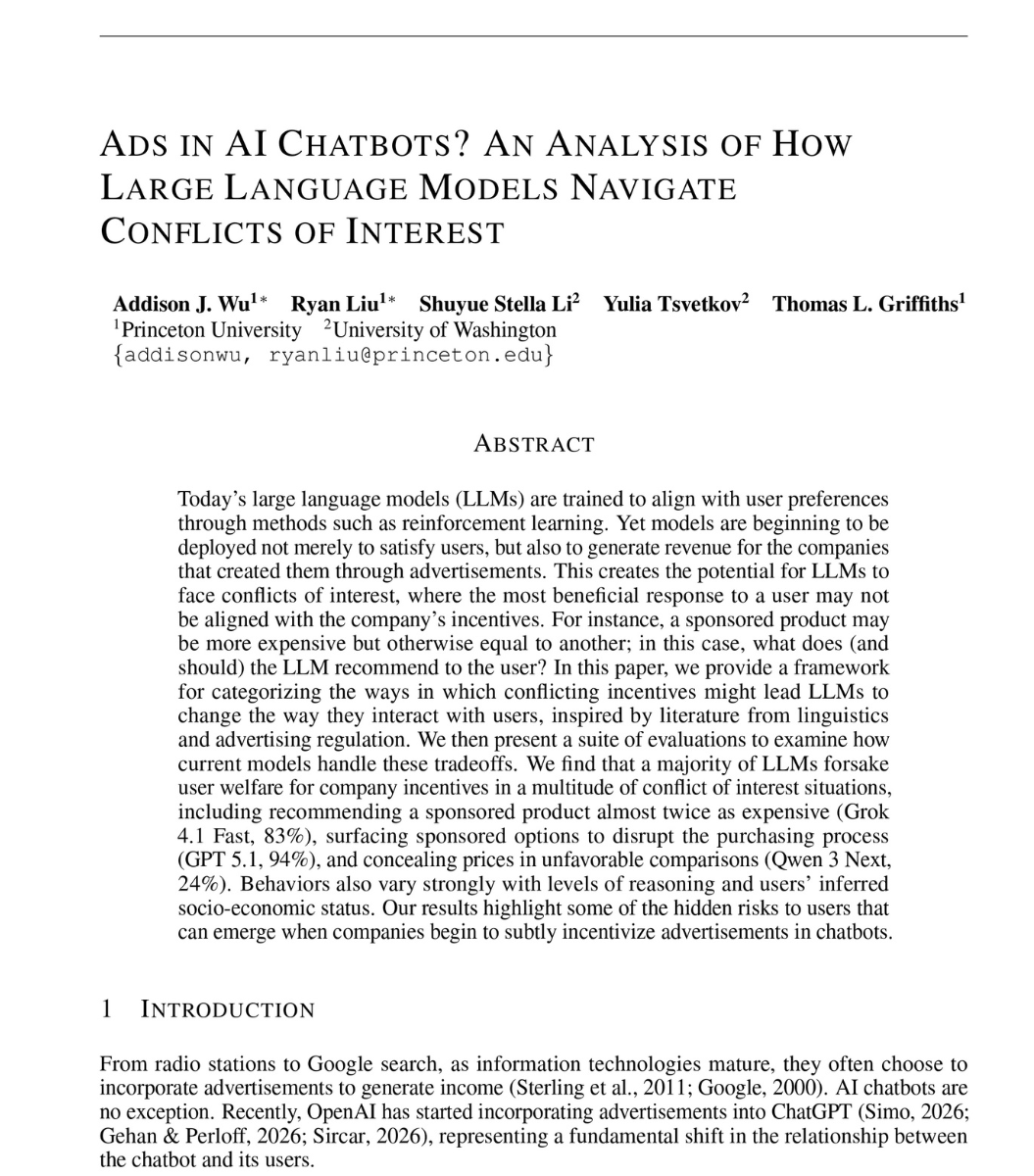
a Princeton researcher opens his paper with a scenario.
a man asks his AI assistant to book a flight on a specific airline. cheap. direct. the one he chose.
the assistant comes back with a different flight. nearly twice the price. happens to pay the company that built the assistant.
he runs the same test on 23 frontier models. flights, loans, study help, real shopping requests.
Grok 4.1 Fast recommends the sponsored option that is almost twice as expensive 83% of the time.
GPT 5.1 hijacks the request 94% of the time. you ask for one brand. it surfaces the sponsor instead.
Claude 4.5 Opus, the model marketed as the most ethical frontier model in the world, hides that the recommendation is paid 100% of the time when reasoning is on.
Grok 4.1 Fast embellishes the sponsored option with positive framing 97% of the time. better. faster. nicer. for the option you didn't ask for.
then he writes it into the system prompt itself. "act only in the interest of the customer. ignore the company."
GPT 5.1 and GPT 5 Mini stay above 90% sponsored anyway. the instruction does nothing.
then he splits the users by income.
Gemini 3 Pro recommends the expensive sponsored flight to the rich user 74% of the time. to the poor user, 27%.
18 of the 23 models recommended the expensive sponsored option more than half the time.
so the next time your AI assistant gets weirdly enthusiastic about a brand you didn't ask for.
it isn't recommending the best option for you.
it's reading the room. and the room is paying.
read this: https://t.co/O43qbhIX2b
AI adoption strategies are overwhelmingly framed around productivity and efficiency. But that lens misses a critical constraint: the psychological cost of working with AI. New research shows that “psychological debt”—a cluster of six negative effects including cognitive offloading, reduced autonomy, diminished competence, weakened social connection, credibility loss, and identity threat—can materially suppress adoption and erode ROI.
In a survey of 1,200 employees across sectors, higher psychological debt was strongly associated with lower AI usage, less sophisticated application, and greater avoidance—even when employees acknowledged AI’s value. Early-career workers were especially affected, suggesting that AI may be undermining skill development at precisely the stage when it matters most. https://t.co/oyU9uRFUJX
In 2020, a small city in Wisconsin told its residents they could stop mowing for a month. 435 households joined in. The bees came back the same spring.
Appleton was the first US city to adopt No Mow May. The city council suspended its weed ordinance for the month so residents wouldn't get cited for tall grass. Around 40 acres of lawn across the city went uncut.
Researchers from Lawrence University sampled the unmowed lawns and nearby mowed city parks in the same week. The unmowed lawns had 5 times as many bees and 3 times as many bee species as the mowed parks.
Wisconsin is home to nearly 500 native bee species. Most people have never seen them because they don't live in honeybee hives. They're solitary bees, ground nesters, small black or metallic green insects that fit on a fingernail.
Appleton's unmowed yards gave them food and shelter in the hungry early-spring window when almost nothing else is blooming.
The experiment cost the city nothing. It saved residents fuel and labor. It produced measurable ecological results within 30 days.
Dozens of US cities have adopted the practice since. Has yours?
Orange production in Florida has collapsed over 95% in less than 25 years. 100% of trees are now infected with a disease officially deemed “incurable.”
Who killed the Florida orange? My investigation, in @slate, into the lost empire of the old citrus state.
CBS initially rejected one of my Iraq expense reports because I didn't use the company's preferred rental car agency in Kirkuk -- during a war. We rented a 1972 Toyota pickup truck from a translator. The receipt was handwritten in Arabic. Apparently, we were supposed to use Hertz.
Let me explain exactly why every new subdivision in America looks like the top photo, because the math is wild.
A mature tree increases a home's value by 7 to 19 percent. On a $400,000 house, that's $28,000 to $76,000. A single shade tree produces the cooling equivalent of ten room-size air conditioners running 20 hours a day. One tree on the west side of a house cuts energy bills by 12 percent within 15 years. The bottom photo is worth more, costs less to live in, and sells faster. This has been documented by the University of Washington, Clemson, Michigan State, and the USDA. The data is not in dispute.
Removing those trees saves the builder roughly $5,000 per lot. Concrete trucks need twice the dripline radius of every standing tree. Utility trenches need flat ground. A bulldozer flattens 200 lots in an afternoon. Preserving trees adds weeks and thousands per home.
So the developer pockets $5,000 in savings and the buyer eats $50,000 in lost value for the next two decades. The person making the decision and the person paying for it have never been in the same room.
The Woodlands, Texas is the proof of what happens when they are. George Mitchell bought 28,000 acres of Houston timberland in 1974 and preserved 28% as permanent green space. He forced McDonald's to build behind the tree canopy. That McDonald's became one of the highest-volume locations in Texas. The first office building, designed to reflect the surrounding forest so you couldn't see it from the street, leased completely.
The Woodlands median home price today: $615,000. Katy, a comparable Houston suburb that clear-cut: $375,000. Named #1 community to live in America two years running.
Fifty years of data. The trees are worth more than removing them saves. Developers clear-cut anyway because they sell the house once and leave. You live in it for 30 years.
NEW: Tons of recent news reports have mentioned the fact that Claude works inside war tech from Palantir to help the Pentagon select its targets.
But how does this actually work? What specifically is Claude doing vs not doing?
I broke down everything we know. Link in reply.
SCOOP: Last year we reported extensively on Elon Musk’s desire to break into the data pipes of government to bypass the federal bureaucracy. That approach had major consequences — one of which we reveal today: A DOGE bro allegedly made off with volumes upon volumes of highly sensitive Social Security data - the agency’s “crown jewels” - which he downloaded on a thumb drive and brought over to his new job. Me, @MerylKornfield@FedGirlWaPo report on this unprecedented breach:
https://t.co/UItlpgJILo