First by @aziz_maig7@BoubaSombie@DaveW43883848@philipmccall11 in @PLOSONE. First report of pyrethroid resistance in aegypti from Niger associated with 1016I, 1534C, 410L kdr mutations. Another piece to Ae aegypti resistance’s puzzle in Africa. Pls read https://t.co/2xprkcDmY8
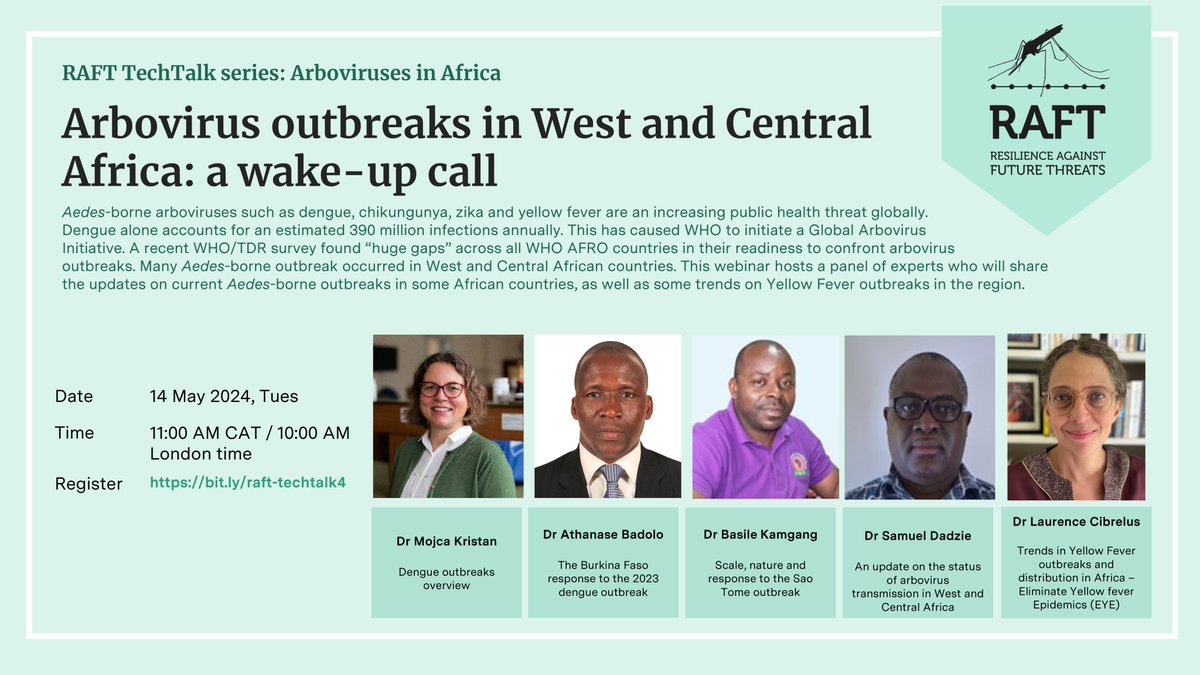
RAFT would like to invite you to 4th webinar of TechTalk series on arboviruses in Africa:
Arbovirus outbreaks in West & Central Africa: a wake-up call
📅14 May (Tues) 2024
🕠10:00am (UK)
Register: https://t.co/pwdcMfLBGO
More info: https://t.co/wEXp5ygIhF
#arboviruses#dengue
@noahhrose @Akorli_J @AGloriaSoria @Skeeterology@lindymcbr Great work, a unique way to tell the natural history of Aedes aegypti using its genome, thank you @noahhrose
We are extending abstract submission to September 1st! With topics ranging from Antimicrobial Stewardship to Zoonoses & Infections in Animals, we look forward to your submission. #ISIDCongress2022
We can't wait to see you in Kuala Lumpur. https://t.co/X6Xri13QFF
ISID is accepting applications for the Emerging Leaders Program! The program recognizes excellence in the field of #ID at an early career level, promising the opportunity to become familiar w/ the Society’s work. Click here for eligibility & requirements: https://t.co/rGgfgwpssd
I will be chairing this important ISID webinar on "Global Dengue Preparedness" on February 15th at 10am Burkina Faso time. You are more than welcome to attend.
Be sure to save the date for our next #KnowledgeExchange webinar - “Global Dengue Outbreak Preparedness,” on February 15, 2022 @ 5am EST/10am GMT/11am CET @TakedaPharma
➡️ Sign up for our mailing list to receive the latest Knowledge Exchange updates! https://t.co/s7Q65ZRPnd
In collaboration with @DaveW43883848 and @abadolo: Bionomics of Aedes aegypti during the 2016-2017 dengue outbreaks in Ouagadougou, Burkina Faso. https://t.co/nSRtKOfEWB
@cwondji@LSTMnews@cam_crid@wellcometrust Congratulations Charles, well deserved. Thank you for pathing the way for new generations of African Scientists and behyound.
@Fredros_Inc @KnolsMosquito @drheatherferg I think it is much more about water quality, less about the container. It is now usual to find Anopheles larvae sharing same breeding sites with Aedes. I will not be surprise to find them in treeholes as well.