Former Apple, Microsoft, Amazon exec. founder and CEO of Techquity - helping non-tech companies embrace world class software tech. passionate conservationist
Every company, every operator, and arguably every individual now needs a working understanding of AI at the tool level. Not as a research interest or a strategic abstraction, but as a practical capability. You need to be able to use these tools, ask the right questions, and understand how to get them to complete tasks.
The historical pattern here is worth taking seriously. Thirty years ago, some people decided they did not need to figure out the internet. The objection at the time sounded reasonable. The work they were doing did not seem to require it. A similar dynamic played out with mobile a decade later. People who already had phones did not see the point of the new kind of phone, and the framing felt sensible until it suddenly did not.
The people who sat out those waves did not catch up later. They fell behind in ways that compounded across the rest of their careers. The skills, intuitions, and network effects that came from early engagement were not available to acquire in retrospect.
AI is an accelerated version of the same dynamic. The transition is moving faster than the previous two, which means the cost of waiting is higher and the window for catching up is narrower. The people developing real fluency now are building intuitions that those watching from the sidelines will struggle to replicate later.
There is no requirement to become a technical expert. The standard is functional capability. Use the tools, understand what they are good at, learn where they break, and integrate them into how you actually work.
Before any company commits meaningfully to AI, there is a strategic question that deserves more attention than it typically gets. Where are the actual growth opportunities, and what are the risk and reward trade-offs that come with pursuing them?
The framing matters because most AI initiatives I see being launched start with the technology and work backward toward a use case. The order should be reversed. Begin with the business. What are the important things this company could do differently, or do for the first time, that would serve customers better or operate the business more efficiently? Where is the meaningful upside, and what are the risks attached to going after it?
The answers to those questions are specific to each company. They depend on the industry, the customer base, the competitive position, the operating model, and the realistic capabilities of the organization. Generic AI strategy decks rarely surface these answers. The work has to be done internally, with honesty about what the business actually needs and where its constraints sit.
Once the strategic priorities are clear, technology decisions become substantially easier. You know what you are building toward, why it matters, and what success would look like. The build-versus-buy question, the team composition question, and the sequencing question all become more tractable when the underlying business logic has been worked through.
The companies that struggle with AI rarely struggle because the technology failed them. They struggle because they launched without doing the strategic work first. That work is unglamorous and easy to defer. It is also the difference between initiatives that produce returns and initiatives that produce expensive lessons.
McKinsey and BCG have reported AI project failure rates around 70%. A meaningful share of those failures trace back to the same root cause. The companies running the projects are users of software, not builders of it, and they underestimate what the shift actually requires.
The first decision worth making, before any specific use case is chosen, is which posture you are taking. Are you continuing to use technology, or are you becoming a company that builds with it? AI changes one part of this equation by lowering the technical bar. Non-programmers can produce working software. Experienced engineers are significantly more productive. The range of what is feasible inside a company has expanded in real terms.
What has not changed is the strategic question underneath. Where are the growth, risk, and reward opportunities for your specific business? What can you do differently or newly that serves customers better or makes the company more efficient? Those answers should drive the build agenda. Launching first and finding the rationale later is a familiar path to ending up in the failure statistics.
There is also a minimum standard that applies to every company and arguably every individual. You need to be fluent with these tools at a working level. The historical parallel is the people thirty years ago who decided they did not need to understand the internet, or the early skeptics of mobile. The waves you choose to sit out tend to compound against you.
AI is an accelerated version of the same dynamic. The companies and the operators who engage now will see opportunities the others will not, and the gap between the two groups will widen faster than previous transitions allowed.
Full Video Now Live to Learn More: https://t.co/cDix6rxt1B
McKinsey, BCG, and others have published failure rates for AI projects in the range of seventy percent. The headline gets attention. The underlying explanation is more useful.
A large share of those failures are not really AI problems. They are software-building problems. The companies running these initiatives are organizations that have historically been users of software, not builders of it. They do not have the culture, the operating history, or the in-house skills required to ship and sustain custom software. When they take on an AI project, they are quietly stepping into a discipline they have never actually practiced.
Before deciding what to build, the more important question is whether the organization understands what becoming a builder actually requires. The playbook for shipping software is different from the playbook for buying it. Different governance, different talent, different timelines, different tolerance for iteration, and a different relationship between business stakeholders and the people doing the work.
AI changes one part of this equation in a meaningful way. It lowers the technical bar for building software. That is a real shift, and it expands what is possible inside companies that previously could not have considered building anything custom. What it does not lower is the organizational bar. The cultural, structural, and leadership requirements of being a builder are largely unchanged.
That is where most of the failures actually originate. Not in the model, not in the use case, but in the gap between what the company is set up to do and what shipping AI software actually requires.
The mechanics of platform-level IP protection are worth understanding clearly, because the responsibility split is not always intuitive.
When a creator files that a piece of work is theirs and can demonstrate provenance, platforms like YouTube generally take on the obligation to police misuse from that point forward. That framing matters. The system is reactive by design, and it depends on the original creator establishing the claim in the first place.
The realistic caveat is that actors with sophisticated legal support tend to stay ahead of these systems. Enforcement mechanisms exist, but they are uneven in practice, and the parties with the most resources are usually the ones best positioned to navigate the edges. That is not a reason to disengage from the process. It is a reason to be deliberate about it.
The more important question, and the one operators and creators tend to underinvest in, is how you protect the intellectual property you create in the first place. That work happens upstream of any platform dispute. It includes how you document creation, how you structure ownership, how you handle disclosures, and how you think about defensibility from the moment something valuable starts to take shape.
Platforms can help enforce claims you have already established. They cannot retroactively create the foundation for those claims. That foundation has to be built deliberately by the people generating the underlying work.
For founders, creators, and operators building anything with meaningful IP, the practical implication is to treat protection as part of the creation process, not as something to handle later. Later is usually more expensive and less effective.
There is a distinction that often gets blurred in conversations about technology, and it has practical consequences for how companies make decisions about building software.
Being highly capable as a user of software is not the same as knowing how to build software. The two skill sets overlap, but they are not interchangeable. Sophisticated users can evaluate products, identify gaps, and articulate what they need with real clarity. That is valuable, and it is often mistaken for the ability to direct a build effort.
Building is a different discipline. It involves judgments about architecture, sequencing, team composition, and the trade-offs between speed and durability that only become visible once you are inside the work. Companies that conflate the two often start build efforts they later regret, or staff them in ways that produce predictable problems.
The first question worth answering is whether to build at all. The second, equally important, is when to build. Both questions deserve more rigor than they typically receive. A build decision made for the wrong reasons or at the wrong moment is one of the more expensive mistakes a company can make, and the cost is rarely visible at the point of commitment.
Assuming the answers point toward building, the next question is what the organization actually needs to look like. What does the team require in terms of capability, structure, and leadership? Treating this as an extension of existing functions, rather than as a distinct discipline with its own requirements, is a common error.
The skill set is different. The decisions deserve to be treated that way.
Looking back across my career, the vast majority of the people I now consider friends are people I originally met through work. Colleagues, counterparts, partners, people I worked with on specific problems and then stayed connected to over the years.
The realization that has come with time is how much that network actually shapes what is available to you later. Optionality in a career is not a straightforward function of resume or title. It comes from the relationships you have built and maintained, and from the fact that those people have built parallel networks of their own.
The compounding here is real. Every meaningful relationship in your professional life is also a connection to that person's network, their judgment, and their access. Over a long enough horizon, the cumulative reach is significant, producing choices that would not otherwise be visible to you.
The catch is that this kind of network does not get built in any single phase of a career. It accumulates from years of small investments. Following up. Showing up. Being useful when there is nothing obvious in it for you. Staying in touch during periods when neither side has an active reason to. The people who do this consistently end up with something that cannot be replicated quickly later.
For operators earlier in their careers, the practical implication is simple. The relationships you build today are the optionality you will have in twenty years. The investment compounds quietly, and the return shows up most clearly when you need it.
A pattern I have observed repeatedly is people looking outside themselves for the thing that will finally make them satisfied. The next role, the next outcome, the next person who is going to deliver what they have been waiting for.
The expectation almost never resolves the way they hoped. External outcomes can contribute to a good life, but they do not produce satisfaction on their own. The people who appear most settled tend to be the ones who stopped expecting any single external factor to do that work for them.
What carries weight, in my experience, is the people you are on the journey with. Spouse, family, close friends, the professional relationships that have held up over years. These are foundational in a way that titles and outcomes are not. They shape the texture of daily life, the quality of the decisions you make, and how the wins actually feel when they arrive.
This is not a soft point. It has practical implications for how operators allocate their time and attention, particularly during high-intensity periods when the temptation is to defer relationships in favor of professional demands. The deferral tends to be costlier than it looks, and the cost only becomes visible later.
The work matters. The outcomes matter. The people you build your life with matter more, and they require sustained investment to be there in any meaningful form when you actually need them.
That investment is one of the more reliable returns available in a career. It also happens to be the one most easily neglected.
A familiar pattern in organizations is people focused on what the company is not doing for them. The framing shows up in different forms. The work is not being recognized. The opportunities are going elsewhere. The environment is not what it should be.
There are cases where those observations are accurate and worth acting on. But the underlying orientation, the one that treats the company as something that owes you an outcome, tends to limit careers more than it advances them.
The more productive posture is to show up and contribute. Bring real value to the work, day after day, and see what happens. If the contribution is genuine and the environment still does not recognize it, the answer is to find a different environment. Move to a place that values what you bring. That is a clean and legitimate decision.
The trap is the middle ground: staying in a role while building a case for why that role owes you more than it is providing. It rarely produces the outcome people hope for. Contributions drop, resentment grows, and visible behavior reflects entitlement rather than tangible impact.
Entitlement is one of the more reliable career limiters I have seen. It looks like advocating for yourself, but it functions differently. It shifts your focus from creating value to claiming it, and the people around you notice the difference even when no one says anything directly.
Contribute, or move. Both are reasonable. The space in between is where careers stall.
A lot of people evaluate their relationships through a single lens. What am I getting from this? Is this person making me happy? Is this partnership serving my interests?
That framing is common and, in my experience, the wrong starting point. The more useful question is the inverse. How am I contributing to this relationship? What am I bringing to the marriage, the partnership, the team?
The reversal matters because it changes what you optimize for. When the orientation is extraction, the relationship becomes transactional and fragile. Both people end up keeping score, and the score never quite balances in a way either side finds satisfying. When the orientation is contribution, the dynamic shifts. Each person focuses on what they can add, and the relationship compounds rather than erodes.
This is true in marriages, in long-running business partnerships, and in the executive teams that hold together through hard periods. The principle does not change with context.
It is worth being honest that this is difficult. No one who has done it would describe it as easy. Contributing consistently, particularly during periods when you feel undervalued or stretched, requires a kind of discipline that runs against most natural instincts. The relationships worth having are also the ones that demand the most.
The trade is that they are the ones that produce the most over time. Personally, professionally, and in almost every other dimension that ends up mattering when you look back.
Business is a team sport. Life is a more important one. The relationships you build and sustain over time are what most of the meaningful outcomes ultimately rest on.
I have been married for 43 years. My wife has been patient in ways I have benefited from more than I have probably acknowledged. What I have observed across that time, and across the professional partnerships I have been part of, is that the underlying principle is the same in both contexts.
Durable relationships start with "we." Decisions get made with the relationship itself prioritized above the individuals inside it. That sequencing matters. When each person optimizes primarily for their own position, the relationship becomes a negotiation. When both people optimize for the relationship, individual outcomes tend to take care of themselves over time.
This applies in marriages, family dynamics, long-running professional partnerships, and executive teams that hold together through difficult periods. The mechanism is the same. Shared priority above individual priority. Not all the time, and not without honest disagreement, but as the default orientation.
It is worth being explicit about this because the alternative is the more natural default. Most environments reward individual performance and gain. Choosing to prioritize the relationship is a discipline, not an instinct.
The partnerships that last, personal and professional, tend to be the ones where both people made that choice repeatedly, over a long period of time, even when the short-term math would have suggested otherwise.
When someone sponsors you, they are taking on real risk. Their judgment, credibility, and standing inside the organization are tied, at least in part, to whether their bet on you pays off.
The appropriate response is to step up. Treat the opportunity as something you earned and must now deliver against. The people who do this consistently get sponsored again, often by the same person and frequently by others who watched the first bet work out. Those who do not find that future opportunities quietly stop arriving, usually without explanation.
Mentorship requires a different posture. A mentor invests time and attention rather than political capital. What they need from you is presence. Actually showing up, actually listening, and actually applying what you hear. Mentors notice quickly when their input is being collected without being used, and most of them will not say anything. They will simply give less of themselves over time.
Both relationships operate on a similar underlying principle. People extend themselves when they see a return on that extension. The return does not have to be immediate or material, but it must be visible. Stepping up, paying attention, and following through are the signals that tell sponsors and mentors their investment was worth making.
Careers that look fortunate in hindsight are usually careers where someone delivered on the early bets placed on them. The opportunities compound from there.
No one builds a meaningful life alone. The relationships you invest in over time are, in my experience, the most important building block of everything else.
This is easy to say and harder to live by, particularly for people who spend their careers optimizing for professional outcomes. Relationships compound much like capital does, but they require a different kind of attention. Consistent, unhurried, and largely invisible in the short term.
The challenge is that the demands of an operating career are not patient. They will absorb every hour you give them and continue asking for more. The relationships that matter rarely demand anything in a way that competes effectively for that attention. They tend to quietly erode while you are busy with things that feel urgent at the time.
The people I have watched navigate long careers well, and arrive at the later stages with something worth having, share a common pattern. They treated their important relationships as non-negotiable investments rather than residual ones. Not perfectly, not without trade-offs, but consistently enough that those relationships were still there when they mattered most.
This is not a soft observation. It has practical implications for how you allocate time, how you make trade-offs during demanding periods, and how you think about success over a longer horizon than any single role or company.
Professional outcomes matter. They also turn out to be insufficient on their own. The relationships you build are what give the rest of it meaning.
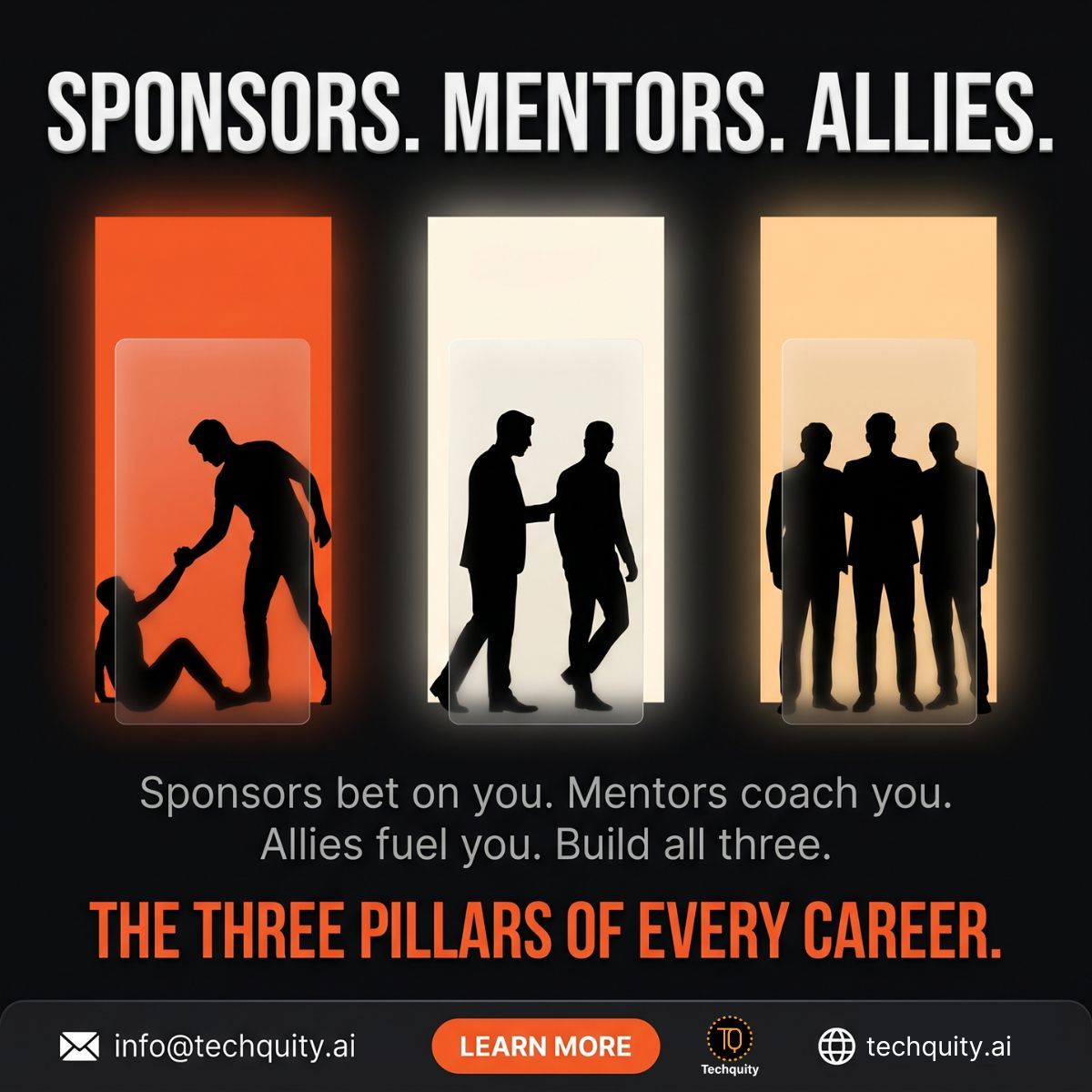
Most career advice collapses three distinct relationships into one. The result is a generic call to find a mentor, which underestimates how careers actually progress at the senior level.
Mentors offer perspective. They have been through what you are facing and can shorten the learning curve through honest counsel. The relationship is valuable, but its impact is bounded by what you do with the advice. Mentors do not change the opportunities in front of you. They help you think more clearly about the ones you have.
Sponsors operate differently. They put their own credibility behind you in rooms you are not in. They advocate for the promotion, recommend you for the board seat, and use their position to create access. Sponsorship is earned through demonstrated performance and trust, and it is the lever that most often shifts a career trajectory rather than refines it.
Allies are the third category, often the most underweighted. These are peers and colleagues who move alongside you over time, share information, open doors laterally, and create the network effects that compound across decades. Allies are not transactional. They are the result of operating with generosity and consistency over a long horizon.
The careers that reach the highest levels tend to have all three in place. Sponsors create the opportunities. Mentors sharpen the judgment to handle them. Allies expand the surface area of what becomes possible.
For senior operators, the question is not whether you have a mentor. It is whether you have built the full set, and whether you are playing those roles for others as well.
I played bass in a band in sixth grade. I cared about it, I put time into it, and I was a good listener. At some point I recognized that no matter how much passion I brought, I was not going to be a great musician.
That recognition was useful. It pointed me toward a question I have come back to throughout my career. Where does what I am genuinely good at intersect with what I actually care about? The answer is rarely obvious, and it shifts as you accumulate more experience and more honest feedback.
Passion alone is not a strategy. There are areas where people care deeply and will still hit a ceiling because the underlying aptitude is not there. There are also areas where people have real ability but no genuine interest, and the work eventually feels hollow regardless of how well it pays.
The intersection is where compounding happens. You get better faster because you care, and you stay longer because you are succeeding. Without both, one side eventually erodes the other.
Finding that intersection is not a single decision. It is an ongoing process of testing, observing what actually works, and being willing to update your assumptions about yourself. The people I have seen build the most meaningful careers were not necessarily the most talented or the most driven. They were the most honest with themselves about where their real leverage was, and the most disciplined about pursuing it.
That honesty is harder than it sounds, and it is worth the work.
One of the more reliable predictors of long-term career outcomes is the orientation a person brings to their work. Specifically, whether they are focused on what they can contribute or on what they can extract.
The framing that has served the operators I respect most is straightforward. Lead with how you can add value. Treat contribution as the North Star, and accept that what you get back will, over time, be proportional to what you put in.
The opposite orientation is common and easy to spot. People who are continually scanning for what they can get from a role, a relationship, or an organization. The behavior produces short-term gains and long-term ceilings. People notice, and the network around them eventually adjusts.
The contribution-first orientation is not about working for less than you are worth or ignoring your own interests. Compensation, recognition, and advancement still matter and should be addressed directly. The point is sequencing. Value created comes first. Value captured follows.
This applies at every level. Junior people who consistently add more than they take get pulled into better opportunities. Senior operators who build genuine value for their teams and their companies tend to find that the economics work out over time. Leaders who orient their organizations around contribution build cultures that retain talent and outperform peers.
It is one of the simpler principles in business and one of the more durable. The people who internalize it early tend to compound advantages the people focused on extraction never quite catch.
As a general principle, taking ownership of your own life is the starting point for almost everything else worth pursuing.
Attitude is the grounding. Skills can be learned. Networks can be built. Knowledge accumulates over time. None of that compounds unless the underlying orientation is one of personal responsibility for the outcomes you are trying to produce.
The framing that has held up for me is wanting to win on my own terms. That phrasing matters. It is not about winning by someone else's definition or competing in someone else's frame. It is about deciding what you are actually trying to achieve and then accepting that the responsibility for getting there is yours.
This is not a motivational point. It is a practical one. The people I have seen build durable careers and durable companies almost all share this trait. They do not outsource accountability for their outcomes, even when external factors are clearly at play. They look for what they can influence and act on it.
Everything else, the persistence, the learning, the willingness to keep going through difficult periods, follows from that foundation. Without it, those qualities tend to surface inconsistently and fade under pressure.
Ownership is the precondition. The rest is what you build on top of it.
A century ago, manufacturing required enormous numbers of people. The cost of producing almost anything was high because labor was the bottleneck. Over time, automation and process improvements changed that, and the workforce moved up what I would call the "intellect chain". Physical jobs gave way to a combination of physical, mental, and interpersonal work, much of it in offices.
A meaningful share of those office jobs turned out to be low value add. They existed because the previous transition pushed people there, not because the work itself was essential.
AI is now doing to white collar work something similar to what mechanization did to manufacturing and agriculture. The difference is speed. The previous transitions played out over decades. This one is compressing into years.
Steve Jobs described computers as bicycles for the mind. AI is a meaningful step beyond that. Used well, it is one of the more capable tools ever built, and it changes what office work actually requires from the people doing it.
The people who adapt will combine judgment, domain expertise, and fluency with these tools to produce more than they could before. The people who do not re-skill will find themselves in the same position as workers who waited for manufacturing jobs to come back. Those specific jobs are not returning. Different ones are emerging in their place.
For leaders, the question is not whether to engage with this shift. It is how quickly your organization can move people up the value chain before the transition does it for you.
Full Video Now Live to Learn More: https://t.co/YnaaHmna1b
Being Right Too Early Is Still Being Wrong
The first company I started was a social media business called The Grapevine. The year was 1983.
The idea of connecting people through computers was correct. The execution was reasonable. What was missing was almost everything else. The infrastructure, the user base, the cost structure, and the broader environment were not yet in place. Facebook arrived twenty years later with the same fundamental premise, and they were not the first either.
The lesson is one I have come back to repeatedly. Being right about a thesis is not the same as being right about the timing. Markets only reward conviction when the surrounding conditions are actually ready to support it.
The harder lesson is patience. A lot of operators and investors declare failure too quickly. They conclude that the idea was wrong when the more accurate read is that the timing was off, the inputs were incomplete, or the market was not yet shaped the way the thesis required. Sometimes the right response to a failed venture is to keep watching the space.
Distinguishing between a wrong idea and an early one is one of the more difficult judgments in business. Both look the same in the short term. The difference only becomes clear with time, and often only to people who were paying attention to why the original attempt actually failed.
Patience, in this sense, is not passivity. It is the discipline of holding a thesis open long enough to learn what the market is actually telling you.
One of the more useful distinctions when evaluating any new idea is whether you are looking at a feature, a product, or a company. The three are often confused, and the confusion has real consequences for where capital and time get spent.
A feature is something that adds value but cannot stand on its own. It belongs inside someone else's product. Nothing about it is structurally defensible, which means a larger player can absorb it the moment it becomes interesting enough to matter.
A product is something a customer will use and pay for, but that does not automatically make it a business. Plenty of well-designed products lack the economics, distribution, or market depth required to sustain a company around them. They generate revenue without generating a durable enterprise.
A company is something different again. It has defensibility, repeatable economics, and a market large enough to support continued investment and growth. Building one requires a set of conditions that most ideas, even good ones, do not meet.
Founders who confuse these categories tend to build the wrong thing or build it for the wrong reasons. Investors who confuse them tend to fund features at company valuations. Operators who confuse them tend to defend products that should have been sold or absorbed.
The discipline is asking the question early and answering it honestly. Not every good idea deserves a company built around it. Knowing which category you are actually in changes almost every subsequent decision.